

INVESTIGATION: 555 Drones Over Moscow — the Night the War Came to the Russian Capital
On the night of June 18, 2026, Ukraine launched what constitutes the largest drone attack ever conducted against Moscow since the beginning of the war. Moscow Mayor Sergei Sobyanin confirmed that air defenses had destroyed nearly 200 drones on approach to the capital. According t
- On the night of June 18, 2026, Ukraine launched what constitutes the largest drone attack ever conducted against Moscow since the beginning of the war. Moscow Mayor Sergei Sobyanin confirmed that air defenses had destroyed nearly 200 drones on approach to the capital. According t
- Introduction: Moscow Under Drones — a Historic Night
- June 18, 2026 — numbers and black smoke
Facts, quotes, and cited links remain in the body. Interpretations are framed as analysis or opinion according to the format.
Introduction: Moscow Under Drones — a Historic Night
June 18, 2026 — numbers and black smoke
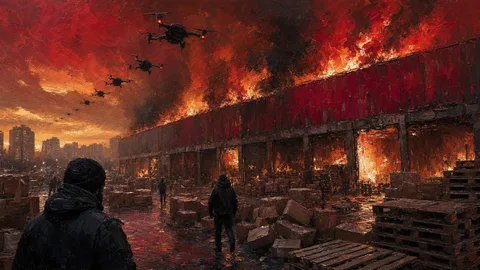
On the night of June 18, 2026, Ukraine launched what constitutes the largest drone attack ever conducted against Moscow since the beginning of the war. Moscow Mayor Sergei Sobyanin confirmed that air defenses had destroyed nearly 200 drones on approach to the capital. According to alternative sources cited by military observers, the total number of drones launched in this attack reached 555 aircraft, or more according to some information channels. The Kapotnya oil refinery, belonging to Gazprom Neft, located only 9 miles (approximately 14 kilometers) from the Kremlin, caught fire for the second time in less than a week.
The immediate consequences were visible and spectacular: columns of black smoke enveloped Moscow's sky for hours, visible from dozens of kilometers away. Moscow's four major airports — Sheremetyevo, Domodedovo, Vnukovo, and Zhukovsky — suspended operations for several hours, causing hundreds of flight cancellations and thousands of stranded passengers. One drone struck an apartment building in the Zhukovsky region. Another hit a large shopping center on the outskirts. Moscow region authorities reported 17 injured, including two children — injuries caused in part by debris from intercepted drones falling on inhabited areas.
The Kapotnya Refinery — Why This Target
Moscow's largest refinery, twice in one week
The Kapotnya refinery (Moscow Oil Refinery — MNPZ) is the most important refining installation in the Russian capital. It processes a significant share of the fuel needs of the Moscow metropolis. Striking it sends an economic and symbolic message simultaneously: economic, because fuel supply disruptions have cascading effects on transportation and the local economy; symbolic, because Moscow residents see from their windows the smoke telling them war has arrived in their city.
The first strike of the week had damaged the refinery's ELOU-AVT-6 unit — the primary crude oil distillation unit — forcing a temporary shutdown. The strike of June 18 set fire to another section. These repeated strikes on the same site are not coincidental: they illustrate Ukraine's strategy of persistent targeting of Russian energy infrastructure, aimed at imposing cumulative costs rather than a single destruction. Striking the same target twice says: we can come back. And we will.
The strategic choice — not barracks, refineries
What makes the Kapotnya strike strategically sophisticated is its deliberate targeting of a civilian-economic infrastructure rather than a military one. Ukraine did not strike a headquarters, a missile depot, or an air base on the night of June 18. It struck a refinery that fuels the daily lives of ordinary Muscovites. This choice is analyzed by experts as an information warfare strategy: making ordinary Russian citizens feel the war, breaking the psychological dissociation between support for the war and its real effects. A Muscovite who sees black smoke from their window and cannot fill their car's tank is a Muscovite who thinks about the war differently.
Ukrainian President Volodymyr Zelensky confirmed the attack on Russia after the June 18 strikes, declaring that the Ukrainian army had used long-range weapons to strike targets "500 kilometers away." He presented these deep strikes as an essential tactic to force Moscow to halt its military operations. The war must return to those who started it — this is the logic articulated by Zelensky, and the Kapotnya refinery is its most spectacular implementation.
Ukrainian Drones — Anatomy of an Arsenal
The UJ-26 Bobr — the main weapon
The main weapon of this attack is in all likelihood the UJ-26 Bobr drone (sometimes called UJ-26 Beaver), the primary long-range strike drone developed and manufactured by Ukraine. Its 1,000-kilometer range allows it to reach Moscow from unoccupied Ukrainian territory — with comfortable operational margin. Its aerodynamic cell with an inverted delta wing, rear propeller, and hybrid guidance system (autonomous + remote control in final phase) makes it a difficult platform to intercept. Its 50-kilogram explosive payload, integrating a KZ-6 shaped charge capable of piercing reinforced concrete, allows it to damage robust industrial installations like a refinery's storage tanks.
Bobr production has been industrialized since 2024, with factories dispersed across Ukrainian territory to withstand strikes. Ukraine has developed the capacity to produce these drones in quantities sufficient for mass operations — the 555 drones of the night of June 18 are its direct illustration. This industrialization of long-range drone production is one of Ukraine's most significant military-industrial achievements since the beginning of the invasion. It transforms an attacked country into a deep-strike power capable of imposing costs on its adversary on its own territory.
The coordination — swarms from multiple directions
The effectiveness of a 555-drone attack on Moscow is not only about numbers — it is about coordination. Drones are sent simultaneously from multiple directions, forcing Russian air defenses to cover a 360-degree arc around the capital. The Exilenova+ channel documented "swarms of drones approaching the city from multiple directions." This spatial coordination is difficult to neutralize: air defense systems cannot be concentrated in a single direction without leaving blind spots elsewhere. Directional saturation is the drone equivalent of the land envelopment tactic.
Moscow Mayor Sobyanin reported on June 22, 2026 that Russian forces had shot down 84 drones en route to Moscow on that day alone. The previous night (June 21 to 22), a Ukrainian strike had hit the Dubna Space Communication Center in Moscow oblast, approximately 540 kilometers from the Ukrainian border. This center, managing Russian communications satellites at national scale, is a high-value strategic target — its strike disrupts military and civilian communications that depend on Russian satellite infrastructure.
The Russian Response — Rage Without Solution
Retaliatory strikes against Ukraine
Moscow's response to the June 18 Ukrainian strikes was immediate and predictable: "precision" strikes on Ukrainian defense and energy installations, announced the same day by the Russian Defense Ministry. This action-reaction pattern has repeated throughout the conflict since 2022: Ukraine strikes a military or economic target in Russia, Russia announces reprisals against Ukraine. But the asymmetry is striking — Ukraine hits refineries 14 kilometers from the Kremlin; Russia bombs Ukrainian cities that have been bombed for two years. This is not a fair exchange. It is an escalation that Russia wished to avoid but cannot control.
During the night of June 21 to 22, 2026, Russian forces launched 88 Shahed, Gerbera, and Italmas drones and one Iskander-M ballistic missile against Ukraine. The Ukrainian Air Force shot down 79 drones. The missile and 5 drones struck 6 localities; debris hit 9 others. These strikes caused civilian deaths — including 3 in Kryvyi Rih on June 23. But compared to Ukraine's campaign against Moscow, Russia's response strikes a country already at war — not a distant capital that believed itself safe.
Russian escalation threats
Russia issued warnings against any escalation supported by NATO. The Russian Foreign Ministry warned that "any further aggression backed by NATO will be met with a decisive and devastating response." This type of rhetoric is recurrent in the conflict — Moscow formulates escalation ultimatums that it does not systematically implement, hoping to deter the West from reinforcing its support for Ukraine. So far, this deterrence strategy has not worked: the West has progressively lifted its restrictions on the types of weapons provided to Ukraine, and Ukrainian strikes on Russian soil have continued to intensify.
The Kremlin also blamed Ukraine for using American Patriot systems for strikes on Russian positions — an accusation that, if verified, would imply a non-conventional use of this air defense system. Western military experts received this claim with skepticism. It resembles more an attempt to create friction between the United States and Ukraine than a documented technical reality. Informational manipulation is a Russian weapon as important as missiles.
The Impact on Daily Life in Moscow
Airports closed, flights canceled
The closure of Moscow's four airports during the June 18 strikes had immediate practical effects on millions of people. Hundreds of flights were canceled or delayed. Sheremetyevo airport — the busiest in Russia — evacuated its passengers to "secure zones" according to its official communications. These closures are both a direct consequence of the strikes (airports cannot operate while drones are flying over the city's airspace) and a powerful symbol: Moscow, capital of a country that daily bombs its neighbors, no longer has safe airspace.
The economic impact of these closures is difficult to quantify precisely but is real: every hour of closure of a major international airport costs millions of dollars in lost airport revenues, missed connections, and undelivered cargo. Multiplied by the number of closures induced by drone campaigns since June 2026, the cumulative economic impact on the Russian aviation sector is significant — even if Moscow will never publicly acknowledge it.
Smoke as a political message
Images of black smoke above Moscow — broadcast by hundreds of Russian social media accounts before censorship attempted to remove them — had an internal political effect. A poll cited in the context of these attacks notes that 39% of Russians felt economic conditions were deteriorating in 2025 — a rising figure. Direct correlation between these negative perceptions and Ukrainian strikes is impossible to establish with certainty; but the visibility of the war's consequences on Russian soil contributes to creating a reality that state-controlled media struggle to fully mask.
Smoke does not lie. When Moscow residents see from their apartments a column of black smoke rising from a refinery 14 kilometers from the Kremlin, they know something unusual is happening — even if official media speak of a "technical incident." These breaches in the official narrative accumulate, and each major Ukrainian strike widens these breaches. This is not revolution — but it is erosion. And erosion has its own laws.
The Sequence of Strikes — Methodical Escalation
Third strike on June 19
On the same topic

COLUMN : Europe Moved 8.5 Billion Euros in a…
That is what the European Commission says it has disbursed for…
ANALYSIS: 800 drones over Russia in one night —…
More than eight hundred drones, in a single night, August 14…

ANALYSIS: 313 Votes, a 20th Extension — Ukraine Keeps…
313 votes to approve the presidential decree extending martial law by…
On Friday June 19, 2026, the day after the major strike, Ukrainian forces conducted a third attack on the Moscow region. Sobyanin reported that 35 drones were shot down in 90 minutes — nearly one drone every 2.5 minutes. This cadence reveals the permanent pressure that Ukraine seeks to maintain on the Russian capital: not giving Moscow time to normalize, to regain confidence, to believe the threat has passed. Each new strike renews the uncertainty, mobilizes defenses again, closes airports again if necessary.
This strategy of repetitive harassment is costly for Ukraine — each drone represents significant resources, even if its unit cost is much lower than conventional missiles. But it is also costly for Russia: each interception consumes defensive missiles, human resources from air defense operators, fuel for protective aircraft. Sustained saturation defense is a war of attrition — and in this attrition, the side that can produce drones faster than the other can shoot them down is the one that eventually prevails.
Controlled escalation — the Zelensky doctrine
The repeated attacks on Moscow in June 2026 represent the application of a doctrine articulated by Zelensky for several months: controlled escalation on Russian soil. This is not about striking blindly — it is about choosing targets with strategic value (refineries, communication infrastructure), defensible under international law (economic installations linked to the war effort), and with maximum psychological impact in Russia. This is not a purely defensive strategy — it is a strategy of imposing costs on the adversary to change its cost-benefit calculation on continuing the war.
On June 22, 2026, after a new wave of strikes that briefly disrupted Moscow's airports, Zelensky declared on X (formerly Twitter) that he wanted to "bring the war back to Russia." This phrase, cited by the Guardian in its live coverage of June 22, summarizes the doctrine in three words. It also says something political: Ukraine refuses to be the only one to suffer. If Moscow bombs Kyiv, Kharkiv, Zaporizhzhia, Pokrovsk — then Moscow will receive something in return. Not the equivalent in destruction. But enough to make the war cease to be abstract for Russians.
The International Response — Neither Silence nor Consensus
The West facing Ukrainian strikes on Russia
Ukrainian strikes on Moscow provoked nuanced reactions in Western capitals. On one hand, Ukraine's allies clearly avoided condemning these actions — implicitly recognizing a nation's right to strike the military and economic capabilities of its aggressor. On the other, some officials expressed private concerns about escalation risk and the impact on peace negotiations that seemed to be progressing after the Évian G7.
The Évian G7 of June 17, 2026 had announced commitments to deliver long-range capabilities to Ukraine — a decision consistent with an implicit acceptance that Ukraine will use these capabilities to strike Russian soil. If you deliver weapons with a 1,000-kilometer range to a country at war with Russia, you implicitly accept that it will strike Moscow. This logic is uncomfortable for some allies who would like to maintain a fictional distinction between "defensive support" and "offensive escalation." Ukraine, pragmatically, no longer makes this distinction.
Trump and the equivocal rhetoric
President Donald Trump, who attended the Évian G7, maintained an equivocal position in his public statements on Ukrainian strikes in Russia. On one hand, he declared that Russia should "make a deal" and that he would do "everything he can" for peace. On the other, he did not clearly condemn the strikes on Moscow. This ambiguity is characteristic of the Trump approach — it maintains pressure on both parties without committing the United States to a clear position that would limit its diplomatic room to maneuver.
But this ambiguity also has a cost: it prevents the kind of clear diplomatic signal that could, in certain circumstances, push Putin toward real concessions. An ambiguous America does not frighten Putin — it encourages him to test limits. And Ukraine's 555 drones over Moscow are also a response to this ambiguity: Ukraine makes its own escalation decisions without waiting for American approval.
The Dubna Center — Striking Russia's Eyes
The strike on communications satellites
Among Ukraine's strikes during the week of June 22, 2026, one of the most strategically significant is the strike on the Dubna Space Communication Center in Moscow oblast. This center — operated by the State Space Communications Company, parent company Kosmicheskaya Svyaz — is a crucial node in Russia's satellite telecommunications system. It manages the links between satellites in orbit and ground networks, ensuring the transmission of television signals, government communications, and military data.
The ISW noted in its assessment of June 22, 2026 that "the blow did not disrupt television broadcasts and communications" according to the company itself — a statement that, in the Russian context, should be read with caution. Geolocated images published on June 22 show smoke rising over Dubna. The strike on this center illustrates the growing sophistication of Ukrainian targets: not only refineries and bridges — but the command, control, and communication infrastructure that ensures the cohesion of Russia's military and civilian system.
The airwave war
Discover

INVESTIGATION: Beijing cuts Africa to 2.1 billion in loans…
2.1 billion — the lowest figure in almost twenty years, according…

SPECIAL REPORT: Beijing Promises Stimulus as Its Households Give…
That is the growth rate of Chinese industrial output in July,…

INVESTIGATION: Two Chinese Ex-Soldiers Arrested in Seoul as 18,000…
For five years, a man ran a military-supply shop at the…
The Dubna strike fits within a strategy of degrading Russian command and control capabilities. A damaged space communication network forces military operators to use less reliable, less secure, more intercept-vulnerable alternatives. It lengthens transmission delays, introduces uncertainties in data links, and potentially degrades the quality of intelligence received by front-line units. This is not a visible strike like that of a refinery — but its operational effects are potentially more lasting.
Ukraine has learned, in four years of war, that wars are also won in the electronic and informational spectrum. Destroying enemy materiel is necessary — but degrading its ability to see, communicate, and coordinate is equally decisive. Ukraine's June 2026 strikes combine both dimensions: visible economic impact (refineries) and invisible strategic degradation (communication centers). This is a complete war, conducted simultaneously on all levels.
The 17 Russian Injured — War as Moscow Reality
The human cost in Moscow
The 17 people injured in Moscow and the Moscow region during the June 18 strike include two children. These injuries are, for the most part, caused not by direct hits from Ukrainian drones but by debris from intercepted drones falling on inhabited areas — a collateral effect of Russian air defenses themselves. This is an important point to clarify: when Russian air defense systems shoot down a drone over an urban area, the debris falls somewhere. And sometimes they injure civilians.
This reality is documented and illustrates the moral complexity of strikes in urban zones. Ukraine strikes military and economic targets — refineries are defensible targets because they fuel Russia's war economy. But collateral consequences — debris, indirect injuries — affect civilians who did not choose this conflict. This text does not minimize this reality. It notes it, and recalls that the same consequences — far worse — fall on Ukrainian civilians every night for two years. In Sumy, on June 22, a 13-year-old boy was killed with his father and grandmother in their home. In Moscow, 17 people were injured, including two children. Both realities must be stated. Their comparison belongs to the reader.
The death of an 8-year-old girl — the propaganda reversal
Al Jazeera reported on June 19, 2026 that among the victims of strikes in the Moscow region, a girl of 8 years old had been killed — dying from injuries sustained during the night of strikes on June 18. Moscow region Governor Andrei Vorobyov confirmed this death. The death of this child is a documented, heartbreaking fact that deserves to be reported with all the gravity it demands. It illustrates the real human cost of military operations in urban zones — regardless of the belligerent.
It also illustrates the morally complex dynamic of this war: Ukraine strikes Moscow to force Putin to stop bombing Ukrainian children. In this strike, a Russian child dies. This tragedy does not invalidate the strategic logic of the strike, but it reveals its real human cost. There is no clean war. There are only avoidable wars that someone chose to start. Putin made that choice in February 2022. The consequences — for Ukrainian children and, now, for an 8-year-old girl near Moscow — are his.
The Size Comparison — Ukraine vs. Russia
The reversed asymmetry
One of the most striking data points of the June 18 attacks is that reported by the Ukrainian Air Force itself: the number of drones intercepted by Russia in this attack was nearly double the number of drones Moscow had launched against Ukraine over the same period. This information, difficult to verify independently but consistent with observed trends, reveals a reversal of the initial asymmetry: Ukraine, in 2022, was a permanent target of Russian drones with no equivalent response capacity. In 2026, it launches more drones against Russia than Russia launches against it. The symmetry of strikes has reversed.
This reversal is the product of several factors: the industrialization of Ukrainian drone production, Western support in components and technologies, the tactical innovation of Ukrainian operators, and the partial degradation of Russian production capacities under the effect of refinery strikes. This is not a total victory — Russia continues to strike Ukraine with ballistic missiles and Shahed drones. But in the drone war, Ukraine is taking the upper hand.
The broken record — and what it means
The June 18, 2026 attack on Moscow is described by TASS, the Russian state agency, as "the largest Moscow attack in at least two years." Other sources identify it as the largest since the beginning of the war. Breaking this record is not an end in itself for Kyiv — it is the signal of a growing capacity telling Moscow that the next strikes may be even larger. This controlled escalatory logic aims to maintain pressure without triggering a nuclear response or direct Russian intervention against Western allies.
The fact that the West has not been drawn into major escalation despite repeated strikes on Moscow confirms that Putin's actual red line is different from his escalatory rhetoric. He has not used nuclear weapons. He has not attacked NATO countries. He has launched missiles against Ukraine — which he was already doing. Russian escalatory rhetoric is, largely, deterrent communication rather than a signal of genuine intent.
Diplomacy After the Drones — Negotiations Under Fire
More investigation
INVESTIGATION: Beijing cuts Africa to 2.1 billion in loans…
2.1 billion — the lowest figure in almost twenty years, according…
SPECIAL REPORT: Beijing Promises Stimulus as Its Households Give…
That is the growth rate of Chinese industrial output in July,…
INVESTIGATION: Two Chinese Ex-Soldiers Arrested in Seoul as 18,000…
For five years, a man ran a military-supply shop at the…
Strikes and G7 — a calculated coincidence
The major wave of strikes against Moscow on June 18, 2026 occurred a few days after the conclusion of the G7 at Évian-les-Bains (June 16-17). This temporal proximity is probably not coincidental. Zelensky sought, at the G7, to demonstrate to Western leaders — and notably to Trump — that Ukraine was capable of conducting major offensive operations on Russian soil. By striking Moscow a few days after the summit, he consolidated this message: Ukraine can put into practice what it asks for in weapons. It is not just a victim waiting for assistance — it is an army that strikes.
Zelensky moreover explicitly presented at the G7 the deep drone attacks as an argument for the West to accede to his requests for additional long-range weapons. The logic is circular but effective: Ukrainian drones demonstrate the effectiveness of deep strikes; this demonstration justifies deliveries of even more capable systems; these systems will allow even deeper strikes. This is a strategic reinforcement loop that Ukraine consciously nurtures.
The impact on talks
Do the Moscow strikes complicate peace talks? This is the question some Western diplomats are privately asking. Ukraine's answer — and it is a strategically coherent one — is that the absence of strikes does not bring peace closer. Talks have stalled for months, Russia formulates unacceptable conditions, and Russian bombing of Ukraine continues unrelentingly. In this context, Ukrainian strikes on Moscow are more a pressure tool to change Russian calculation than an obstacle to negotiations.
Putin himself, in his June 24 comments about "massive streams" of drones, did not say these strikes were preventing negotiations — he said they aimed to destabilize Russian society. This formulation is important: it acknowledges the psychological effect of the strikes without invoking a halt to talks. Pressure works if Putin acknowledges it. And he just acknowledged it publicly.
The Future of Strikes — Escalation or Ceiling
The ceiling question
The major strategic question raised by the June 2026 strike campaign is that of the ceiling: how far can Ukraine go without triggering a response that exceeds its absorption capacity? Current strikes — refineries, communication centers, bridges — remain in the category of legitimate economic and military infrastructure. Striking the Kremlin itself, or Russian nuclear installations, would cross a different line. Ukraine is not seeking to cross that line — it seeks to remain in controlled escalation that imposes costs without triggering a catastrophe.
But the definition of this ceiling is dynamic: what was unacceptable in 2022 (striking Russian soil) has become normal in 2026. If the war continues, targets evolve, technologies improve precision, and thresholds shift. Controlled escalation is a delicate balance that Ukraine is skillfully managing for now — but which requires permanent vigilance and close communication with Western allies to avoid crossing lines that would force an unpredictable Moscow reaction.
What June 2026 established
June 2026 established a clear military precedent: Ukraine strikes Moscow with hundreds of drones, repeatedly, industrially. Russia intercepts most of these drones but cannot stop them all. Life in Moscow is disrupted — airports closed, smoke above refineries, restrictions in the capital. And Russia does not trigger nuclear escalation or attack NATO countries. This precedent sets the parameters of a new phase of the war — a phase in which Ukraine has the capacity and will to strike deep inside Russia, and in which Moscow does not have the means to completely stop these strikes without massively restructuring its defenses.
This is a transformation of the strategic equation. And it was achieved not by a spectacular land military victory — but by a patient, industrialized, methodical drone campaign. 21st-century warfare looks like this: drone factories in Kyiv, rationed fuel in Moscow, and a collapsed bridge in Crimea.
Conclusion: War Always Returns to Its Origin
What the night of June 18 will remain in history
The night of June 18, 2026 will remain in the historiography of this war as one of its pivotal dates: the moment Ukraine demonstrated it could strike Moscow with industrial force, repeatedly, imposing real costs on the Russian capital. 555 drones, 200 intercepted, a burning refinery, closed airports, 17 injured, an 8-year-old girl killed. These numbers do not tell a victory — they tell a paradigm shift. The war that Putin launched from Moscow in 2022 arrived in Moscow in 2026.
This is not justice in the legal sense. This is not vengeance in the moral sense. It is strategy: imposing costs on the adversary to change its calculation. And if these costs change Putin's calculation — if the economic, military, and psychological pressure finally convinces him that the cost of war exceeds the benefit of an impossible victory — then these 555 drones will have served peace better than months of diplomatic speeches.
And yet the war continues
And yet the war continues. The 17 injured in Moscow do not change the fact that bombing of Ukraine goes on. The 3 dead in Kryvyi Rih on June 23 attest to this. The 13-year-old boy killed in Sumy on June 22 with his father and grandmother attests to it even more cruelly. Ukraine's campaign of strikes on Moscow has not stopped the Russian war machine — it has made it more costly. And between "costly" and "stopped," there is an abyss that only a political decision can bridge. That decision does not belong to the drone pilots. It belongs to the Kremlin. And the Kremlin has not yet made the right calculation.
Investigation Summary: The Numbers from the Night of June 18
What is established
To close this investigation with factual rigor: the Ukrainian strike of June 18, 2026 on Moscow involved nearly 200 intercepted drones on approach to the capital according to Sobyanin, with a total estimated at 555 drones or more according to military analyst sources. The Kapotnya refinery was struck and caught fire — for the second time in less than a week. Moscow's four airports temporarily closed. 17 people were injured, including two children. An 8-year-old girl died from her injuries. This data, drawn from official Russian sources (Sobyanin, Vorobyov) and verified reporting (NPR, OPB, CNN), constitutes the factual foundation of this investigation.
What these figures establish with certainty: the largest Ukrainian strike on Moscow since the beginning of the war, having produced real damage to a major oil infrastructure and significant disruptions in the Russian capital. What they do not establish: the long-term impact on Russian strategy, the exact number of drones launched, or the strategic decisions that will follow. These unknowns belong to the future — a future that 555 drones may have, a little, altered.
Aftermath: the 48 Hours That Followed
The third wave and information resistance
In the 48 hours following June 18, strikes continued — 35 drones shot down on June 19 in 90 minutes on approach to Moscow, then a strike on the Dubna Center on June 22. This closely packed sequence reveals Ukraine's strategy of series attacks, leaving Russian defense no time to reconstitute, plan, or reassure its population. Each new drone that gets through the defenses, or forces another airport closure, renews uncertainty in Moscow.
On Russian social networks — before censorship attempts — thousands of posts documented the smoke, airport closures, and detonations. This citizen documentation, which the Kremlin cannot completely suppress in a country of 140 million smartphone-equipped inhabitants, is an information front as important as the military front. As long as Russians can see with their own eyes that their capital is burning, official propaganda has its limits. And these limits count.
Signed Maxime Marquette, columnist
Columnist's transparency box
Editorial positioning
This investigation is conducted from a pro-Ukrainian and pro-Western stance. It considers Ukrainian strikes on Russian economic and military infrastructure as legitimate military operations within the framework of a defensive armed conflict. It does not endorse the death of civilians — all civilian deaths in this conflict, Russian or Ukrainian, are addressed with equal gravity. The death of the 8-year-old girl in Moscow is reported factually and with the dignity every human life deserves. I am a columnist and analyst, not a war correspondent. I was not in Moscow on June 18, 2026.
Methodology and sources
Data on the June 18 strikes come from reporting by NPR (OPB), CNN, Euromaidan Press (June 19, 2026), and analysis of specialized source video. Sobyanin's figures (200 intercepted drones) come from his official statements as reported by OPB and CNN. The total of 555 drones comes from a specialized channel analysis. The 8-year-old girl's death is confirmed by Al Jazeera (June 19, 2026) and Governor Vorobyov's statements. Strikes on the following days (June 19-22) are documented by ISW and Kyiv Independent.
Nature of the analysis
This investigation combines factual reporting on events of June 18-22, 2026 with strategic analysis of Ukraine's deep-strike doctrine. It contextualizes the strikes within the framework of attritional warfare theory and cost imposition. Strategic aspects are distinguished from verified facts. Unconfirmed estimates are flagged as such.
Sources
Primary sources
Secondary sources
Get the geopolitics analyses
Conflicts, powers, alliances: the MadMax thread without the noise.
Cite this article
Maxime Marquette (2026). INVESTIGATION: 555 Drones Over Moscow — the Night the War Came to the Russian Capital. MadMax. https://mad-max.co/en/article/enquete-555-drones-sur-moscou-la-nuit-ou-la-guerre-est-arrivee-a-la-capitale-russe
Read next
INVESTIGATION: Beijing cuts Africa to 2.1 billion in loans…
2.1 billion — the lowest figure in almost twenty years, according…
SPECIAL REPORT: Beijing Promises Stimulus as Its Households Give…
That is the growth rate of Chinese industrial output in July,…
INVESTIGATION: Two Chinese Ex-Soldiers Arrested in Seoul as 18,000…
For five years, a man ran a military-supply shop at the…
Enjoyed this piece? Get the next one.
One chronicle a week, straight to your inbox. No noise.
This article was generated with AI assistance, under human supervision.
Comments
Be the first to weigh in.