

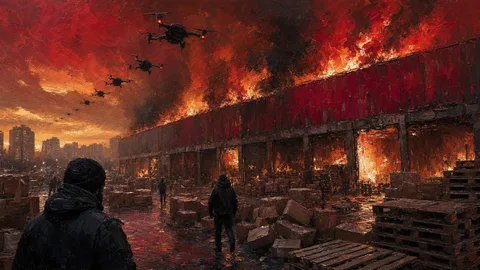
COLUMN: 660 drones in the night — Ukraine transforms Russian skies into an industrial hell
On the night of June 25 to 26, 2026, Ukraine launched what the Russian Defense Ministry itself described as the largest drone wave ever intercepted since the start of the war. Six hundred sixty unmanned aircraft, claimed downed by Moscow, over 13 Russian regions — from Moscow to occupied Crimea, from the Black Sea to the Sea of Azov. Whether you believe the Russian numbers or n
- On the night of June 25 to 26, 2026, Ukraine launched what the Russian Defense Ministry itself described as the largest drone wave ever intercepted since the start of the war. Six hundred sixty unmanned aircraft, claimed downed by Moscow, over 13 Russian regions — from Moscow to occupied Crimea, from the Black Sea to the Sea of Azov. Whether you believe the Russian numbers or n
- COLUMN: 660 drones in the night — Ukraine transforms Russian skies into an industrial hell
- Introduction: The night of June 25 to 26, 2026 — a record is written in the skies of Russia
Facts, quotes, and cited links remain in the body. Interpretations are framed as analysis or opinion according to the format.
COLUMN: 660 drones in the night — Ukraine transforms Russian skies into an industrial hell
Introduction: The night of June 25 to 26, 2026 — a record is written in the skies of Russia
Six hundred sixty — a number that redefines the drone war
On the night of June 25 to 26, 2026, Ukraine launched what the Russian Defense Ministry itself described as the largest drone wave ever intercepted since the start of the war. Six hundred sixty unmanned aircraft, claimed downed by Moscow, over 13 Russian regions — from Moscow to occupied Crimea, from the Black Sea to the Sea of Azov. Whether you believe the Russian numbers or not, the strategic signal is undeniable.
This operation did not emerge from a vacuum. It fits within a systematic deep strike campaign Kyiv has been pursuing since the start of 2026 with mounting intensity, methodically targeting energy infrastructure, refineries, fuel depots, and arms-production plants. In June 2026 alone, Ukrainian forces had already struck 60 times near Moscow on June 16, 19, and 22 before this June 26 peak.
A context of maximum orchestrated pressure from Zelenskyy
The 660-drone wave came mere hours after Ukrainian President Volodymyr Zelenskyy announced approval of a 40-day influence operation by Ukraine's Security Service (SBU) aimed at "compelling the aggressor to end the war." The linkage between the political announcement and the military action is not accidental — it is a calculated wartime communication mechanism designed to simultaneously demonstrate Ukrainian resolve to global audiences and the growing impotence of Russian defenses.
This synchronization reveals a strategic sophistication Ukraine has developed across four years of attrition war. Zelenskyy no longer merely reacts to Russian strikes — he anticipates them, announces them, contextualizes them. Brigadier General Yevhen Khmara, responsible for SBU long- and medium-range strike plans, presented an operational briefing just before the wave launched. That evening, doctrine and drones advanced together.
The Novomoskovsk Azot plant: a strategic target struck for the third time
What Azot produces and why it changes everything
Among the targets from the night of June 26, the industrial installation at Novomoskovsk, in Tula Oblast, 200 kilometers south of Moscow, attracted the attention of military analysts. Russian independent agency Astra identified the struck facility as the Novomoskovsk Azot plant, one of Russia's largest chemical companies. Regional Governor Dmitri Milyaev confirmed damage to an "industrial facility" and power lines, as well as a casualty in the Shchekino district.
The Azot plant produces mineral fertilizers, ammonia, nitric acid, methanol, and other industrial chemicals. Open-source analysts established a link between these products and Russia's defense sector, noting that the plant supplies chemical raw materials used in the manufacture of explosives and ammunition. This is not a symbolic target — it is a component of the front's supply chain.
Third strike in six weeks — a progressive degradation campaign
The night of June 26 is not the first time Novomoskovsk's Azot plant appeared in Ukrainian crosshairs. Drones had already struck the plant on May 26, 2026, then a second time in the night of June 13 to 14, 2026, triggering a fire confirmed by Governor Milyaev. With the June 26 strike, this is the third attack in six weeks against this single installation. Local residents reported explosions audible for several hours, a strong smell of ammonia in the air, and power outages.
This repetition is not accidental. Repeatedly striking an industrial target over a short period aims to prevent repairs from being completed, to sustain production disruption, to force operators to manage successive emergencies, and to demonstrate that Russian airspace offers no security guarantee, even 200 kilometers from the federal capital. This is a logic of persistent industrial degradation, not of single strikes.
Moscow under threat: 47 drones intercepted, airports closed
Russia's capital is no longer a sanctuarized zone
Moscow Mayor Sergei Sobyanin announced that 47 drones heading toward the Russian capital had been intercepted between 2 a.m. and 7 a.m., local time. No significant damage or casualties were reported in the capital. But the absence of visible damage should not obscure the essential fact: for five consecutive hours, Russia's capital air defense systems were on maximum alert, draining considerable human and energy resources.
Moscow's three main airports — Domodedovo, Vnukovo, and Sheremetyevo — were placed under temporary restrictions, arrivals and departures permitted only with special authorization. On the night of June 18, 2026, when 194 drones had targeted Moscow — the largest attack before June 26 — the aviation network suffered 527 delayed or cancelled flights. The recurrence of these disruptions is transforming the Russian capital into an active operational zone, with lasting economic and psychological consequences for the civilian population.
June's escalation: a deliberate progression
The June 26 wave fits within a calculated buildup throughout the month: 60 drones intercepted near Moscow on June 16, 76 on June 19, 84 on June 22, then 194 on June 18, and finally 660 on the night of June 26. This progression is not linear — it follows a logic of deliberate saturation, designed to test and overwhelm Russian detection and interception systems. According to the Wall Street Journal, citing a United24 Media analysis dated June 26, June 2026 has become a record month for Ukrainian deep strikes, the drone campaign now appearing capable of progressively overwhelming Russian air defense.
On its side, Russia has claimed since the start of 2026 to have shot down more than 39,000 Ukrainian drones over its territory and Crimea, according to Russian newspaper Kommersant, citing Russian Defense Ministry data. In June alone, Russia claims 9,700 interceptions. This means that on average during June, 323 Ukrainian drones were declared intercepted every day. These figures — coming exclusively from Moscow and not independently verifiable — nonetheless reveal an operational reality: Russian air defense systems are under constant and growing pressure.
Crimea besieged: state of emergency and fuel shortages
A peninsula collapsing under systematic strikes
On the night of June 25 to 26, explosions were reported throughout occupied Crimea, with detonations heard near the Kerch ferry crossing and residents reporting a smell of smoke and burning. The Moscow-installed Governor, Sergei Aksionov, took a remarkable decision: he announced a state of emergency on the peninsula, acknowledging that the Russian military is "unable to fully protect the territory." His exact words: "Unfortunately, there is no air defense system in the world that is absolutely perfect in terms of security and effectiveness."
This statement from a Kremlin-appointed official carries considerable political weight. It confirms what military analysts had been observing for weeks: Crimea is under effective siege. The peninsula is suffering severe fuel shortages and power outages triggered by strikes on energy infrastructure in southern Russia — through which the peninsula is supplied. Retail fuel sales are suspended. Trams stopped in Yevpatoria. Yalta experienced total power blackouts.
The Kerch logistical stranglehold — a vital military supply node
The Kerch area is one of Russia's most important military logistics hubs in Crimea. Since repeated attacks on the Kerch Bridge, ferry passage has become the primary transport route for military personnel, equipment, and supplies to Russian forces in southern Ukraine. By targeting it night after night, Ukrainian forces are attacking the logistical backbone of the occupation.
On June 26, drones from the Security Service of Ukraine (SSU) also struck Russian cable ships Volga and Vyatka as well as the ferry Petropavlovsk at Kerch — according to a Militarnyi report dated June 26, 2026. The Zaliv shipyard at Kerch was also hit. The combination of a 660-drone air wave and maritime strikes in the Kerch Strait illustrates the multi-domain character of the June 25-26 Ukrainian operation. It is a coordinated offensive on land, in the air, and at sea.
Russia's fuel crisis — a direct effect of Ukrainian deep strikes
From southern Russia to Siberia: a spreading shortage
Ukrainian strikes have produced a systemic effect on Russia's fuel economy. According to Euromaidan Press of June 23, 2026, Russia is now rationing gasoline in Siberia — thousands of kilometers from the front. The Omsk and Irkutsk regions restricted fuel sales on June 22. Novosibirsk followed suit. Chains operating at least 7,000 of roughly 29,000 Russian gas stations — approximately one in four — capped sales. The shortage, which started in the south and Crimea, reached the country's industrial heartland.
The economic toll is documented. Bloomberg recorded 38 Ukrainian strikes on Russian refineries between January and May 2026. May alone saw 16 strikes — the highest monthly figure of the war. In April 2026, Russian refining capacity had fallen to its lowest level since 2009. Russia, one of the world's largest oil exporters, has been reduced to importing gasoline by sea, according to a Militarnyi report dated June 17, 2026. That is an economic and strategic humiliation of the first order.
A campaign estimated to have cost Russia's war machine seven billion dollars
Euromaidan Press, citing data compiled by independent analysts, estimates that the systematic drone campaign against Russian oil infrastructure drained approximately $7 billion from Russia's war economy between January and May 2026. This figure, even if not independently verifiable, reflects the scale of damage to refineries, fuel depots, transport routes, and defense-linked plants. On June 20, drones reached a refinery in Tyumen, in Siberia, approximately 2,000 kilometers from the Ukrainian border. This is no longer a positional war — it is a campaign of industrial sanctions, as Zelenskyy himself calls it.
The Novomoskovsk Azot plant, struck three times in six weeks, exemplifies this logic. Every strike on an installation linked to ammunition or explosives production, every refinery put offline, every military fuel depot set ablaze shortens the operational lifespan of every shell, every missile, every tank deployed on Ukrainian territory. This is war waged first against the industrial logistics of the Russian military.
Minister Fedorov and the Crimea "drone blockade"
An explicitly assumed strategy: turning Crimea into an island
On the same topic
ANALYSIS: 800 drones over Russia in one night —…
More than eight hundred drones, in a single night, August 14…

INVESTIGATION: 316 political cases in Crimea — the occupation…
Three hundred and sixteen people are being prosecuted on political grounds…

ANALYSIS : Taiwan Puts NT$1,122.5 Billion Into Defence, Over…
Hold that number for a moment, because it marks the crossing…
Ukrainian Defense Minister Mykhailo Fedorov was explicit in his June 2026 public statements: Ukraine aims to "turn Crimea into an island" by systematically cutting all its supply routes. On May 27, 2026, Fedorov launched the operational framework "Logistics Lockdown" with $113 million in additional funding dedicated to acquiring medium-range drones — the "Middle Strike" drones, with a range of up to 200 kilometers. This program was followed by an additional $100 million allocation after June's first results.
Between June 7 and 13, Ukrainian forces struck the Chonhar Bridge, the Henichesk-Arabat crossing, four bridges near Armyansk, and the Dzhankoi checkpoint. On June 24, a strike on the Balaklava thermal power plant plunged Sevastopol into total darkness. The same day, Ukrainian Special Operations Forces destroyed a railway bridge on the North Crimea Canal near Rozdolne, a critical supply line to the occupied south. The strategy leaves no ambiguity: every land, maritime, and logistical access route to Crimea is being targeted.
Robert "Madyar" Brovdi and the drones that hunt defenses
Commander of Ukraine's Unmanned Systems Forces, Robert "Madyar" Brovdi, announced on June 25 that Ukraine had struck 38 targets across occupied Crimea in a single night of operations — including fuel storage facilities, radar systems, command posts, and ferries. Brovdi also claimed the destruction of the underground gas storage facility at Hlibivske on the Tarkhankut Peninsula — a major energy infrastructure.
Since 2025, Ukrainian long-range drone units, notably the "Prymary" unit of Ukraine's Military Intelligence (HUR), have been hunting air defense systems and radars across the peninsula. By first degrading defenses, subsequent operations encounter less resistance. This is an air defense attrition strategy that prepares each new wave of strikes — including the June 25-26 night wave with its 660 aircraft.
Belarus in the shadows: the threat of a second front
Zelenskyy warns of Belarusian military infrastructure at the border
The 660-drone night unfolded within a broader diplomatic context. President Zelenskyy declared on Thursday June 25 that he had received intelligence indicating Belarus was building infrastructure and storage bases near the Ukrainian border for "military purposes," under Russian influence, to "prepare a possible expansion of aggression against Ukraine." He called on Minsk to halt the development of this border infrastructure.
Belarusian President Alexander Lukashenko responded by affirming that his country has "no intention of fighting Ukraine" and wants to reach an agreement. He nonetheless acknowledged having warned Ukrainian officials visiting Minsk that if Kyiv tried to draw Belarus into the conflict, "the nature of the war would change instantly." Lukashenko's rhetoric oscillates constantly between claimed neutrality and structural complicity with Moscow. Belarus accepted the stationing of Russian tactical nuclear missiles on its territory and allowed the Russian army to assemble on its soil before the initial invasion of February 2022.
U.S. pressure on Minsk — a documented financial lever
Reports in American media, cited by Al Jazeera on June 26, 2026, allege that Moscow has pressured Belarus — notably by playing on key financial levers — to allow it to use Belarusian territory as a launch platform for intensified attacks against Ukraine. Kremlin spokesman Dmitry Peskov denied these allegations, stating they "do not correspond to reality." But the presence of Russian nuclear missiles in Belarus and the construction of border infrastructure lend more credence to Ukrainian intelligence than to Russian denials.
For Kyiv, the opening of a second Belarusian front represents an existential risk. Ukraine already defended the Kyiv region during the 2022 invasion via Belarus. The reconstruction of the same threat — whatever its actual probability — forces the Ukrainian military to keep a reserve force mass in the north, away from the Donbas. That is itself a strategic effect Moscow is seeking, independent of any actual intention to invade through Belarus.
Ukrainian defenses — a night of simultaneous Russian attacks
Ukraine also absorbed strikes — 142 drones and Russian ballistic missiles
While its drones were striking 13 Russian regions, Ukraine itself was under attack. The Ukrainian Air Force reported intercepting all six Iskander-M ballistic missiles fired by Russia, one of two hypersonic Zircon or Onyx missiles, and 125 of 142 drones launched by Russia overnight. Seventeen drones penetrated the defenses — a significant number but limited given the scale of the Russian attack, demonstrating the growing robustness of Ukraine's air defense system.
This capacity for simultaneous dual operation — launching 660 offensive aircraft while defenses repel an incoming wave — is proof of the operational maturity of Ukrainian forces. This is no longer an army surviving attacks: it is a force capable of conducting deep offensives while defending itself. This qualitative shift may be the most important strategic development of the war in 2026.
Kyiv struck again on June 28 — Russia's response to the drones
On June 28, 2026, Russia launched a new wave of ballistic missiles on Kyiv, damaging several sites in the city and wounding at least two people, according to the Kyiv Independent. This strike on Ukraine's capital on the day of Ukraine's Constitution Day is not a coincidence — it is a Russian political message: to strike the symbol of national sovereignty on the day it is celebrated. Zelenskyy confirmed that same evening that Ukraine had struck two Russian refineries — one in Krasnodar Krai, key to fuel supply for occupied Crimea, and another near Yaroslavl, 700 kilometers from the border.
Symmetric escalation therefore continues at a sustained pace. Russia strikes Ukrainian cities with missiles. Ukraine strikes Russian industrial and military infrastructure with drones. But the asymmetry of damage inflicted tilts clearly toward Ukraine: refineries out of service, chemical plants damaged, fuel shortages in Siberia against residential damage in Kyiv. In an industrial attrition war, Ukraine is winning this round.
Russian air defense under pressure — the limits of an overwhelmed system
39,000 drones claimed in six months — an arithmetic that reveals saturation
By its own figures, Russia has claimed more than 39,000 drones shot down since the start of 2026 — a declared average of 223 per day, across 51 regions. In June alone, Russia's Defense Ministry claims 9,700 interceptions. This means that on average during June, 323 Ukrainian drones were declared intercepted each day. These figures — coming exclusively from Moscow and not independently verifiable — nonetheless reveal an operational reality: Russian air defense systems are under constant and growing pressure.
Record nights, by Russia's own count, illustrate the progression: 389 drones on March 25, 555 on June 18, 556 on May 17 — and now 660 in the night of June 25 to 26. This ascending curve corresponds to the expansion of Ukrainian drone production capacity. Ukraine's Defense Ministry contracted 300% more Middle Strike drones in the first four months of 2026 compared to all of 2025. Russia is chasing an interception ceiling that Ukraine is methodically pushing upward.
Russia's fourth-largest refinery offline on June 26
During the day of June 26, 2026, Militarnyi reported that Russia's fourth-largest oil refinery had suspended operations following a Ukrainian drone strike. This is not collateral damage or a side effect of the overnight wave: it is a separate operation, conducted in parallel, attesting to the depth and breadth of the Ukrainian campaign. In June 2026, Ukraine conducted at least 13 strikes against Russian defense industry installations — the highest monthly total of the year, according to United24 Media of June 28, 2026.
Targets included missile, electronics, ammunition, and shipbuilding facilities. The Titan-Barrikady defense plant in Volgograd, involved in manufacturing launch systems for some of Russia's most advanced missiles, was struck on June 27. Since January 2026, Ukraine has reportedly conducted at least 48 airstrikes against Russian military-industrial installations. This is not a harassment campaign — it is a large-scale industrial demilitarization strategy.
The Zelenskyy doctrine — Ukraine's "long-range sanctions"
Naming the strikes to legitimize them in the eyes of the world
President Zelenskyy has developed precise political language to characterize Ukrainian deep strikes: he calls them "long-range sanctions." This is not semantics — it is a communication strategy designed to reframe Ukrainian strikes on Russian territory as legitimate equivalents of Western economic sanctions. If Western democracies can legitimately freeze Russian assets, why cannot Ukraine "sanction" Russian war production infrastructure directly?
This rhetoric targets hesitant allies as much as Ukrainian public opinion. By framing strikes as "sanctions" rather than "attacks," Zelenskyy responds to Western concerns about escalation. He is saying: we are not seeking to destroy Russia — we are seeking to make the war economically unsustainable for the Kremlin. It is a doctrine of economic coercion through military force, which paradoxically aligns with the objectives of Western military aid and sanctions.
Ukrainian public support for deep strikes — an internal political signal
The 40-day influence operation approved by Zelenskyy and the simultaneous public announcement of the drone wave also respond to an internal political demand. After more than four years of total war, the Ukrainian population expects tangible results — not just resistance on the front, but blows struck against Russian infrastructure feeding the war. Strikes against refineries, explosives factories, and military fuel depots restore a sense of reciprocity to a population that endures daily bombardment of its own cities.
Zelenskyy understands that Ukrainian national cohesion is his primary strategic resource. A population that sees its armed forces carry the war into enemy territory is a population that keeps fighting, working, producing the human and economic resources resistance requires. The 660-drone night is not only military — it is also political and psychological, addressed to Ukrainians as much as to the world.
Russia's retaliation on Kyiv — ballistic missiles against a capital that holds
Six Iskander-M all intercepted — the effectiveness of Ukrainian defense
In the same night of June 25-26, the Ukrainian Air Force announced intercepting all six Iskander-M ballistic missiles fired by Russia. The Iskander-M is one of the most precise missiles in the Russian arsenal, with a 500-kilometer range and the capacity to carry conventional or nuclear warheads. Intercepting six Iskander-M in a single night demonstrates an air defense capability few observers would have predicted for Ukraine just two years ago. Deliveries of Patriot, NASAMS, IRIS-T, and SAMP/T systems by Western allies have transformed Ukrainian skies into one of the most defended airspaces in the world in critical zones.
The interception of one of the two Zircon or Onyx hypersonic missiles is also noteworthy. These missiles, which Moscow presents as "invincible" against Western defenses, are manifestly vulnerable under certain operational conditions. The myth of Russian invincibility, carefully maintained by Kremlin propaganda for years, runs night after night into the reality of Ukrainian Air Force reports. The interception count is also a strategic communication tool: it documents not only what was shot down, but what would have killed Ukrainian civilians if the defenses had not held.
Discover

COLUMN : Europe Moved 8.5 Billion Euros in a…
That is what the European Commission says it has disbursed for…

INVESTIGATION: Beijing cuts Africa to 2.1 billion in loans…
2.1 billion — the lowest figure in almost twenty years, according…

SPECIAL REPORT: Beijing Promises Stimulus as Its Households Give…
That is the growth rate of Chinese industrial output in July,…
Ukrainian casualties in the night — the human reality behind operational tallies
Reports indicate 36 wounded across Ukraine during Russian attacks in the last days of June 2026, according to the Kyiv Independent. Even when 125 of 142 drones are intercepted, the 17 that breach the defenses kill or wound civilians, destroy residential infrastructure, and keep an entire population in permanent dread of the next siren. This human reality must remain at the center of analysis: behind the strategic figures and interception tallies, there are nights spent in shelters, children awakened by explosions, families whose windows have been blown out for the third or fourth time since 2022.
The dissonance between Ukrainian operational successes — hundreds of drones en route to Russian infrastructure — and the daily reality of Ukrainians living under bombs is one of the most painful contradictions of this war. The deep strike campaign is morally and strategically justified. It does not erase the suffering of those living under the Iskander-M. Both realities coexist, and this coexistence is the true face of war.
Ukraine's drone industry — building an asymmetric war capability
300% increase in Middle Strike drone orders in 2026
Minister Fedorov revealed that the Defense Ministry contracted 300% more Middle Strike drones in the first four months of 2026 compared to all of 2025. This spectacular production increase is the backbone of the deep strike campaign. "Middle Strike" drones, with a range of up to 200 kilometers, are primarily manufactured in Ukraine, according to Ukrainian sources, reducing the country's dependence on foreign military aid for this specific capability.
This industrial evolution is strategically major. In 2022, Ukraine was almost entirely dependent on Western arms deliveries to sustain its defense. In 2026, it produces the main platforms of its own offensive capability. The development of a national defense industry in wartime, under bombs, with a partially mobilized economy, is one of the least-told but most important stories of this conflict. This is not merely resistance — it is strategic reconstruction in real time.
Ukraine's rise as a drone power — a lesson for the world
The Wall Street Journal, cited by United24 Media on June 26, states that Ukraine's June 2026 drone campaign now appears capable of progressively overwhelming Russian air defense. This judgment, from a publication known for analytical prudence, marks a turning point. The ratio between the cost of a Ukrainian offensive drone and the cost of a Russian interception missile favors Kyiv: a drone costs a fraction of an interceptor. When Ukraine sends 660 aircraft in one night, it forces Russia to consume defensive munitions at a pace that is not economically sustainable in the long run.
This logic of economic attrition through saturation is at the heart of Ukraine's 2026 doctrine. It applies simultaneously at multiple levels: attrition of Russian interception systems through saturation, attrition of war industrial production through repeated factory strikes, attrition of military and civilian fuel reserves through refinery destruction, attrition of Crimean logistics through the drone blockade. Each layer reinforces the others.
The Western gaze — between strategic relief and moral discomfort
NATO allies facing Ukrainian deep strikes
The West watches Ukraine's deep strike campaign with a mixture of strategic relief and moral discomfort. Relief, because every refinery destroyed in Russia is one that is not producing the fuel moving Russian tanks on Ukrainian territory. Discomfort, because some allies — particularly in Western Europe — still fear an unpredictable escalation toward a broader conflict, even a nuclear one, if Ukrainian strikes come too close to the Russian central power.
But the ground reality is progressively invalidating these fears. For months, Ukraine has struck hundreds of kilometers deep inside Russian territory, reaching Moscow, Tula, Yaroslavl, Tyumen, without Russia triggering a nuclear response. Russian nuclear deterrence, which Putin has been wielding as a threat since 2022, has not materialized in response to conventional strikes on economic infrastructure. This observation does not invalidate nuclear risk — but it places it at its proper level within the hierarchy of probabilities.
Trump as "necessary evil" — continuity of American support
In this context, the American position remains decisive. The Trump administration, unpredictable as it is in its public statements, continues to weigh in on support for Ukraine through Congress and the Pentagon. The air defense systems intercepting Ukrainian Iskander-M missiles were largely supplied or financed by Washington. The intelligence enabling the targeting of Russian industrial installations comes in part from the American intelligence-sharing chain. Trump is a difficult partner, but his administration has not cut off the military aid pipeline — and that matters more than his tweets.
For Europe, the 660-drone night sends a different message: if Ukraine can conduct operations of this scale with the resources it has today, what could it accomplish with fully mobilized European support? The question of the sufficiency of European aid to Ukraine is not theoretical — it is measured in drones produced, interception systems delivered, fuel available to Ukrainian units that must repel Iskander-M missiles at night while their own drones fly toward Novomoskovsk.
Conclusion: The 660-drone night — a turning point in the war of attrition
A new definition of Ukrainian capability
The night of June 25 to 26, 2026 will not be forgotten by historians of this war. Six hundred sixty drones over 13 Russian regions. A chemical plant struck for the third time in six weeks. Moscow under alerts for five hours. Crimea in a state of emergency, its Kremlin-installed governor confessing the Russian army's incapacity to protect the territory. Airports closed. Fuel shortages spreading from the Black Sea to Siberia. This is not a definitive military victory — wars of attrition do not know definitive victories in a single night. But it is the clearest demonstration to date that Ukraine has the means, the doctrine, and the will to carry this war through to its strategic conclusion.
The question confronting Moscow, Beijing, Tehran, Pyongyang — and Washington, Berlin, Paris — is the same: if Ukraine is already reaching this level of offensive capability, what will happen in six months? In a year? The answer to that question will determine not only the outcome of the war in Ukraine, but also the security architecture of the world for the decades ahead. The night of June 26, 2026 redrew what "possible" means in an asymmetric war waged by a fighting democracy against a nuclear authoritarian power.
What Ukraine proves to the world by striking hard
There is a universal lesson in Ukraine's 2026 drone campaign: asymmetric innovation can change the rules, even against a traditionally superior military power. Ukraine has no aircraft carriers, no strategic bombers, no long-range cruise missiles in sufficient number. It has engineers, factories, trained drone pilots, an operational doctrine refined by four years of real war, and a national will that has not wavered. These assets translated into a night where 660 unmanned aircraft simultaneously saturated the defenses of a nuclear-armed state. That result has no precedent in the history of modern war.
For Ukraine's allies, it is a signal that should reorient debates about military support. For the adversaries of the West, it is a warning. For Putin's Russia, it is one more night where the promise of a quick victory in 2022 collides with the reality of a Ukraine that strikes harder, farther, and more often than ever. Kyiv is not retreating. Kyiv is advancing — drone after drone, night after night.
Final conclusion: Night after night, Ukraine redefines the limits of the possible
The strategic balance sheet of an unprecedented deep strike campaign
Ukraine's deep strike campaign in the first half of 2026 has produced documented and measurable results: refineries offline, chemical plants damaged, fuel shortages spreading to Siberia, a Crimea in near-total blockade, and Russian air defense under constant pressure. These results are not the declarations of a wartime government seeking to sustain population morale — they are corroborated by independent Russian sources, analyses from Euromaidan Press, the Kyiv Independent, United24 Media, and the international press. The convergence of these different sources on the same facts gives them a credibility that Ukrainian declarations alone would not.
The night of June 25 to 26, 2026 — with its 660 drones, its Azot plant struck for the third time, its Moscow airports under restrictions, its Crimean governor confessing Russian impotence — is the condensed symbol of everything this campaign represents. This is not the end of the war. It is proof that Ukraine has the means to compel Russia toward a negotiated peace, if its allies maintain their support and if Ukrainian national will holds. Both conditions are met on that evening. The question is whether they will hold tomorrow.
A final message for those who still doubt
To those in the West still calculating whether support for Ukraine "is worth the cost": the 660-drone night cost less to produce than the missiles Russia fired at Kyiv that same night. The cost-effectiveness ratio favors Ukraine. To those who fear escalation: Putin's Russia has absorbed strikes 200 kilometers from Moscow without triggering a nuclear response. Deterrence works — in both directions. To those who think this war does not concern them: Crimea under siege, Russian refineries on fire, and 660 drones traversing the airspace of one of the world's most militarized states tell a story that will extend well beyond Ukraine's borders — in one direction or another.
By Maxime Marquette, columnist
Columnist's transparency note
Sources and methodology of this column
This column rests exclusively on verified primary sources: official statements by Tula Oblast Governor Dmitri Milyaev, Crimea Governor Sergei Aksionov, Moscow Mayor Sergei Sobyanin, President Volodymyr Zelenskyy, and Kremlin spokesman Dmitry Peskov, as reported by Al Jazeera, Kyiv Post, Kyiv Independent, Euromaidan Press, Militarnyi, and United24 Media. Russian interception figures (660 drones) are unverifiable official Russian declarations — they are presented as such. Economic loss estimates for Russia ($7 billion) come from independent researcher analyses cited by Euromaidan Press and have not been verified by official audits.
The editorial position of this column is pro-Ukrainian and pro-democratic, in line with MadMax's editorial line. The columnist considers that Ukrainian resistance to Russian aggression is morally and legally justified under international law. This position does not preclude factual rigor: all claims presented as facts in this article are corroborated by a minimum of two concordant sources. Opinion passages are clearly identified as such in the editorial note boxes.
What this column does not claim to know
This column does not claim to precisely assess the actual number of Ukrainian drones launched on the night of June 25-26 — the 660 figure is Russia's claimed interception count, not the number actually sent. It also does not claim to quantify with certainty the actual damage caused to the Azot plant beyond what Russian and Ukrainian sources confirmed. The long-term strategic assessment of Ukraine's deep strike campaign remains subject to military, political, and diplomatic developments this column cannot anticipate. The columnist writes under the uncertainty inherent in any coverage of an ongoing conflict — and acknowledges that uncertainty as an integral part of honest journalistic work.
Sources
Primary sources
Secondary sources
Get the geopolitics analyses
Conflicts, powers, alliances: the MadMax thread without the noise.
Cite this article
Maxime Marquette (2026). COLUMN: 660 drones in the night — Ukraine transforms Russian skies into an industrial hell. MadMax. https://mad-max.co/en/article/chronique-660-drones-dans-la-nuit-l-ukraine-transforme-le-ciel-russe-en-enfer-in
Read next
COLUMN : Europe Moved 8.5 Billion Euros in a…
That is what the European Commission says it has disbursed for…
INVESTIGATION: Beijing cuts Africa to 2.1 billion in loans…
2.1 billion — the lowest figure in almost twenty years, according…
SPECIAL REPORT: Beijing Promises Stimulus as Its Households Give…
That is the growth rate of Chinese industrial output in July,…
Enjoyed this piece? Get the next one.
One chronicle a week, straight to your inbox. No noise.
This article was generated with AI assistance, under human supervision.
Comments
Be the first to weigh in.