

COLUMN : 992 Drones in One Night — The Low-Cost Revolution Battering Putin's Petroleum Empire
On the night of June 17–18, 2026, Ukraine launched what Russia's own Defense Ministry confirmed as the largest drone attack of the entire war. Nearly 1,000 drones. Moscow's main refinery in flames. Four airports shut down. The low-cost revolution has arrived at the Kremlin's doorstep.
- On the night of June 17–18, 2026, Ukraine launched what Russia's own Defense Ministry confirmed as the largest drone attack of the entire war. Nearly 1,000 drones. Moscow's main refinery in flames. Four airports shut down. The low-cost revolution has arrived at the Kremlin's doorstep.
- Introduction: The Night of June 17–18, or When Ukraine Breaks Its Own Record
- A figure that changes the nature of the war
Facts, quotes, and cited links remain in the body. Interpretations are framed as analysis or opinion according to the format.
Introduction: The Night of June 17–18, or When Ukraine Breaks Its Own Record
A figure that changes the nature of the war
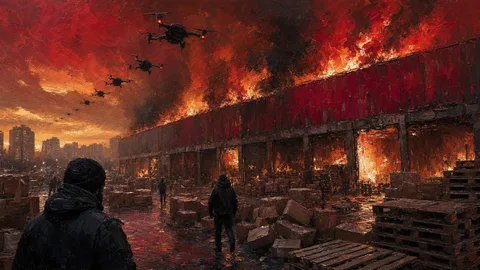
On the night of June 17 to 18, 2026, Ukraine launched against Russia what became, according to Russia's own Defense Ministry, the largest drone attack of the entire war. The exact figure — the total number of Ukrainian drones involved — was not disclosed by Kyiv. Ukraine does not comment on its offensive strikes. But the Russians spoke: their Defense Ministry announced it had intercepted 992 fixed-wing Ukrainian drones, surpassing the previous record attack of June 6, which had seen 911 drones claimed destroyed. And as Ukrainska Pravda notes, Russian figures count only the drones they claim to have shot down — the actual number launched was likely considerably higher.
Add to this that same night Russian air defense forces also claimed to have downed 4 long-range cruise missiles and 10 guided air bombs. The strike was massive, coordinated, and culminated in a major fire at the Kapotnya refinery in Moscow, 15 kilometers from the Kremlin — the second attack on that same site in three days. The previous one had taken place on June 16, forcing a temporary shutdown of operations.
Why this record is different from the previous ones
Ukrainian drone records have been set before. But the June 17–18 one is different for several reasons. First, the scale: nearly a thousand drones in a single night. Second, the target: Moscow, and specifically the refinery that alone supplies 40% of the gasoline and 50% of the diesel for Russia's entire capital, as well as jet fuel for the airports of Vnukovo, Domodedovo, Sheremetyevo, and Zhukovsky — all four airports suspended operations during the attack. Third, the strategy: by striking the same refinery twice in three days, Ukraine was not seeking to partially damage it. It sought total neutralization. According to analysts at CyberBoroshno, the strikes hit 100% of the facility's primary refining capacity.
The Moscow Refinery: Perfect Target, Maximum Symbol
Kapotnya, 15 kilometers from the Kremlin
The Moscow Oil Refinery (MNPZ) — owned by Gazprom Neft, the petroleum subsidiary of Russia's state energy giant — is no ordinary industrial facility. With a refining capacity of 12 million metric tons of crude per year, spread across 284 hectares and more than 30 processing units, it sits at the heart of Moscow's energy supply. It is also, geographically, 15 kilometers from the Kremlin — in the Kapotnya district, in southeast Moscow.
Hitting this refinery means hitting Russia's economic heart. But it also means hitting the most powerful symbol: Moscow is no longer a safe zone. For four years, Putin maintained the illusion that normal life continued in the capital, that the war was distant, that information control preserved the comfortable bubble of Russia's elite. Ukrainian drones are methodically destroying that illusion. Kapotnya residents reported an "oil rain" — crude oil dispersed over neighboring blocks. Four airports shut down. Residents complaining about the absence of official alerts and sirens.
The second strike in three days: a strategy of systematic destruction
The June 18 strike was not spontaneous. It was part of a planned campaign. On June 16, a first attack had hit the ELOU-AVT-6 unit — the primary crude processing unit — forcing it to temporarily shut down. On June 18, the second strike hit the integrated crude processing unit, which includes the second AVT-6 unit. According to CyberBoroshno, after these two successive strikes, 100% of the MNPZ's primary refining capacity had been neutralized. The refinery had already been targeted in September 2024, March 2025, and May 2026 — a systematic degradation campaign, night after night, month after month.
This systematic approach is the hallmark of Ukraine's strategy against Russian petroleum infrastructure. Not one spectacular strike then abandonment. Continuous, methodical, economically calculated degradation: every refining unit destroyed reduces Russia's capacity to produce fuel for its tanks, planes, and rocket systems. And according to Reuters, citing energy market sources, Russia was by June 2026 already forced to import gasoline by sea — an indirect acknowledgment of the cumulative impact of these strikes.
The Low-Cost Revolution: How Ukraine Produces Thousands of Drones a Week
The economics of drone warfare
The record strike of June 17–18 would not have been possible without an unprecedented Ukrainian industrial transformation. In 2022, Ukraine was almost entirely dependent on its allies for long-range strike capabilities. By 2026, it produces hundreds of drones per day, in dozens of factories spread across its territory and increasingly abroad, in allied countries out of reach of Russian strikes. Fire Point alone produces several hundred long-range FP-1 drones per day, at approximately €50,000 apiece.
This economics is revolutionary. A Ukrainian long-range strike drone costs between €20,000 and €100,000 depending on type and sophistication. A Russian Kalibr cruise missile costs between $500,000 and $1 million. For the price of one Kalibr, Ukraine can launch 5 to 50 drones. To neutralize each one, Russian defenses must spend disproportionate resources: Pantsir-S1 missiles at $700,000 apiece, S-400 missiles at several million, or electronic jamming systems that consume energy and personnel permanently. That is the economic asymmetry Ukraine is exploiting ever more effectively.
The drone types: FP-1, Liutyi, Bars
Images from the June 18 strikes on the Moscow refinery, analyzed by OSINT experts, revealed the presence of at least three types of Ukrainian drones. The FP-1 from Fire Point — a long-range strike and reconnaissance drone with a significant military payload. The An-196 Liutyi (the "Fierce") — a strike drone developed by Ukrainian special forces, known for its ability to fly at low altitude to avoid radar. And the Bars — a Ukrainian jet-powered drone, faster than the other two, capable of reaching speeds difficult for conventional air defense systems to intercept.
This combination of types is deliberate. Drones at different speeds, different altitudes, and different radar signatures arrive simultaneously and overwhelm defense systems that can only process a limited number of simultaneous threats. Saturation is the strategy. With approximately 200 drones approaching Moscow according to Mayor Sobyanin — himself a figure likely understated — Russia's air defense systems around the capital, despite their density (around 100 Pantsir-S1 systems, some two dozen S-400 batteries), could not neutralize them all.
"Safe Moscow": The Myth Collapses
The Russian capital as a permanent target
The June 18 strike is not isolated. It is part of a series of attacks that have progressively demonstrated that Moscow is no longer safe. In May 2026, SSU (Security Service of Ukraine) drones had already hit the MNPZ. Before that, in September 2024 and March 2025, other attacks had targeted the same facility. Over the months, Ukraine has refined its approach trajectories, radar-avoidance techniques, and saturation strategies. The result, in June 2026: two successive strikes in three days that completely halted Russia's capital's main refinery.
Moscow Mayor Sergei Sobyanin managed the announcement with characteristic hesitation. First he claimed the drones had been shot down. Then his statements evolved — between 25 and 60 drones "destroyed" across his various messages, before admitting the refinery had in fact been hit. This chaotic communication says something important about the state of Russian air defense around Moscow and the regime's capacity to manage information when physical reality asserts itself.
The psychology of the Russian population
These strikes are having a psychological effect that analysts are beginning to document. Moscow's population — which had lived in a bubble of relative normality since the start of the war, with media blackouts smothering bad news — is gradually discovering that the war also exists in Kapotnya. The explosions heard, the black smoke visible from multiple districts, the airport suspensions, the oil rain in neighboring gardens — all of this erodes the illusion of security that the Kremlin has worked to maintain.
Putin presents this war to his people as a slow but inevitable victory. Every time a Ukrainian drone hits a target on Russian soil, that narrative cracks a little more. It is not enough to spark a revolt — Russia is not a democracy and repression is massive. But the accumulation of these micro-fractures in the easy-victory narrative has a long-term political effect that even Russian leaders cannot entirely ignore.
Russian Defenses Against Saturation: Exposed Limits
Two defense rings and their gaps
Russia has massively reinforced its air defense around Moscow since 2022. According to data available in spring 2026, the capital is protected by two dense rings of anti-aircraft systems — with multiple positions inside the city itself. More than 100 air defense positions reportedly surround Moscow, including approximately 100 Pantsir-S1 systems, around two dozen S-400 batteries, and mobile fire groups. Since May 2026, new SMD-E Pantsir systems have even begun being deployed on the rooftops of apartment buildings, shopping centers, and office towers.
And yet the drones still get through. For several technical reasons. First, quantitative saturation: when 200 or more drones approach simultaneously, even a dense defense network cannot process them all. Second, diversity of flight profiles: Ukrainian drones fly at low altitude, on circuitous trajectories that avoid radar corridors, using the terrain to mask themselves. Third, tactical improvisation: each Ukrainian strike incorporates lessons from the previous one, exploiting identified gaps in the adversary's coverage.
The irony of Pantsir missiles hitting debris
One of the most striking revelations of this strike: according to analysis reports, one of the refinery tanks exploded after being hit by a Russian Pantsir-S1 missile attempting to shoot down a Ukrainian drone. In other words, Russian defenses themselves contributed to amplifying the damage by detonating their own munitions over adjacent civilian-industrial facilities. This is anti-drone friendly fire — a phenomenon documented in several Russian cities — where Russian defense systems cause collateral damage on their own territory while trying to intercept Ukrainian drones.
This paradox reveals something fundamental about the nature of large-scale drone warfare. Defending an urban territory against a rain of small flying devices is technically and economically far harder than it appears. Every successful interception risks causing damage in the areas below. Every failed interception lets the threat through. And with hundreds of drones arriving simultaneously, the acceptable failure rate is very limited.
The Refinery Campaign: War's Other Front
On the same topic
ANALYSIS: 800 drones over Russia in one night —…
More than eight hundred drones, in a single night, August 14…

INVESTIGATION : Russia's FSB Erases 4 Ukrainian Regions' Border…
Not an assault, not an ultimatum, not a televised proclamation from…

ANALYSIS: 313 Votes, a 20th Extension — Ukraine Keeps…
313 votes to approve the presidential decree extending martial law by…
Strike the fuel, strike the army
Ukraine's campaign against Russian refineries is one of the most coherent and least publicized strategies of this war. Since 2024, Ukraine has methodically struck refining installations across Russian territory: Saratov, Krasnodar, Ryazan, Nizhny Novgorod, and now Moscow repeatedly. The objective is simple: reduce Russia's capacity to produce fuel for its armed forces. Tanks, planes, helicopters, armored vehicles — all depend on fuel. And Russia, despite its immense crude oil reserves, has a limited refining capacity concentrated in identifiable facilities.
The effects are beginning to show. Reuters reported that Russia was importing gasoline by sea to compensate for shortages created by Ukrainian strikes on refineries. The irony is striking: the world's largest hydrocarbon exporter was importing gasoline because its refining network is too damaged to meet domestic demand. Every drone launched at a refinery for €50,000 is potentially the equivalent of millions of dollars in economic and logistical damage to Russia's military machine.
Cost-benefit ratio as doctrine
This campaign perfectly illustrates Ukraine's low-cost warfare doctrine. Drones cost between €20,000 and €100,000 for strikes that cause billions of dollars in damage to Russia's war economy. The Moscow refinery alone, with its annual capacity of 12 million tons, represents tens of billions of dollars in industrial investment. Neutralizing it with a series of drone strikes is a spectacular demonstration of the economic asymmetry of modern warfare.
This logic has been perfectly integrated by the Ukrainian chain of command. The June 17–18 operation involved multiple coordinated units: the 1st USF Operations Center, the 9th Kairos Battalion of the 414th Brigade Madyar's Birds, the 413th Raid Operations Unit, the 412th Nemesis Brigade, Special Operations Forces, the Security Service of Ukraine (SSU), and Military Intelligence. A massive strike is not the work of a single unit — it is a joint operation requiring sophisticated coordination among dozens of military entities.
The Drone War Figures: A Permanent Escalation
From 300 to 992: the exponential curve
The escalation of drone numbers is vertiginous. In 2022, a "large" Ukrainian attack meant a few dozen drones. By 2024, records approached 400–500. In March 2025, during the largest Russian attack ever recorded, 982 vectors were launched in 24 hours against Ukraine. And on June 6, 2026, Ukraine set its own record with 911 drones claimed by Russia. Twelve days later, on June 18, the record moved to 992 drones in a single night.
This escalation is symmetrical and mutual: both sides are increasing their production and strike capabilities in parallel. The difference is that Ukraine is increasing its offensive drone production faster than Russia is increasing its defensive capacity against them. The massive allied investments — €250 million from the Netherlands for drones, German funds for Ukrainian production, the UK's 150,000 drones ordered, the Drone Deal initiative bringing together 27 nations — are creating production capacity that will allow Ukraine to maintain and increase this strike pace for years.
Ukrainian defense against Russian drones: the inverted mirror
While Ukraine was striking Russia with its drones, Russia continued its own massive attacks. That same June 18, Russia had launched hundreds of its Shahed drones against Ukraine. The night before, 97 of 119 Russian drones launched had been shot down by Ukrainian defenses. On June 15, during the massive attack on Kyiv, Ukraine intercepted 632 of the 681 vectors launched — a rate of 92.8%. It is this defensive capacity — built with Patriots, IRIS-Ts, Gepard systems, and interceptor drones — that allied investments have made possible.
The two drone wars thus unfold in parallel: Ukraine strikes Russia with long-range offensive drones, while defending its territory with a combination of allied systems and interceptor drones. This dual competency — offensive and defensive — is unique in today's world. No other army has acquired in such a short time such mastery of both sides of drone warfare. It is this war's most lasting military legacy.
The Four Suspended Airports: Economic and Symbolic Impact
When war closes runways
The June 18 strike had an unexpected and symbolically powerful collateral effect: the simultaneous suspension of operations at Moscow's four main airports — Vnukovo, Domodedovo, Sheremetyevo, and Zhukovsky. These four airports handle virtually all air traffic for Europe's largest city. Shutting them down simultaneously, even for a few hours, disrupts tens of thousands of travelers, creates delays in critical logistics chains, and above all sends a powerful symbolic message: the war is in Moscow.
The Kapotnya refinery supplies jet fuel to these same airports. The repeated strikes on the facility create a structural threat to the Russian capital's kerosene supply. If the MNPZ remains offline for several weeks, the consequences for air traffic and road transport (40% of Moscow's gasoline) would become economically significant — and politically embarrassing for a regime that claims normal life continues.
Inverted information: Putin can no longer hide the war from his citizens
For four years, the Kremlin managed to maintain a relative bubble of ignorance around Moscow's population. Front-line losses, destroyed Ukrainian cities, growing economic isolation — all were filtered, minimized, reframed within the narrative of "inevitable victory." But when the refinery burns 15 kilometers from the Kremlin, when airports close, when "oil rain" falls on Kapotnya residents' gardens — maintaining the narrative becomes very difficult.
Muscovites were complaining on social media about the absence of official alerts, the lack of sirens, the shortage of real-time information. This spontaneous reaction says something important: Russian citizens are not as impervious to reality as a reading of Kremlin media control might suggest. The dissonance between what they see through their windows and what state media tells them creates a cognitive fracture that propaganda cannot paper over indefinitely.
Ukrainian Technology: The Engineering of Necessity
Drones designed to travel 600 kilometers
Reaching Moscow from Ukrainian territory means covering at least 500 to 600 kilometers depending on the trajectory. For fixed-wing drones, that requires endurance, precise navigation, and the capacity to avoid radar for the entire journey. The FP-1s from Fire Point, the Liutyis, and the other Ukrainian long-range drones deployed in this strike are not enhanced toys. They are sophisticated military devices capable of navigating autonomously for several hours, at low altitude, following pre-programmed trajectories that use the terrain to mask themselves from enemy radar.
Developing this capability in under four years — from virtually nothing in 2022 — is remarkable. Fire Point alone produces several hundred FP-1s per day. Other Ukrainian manufacturers — whose identities often remain confidential for security reasons — add their own capabilities. Ukraine has created a genuine industrial war drone ecosystem that mass-produces moderate-cost, high-impact devices. It may be the most spectacular industrial transformation achieved by a nation at war since the production of Spitfires in Britain during World War II.
Exporting the model and its implications
This Ukrainian industrial model is beginning to spread. In the Netherlands, Germany, and soon other allied countries, relocated Ukrainian factories will produce these same drones on European soil. The Build with Ukraine agreement with the Netherlands for long-range drone production, the discussions between Fire Point and Diehl Defence for manufacturing the Flamingo in Germany — all of this indicates that the Ukrainian industrial drone warfare model will diffuse throughout the allied space.
The strategic implications are profound. In ten years, if peace has returned and democracies maintain their investments, Europe will have a defense drone industry massively reinforced by Ukrainian operational experience. That would be a paradoxically positive consequence of the most destructive war in Europe since 1945: the birth of an independent, sovereign, globally competitive European security industry.
Commander Madyar and the Birds Brigade
The human faces behind the figures
Behind the abstract figure of 992 drones are faces and stories. Commander Robert "Madyar" Brovdi, whose 414th Brigade Madyar's Birds is one of the units cited in the June 18 operation, has become an iconic figure of Ukrainian drone warfare. His unit — specialized in precision drone strikes — has operated since the start of the war with documented effectiveness on Ukrainian social media and in the international press.
Ukrainian drone soldiers — often young people in their 20s and 30s, former software developers, engineering students, professional gamers converted to real war — represent a new category of combatant. They don't carry heavy weapons. They carry laptops and remote controls. They work in modified vans or unremarkable apartments, dozens or hundreds of kilometers from the targets they strike. Their competence is digital as much as military. And their impact is measured in burning refineries, destroyed ammunition depots, and paralyzed airports.
The generation reinventing war
This generation of Ukrainian drone warriors is the product of a particular society: a young, digital, tech-savvy Ukraine formed by years of IT industry development and startup culture. Before 2022, Ukraine was recognized as one of Europe's largest reservoirs of IT talent. After 2022, that competence was mobilized for national defense. Companies like Fire Point, units like Madyar's Birds, programs like Build with Ukraine — all were born from this encounter between technological talent and existential necessity.
This reality must be recognized for what it is: a military revolution. Not the one American theorists envisioned when they spoke of "revolution in military affairs" at the turn of the 2000s — with ultra-costly systems, sophisticated networks, multi-billion-dollar platforms. It is a low-cost revolution, born of constraint, fueled by creativity, and defined by its large-scale availability. And it is rewriting the rules of modern warfare.
What This Record Reveals About the State of the War
Ukraine is on offense, not only defense
The record strike of June 17–18 says something essential about Ukraine's strategic posture in 2026: Ukraine is not only defending its territory. It is bringing the war to Russia. This large-scale offensive capability — hundreds of drones hitting the economic heart of the aggressor country — changes the nature of the conflict. It tells the Russian population that the war has a real, visible, tangible cost. It tells the Russian army that its rear areas are not secure. It tells Putin that his attrition strategy has limits that Ukraine is capable of breaching.
Discover

COLUMN : Europe Moved 8.5 Billion Euros in a…
That is what the European Commission says it has disbursed for…

INVESTIGATION: Beijing cuts Africa to 2.1 billion in loans…
2.1 billion — the lowest figure in almost twenty years, according…

SPECIAL REPORT: Beijing Promises Stimulus as Its Households Give…
That is the growth rate of Chinese industrial output in July,…
This shift in posture is partly made possible by allied decisions to authorize Ukraine to strike targets on Russian territory with supplied weapons — a decision that took time to come but has profoundly changed the operational landscape. When the United States, the United Kingdom, and other allies finally gave the green light for deep strikes, Ukraine demonstrated it knew exactly what to hit and how. Refineries. Ammunition depots. Military airfields. Logistical bridges.
The record will not be the last
With the $4 billion committed at the June 18 Ramstein, with the 27 nations of the Drone Deal, with Ukrainian drone factories being built in the Netherlands and soon in Germany — this record of 992 drones will not be the last. Production capacity continues to grow. Deep-strike doctrine continues to be refined. Coordination among the multiple units involved continues to improve.
In six months, in a year, the June 17–18 record will probably be broken. Not because Ukraine is chasing records for the sake of it. But because the logic of this war — maintaining economic and psychological pressure on Russia while defending its own territory — imposes a continuous escalation of offensive capabilities. The low-cost drone revolution has not reached the end of its journey. It is in its opening hours.
Strategic Significance: Russia's War Economy Under Pressure
Strike the oil, strike the war
The refinery campaign is part of a broader Ukrainian strategy of degrading Russia's war economy. Oil is the backbone of Russia's war financing: it provides the export revenues that allow Moscow to buy weapons from Iran and North Korea, fund domestic weapons production, and pay soldiers' salaries. Striking refineries therefore means hitting both direct military logistics (fuel for front-line forces) and indirect financial resources (oil revenues).
This strategy is documented in economic data. Despite oil price rises linked to the Iran war, Russia's reduced refining capacity — damaged by Ukrainian strikes — has compressed margins and created local shortages. Gasoline imports — an unprecedented phenomenon for the world's largest hydrocarbon producer — are the most tangible proof. Ukraine is accomplishing what Western sanctions alone struggled to achieve: concretely reducing Russia's capacity to finance and sustain its war machine.
The cost of Russia's defensive victory
Russia's Defense Ministry announced intercepting 555 Ukrainian drones that night across the country. Moscow's mayor claimed 194 interceptions around the capital. If these figures are accurate — and they are likely inflated — Russia spent tens of millions of dollars in interception missiles for that single night. Pantsir missiles at $700,000 apiece, S-400 missiles at several million: the cost of intercepting each Ukrainian drone is structurally higher than the cost of the drone itself. That is the economic asymmetry progressively exhausting Russian defenses.
This reality, multiplied by hundreds of nights of Ukrainian attacks since 2022, represents a defense cost that Russia's war economy is sustaining with increasing difficulty. It is not visible in official Russian declarations — which never acknowledge difficulties — but it shows through in military decisions, reports of logistical failures, and growing signs of internal economic strain.
The Strategic Message: Why Russia Cannot Win This Battle
The fundamental asymmetry of cost
There is an arithmetic truth that no one in the Kremlin can ignore indefinitely. A Ukrainian FP-1 drone costs between €50,000 and €100,000 to produce. A Russian Pantsir-S1 interceptor missile costs approximately $700,000. An S-400 missile costs several million. To neutralize each Ukrainian drone, Russia spends 7 to 50 times more than Ukraine invested in building it. This asymmetry, multiplied by thousands of strikes since 2022, creates a structural financial hemorrhage that even Russia's war economy — despite its oil revenues and mobilized armaments industries — cannot sustain indefinitely at this pace.
And this asymmetry is worsening for Russia. While Ukraine reduces its production costs through economies of scale and continuous innovation, Russia must maintain increasingly expensive interception systems around its cities. With allied investments — $4 billion at the June 18 Ramstein alone — Ukrainian production capacities will continue to grow. The Drone Deal project bringing together 27 nations plans an industrial scale-up that will allow Ukraine to maintain and intensify this strike pace for years.
The losing spiral of Russian defense
Russia's response to this asymmetry — building more air defenses around its cities — creates its own losing spiral. The more Russia deploys interception systems, the higher their total operating cost grows. The more it concentrates these systems around Moscow and major cities, the more peripheral rural and industrial areas remain exposed. The more it reinforces static defenses, the fewer resources it has for mobile defenses on the Ukrainian front. Every defensive decision on Russian soil carries a military opportunity cost in Ukraine.
Ukraine knows this. That is why the deep-strike campaign is not a strategic luxury. It is an economic and military necessity: force Russia to spend on two fronts simultaneously, exhaust it through long-range attrition, and demonstrate to the Russian population that their government cannot protect them from the consequences of its aggression. The record strike of June 17–18 is a milestone in this strategy. Not the last.
Conclusion: The Low-Cost Revolution, the Decisive Weapon of the 21st Century
What 992 drones proved
The record strike of June 17–18, 2026 proved several things simultaneously. That Ukraine can produce hundreds of drones per day and deploy them en masse against strategic targets deep in enemy territory. That Russian air defense, however dense and well-funded, cannot stop a massive saturation. That Russian petroleum infrastructure, concentrated and identifiable, is vulnerable to a campaign of systematic degradation. And that low-cost drone warfare is a permanent military revolution, not a temporary novelty.
These conclusions must be integrated by every army, every defense industrialist, every strategist worldwide. 21st-century wars are no longer won solely with the most sophisticated and costly weapons. They are won with weapons sufficiently effective, produced in sufficient quantities, at costs sufficiently low to be sustainable over the long term. Ukraine has written that equation in the blood and fire of four years of war. The rest of the world is only beginning to understand its implications.
The future: the next night
As these lines are written, the engineers at Fire Point, other Ukrainian manufacturers, and their European partners are working to prepare the next strike. Perhaps 1,000 drones. Perhaps more. Perhaps a different target. Perhaps the same refinery to complete its neutralization. Ukraine does not communicate its plans in advance. But the logic of this war — and the record of June 17–18 — suggests that the worst is yet to come for Putin's petroleum empire.
Primary Sources
Secondary Sources
Get the geopolitics analyses
Conflicts, powers, alliances: the MadMax thread without the noise.
Cite this article
Maxime Marquette (2026). COLUMN : 992 Drones in One Night — The Low-Cost Revolution Battering Putin's Petroleum Empire. MadMax. https://mad-max.co/en/article/chronique-992-drones-en-une-nuit-la-revolution-low-cost-qui-terrasse-lempire-petrolier-de
Read next
COLUMN : Europe Moved 8.5 Billion Euros in a…
That is what the European Commission says it has disbursed for…
INVESTIGATION: Beijing cuts Africa to 2.1 billion in loans…
2.1 billion — the lowest figure in almost twenty years, according…
SPECIAL REPORT: Beijing Promises Stimulus as Its Households Give…
That is the growth rate of Chinese industrial output in July,…
Enjoyed this piece? Get the next one.
One chronicle a week, straight to your inbox. No noise.
This article was generated with AI assistance, under human supervision.
Comments
Be the first to weigh in.