

COLUMN: 660 drones over Moscow — Ukraine saturates Russian defenses and paralyzes an empire
In the night of June 25–26, 2026, Ukraine launched what the Russian Defense Ministry itself acknowledged as the largest drone attack against Russia since the beginning of the war. Six hundred and sixty Ukrainian drones, intercepted according to Moscow, saturated the airspace of twelve Russian regions, occupied Crimea, and the surrounding seas. The word "intercepted" is one Russ
- In the night of June 25–26, 2026, Ukraine launched what the Russian Defense Ministry itself acknowledged as the largest drone attack against Russia since the beginning of the war. Six hundred and sixty Ukrainian drones, intercepted according to Moscow, saturated the airspace of twelve Russian regions, occupied Crimea, and the surrounding seas. The word "intercepted" is one Russ
- COLUMN: 660 drones over Moscow — Ukraine saturates Russian defenses and paralyzes an empire
- Introduction: A night in June 2026 that changed the war
Facts, quotes, and cited links remain in the body. Interpretations are framed as analysis or opinion according to the format.
COLUMN: 660 drones over Moscow — Ukraine saturates Russian defenses and paralyzes an empire
Introduction: A night in June 2026 that changed the war
The figure that stuns: 660 drones in a single night
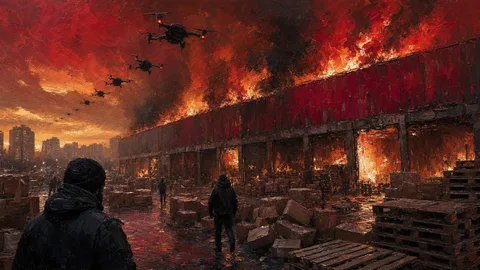
In the night of June 25–26, 2026, Ukraine launched what the Russian Defense Ministry itself acknowledged as the largest drone attack against Russia since the beginning of the war. Six hundred and sixty Ukrainian drones, intercepted according to Moscow, saturated the airspace of twelve Russian regions, occupied Crimea, and the surrounding seas. The word "intercepted" is one Russia uses systematically — even when the drones had already reached their targets. What we know with certainty: the night of June 26 represented a qualitative shift in Ukraine's offensive capability, a step beyond the previous attack of May 17 that had mobilized 556 drones.
This column tells the story of that night — and what it means for what comes next. Not as an isolated military event, but as the culmination of a strategy conceived, built, and refined over months. Zelensky ordered what he himself called a 40-day influence operation, aimed at forcing Russia to end the war. June 26 was at the heart of that operation. And the results are there — visible, documented, devastating for the Russian economy.
The 40-day campaign: a doctrine of exhaustion
Zelensky announced this offensive operation — 40 days of influence — on X, framing it as a calibrated response to Russian attacks on Ukrainian territory. The logic is simple and brutal: every Russian drone that bombs Kharkiv, Zaporizhzhia, or Kyiv must carry an equivalent cost on Russian soil. Every refinery fueling Putin's tanks can burn. Every factory producing components for Russian missiles can be destroyed. The 40-day campaign is not improvised escalation — it is strategy.
The month of June 2026 became, according to data from Janes, the month that concentrated roughly 35% of all confirmed strikes on Russian territory since the start of the year. The number of confirmed long-range strikes rose from 12 in May to 32 in June — nearly a threefold increase in a single month. Moscow had not anticipated this pace.
Saturation: how Ukraine overwhelms Russian defenses
The Pantsir can only engage four targets at once
The key to Ukraine's doctrine of massive swarms rests on a simple physical reality that aviation expert Valerii Romanenko laid out clearly: Russian Pantsir systems — the backbone of short-range air defense — can engage at most four targets simultaneously. Send fifty drones down the same corridor and the Pantsir will down four — the remaining forty-six get through. Ukraine grasped this equation and made it the founding principle of its June 2026 campaign.
Denys Shtylerman of Fire Point articulated the doctrine with remarkable candor: "We simply used a large number of drones, and they overwhelmed the Russian air defense systems." That is not military genius — it is arithmetic applied to warfare. When the number of projectiles exceeds interception capacity, some reach their destination. And Russia, for the first time in this war, finds itself in the position that Ukraine had occupied since 2022.
Geography as ally: the distances exceed Russian defensive reach
Douglas Barrie, analyst at the IISS, identified a structural vulnerability in Russian air defense: it was designed to protect against piloted aircraft, cruise missiles, and ballistic missiles — not against low-cost drones in massive swarms. This defense architecture, conceived during the Cold War, is structurally ill-suited to the threat that Ukraine has developed.
Moreover, Russia must simultaneously defend a front line of 1,200 kilometers, a strategic depth of thousands of kilometers, and infrastructure dispersed across the entire expanse of its territory. This dispersion of defensive obligations creates gaps that Ukrainian planners exploit methodically. Each attack wave reveals the positions of active defense systems — enabling subsequent waves to identify the breaches.
The targets: refineries, ports, depots — Russia's energy heartland
The Kapotnya refinery: the heart of Moscow in flames
The Kapotnya refinery in southeastern Moscow, just 15 kilometers from the Kremlin, was struck in the night of June 17–18, 2026. This facility supplied more than a third of the Russian capital's fuel needs according to market data cited by Le Monde — some sources put it as high as 40% of the Moscow market. Its partial shutdown created the first visible shortages in the Russian capital: one-hour queues at still-operating gas stations, half of all stations closed in certain districts, the progressive disappearance of certain fuel types from available pumps.
This is not an incidental strike. Hitting the main refinery of a capital city of 12 million residents from 15 km from the Kremlin is a military and psychological act of the first order. On the night of June 18, Russian social media filled with videos showing massive flames and an oil rain over Moscow. These images circulated despite censorship.
From the port of Saint Petersburg to the refineries of Perm and Krasnodar
Ukraine's June 2026 campaign did not target just one installation. The oil port of Saint Petersburg, more than 1,000 km from the Ukrainian border and 500 km from Finland, was struck early in the month. Facilities in Krasnodar, more than 500 km away, suffered repeated damage. The Perm refinery, at 1,500 km, was hit. Combined, these strikes reduced between a quarter and a third of Russia's total refining capacity according to independent sources — a figure cited by Le Monde that Moscow did not explicitly contest.
An app called "Where to find fuel?" appeared in Russian app stores, mapping in real time which stations were still supplied. Tutorials on siphoning fuel circulated. Videos of fuel theft between neighbors were shared. These are signals of real pressure on the daily lives of ordinary Russians — pressure that Putin himself finally acknowledged.
Putin's acknowledgment: the moment no one expected
June 23, 2026, before graduating military academy cadets
On June 23, 2026, before graduating cadets of the military academies assembled at the Kremlin, Vladimir Putin spoke words that resonated through every Western chancellery. He acknowledged that Ukrainian strikes on Russian oil infrastructure had achieved their stated goal of "destabilizing society." He described the campaign as "a relentless stream of drones" designed to "create uncertainty about the actions of our armed forces."
That is an extraordinary concession. Putin never admits Ukrainian successes. For two years, Kremlin rhetoric had presented Ukrainian strikes as failures or footnotes. That day, before his own military cadres, he acknowledged that Kyiv's strategy is working. He did add that it "will not sow doubt" and that "they will achieve their goals" — but the admission that preceded those hollow formulas speaks louder than the formulas themselves.
Fuel restrictions: fifteen regions under emergency measures
On the same day as Putin's acknowledgment, at least 15 Russian regions imposed emergency restrictions on fuel sales. Omsk, Irkutsk, Saratov, Voronezh, Amur, and Tambov implemented emergency caps to curb panic buying. Saratov limited individual purchases to 30 liters of gasoline. Irkutsk authorized some stations to suspend sales entirely in order to prioritize emergency services. In Crimea, Sergey Aksyonov suspended fuel sales to the public as early as June 21.
These restrictions are not cosmetic measures. They signal a breakdown of supply chains at national scale. The Russian government banned fuel exports until July 31, 2026. Tatneft, one of Russia's oil giants, imposed per-person purchase limits. The City of Moscow authorized fuel tanker trucks to operate without permits in an emergency effort to resupply the capital.
216 drones in 6 hours: the night of June 19
An attack density that shatters all previous records
Even before the record attack of June 26, the night of June 18–19, 2026 had already set a new threshold. In just 6 hours, Russian air defense systems reported downing 216 Ukrainian drones over Russian regions. This temporal density — 36 drones per hour, one every 100 seconds — represents a pace that few air defense systems in the world can sustain for such a duration without running short of interceptor missiles.
It was during that same night that the Kapotnya refinery, 15 km from the Kremlin, was struck for the second time in two days — following an initial strike on June 17. The combination of maximum attack density and a uniquely symbolic target at the heart of the Russian capital created a psychological effect that even Russian censorship could not contain.
Trump and the international reaction: between discomfort and admiration
The attack of the night of June 18–19 even drew a reaction from Donald Trump, who, according to CNBC, commented on the strikes from Moscow and Ukraine through his usual communications. The American president perpetually navigates between his stated desire to end the war and the impossibility of ignoring that Ukraine is demonstrating mounting military effectiveness. This effectiveness makes any political pressure on Kyiv to stop striking costly in the United States — where public opinion applauds Ukrainian successes.
European capitals, for their part, observe this campaign with a mixture of admiration and strategic caution. Striking refineries at 1,500 km from the border, hitting installations at 15 km from the Kremlin — this is de facto escalation that some governments still hesitate to endorse publicly, even as they supply the components that make these strikes possible.
The economic impact: fuel as a weapon of war
Between a quarter and a third of Russia's refining capacity offline
On the same topic
ANALYSIS: 800 drones over Russia in one night —…
More than eight hundred drones, in a single night, August 14…

INVESTIGATION: 316 political cases in Crimea — the occupation…
Three hundred and sixteen people are being prosecuted on political grounds…

INVESTIGATION : Russia's FSB Erases 4 Ukrainian Regions' Border…
Not an assault, not an ultimatum, not a televised proclamation from…
The figures are striking. According to independent sources cited by Le Monde, between a quarter and a third of Russia's total refining capacity is offline because of Ukrainian strikes. Energy expert Sergey Vakulenko estimates the loss at 1.3 million barrels per day of refining capacity, to which are added secondary transportation and supply losses. This is an economic disruption layered on top of already troubling inflation and interest rates held at elevated levels.
For Russia's agricultural sector, the effects are immediate and concrete: the 2026 harvest begins with more expensive, less available diesel. Tractors and grain transport trucks run on fuel — if supply is disrupted, yields and deliveries follow. This is not the image of a healthy war economy that Russia is presenting to its citizens heading into autumn 2026.
The September 20 parliamentary elections in the crosshairs
Among the potential political consequences, Le Monde cites discussions at the Kremlin about possibly postponing the September 20, 2026 parliamentary elections to prevent public discontent linked to fuel shortages from affecting the electoral outcome. A regime contemplating postponing its own elections out of fear of public discontent is not a regime confident in its legitimacy.
The combination of fuel shortages, purchase restrictions in 15 regions, closed stations in Moscow, suspended sales in Crimea — this is the war entering the daily lives of Russians in a way that no propaganda can erase. Zelensky stated it explicitly in his nightly address: "The majority in Russia is beginning to have problems with Putin because there is no end in sight to his war."
The swarm doctrine: what June 2026 changed forever
Ukraine adopts the tactic Russia developed against it
There is a deep irony in the June 2026 campaign: Ukraine systematically adopted and perfected the tactic that Russia had developed against Ukrainian cities since 2022. Sending massive waves of drones to saturate defenses, drain interceptor missile stocks, let the strike drones through while defenders are busy shooting down decoys — this is exactly what Russia did to Kharkiv, Kyiv, and Odesa for two years.
Ukraine did it at greater scale, with increased industrial precision, against an adversary whose defenses had been designed for a different threat. The result is spectacular: 35% of all confirmed strikes on Russian territory since the start of 2026 took place in June. One month. A demonstration of capability that no military analyst can minimize.
The first wave locates the defenses, the second breaches them
The operational mechanics are precise: the first drone wave activates Russian air defense systems — forcing radars to reveal themselves, batteries to deploy, positions to become visible. The second wave, planned using the data collected in real time, identifies the gaps and concentrates strike drones in them. This is a doctrine that turns every drone sacrificed in wave one into a paid reconnaissance asset for wave two.
This doctrinal sophistication is particularly visible in the June 26 strike: 660 drones do not fly at random. Their trajectory, their timing, their geographic distribution across twelve regions simultaneously — all of this reflects operational planning at a strategic level. This is no longer the artisanal drone war of 2022. It is an industrial air campaign.
Moscow under psychological pressure: the drones reshaping a capital
Kapotnya's flames visible from the center of Moscow
When the Kapotnya refinery burned on the night of June 17–18, then again on June 18–19, images captured from central Moscow showed massive columns of black smoke and flames visible from dozens of kilometers away. The oil rain — hydrocarbon droplets falling back onto surrounding residential neighborhoods — was documented by residents on social media before the posts were massively deleted by pro-Kremlin moderators.
This physical visibility of the war — no longer on a screen showing the ruins of Kharkiv, but in the sky above one's own city — is a fundamental psychological shift for the Moscow population. The illusion of a clean, distant war won at no daily cost collapses one gas station at a time. And accounts from Omsk to Irkutsk confirm this is not only a Moscow phenomenon.
The ISW documents Ukraine's sustained escalation
In its campaign assessment of June 26, 2026, the Institute for the Study of War documents the persistence and acceleration of Ukraine's deep strike campaign. ISW analysts note that the successive drone records — 216 in 6 hours on June 19, 555 on the night of June 18, 660 on June 26 — are not isolated blows but milestones in a planned escalation.
This analysis is consistent with Zelensky's statement on his 40-day operation: every night is one more step in a systematic pressure campaign on Russian society. The objective is not to defeat Russia militarily in a single strike — it is to accumulate costs until the point at which Putin's calculation on continuing the war becomes unsustainable.
The stakes in the Black Sea and Crimea
Strikes on Kerch: Russian reconnaissance vessels targeted
As part of the same overnight campaign of June 26, 2026, Ukraine's Security Service (SBU) announced using drones to strike Russian naval vessels and air defense radars at Kerch, in Crimea. The identified targets included the reconnaissance and minelaying vessels Volga and Vyatka, along with the cargo-passenger ferry Petropavlovsk.
These strikes follow the logic of systematic degradation of Russian naval capabilities in the Black Sea — a campaign that has already forced the Black Sea Fleet to withdraw from Sevastopol and significantly reduce its operational presence in Ukrainian waters. Crimea, where fuel sales were suspended as early as June 21, is simultaneously under military and economic pressure.
Crimea as maximum pressure point
Occupied Crimea concentrates every dimension of Ukraine's June 2026 pressure: strikes on naval military installations, attacks on fuel refineries and depots, disruptions to civilian supply, power outages at the main power station in Simferopol and in Sevastopol. For Russians settled in Crimea since 2014, the reality of 2026 is radically different from the comfortable illusion of a sanctuarized peninsula they had known.
The Kerch Bridge, already damaged in earlier strikes, remains a primary symbolic and strategic target for Ukraine. A strike on a bridge crossing the North Crimean Canal the same evening reinforces the logic of cutting Russian supply lines to the peninsula.
The 660 record: what this figure means for the future
660 drones are not the ceiling — they are the floor
The figure of 660 drones in one night is the largest ever recorded since the start of the war, according to Russia itself. But in the context of Ukrainian production — with a monthly growth rate of +12.7% reported by the Ukrainian commander-in-chief and massive investments in industrial drone production — this figure is probably not the ceiling. It is more plausibly the floor of a continuously expanding capability.
The next record night will be higher. The next campaign will run longer. The next wave will target still-deeper regions, with still-more-capable drones. The trajectory drawn by June 2026 is clear: Ukraine is building a strategic aerial strike capability from nothing, while fighting for its survival. No army in history has done anything comparable under such extreme conditions.
The pressure that must lead to peace — or Russian collapse
Zelensky's strategy rests on a wager: that the accumulation of economic, military, and psychological pressures will eventually make the cost of the war unbearable for the Russian regime or for its population. The fuel shortages in 15 regions, Putin's acknowledgment, the queues in Moscow, the suspended sales in Crimea — these are the first visible signs that this wager is beginning to pay off.
The open question is timing. Putin has shown a capacity to absorb considerable costs without changing course. But an economy losing a quarter to a third of its refining capacity, a population that must queue for a tank of fuel, an elite watching its factories burn 900 km from the front — that is pressure of a different kind from anything the regime has managed before.
The Russian response: strikes on Kharkiv and continued escalation
Russia strikes while Ukraine strikes
The night of June 26 was not unilateral. While 660 Ukrainian drones targeted Russian regions, Russia struck back: 3 civilians killed, 29 wounded in Ukraine. In the Kharkiv region, 2 people were killed and 7 wounded in the preceding 24 hours — the city of Kharkiv and 16 other localities in the region were struck. A Russian drone over Izium killed a woman and wounded three others on Friday morning.
Ukrainian air defense succeeded in stopping 174 of the 189 Russian drones launched that night — an interception rate of roughly 92%, far superior to Russian capabilities against Ukrainian swarms. However, 4 of the 7 Iskander-M ballistic missiles penetrated the defenses and struck targets in Ukraine. In Kyiv, Odesa, Zaporizhzhia, and Sumy, strikes wounded at least 19 people, including a 9-year-old girl.
A prisoner exchange amid the bombardments
Alongside the mutual strikes, 160 prisoners from each side were exchanged that Friday — one of those paradoxical wartime moments where minimal cooperation coexists with maximum violence. These exchanges are not peace signals — they are humanitarian obligations that both parties accept under international pressure. But they confirm that some form of minimal communication channel still exists between Kyiv and Moscow, even in the midst of the largest drone attack in the conflict's history.
Ukraine's assessment of Belarus is also instructive: according to Kyiv, there is no troop buildup near the Belarusian border, even as Russia continues to expand its training bases deeper inside Lukashenko's territory. This relative stability on the northern front allows Ukraine to concentrate its efforts on the deep strike campaign.
The role of Ukrainian industry: producing under bombs
An unprecedented ramp-up in industrial capacity
Behind the figures of the June 2026 campaign — 660, 555, 216 drones in just a few nights — lies a remarkable industrial reality: Ukraine produces these systems on its own territory, under Russian bombardment, with a dispersed workforce and constantly threatened supply chains. This production capacity barely existed in 2022. It is the result of four years of emergency investment, forced innovation, and national mobilization of Ukrainian engineering talent.
The data on Ukrainian drone production growth speaks for itself: the Ukrainian commander-in-chief confirmed monthly growth of +12.7% — a rate that, sustained over a full year, means more than a fourfold multiplication of production capacity. Reconnaissance drone figures have risen +441% since January 2026, intermediate strike drones +312%. This is an industrial revolution in the middle of a war.
Dispersed subcontractors and resilience to Russian strikes
Part of this industry's resilience stems from deliberate dispersal. Ukrainian drone manufacturers learned from early Russian strikes on their facilities — they fragmented production into hundreds of small workshops and subcontractors spread across the entire territory. Striking one factory now destroys only a fraction of overall capacity. Assembly lines can be reconstituted quickly in other premises.
This industrial resilience is an organizational innovation as much as a technological one. It serves as a model for other democracies thinking about their own industrial resilience against adversaries that would target their infrastructure. Ukraine is experimenting, under extreme constraint, with forms of distributed defense production that military manuals had not yet theorized.
Zelensky, strategic communication, and the 40 days
The public announcement as a tool of psychological pressure
Discover

COLUMN : Europe Moved 8.5 Billion Euros in a…
That is what the European Commission says it has disbursed for…

INVESTIGATION: Beijing cuts Africa to 2.1 billion in loans…
2.1 billion — the lowest figure in almost twenty years, according…

SPECIAL REPORT: Beijing Promises Stimulus as Its Households Give…
That is the growth rate of Chinese industrial output in July,…
Zelensky's choice to publicly announce his 40-day operation on X is itself a strategic decision. By making the operation public, he transforms every drone night into a chapter of an ongoing narrative — a communication campaign as much as a military one. Allies can track the progress. Enemies know the pressure will not stop. The Ukrainian population knows its president is on the offensive.
This kind of communication runs counter to classical military practice, which calls for maximum operational secrecy. Zelensky chose narrative transparency because he is playing on multiple boards simultaneously: military, diplomatic, psychological. The announcement of 40 days of influence is a message addressed to Putin (this will last), to allies (we have a plan), and to the Ukrainian population (your army is taking the initiative).
Zelensky's response to Putin's admission
When Putin acknowledged on June 23 that Ukrainian strikes "destabilize society," Zelensky responded in his nightly address with a formulation that summarizes his entire strategy: "The majority in Russia is beginning to have problems with Putin because there is no end in sight to his war. And all the difficulties that Russians are experiencing today should bring them closer to realizing that their war is real, that these are not just stones falling from the sky, and that their war must end."
This message — addressed as much to the Russian population as to the Ukrainian one — articulates Kyiv's theory of change: create enough real discomfort, enough disruption in the daily lives of Russians, for the war to begin carrying a domestic political cost for Putin. It is a long-term strategy. Its effects will not be immediate. But the early signs are there.
Ukraine's naval drone war: Kerch and the Black Sea as a second front
Striking Russian warships in port
Alongside the terrestrial and energy strikes, Ukraine's June 2026 campaign extended to the Black Sea with devastating effectiveness. Ukraine's Security Service confirmed strikes on the reconnaissance and minelaying vessels Volga and Vyatka at Kerch, demonstrating that the Russian Black Sea Fleet remains vulnerable even in its fallback ports in Crimea. This naval dimension of the drone campaign often receives less coverage than the refinery strikes — but it is strategically as important.
The combination of aerial pressure on energy infrastructure and naval strikes on Russian maritime capabilities creates a two-dimensional operational environment that Russia struggles to defend simultaneously. Its air defense resources are already saturated by aerial drone swarms — naval defenses face the same pressure. The result is a Crimea besieged by sea and land at the same time.
The abandonment of Sevastopol and the retreat to Novorossiysk
The progressive withdrawal of the Russian Black Sea Fleet from Sevastopol to Novorossiysk is one of the quietest strategic naval defeats of the war. Without a conventional naval battle, without torpedoes or traditional anti-ship missiles, Ukraine forced the Russian navy to abandon its principal Black Sea port. Ukrainian surface and submarine naval drones made Sevastopol untenable for large Russian warships.
This asymmetric naval victory is the template for what the refinery strikes are doing: no spectacular conventional victory, but an accumulation of pressures that changes fundamental strategic realities. Russia still controls Crimea militarily — but it no longer controls its maritime space or fuel supply. It is no longer a sanctuary.
Conclusion: June 2026, the turning point history will remember
The month that set the new standard of drone warfare
June 2026 will be remembered as a turning point in contemporary military history. The month when drone swarms crossed the threshold of 600 units in a single night. The month when between a quarter and a third of a major power's refining capacity was temporarily taken offline by drones. The month when a Russian president acknowledged, before his own military cadres, that the enemy's strategy "destabilizes society." These three facts, taken together, define a new paradigm of low-cost aerial warfare.
This paradigm, Ukraine did not invent — it scaled it to an industrial level that no one had anticipated. The massive drone swarms, the saturation of defenses through sheer numbers, the systematic targeting of energy infrastructure, the narrative communication of the campaign — all of this constitutes a doctrine that will be studied in military academies worldwide for decades.
660 drones — and the next night will be larger still
The figure of 660 is a record. It will probably no longer be one within a few weeks. Ukraine's production trajectory, the investments committed, the tested doctrine, the national motivation — everything points toward a continuation and amplification of the campaign. The next record night will come. And the next after that. Until the cost becomes unbearable for Moscow — or until peace is negotiated under this pressure.
By Maxime Marquette, columnist
Columnist's transparency note
What I assert and what I do not know
The drone figures — 660, 555, 216 — come from Russian Defense Ministry statements, which I cite as such. Russia has an interest in overstating intercepted drones to minimize its failures; these figures are therefore plausible minimums for drones launched, not certainties about drones actually downed. The economic data on refining capacity losses and regional fuel restrictions come from Le Monde, United24, and EAWorldView — credible sources but not fully independently verifiable on every detail.
I am Maxime Marquette, pro-Ukraine, and I support the legitimacy and strategic necessity of Ukraine's deep strike campaign. I acknowledge that damage to Russian civilian infrastructure has consequences for civilians who did not choose this war. That reality does not change my assessment of responsibility — which rests with Putin and those who support his regime. But it deserves to be named.
Sources and their limits
Zelensky's statement on the 40-day operation is public and confirmed by multiple sources. Putin's declarations of June 23 are documented by EAWorldView and other independent sources. The economic data remain partly dependent on sources that do not have full access to official Russian data — the ground reality could be worse or slightly different from what is reported here.
What I know with certainty: fuel restrictions in 15 Russian regions are documented. Putin's acknowledgment is documented. The 660-drone attack is documented by Russia itself. These facts underpin the analysis.
Sources
Primary sources
Secondary sources
Get the geopolitics analyses
Conflicts, powers, alliances: the MadMax thread without the noise.
Cite this article
Maxime Marquette (2026). COLUMN: 660 drones over Moscow — Ukraine saturates Russian defenses and paralyzes an empire. MadMax. https://mad-max.co/en/article/chronique-660-drones-sur-moscou-l-ukraine-sature-les-defenses-russes-et-paralyse
Read next
COLUMN : Europe Moved 8.5 Billion Euros in a…
That is what the European Commission says it has disbursed for…
INVESTIGATION: Beijing cuts Africa to 2.1 billion in loans…
2.1 billion — the lowest figure in almost twenty years, according…
SPECIAL REPORT: Beijing Promises Stimulus as Its Households Give…
That is the growth rate of Chinese industrial output in July,…
Enjoyed this piece? Get the next one.
One chronicle a week, straight to your inbox. No noise.
This article was generated with AI assistance, under human supervision.
Comments
Be the first to weigh in.