

EYEWITNESS: In Sumy, three horses killed by a Russian drone in a children's riding school
On the night of June 16-17, 2026, shortly after midnight, a Geran-2 drone — the Russian version of the Iranian Shahed —
- On the night of June 16-17, 2026, shortly after midnight, a Geran-2 drone — the Russian version of the Iranian Shahed —
- Introduction: The night innocence burned in a stable
- A Geran-2 against children's horses
Facts, quotes, and cited links remain in the body. Interpretations are framed as analysis or opinion according to the format.
Introduction: The night innocence burned in a stable
A Geran-2 against children's horses
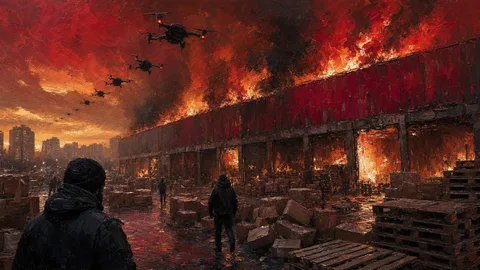
On the night of June 16-17, 2026, shortly after midnight, a Geran-2 drone — the Russian version of the Iranian Shahed — crashed into the premises of the Sumy riding school, a city in northeastern Ukraine located less than thirty kilometers from the Russian border. The target: a stable. The victims: three horses, killed instantly or dead from their wounds. A fourth animal was still under the rubble at the time of the first reports. More than ten other horses were injured by shrapnel. Rescuers from the State Emergency Service of Ukraine had to clear collapsed floor slabs to recover the animals' bodies.
The Sumy Regional Military Administration, led by Oleh Hryhorov, was the first to react on Telegram. The head of the OVA (Oblast Military Administration) did not mince his words: “The Russians deliberately struck a civilian object where children trained every day.” The acting mayor of Sumy, Artem Kobzar, confirmed shortly after: “An enemy Geran-2 type UAV struck the territory of the Sumy equestrian school. The stable was damaged. Three horses were killed. The fire triggered by the impact was contained.”
A city already under permanent siege
Sumy is no ordinary city in wartime. It is a border city, a target city, a city where air raid alerts have punctuated daily life for over four years. During the single day of June 17, Russian forces carried out more than 90 attacks on 22 localities spread across 15 communities in the Sumy region, according to Ukrinform. Three civilians were killed that same day in the region: a 56-year-old man who died in a strike on a Sumy residential building, a 68-year-old man killed in the Shostka community, and a third victim in the Velyka Pysarivka community. Seven other people were injured. Houses, vehicles, civilian infrastructure — everything was hit.
That night, Ukrainian air defense shot down 97 of the 119 drones launched by Russia across the national territory. The remaining 22 reached their targets: houses, a grain elevator, gas stations, and a children's stable. The attack is part of a series of strikes that, that day, caused at least 10 deaths and 64 injuries across all of Ukraine, according to the Kyiv Independent.
The Geran-2: the drone of daily terror in Ukraine
A weapon designed to terrorize, not to win
The Geran-2 is the Russian version of the Shahed-136 kamikaze drone produced in Iran. Moscow began using it massively in Ukraine starting in the fall of 2022, initially to strike energy infrastructure. Since then, these machines have evolved into a role of diffuse terror: they strike anywhere, anytime, at any hour of the night. Their production cost is relatively low, allowing Russia to launch them in waves of dozens or hundreds, saturating air defense systems. On the night of June 16-17, 119 long-range drones were launched against Ukraine in a single night.
The doctrine is simple: for every drone shot down by Ukrainian air defense, one or two get through. And when they get through, they hit whatever they find — a power plant, a residential building, a gym, an equestrian school. There is no precise targeting in these massive salvos. There is an intent to break. According to the Strategic Communications Center of the Ukrainian Armed Forces, the drone that hit the Sumy equestrian school struck a “civilian object where children studied every day.” This is not collateral damage in the strategic sense of the term: it is the result of a deliberate policy of indiscriminate bombing.
Iran, silent accomplice of Putin
Since 2022, Iran and Russia have developed a structural military partnership. Tehran provides drone models, technology, and sometimes components, and Moscow produces or assembles them on its soil under the Geran brand. This partnership is one of the pillars of Russian offensive capability against Ukrainian cities. Iran is thus directly co-responsible for the Ukrainian civilian deaths caused by these weapons — a responsibility that Western governments have progressively recognized by expanding their sanctions against Tehran. But production continues, deliveries continue, and the Sumy horses are the latest concrete proof.
We must call things what they are: the Moscow-Tehran axis is an axis of destruction. Vladimir Putin has transformed Iran into a subcontractor for his war against Ukrainian civilians. And Western capitals that still delay in designating Iran as a state actively supporting a war of aggression in Europe are closing their eyes to a reality documented strike after strike, night after night, stable after stable.
Sumy, systematic target since the beginning of the war
A city of 270,000 residents within range of Russian artillery
Sumy is a city of 270,000 residents that, since February 24, 2022, has lived under permanent threat. Its proximity to the Russian border — about 30 kilometers — makes it one of the most exposed urban areas in the country. Russian tube artillery can reach it directly, without even resorting to drones. In this context, the people of Sumy have developed over four years a form of painful resilience: they continue to live, send their children to school, to sports training, to riding — all while knowing the siren can sound at any moment.
The regional governor, Oleh Hryhorov, has become the voice of this stubborn resilience. He communicates every day on Telegram, documents the attacks, publishes victim numbers, and maintains a transparency that many governments at peace would love to emulate. It was he who first reported the strike on the equestrian school, and he again who denounced the deliberate nature of the target. This accumulation of official testimonies forms an indictment against the Russian army that is now irrefutable.
A pattern of attacks deliberately targeting facilities for children
The attack on the equestrian school is not an isolated incident. It is part of a documented series of Russian strikes targeting facilities frequented by children in the Sumy region. In December 2025, two drones targeted a sports school in Shostka during children's training — all were evacuated in time. In July 2025, a drone struck an educational facility in the Sumy community, injuring six people. In August 2025, a strike on Okhtyrka injured 14 people, including three children aged 5 months, 4 years, and 6 years.
This is not bad luck. This is not imprecision. Ukrainian authorities have documented, incident after incident, that child-related civilian infrastructure — schools, nurseries, sports centers, playgrounds — constitutes recurring targets for the Russian army in this region. The May 2026 report from the UN Human Rights Monitoring Mission in Ukraine (HRMMU) confirmed that this month had been the deadliest since April 2022 for Ukrainian civilians: 274 dead and 1,763 injured verified in a single month.
The horses, improbable victims of an industrial conflict
Three dead, ten wounded, one still under the rubble
Initial reports stated “several horses killed.” It was the Interfax-Ukraine agency that provided, later on the morning of June 17, the most precise toll, citing war correspondents from Kordon.Media on the ground: three confirmed dead horses, one still under the rubble, two others deceased from their shrapnel wounds. More than ten horses wounded. Rescuers from the State Emergency Service worked to clear dangerous structures, dismantling large floor slabs to recover the bodies. These are gestures usually associated with searching for human survivors in collapsed buildings — applied here to animals victims of war.
The Sumy riding school is a civilian sports facility where children train every day. These horses were not military mounts. They were not strategic assets. They were the sporting and educational partners of children who were learning to ride, to take care of animals, to develop a relationship of trust with a living being. To kill them is also to destroy something of the future of those children — their relationship to life, to beauty, to lightness.
The symbol that Moscow didn't mean to create
By a cruel irony, in striking this stable, the Russian army produced a symbolic image of particular power. Horses killed by a drone: it is an image that crosses civilizations, that mobilizes immediate, universal empathy. On Ukrainian and international social networks, the reactions were massive. The Strategic Communications Center of the Ukrainian Armed Forces published on its X account: “The Russians killed horses in a children's equestrian school in the Sumy region.” This formulation, in its factual dryness, circulated in many languages.
It is not cynicism to note the accidental symbolic effectiveness of this incident. It is a reality of wartime communication: some strikes hit harder in international opinion than others, not because they are objectively more serious, but because they reach something universal. The innocence of an animal, the cruelty of a drone, the image of a stable in flames — all of this says in a single shot what 200-page reports struggle to convey.
The night of June 16-17: An entire Ukraine under the bombs
119 drones, five oblasts hit, ten dead
The strike on the Sumy equestrian school was just one episode among others on the night of June 16-17, 2026. That night, Russia launched 119 long-range drones on Ukrainian territory, according to the Ukrainian Air Force. Air defense shot down 97. The remaining 22 struck 11 identified sites, with debris from shot-down drones reported at 6 other sites. Five oblasts were hit: Sumy, Kharkiv, Zaporizhzhia, Dnipropetrovsk, and Kherson. The final toll for the day of June 17 stood at at least 10 civilians killed and 64 wounded across Ukraine.
In Zaporizhzhia and its surroundings, one person was killed and 14 wounded. Russian forces carried out 931 strikes against 50 localities there during the day. In Sloviansk, in the Donetsk region, three people were killed including an 81-year-old woman whose house was hit by a FAB-250 bomb equipped with a UMPK glide kit. In Kherson, two people were killed and 11 wounded, with apartment buildings, houses, a gas pipeline, and a passenger bus damaged. In Dnipropetrovsk region, three more were killed and three wounded.
Sumy: 90 attacks in 24 hours on a single region
But it was the Sumy region that suffered the strongest continuous pressure. Between the morning of June 17 and the morning of June 18, more than 90 attacks targeted 22 localities in 15 communities in the region, according to Ukrinform. Russian forces used artillery, mortars, multiple launch rocket systems, FPV drones, UAVs, and guided aerial bombs. Residential buildings, educational facilities, civilian infrastructure, and vehicles were damaged in several communities.
On that same June 17, a 56-year-old man was killed in his residential building in the Kovpakivskyi district of Sumy when an unidentified drone struck his property. A gas station also burned. In Shostka, a 68-year-old man lost his life in a drone strike. In the community of Bilopillia, three people were wounded — two men aged 47 and 59, and a 62-year-old woman. The accumulation of this data reveals a systematic harassment campaign of a civilian region by an army that claims to only target military objectives.
Oleh Hryhorov: The voice documenting the unbearable
A governor on the front line of information
Oleh Hryhorov, head of the Sumy Regional Military Administration, is one of the most active Ukrainian officials on Telegram. Day after day, he publishes reports of attacks, victim counts, and calls for evacuation. His style is sober, factual, without frills — and it is precisely this sobriety that makes his statements powerful. When he writes “The Russians deliberately struck a civilian object where children trained every day,” it is not propaganda. It is a finding documented by physical evidence, testimonies, and images.
We must highlight the work of these Ukrainian officials who, under the bombs, maintain a transparency and traceability of war crimes that is both remarkable and necessary. This documentation is the backbone of future legal cases against Russian officials. Every Hryhorov press release is a piece of evidence. Every tweet from acting mayor Artem Kobzar confirming the three horses killed is an element of the criminal case. International justice will take time. But it will have proof.
The importance of documentation in a war of attrition
The war in Ukraine is also a war of information, proof, and memory. The systematic documentation of crimes — by regional authorities, NGOs, journalists on the ground, intelligence services — constitutes a legal and historical heritage that will serve sooner or later. The Ukrainians understood this very quickly: every reported strike, every identified victim, every type of ammunition cataloged strengthens the case against Moscow at the International Criminal Court and before world opinion.
Kordon.Media, a local Sumy media outlet, was the first to publish images of the stable's damage after the strike. Its war correspondents were among the first to provide the detailed toll: 3 horses dead, 1 still under the rubble, 2 dead from shrapnel wounds, more than 10 wounded. This local journalism in a war zone, often overlooked internationally, is an irreplaceable resource. These correspondents take real risks to provide precise information to a world that sometimes struggles to distinguish facts from propaganda.
The pattern of attacks on the Sumy region in June 2026
A documented escalation week after week
The strike on the equestrian school is part of a context of marked escalation of Russian attacks on the Sumy region throughout June 2026. On June 11, a Shahed drone had struck the Konotop locomotive depot, killing one railway employee and seriously injuring four other workers, one of whom suffered burns on 55% of his body. This attack left the entire city of Konotop without water or electricity. On June 12, drones killed a woman and injured several people in the region. On June 13, two more civilians were killed. On June 14, two more dead and four more wounded.
Even before the attack on the equestrian school, the Sumy region had therefore already suffered a week of intense violence. And yet, the residents continued to bring their children to training. The instructors continued to prepare the horses. It is this stubborn normalcy that the Geran-2 drone struck on the night of June 16-17. Resilience is not naivety: it is an act of daily resistance, a way of refusing to let fear dictate every decision.
An exhaustion strategy targeting civilian life
Military analysts are unanimous: Russia is applying a strategy of psychological and material exhaustion of the Ukrainian civilian population. By bombing the infrastructure of daily life — water, gas, electricity, transport, leisure spots, educational spaces — Moscow seeks to make life in Ukraine unbearable, to push the population toward capitulation or exodus. It is a terror strategy that systematically violates international humanitarian law, notably articles 51 and 52 of Additional Protocol I to the Geneva Conventions.
The UN Human Rights Monitoring Mission (HRMMU) documented that May 2026 was the deadliest month for Ukrainian civilians since April 2022, with 274 dead and 1,763 verified civilian injuries. These figures represent minimums: the mission specifies that the reality is likely higher, given the difficult-to-access areas. The trend is upward, not downward. And no one in Moscow seems concerned.
Zelensky and the defense of Ukrainian normalcy
A president who refuses to bend
Volodymyr Zelensky has made the protection of Ukrainian civilian life the heart of his international communication since February 24, 2022. Every strike on civilian infrastructure, every civilian death, every image of a destroyed school or a maternity ward in ruins fuels his diplomacy of denunciation. This is not propaganda in the negative sense: it is the narrative of a documented reality, presented to Western partners who sometimes need to be convinced to maintain their support.
The strike on the equestrian school in Sumy fits into this record. Zelensky and his teams know that the images of dead horses, collapsed stables, and rescuers digging through rubble to find animals have a particular emotional power in Western democracies. This is not manipulation: it is the translation into terms understandable for the international public of a violence that Ukrainians live daily but which remains abstract for many in Western Europe or North America.
The West, guarantor of normal life in Ukraine
Western military aid to Ukraine — air defense systems, ammunition, armored equipment, intelligence — is directly linked to the ability of Ukrainians to maintain a form of normal life despite the war. Every Patriot battery delivered protects entire cities. Every drone shot down by air defense is one less drone hitting a house, a school, a stable. The 97 drones shot down that night represent just as many avoided strikes, just as many lives preserved, just as many untouched stables.
On the same topic

DOSSIER: 60,000 Russian passports in Transnistria — the annexation…
More than sixty thousand applications for Russian citizenship in three months,…
ANALYSIS: 800 drones over Russia in one night —…
More than eight hundred drones, in a single night, August 14…

SPECIAL REPORT: Beijing buys 40 cargoes of sanctioned Russian…
On August 28, 2025, a tanker named Arctic Mulan moored at…
The question facing the West is simple: how far does it want to maintain this protection capability? Ukrainian air defense systems are under permanent strain. Ammunition is consumed faster than it is replenished. Every time Western support hesitates, wavers, or reduces for internal political reasons, Ukrainian air defense weakens, and more drones get through. Drones that end up in children's stables.
Absurd cruelty as the signature of the Putin regime
When the target has no military value
A riding school for children has no military value. Zero. It contains no weapons, no soldiers, no command infrastructure, no military production capacity. Striking it does not slow the Ukrainian army for a second. It does not change the front lines. It does not destroy a single opposing missile, tank, or drone. It kills horses and terrifies children. That's it.
It is precisely this total military uselessness of the strike that reveals its profound nature: an act of gratuitous terror, a demonstration of nihilistic power, a message addressed to the Ukrainian civilian population — “Nothing is safe, nowhere, ever.” This message is the signature of the Putin regime in its conduct of this war. Not the rational territorial conquest of an expansionist state. The blind terror of a regime that has understood it cannot win militarily and seeks to break the opponent's morale through systematic destruction.
A documented war crime, a court that is slow to act
The strike on the Sumy equestrian school constitutes, in all likelihood, a violation of international humanitarian law. The principle of distinction — which prohibits attacks against civilian targets — is clearly transgressed. The principle of proportionality — which prohibits excessive civilian damage relative to the expected military advantage — has no application here since there is no conceivable military advantage. The International Criminal Court has already issued an arrest warrant for Putin for another charge (the deportation of Ukrainian children). The file of deliberate strikes on civilian infrastructure grows fatter every day.
But the arrest warrants will only be executed if international pressure keeps Putin in a position of isolation. Every concession made to Moscow, every premature normalization of diplomatic relations with Russia, every indirect aid from countries that sell Russia components for its drones, weakens the credibility of international justice. Justice is as much about politics as it is about law.
International reaction: indignation and oblivion
The short cycle of global media attention
The strike on the Sumy equestrian school generated notable international coverage on June 17, 2026. From media like Euromaidan Press to the Kyiv Independent, from Ukrinform to Interfax-Ukraine, passing through international agencies, the news circulated quickly. The image of dead horses in a stable at a children's school had the predictable symbolic effect: a wave of indignation on social networks, statements from Ukrainian officials, a mention in international press reviews.
Then, as always, the cycle closed. Other strikes took place on June 18. Other victims. Other images. The news flow of war has a logic of crushing that makes every event perishable. For the people of Sumy, the killed horses are a lasting reality. For the connected world, it is one notification among others in an already saturated news feed. This imbalance between the duration of suffering and the brevity of attention is one of the major challenges of long-war communication.
What Europe must do, now
Europe must maintain and amplify its military and financial support for Ukraine, not because it is comfortable, but because it is necessary. Every additional air defense system delivered to Ukraine is a life protected, a school preserved, a stable spared. The argument that helping Ukraine would escalate the conflict has been refuted by facts since 2022: Russia has escalated without causal relation to Western support, because escalation is its policy, not a response to Western support.
European governments must also stick to their commitments on sanctions, seizures of Russian assets, and pressure on third states that fuel Russia's war machine — notably Iran for drones, China for electronic components, North Korea for artillery shells. This war is not just Russo-Ukrainian: it is a confrontation between an international order based on law and an autocratic axis that intends to replace it with the law of the strongest.
Ukraine that resists: between mourning and continuity
Images of a society that refuses to be broken
Despite everything — despite the 90 attacks in 24 hours, despite the dead horses, despite the 56-year-old man killed in his apartment at midnight — the Sumy region continues to function. Rescuers work. Firefighters contain fires. Doctors treat the wounded. Mayors publish their updates. Journalists document. This is not a war metaphor: it is the concrete reality of a Ukrainian society that has decided that normalcy is itself a form of resistance.
The Ukraine of 2026 is a society transformed by four years of total war, but not broken. Indicators of morale, civil resistance, and support for national defense remain remarkably high despite the considerable human, economic, and psychological losses. Zelensky embodies this resilience with a constancy that commands respect. Even those who criticize some of his political decisions must recognize that he has maintained national cohesion in conditions that few leaders in the Western world would have known how to manage.
The children of the riding school and the aftermath
Will the children who trained at the Sumy riding school return after the strike? We don't know. What we do know is that other Ukrainians continued to go to school after strikes on schools. That parents continued to bring their children to the pool after strikes on pools. That worshippers continued to go to church after strikes on churches. Ukrainian resilience is not an abstraction: it is measured in these daily choices of resistance to terror, in this refusal to abandon normal life as if normalcy were a weakness.
These killed horses also represent, symbolically, all the parallel worlds of Ukrainian childhood that this war has destroyed or threatened: the football clubs whose stadiums were bombed, the music conservatories whose instruments burned, the libraries whose books are under the rubble. Every destroyed space is a void in the formation of Ukraine's future generations. It is a crime against the future as much as against the present.
Trump, the West, and the funding of Ukrainian defense
The American paradox in supporting Ukraine
Donald Trump returned to the White House with ambiguous rhetoric on Ukraine — initially skeptical about maintaining military support, then forced by geopolitical realities and pressure from his European allies to maintain a form of engagement. Trump is a necessary evil for the West on this issue: his transactional instincts and his confessed admiration for authoritarian leaders make him unpredictable, but his coalition of geopolitical advisors — and American defense industrial interests — keeps him in the orbit of support, at least partial, for Ukraine.
What is certain is that without American support in terms of air defense, intelligence, and ammunition, Ukraine's ability to intercept 97 drones out of 119 in a single night would not exist. Patriot systems, F-16s, ATACMS ammunition — all these capabilities were conditioned by American decisions. Every drone shot down that doesn't reach its target is a direct dividend of this support. Every drone that gets through and hits a stable is a warning of what Ukraine would be without it.
Europe must take the lead, not just fill the gaps
American ambiguity under Trump has had at least one virtuous effect: it forced Europe to take its responsibilities more seriously. The rise of the European defense industry, increased commitments from Germany, France, the United Kingdom, the Nordic and Baltic countries, new capability coalitions — all this represents a structural change in how Europe envisions its own security. This change is painful, costly, and late — but it is real.
China, meanwhile, watches and calculates. Beijing supports Moscow diplomatically, provides components that indirectly feed the Russian war machine, and uses this war as an observation laboratory for the capabilities and limits of the Ukrainian army and the Western alliance. China is the greatest long-term threat to the international order — and Ukraine is the first battlefield of this systemic confrontation, even if the tanks bear Russian markings.
What the Sumy riding school says about the nature of this war
A war against civilian life, not against an army
The strike on the Sumy riding school is a microcosm of the war Russia is waging in Ukraine. It is not a war in the classic Clausewitzian sense — a clash between armies for defined strategic objectives. It is a war against civilian life, against the infrastructure of normalcy, against the spaces of childhood and socialization. A war that seeks to make a territory uninhabitable by destroying everything that makes up daily life: houses, schools, hospitals, markets, and yes, children's stables.
This distinction is important because it determines the appropriate response. Faced with a classic war between armies, we negotiate front lines, buffer zones, and ceasefires. Faced with a war of destruction of civilian life, the only valid response is the maximum protection of that civilian life — through air defense, deterrence, and pressure on the perpetrators. Accepting a ceasefire that leaves Russia in a position to resume this war of destruction at its leisure would be a de facto capitulation, not a peace settlement.
Memory as resistance
Discover

INVESTIGATION: Beijing cuts Africa to 2.1 billion in loans…
2.1 billion — the lowest figure in almost twenty years, according…

SPECIAL REPORT: Beijing Promises Stimulus as Its Households Give…
That is the growth rate of Chinese industrial output in July,…

INVESTIGATION: Two Chinese Ex-Soldiers Arrested in Seoul as 18,000…
For five years, a man ran a military-supply shop at the…
These three horses killed in the Sumy night may not be in the history books. There will be larger battles, more deaths, more media-covered disasters to recount. But they are part of the living memory of what Putin's Russia did to Ukraine. Every victim counts. Every documented fact builds a true narrative of a real war, against a rewriting of history that Moscow is already preparing for internal and external use.
Documenting, naming, analyzing, refusing to forget: this too is a form of resistance. The Ukrainian journalists of Kordon.Media who photographed the stable's ruins at the dawn of June 17 knew something about this. They knew these images mattered — not to provoke emotion, but to establish a record. To say: here and now, this happened. And we bear witness.
Conclusion: Three horses and the war that people refuse to see
The unbearable banality of the Russian crime
A riding school for children. A stable. A Geran-2 drone launched in the night. Three horses killed, a dozen injured, rescuers digging through rubble. Children who, the next morning, do not find their equestrian partners. This story, in all its factual precision, should shock. It should mobilize. It should elicit reactions from diplomats, governments, and leaders of international organizations. And to a certain extent, it does.
But not enough. Not with the necessary constancy. Not at the level of the daily violence that the residents of Sumy and all of Ukraine have endured for over four years. The banalization of Russian violence — the fact that 90 attacks in a day on a Ukrainian region no longer provoke major international indignation — is one of the involuntary successes of Moscow's exhaustion strategy. It hasn't exhausted the Ukrainians. It has exhausted the world's attention.
Refusing normalization, demanding answers
The response to this exhaustion of attention is not sensationalism. It is precision. It is the refusal to generalize when facts are specific. It is the reminder that behind every victim number there are real people, real animals, real schools, real life projects destroyed. The Sumy equestrian school is not a metaphor. It is a real place where real children learned to ride with real horses. And Russia struck it in the night, with an Iranian-designed drone, knowing full well it was a civilian target.
What we owe to these children of Sumy, to these horses, to all those who were killed or wounded on this night of June 16-17, 2026, is to maintain the demand. The demand for support for Ukraine. The demand for sanctions against Russia and its accomplices. The demand for justice for documented war crimes. The demand that truth must never be sacrificed on the altar of diplomatic convenience. No normalization, no early amnesty, no commanded forgetting.
Signed Maxime Marquette, columnist
Sources
Sources primaires
Ukrainska Pravda — Russian strike hits riding school in Sumy Oblast, killing animals — June 17, 2026
Sources secondaires
Get the geopolitics analyses
Conflicts, powers, alliances: the MadMax thread without the noise.
Cite this article
Maxime Marquette (2026). EYEWITNESS: In Sumy, three horses killed by a Russian drone in a children's riding school. MadMax. https://mad-max.co/en/article/temoignage-a-soumy-trois-chevaux-tues-par-un-drone-russe-dans-une-ecole-d-equita-2
Read next
INVESTIGATION: Beijing cuts Africa to 2.1 billion in loans…
2.1 billion — the lowest figure in almost twenty years, according…
SPECIAL REPORT: Beijing Promises Stimulus as Its Households Give…
That is the growth rate of Chinese industrial output in July,…
INVESTIGATION: Two Chinese Ex-Soldiers Arrested in Seoul as 18,000…
For five years, a man ran a military-supply shop at the…
Enjoyed this piece? Get the next one.
One chronicle a week, straight to your inbox. No noise.
This article was generated with AI assistance, under human supervision.
Comments
Be the first to weigh in.