

TESTIMONY: 13 dead, 109 wounded in one night — the Russian terror of June 30 recounted
On the night of June 29 to 30, 2026, Russia launched 154 drones against Ukraine. Within twenty-four hours, 13 civilians were killed
- On the night of June 29 to 30, 2026, Russia launched 154 drones against Ukraine. Within twenty-four hours, 13 civilians were killed
- Introduction: a night of fire over Ukraine
- 154 drones in the Ukrainian sky
Facts, quotes, and cited links remain in the body. Interpretations are framed as analysis or opinion according to the format.
Introduction: a night of fire over Ukraine
154 drones in the Ukrainian sky
On the night of June 29 to 30, 2026, Russia launched 154 drones against Ukraine. Within twenty-four hours, 13 civilians were killed and 109 others wounded across the country. Strikes were recorded at 10 different sites. That figure of 154 drones in a single night is not ordinary — it is a saturation salvo, designed to exhaust defenses, to slip through the gaps, to kill.
The Ukrainian Air Force shot down 138 aerial targets out of 154. An interception rate of 89.6 percent. That figure is impressive. But what the mathematics do not convey is that the 16 drones that broke through the defenses were enough to kill 13 and wound 109. Every drone that gets through is a shattered life somewhere in Ukraine.
The night's figures: what the drones left behind
138 intercepted: Ukraine's air defense holds
The Ukrainian Air Force confirmed it shot down 138 aerial targets on the night of June 29 to 30, 2026. These destructions involved a variety of air defense systems — surface-to-air missile batteries, drone hunter systems, and SHORAD (Short Range Air Defense) platforms. Each wave of Russian drones is a full-scale test of Ukraine's defense capabilities.
The result of 138 out of 154 must be placed in its historical context. At the start of the war, Ukrainian interception rates were far lower. Thanks to Western deliveries of Patriot systems, NASAMS launchers, Gepard systems and other equipment, Ukraine has progressively built a denser air defense coverage. It is not perfect. But it is proof that Western military aid saves concrete Ukrainian lives, every night.
10 sites struck: the geography of terror
Strikes were recorded at 10 different sites across Ukraine within those twenty-four hours. This geographic dispersal is characteristic of Russian tactics: saturating defenses on multiple fronts simultaneously to force air defense system rotations and identify weak zones. This is not blind destruction — it is systemic targeting dressed up as terror.
The 13 civilians killed and 109 wounded represent the human cost across those 10 struck sites. These figures are reported by the Kyiv Independent on the basis of official Ukrainian communiqués. They are likely conservative — in the chaos of the first hours, final tolls take time to stabilize.
The night of June 29 to 30: the detail of the waves
Russia's saturation tactic
The use of 154 Shahed drones in a single night corresponds to the Russian saturation doctrine. These Iranian Shahed-136 drones, manufactured under license in Russia and renamed Geranium-2, are relatively cheap — estimated at approximately 50,000 to 100,000 dollars per unit. Against interceptor missiles that cost several times more, the economic logic of saturation becomes obvious: force Ukraine to spend its expensive air defense munitions shooting down cheap targets.
Russia has developed this doctrine with troubling consistency since 2022. It has invested in large-scale drone production, built assembly lines on its own territory using Iranian components and, increasingly, North Korean ones. Every night of mass strikes is also an economic message: Russia can sustain this tempo longer than Ukraine can afford to intercept it. This is an aerial war of attrition.
The 16 drones that broke through
Of 154 drones launched, 16 crossed Ukraine's air defense network. Those 16 are what killed and wounded. A low-flying drone guided into a residential area can cause considerable damage within a radius of several dozen meters. It takes only one to destroy an apartment building, set a market ablaze, or collapse a school.
The Institute for the Study of War (ISW), in its assessment of the June 30, 2026 campaign, documented the operational impact of these strikes on Ukraine's capacity to maintain its civilian and military activities. The constant pressure of nightly strikes on energy and residential infrastructure remains one of the heaviest challenges for the Ukrainian population after more than four years of war.
What the victims are not: statistics
Behind the numbers, real lives
The 13 civilians killed on June 30, 2026 are not figures. They are people who had plans for July 1. Perhaps a birthday to celebrate, a medical appointment, a child returning from university. The 109 wounded will carry, some of them, lifelong scars — physical, neurological, psychological. Children who will never hear properly again. Adults who will no longer be able to work. Elderly people who will not recover from a head trauma.
I cannot name these people. I was not there. No source available to me provides their full names and complete stories in this immediate June 30 accounting. But refusing to treat them as mere numbers is a moral imperative. Every person killed has a first name. Every wounded person has a family. Russia treated them as collateral damage in its terror strategy. This text owes them at least the reminder that they existed.
The accumulation of civilian losses since 2022
The June 30, 2026 toll, with its 13 civilian dead in twenty-four hours, is not an anomaly. It is a data point in a series that has lasted more than four years. The United Nations has documented thousands of Ukrainian civilians killed and wounded since February 24, 2022, with the certainty that actual figures far exceed those verified. This accumulation is one of the hardest realities of this conflict.
Organizations such as Human Rights Watch and Amnesty International have documented numerous Russian strikes on civilian areas, markets, hospitals, power plants. The pattern is clear. This is not a war accident. It is a doctrine. And that doctrine is called state terrorism.
Air defense: a permanent race against saturation
The acute need for interception munitions
Shooting down 138 drones in one night consumes a considerable volume of air defense munitions. IRIS-T SLM missiles, Patriot PAC-2 and PAC-3 interceptors, HAWK systems — all have limited stocks. Every night of mass strikes deepens the sustainability equation: can Ukraine reconstitute its interception stockpiles fast enough to keep pace with the Russian tempo?
That is precisely why Western military aid deliveries remain critical. The June 30 result — 138 out of 154 intercepted — is only possible thanks to systems provided by the United States, Germany, France, the Netherlands and other allies. Withdrawing that aid, or even slowing it, mechanically increases the number of drones that will get through — and thus the number of 13 dead and 109 wounded per night.
Zelensky calls for more air defense
Volodymyr Zelensky has not stopped since the beginning of the conflict requesting more air defense systems from his allies. Every toll like that of June 30, 2026 — 13 dead, 109 wounded, 10 sites struck — is also a concrete argument in this permanent demand. The numbers do not lie: where defenses are dense, fewer drones get through. Where they are insufficient, civilians die.
India Today reported on June 30 that Zelensky had again urged his allies to provide more air defense capabilities following this night of mass strikes. That is not weakness. It is strategic clarity: Ukraine knows exactly what it needs to protect its civilians, and it asks for it with admirable persistence in the face of sometimes overly cautious partners.
The Ukrainian night: living under permanent alerts
The daily reality of air raid sirens
For residents of Ukraine's major cities — Kyiv, Kharkiv, Odessa, Dnipro — nighttime air raid alerts are no longer exceptional. They have become part of the rhythm of life. A siren at 2 in the morning. An immediate choice: go down to the shelter, or stay in bed hoping the air defense systems will do their job. Some, exhausted, no longer go down. Others have never stopped.
This psychological reality has a name in medical literature: chronic post-traumatic stress. Studies conducted on civilian populations in prolonged conflict zones document rates of anxiety disorders, depression, and structural insomnia well beyond international averages. Ukraine is living this reality on the scale of a nation of 43 million people — those who have remained on the territory. The cost of nightly terror is not only measured in dead and wounded. It is also measured in degraded collective mental health, year after year.
Civilian infrastructure in the crosshairs
Among the 10 sites struck on the night of June 29 to 30, 2026, several were in all likelihood civilian infrastructure — residential buildings, power networks, residential districts. This targeting priority Russia gives to civilian targets is not accidental. It is strategic: exhaust the population, demoralize the home front, create social pressure on the Ukrainian government to accept unfavorable peace terms.
But this strategy has produced the opposite of its intended effect. Far from breaking Ukrainian determination, civilian strikes have reinforced the sense of national unity and the conviction that fighting to victory is the only viable option. Putin was counting on exhaustion. He obtained solidarity. Four years later, Ukraine still holds — and strikes farther and harder than ever.
The ISW assessment: the operational context
Discover

INVESTIGATION: Beijing cuts Africa to 2.1 billion in loans…
2.1 billion — the lowest figure in almost twenty years, according…

SPECIAL REPORT: Beijing Promises Stimulus as Its Households Give…
That is the growth rate of Chinese industrial output in July,…

INVESTIGATION: Two Chinese Ex-Soldiers Arrested in Seoul as 18,000…
For five years, a man ran a military-supply shop at the…
The strikes in the context of Russia's summer campaign
The Institute for the Study of War (ISW), in its assessment of the June 30, 2026 campaign, placed these strikes in the context of Russian offensive pressure on several front sectors. Russia was using drone and missile strikes not only to terrorize the civilian population, but also to degrade Ukrainian energy infrastructure ahead of autumn and winter, when energy demand will be at its peak.
This strategy has been documented since the winter of 2022–2023: Russia strikes power plants, substations, transmission lines, and fuel depots to create mass blackouts in winter. June 30, 2026 fits this preparatory logic: strike critical infrastructure in summer so that winter becomes unbearable.
The Ukrainian General Staff report of July 1
On July 1, 2026, the General Staff of the Ukrainian Armed Forces published its daily front-line report. According to Censor.net, Russian pressure was maintained on several axes — Kupyansk, Lyman, Bakhmut, Avdiivka, Marinka, Zaporizhzhia. Nighttime drone strikes work in concert with the ground offensive: when troops advance during the day, drones exhaust defenses at night.
This land-air combination is the hallmark of Russian strategy since 2024. It forces Ukraine to disperse its defensive resources, protecting simultaneously the front and the rear cities. This is total attrition warfare, and Ukraine sustains it thanks to a resilience that commands respect — even if that respect consoles no one for the 13 dead of June 30.
Russia's drone industry: a production capacity the West underestimates
Factories running despite sanctions
Launching 154 drones in a single night requires considerable industrial production capacity. Russia has developed, with technical assistance from Iran and by partially circumventing Western sanctions, Shahed drone assembly lines on its own territory. Facilities in the Alabuga region in Tatarstan produce hundreds of these craft per month. Despite sanctions, despite restrictions on electronic components, Russian drone production has remained at levels sufficient to fuel regular mass strikes.
This finding should alarm the West. Sanctions are not working fast enough. Electronic components made in Europe and the United States continue to find their way into Russian drones via third countries — Turkey, China, Armenia, Georgia. The European Parliament has adopted measures to tighten export controls, but their implementation remains uneven. Meanwhile, drones continue to fall on Ukraine.
Ukraine's response: striking Russian factories
Ukraine has tried to counter this production capacity by striking Russian drone factories directly. Long-range strikes on industrial installations in Russia have regularly targeted drone and missile production sites. These strikes temporarily disrupt production, but the Russians have developed industrial resilience by dispersing production sites and stockpiling inventories.
This is an asymmetric race that illustrates a fundamental principle: destroying production capacity is far harder than destroying individual operational targets. Ukraine has not abandoned this strategy, but it is aware of its limits. Stopping Russian drones requires a double effort: disrupting production at the source AND strengthening the defense simultaneously. Two fronts. Limited resources. And every night, 154 drones as a reminder that the urgency does not relent.
Conclusion: the night of June 30 and the resistance that continues
A war settling into duration
The night of June 29 to 30, 2026 resembles dozens of other nights in this war. 154 drones, 138 shot down, 13 dead, 109 wounded. Russia strikes. Ukraine defends. Civilians die. And the next day, life continues — because it must continue. Because yielding would be worse. Because Ukraine has decided, collectively, that freedom is worth this terrible price.
That is not an abstract decision. It is made every morning by families burying their dead, wounded people beginning their rehabilitation, cities repairing their windows and reopening their markets. Ukrainian resilience is not a slogan. It is the most documented fact of this war.
What the world must understand
The 13 dead of June 30, 2026 will not be the last. Not as long as Russia has drones to launch and a terror doctrine to apply. The only durable response is twofold: continue strengthening Ukrainian air defenses until the interception rate approaches 100 percent, and maintain economic and diplomatic pressure on Moscow until the cost of this war becomes unsustainable for the Russian regime.
Zelensky has said it. The allies know it. All that remains is to act with the consistency and speed that these 13 dead demand. Because every week without further action from allies is another night of 154 drones being prepared somewhere in Russia.
On the same topic

COLUMN : Europe Moved 8.5 Billion Euros in a…
That is what the European Commission says it has disbursed for…

INVESTIGATION: 36 States Sign in Chișinău — and the…
Thirty-four members of the Council of Europe, plus Australia, plus Costa…
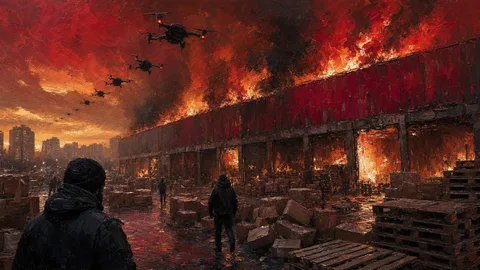
ANALYSIS: 800 drones over Russia in one night —…
More than eight hundred drones, in a single night, August 14…
By Maxime Marquette, columnist
Columnist's transparency note
My sources and my limits
This article is based on data reported by the Kyiv Independent, NewsUkraine RBC, India Today, and the ISW assessment for June 30, 2026. I was not in Ukraine. I have no direct field contacts. All figures used — 154 drones, 138 intercepted, 13 dead, 109 wounded — come from official Ukrainian sources as relayed by these outlets.
I acknowledge that official tallies in the first hours of a conflict can evolve. Final figures may differ slightly. But the overall direction — a night of mass strikes with significant civilian casualties — is factually established and corroborated by several independent sources.
My declared biases
I am pro-Ukraine, convinced that Volodymyr Zelensky represents the side of law against Russian aggression. My analysis of the Russian terror doctrine reflects this conviction. It is, however, based on documented facts, not assumptions. I believe Western democracies have a moral and strategic responsibility to help Ukraine defend itself. This bias is assumed and declared.
My method: read primary sources, cross-reference information, never fabricate testimony, never attribute quotes I cannot verify. When I do not know, I say so. This text contains no false testimony, no fabrication, no unsubstantiated hyperbole.
Sources
Primary sources
Secondary sources
Get the geopolitics analyses
Conflicts, powers, alliances: the MadMax thread without the noise.
Cite this article
Maxime Marquette (2026). TESTIMONY: 13 dead, 109 wounded in one night — the Russian terror of June 30 recounted. MadMax. https://mad-max.co/en/article/temoignage-13-morts-109-blesses-en-une-nuit-la-terreur-russe-du-30-juin-racontee
Read next
INVESTIGATION: Beijing cuts Africa to 2.1 billion in loans…
2.1 billion — the lowest figure in almost twenty years, according…
SPECIAL REPORT: Beijing Promises Stimulus as Its Households Give…
That is the growth rate of Chinese industrial output in July,…
INVESTIGATION: Two Chinese Ex-Soldiers Arrested in Seoul as 18,000…
For five years, a man ran a military-supply shop at the…
Enjoyed this piece? Get the next one.
One chronicle a week, straight to your inbox. No noise.
This article was generated with AI assistance, under human supervision.
Comments
Be the first to weigh in.