

NARRATIVE: The Night a Russian Geran-2 Drone Set the Kyiv Monastery of the Caves on Fire
In the night of June 14 to 15, 2026, Russia launched against Ukraine one of the most massive attacks of the year: 70 missiles and 611 drones converged on Kyiv, Dnipro, and Kharkiv. Among the victims of this terror strike: the Kyiv-Pechersk Lavra Monastery of the Caves, a monastery founded in 1051, inscribed on the UNESCO World Heritage List.
- In the night of June 14 to 15, 2026, Russia launched against Ukraine one of the most massive attacks of the year: 70 missiles and 611 drones converged on Kyiv, Dnipro, and Kharkiv. Among the victims of this terror strike: the Kyiv-Pechersk Lavra Monastery of the Caves, a monastery founded in 1051, inscribed on the UNESCO World Heritage List.
- NARRATIVE: The Night a Russian Geran-2 Drone Set the Kyiv Monastery of the Caves on Fire
- Introduction: A Millennial Site in the Crosshairs
Facts, quotes, and cited links remain in the body. Interpretations are framed as analysis or opinion according to the format.
NARRATIVE: The Night a Russian Geran-2 Drone Set the Kyiv Monastery of the Caves on Fire
Introduction: A Millennial Site in the Crosshairs
The night of June 14 to 15, 2026
In the night of June 14 to 15, 2026, Russia launched against Ukraine one of the most massive attacks of the year: 70 missiles and 611 drones converged on Kyiv, Dnipro, and Kharkiv. Among the victims of this terror strike: the Kyiv-Pechersk Lavra Monastery of the Caves, a monastery founded in 1051, inscribed on the UNESCO World Heritage List.
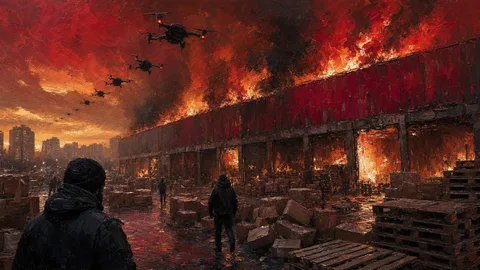
A Russian Geran-2 drone struck the complex directly. The Dormition Cathedral was hit. A fire broke out. Firefighters intervened to prevent the flames from spreading. Deputy Prime Minister for Humanitarian Policies, Tetyana Berezhna, was among the first to confirm the damage and coordinate the emergency evacuation of sacred relics.
What the Lavra represents
The Kyiv Monastery of the Caves is not simply a religious monument. It is one of the oldest and most significant spiritual sites in the entire Slavic Orthodox world. Founded in the 11th century, carved into the hills above the Dnipro, it houses underground crypts, medieval frescoes, sacred icons, and a monastic community that has survived invasions, wars, and totalitarian regimes.
The destruction of this site is not only a crime against Ukraine. It is a crime against all of humanity, as Tetyana Berezhna reminded the world the day after the strike: "When the Lavra is attacked, it is not only Ukraine that is targeted. It is the heritage that belongs to all of humanity." UNESCO condemned the attack, joining the roster of international bodies documenting the systematic cultural destruction carried out by Moscow.
The Attack of June 14–15: A Machinery of Terror
70 missiles, 611 drones: the doctrine of shock
The June 14–15, 2026 strike is the second in June to mobilize 70 missiles or more. Among the weapons deployed: 6 Zirkon hypersonic missiles, 34 Iskander-M ballistic missiles, 30 Iskander-K/Kh-101 cruise missiles, and a wave of 611 Shahed, Gerbera, and Italmas drones, supplemented by Parodiya decoy drones to saturate defenses.
Ukraine managed to intercept a significant share of this wave: 5 Zirkons, 15 Iskander-Ms, 30 cruise missiles, and 582 drones were shot down. But the calculus of mass strikes is brutal: even with a high interception rate, what gets through is enough to cause carnage. On the evening of June 15, Zelensky reported 11 dead and 53 wounded across Ukraine, including 5 killed and 35 wounded in Kyiv alone.
Russian tactics are evolving
Ukrainian air force spokesman Colonel Yuriy Ihnat noted a tactical change: Russia did not use Kalibr missiles that night, opting instead for Iskander-K. The drones flew at low altitude, with jet-propelled units that are faster and harder to intercept. The strikes converged from multiple directions, forcing Ukrainian defenses to cover several axes simultaneously.
This growing sophistication is a worrying signal. Russia adapts its strike doctrine as Ukrainian defenses improve. It is a permanent technological race, and Kyiv continuously needs new systems to maintain its protective capacity. The 140,000 Kyiv households without electricity after the June 15 strike are the consequence of this never-finished race.
The Emergency Evacuation: Saving Relics from the Flames
The monastic brotherhood on the front line
Hours after the strike, Bishop Avraamii announced on social media that an emergency evacuation of sacred relics and liturgical objects had been organized immediately. Ancient icons, antimensia, and other precious objects were secured thanks to the coordinated actions of the monastic brotherhood, rescue teams, and firefighters.
This emergency operation — conducted in the dark, under the threat of additional strikes — illustrates a reality that outside observers sometimes forget: in Ukraine, war is not abstract. It happens a few meters from people, at night, with the sound of explosions in the background. Saving an 11th-century icon while a drone burns the cathedral roof: that is the heroic daily life of thousands of ordinary Ukrainians for more than four years.
The Dormition Cathedral: 80% of the roof damaged
Initial assessments established that more than 80% of the Dormition Cathedral roof had been damaged. Preliminary estimates speak of two years of restoration work. This is a cathedral that has already survived destruction: it was dynamited by Soviet troops in 1941 during the Red Army's retreat. It was rebuilt. It will be rebuilt again.
The Monastery of the Caves is listed as a site benefiting from enhanced protection under the Second Protocol to the 1954 Hague Convention on the protection of cultural property in armed conflict. This international legal protection did not deter Moscow. It has never deterred Moscow.
Russian Disinformation: Deny, Invert, Accuse
The Patriot maneuver: Moscow reverses responsibility
In the hours following the strike, Russia's Defense Ministry declared that confirmed reports would indicate that a Ukrainian Patriot interceptor missile had struck the Monastery of the Caves. Foreign Ministry spokeswoman Maria Zakharova amplified this narrative: the West was fabricating accusations against Russia, the damage was caused by Ukraine itself.
This disinformation strategy is well-practiced and systematic. The presence of interceptor missile fragments at struck sites — a normal phenomenon during any interception — is exploited to muddy responsibility. Ukraine's Center for Countering Disinformation documented a large-scale disinformation campaign claiming that cultural sites are military targets or that Ukrainian forces are responsible for the destruction.
The Ukrainian investigation: a Geran-2 drone identified
Colonel Yuriy Ihnat firmly denied the Russian version: Ukrainian investigations established that it was a Russian Geran-2 drone — the Russian version of the Iranian Shahed-136 drone — that struck the Monastery of the Caves directly. Debris found on site, trajectory data from defense systems, and surveillance imagery confirm this conclusion.
This is not the first time Russia has attempted to shift responsibility for cultural destruction onto Ukraine or its allies. It is a pattern repeated since the beginning of the war: strike a hospital, deny, accuse Ukraine of bombing itself. Strike a marketplace, deny, accuse Ukraine. Strike a UNESCO site, deny, accuse Ukraine. The consistency of the pattern is itself evidence.
Zelensky at the G7 in Évian: The Photos Worth a Thousand Words
Images of the Lavra on Trump's table
Two days after the strike, at the G7 summit in Évian, France, President Zelensky met Donald Trump for a meeting of approximately 30 minutes, with French President Emmanuel Macron present. According to available information, Zelensky showed Trump photos of the damaged Monastery of the Caves, using concrete images of the destruction to remind the American president of the daily reality of the Russian war.
This image diplomacy is a deliberate strategy. Facing an interlocutor like Trump — who responds to the concrete, the visual, the spectacular — Zelensky chooses to show rather than argue abstractly. The photos of smoke columns above the Lavra rooftops, the icons saved under emergency conditions, the firefighters on devastated roofs: that is the dossier the Ukrainian president brought to Évian.
The G7 outcomes for Ukraine
The meeting produced concrete commitments: Zelensky indicated that air defense support had been agreed by all G7 members. He also discussed with Trump the possibility for Ukraine to acquire American licenses to produce anti-ballistic systems and missiles. Trump appeared receptive, without making a formal commitment.
In parallel, British Prime Minister Keir Starmer committed ahead of the meeting to provide Ukraine with enriched uranium to fuel its nuclear power plants for two years. Canadian Prime Minister Mark Carney announced new sanctions against 162 Russian individuals, entities, and vessels. A G7 united, even imperfectly, remains a G7 resisting Russian pressure.
On the same topic
ANALYSIS: 800 drones over Russia in one night —…
More than eight hundred drones, in a single night, August 14…

COLUMN : Europe Moved 8.5 Billion Euros in a…
That is what the European Commission says it has disbursed for…

INVESTIGATION: 36 States Sign in Chișinău — and the…
Thirty-four members of the Council of Europe, plus Australia, plus Costa…
UNESCO and the Protection of Heritage in a War Zone
The condemnation and its limits
UNESCO condemned the strike on the Monastery of the Caves and the adjacent monastery buildings, including Saint Sophia Cathedral, which also sustained damage. This condemnation is documented, formal, and… symbolic. UNESCO has no army, no autonomous sanctions, no coercive mechanism to prevent a permanent member of the UN Security Council from bombing the sites it is supposed to protect.
This is one of the most painful contradictions in international legal architecture: the conventions that protect cultural heritage in wartime are signed, ratified, invoked — and violated with near-total impunity when the perpetrator holds a veto on the Security Council. Russia is a permanent member. Russia bombs UNESCO sites. The Security Council cannot decide anything.
The 1954 Hague Convention: an unfulfilled promise
The 1954 Hague Convention and its 1999 Second Protocol establish a framework of enhanced protection for exceptional cultural sites. The Monastery of the Caves benefited from this protection. That did not prevent the Geran-2 from reaching its target.
Some legal scholars argue that intentional destruction of cultural heritage should systematically be prosecuted as war crimes before the International Criminal Court. Files are being built. But an ICC conviction takes years, and the sites burn now. International law is sometimes tragically lagging behind the urgency of facts.
The History of the Lavra: Surviving Everything
A thousand years of resilience
The Kyiv Monastery of the Caves survived the Mongols in the 13th century. It endured Lithuanian, Polish, and Cossack occupation. It withstood Soviet repression that tried to close it, transform it into an atheist museum, and erase its sacred character. In 1941, retreating Soviet troops dynamited the main church — it was rebuilt after the war.
This millennial resilience is not a political metaphor — it is a historical reality. The Lavra has seen invaders more powerful than Putin try to extinguish it, and it still shines. The fact that monks ran through the night of June 15 to save icons from the flames is not an exception — it is the continuation of a preservation instinct embedded in the very identity of the place.
The Lavra as a symbol of Ukrainian identity
To understand why Putin targets this site, one must understand what it represents in the cultural war Russia is waging against Ukraine. Moscow has long claimed the Monastery of the Caves was a high place of Russian, not Ukrainian, civilization — an argument used to deny the existence of a distinct Ukrainian identity.
By bombing it, Russia sends an ambivalent message: either it seeks to destroy what it can no longer claim, or it wants to break Ukrainian morale by attacking what Ukrainians hold most precious. Both logics overlap. And both reveal the same thing: a regime that cannot win militarily and therefore seeks to win culturally.
The Russian Camp: A Propaganda Running Out of Breath
The exhaustion of disinformation
The Russian disinformation — Ukrainian Patriot, staged event, military targets — was immediately refuted by Ukrainian investigations and documented by the Center for Countering Disinformation. But beyond the technical rebuttal, there is a broader phenomenon: the erosion of Russian credibility internationally.
After four years of false excuses, refuted denials, and inverted narratives, a growing share of world opinion has stopped giving Moscow the benefit of the doubt. Even media outlets attempting neutrality find it increasingly difficult to present both versions as equivalent when one is supported by technical investigations and the other by the propaganda of a state at war.
Russia's international isolation deepens
The strike on a UNESCO site added another layer to Russia's international isolation. States that had hesitated to take a position reacted to the destruction of the Lavra with unusual severity. The argument of humanity's common heritage touches something where cold geopolitics does not — something resembling collective conscience.
This is not a diplomatic revolution. China will not change its position. India will continue buying Russian oil. But at the margins, every documented cultural crime further restricts Moscow's diplomatic space and strengthens the coalitions supporting Ukraine. In a long war, these margins matter.
Ukraine After the Strike: Rebuilding Under Fire
Repair, resist, continue
By June 16, Ukrainian technical teams had begun assessing the damage to the Monastery of the Caves. Restoration estimates — approximately two years of work — were made public quickly, in part to demonstrate Ukraine's capacity to respond and plan even under fire.
This organized response reflects a lesser-known reality: Ukraine has developed, since 2022, an emergency heritage restoration doctrine that enables securing damaged sites, protecting what can be protected, and initiating repairs as quickly as possible. Thousands of volunteers, restorers, and government agents work in coordination so that every site struck is documented, assessed, and treated.
International solidarity for Ukrainian heritage
International funds for the protection of cultural heritage have increased their commitments toward Ukraine since 2022. UNESCO, the Council of Europe, various private foundations, and international museums participate in documentation, reproduction, and collection security efforts. Works have been moved to safe locations abroad.
This global mobilization around Ukrainian heritage serves a dual function: preserving the tangible — objects, archives, structures — and keeping alive the symbolic presence of Ukraine in international consciousness. Every museum exhibiting a Ukrainian icon brought to safety is an act of cultural resistance that crosses borders.
The June 15 Strike in the Context of the Cultural War
A pattern of systematic destruction
The Monastery of the Caves is not an isolated case. Since the beginning of the full-scale invasion in 2022, hundreds of Ukrainian cultural sites have been damaged or destroyed: museums, libraries, theaters, historical monuments, churches. The ISW and other documentation organizations have compiled exhaustive inventories of these destructions.
The same night of June 14–15, the Dnipro House of Organ and Chamber Music and the Kharkiv Art Museum also sustained damage. This is not a coincidence. Russia strikes Ukrainian cities in full knowledge that its missiles and drones will reach cultural facilities. It is a strategy, not an accident.
Discover

INVESTIGATION: Beijing cuts Africa to 2.1 billion in loans…
2.1 billion — the lowest figure in almost twenty years, according…

SPECIAL REPORT: Beijing Promises Stimulus as Its Households Give…
That is the growth rate of Chinese industrial output in July,…

INVESTIGATION: Two Chinese Ex-Soldiers Arrested in Seoul as 18,000…
For five years, a man ran a military-supply shop at the…
The Dovzhenko studio: another cultural loss
The same night, the Dovzhenko Film Studios in Kyiv were also struck. Alexander Dovzhenko is one of the founding fathers of Ukrainian cinema, a director whose works influenced the entire global film world in the 20th century. His studio — still active, still productive — was struck by the same missiles that burned the Lavra roof.
These two sites — the millennial monastery and the century-old studio — illustrate the breadth of what Russia seeks to destroy: not only military or industrial infrastructure, but the cultural soul of a nation. Burning the Lavra and the Dovzhenko studio in the same night means targeting simultaneously the spiritual past and the creative present of Ukraine. That is calculated barbarism.
Ukrainian Defenses: How Long Can They Hold?
An extraordinary interception rate, but not enough
Shooting down 582 drones out of 611, a rate exceeding 95%, is a remarkable performance. Destroying 5 Zirkons out of 6 — hypersonic missiles that many believed indestructible — demonstrates the rising capability of Ukrainian defenses. F-16s participated, for the first time in operations of this type, in intercepting high-altitude targets.
But the saturation calculus is relentless: even 5% getting through a wave of 611 drones means roughly thirty real strikes. And among those thirty, there was the Monastery of the Caves. There were the 11 dead. There were the 140,000 households without electricity. A 95% interception rate is extraordinary — and not sufficient to prevent all war crimes.
What Zelensky was asking Trump for at Évian
It is in this context that what Zelensky asked Trump at the G7 takes on its full meaning: licenses to produce American anti-ballistic systems in Ukraine. These systems are the only ones capable of effectively countering hypersonic Zirkons, Iskander-Ms, and the ballistic missiles that constitute the most lethal threat.
If Ukraine could produce some of these systems itself — with American licenses and its own industries — it would gain in strategic autonomy and production capacity. Trump appeared "receptive," according to Zelensky. That "receptive" could be the difference between a Lavra rebuilt and a Lavra burned again in two years.
What the World Must Remember
The Lavra as a test of the international response
The strike on the Kyiv Monastery of the Caves is a test of the international response to cultural destruction in wartime. Is a UNESCO condemnation sufficient? Are restoration funds enough? Or is the only response that truly matters the one that prevents the next strike — meaning more robust air defenses, delivered more quickly?
The honest answer is that both are necessary: the moral condemnation and the material response. Condemning without acting is moralism. Acting without condemning is blind pragmatism. It is together — words and weapons — that one holds the line against a regime that burns both people and their memories.
Ukraine keeps holding
Four years after the beginning of the full-scale invasion, despite the strikes, despite the destruction, despite the millennia burned in the night of June 15, Ukraine holds. Its soldiers defend Kostiantynivka, its missiles reach Volgograd, its diplomats work the G7, and its monks run to save icons in burning cathedrals.
This is not a war an ordinary nation could sustain. It is a war that only a people who deeply understand what they are defending can wage. And the Kyiv Monastery of the Caves — with its millennial crypts, its frescoes, its icons saved in the night — is precisely the symbol of what Ukraine is fighting for.
The Horizon: Reconstruction and Justice
Two years to repair the cathedral, decades for justice
The two years of restoration announced for the Dormition Cathedral are a technical horizon. The legal horizon is different: prosecutions for war crimes, international reparations, the accountability of commanders who ordered strikes on protected sites — all of that will be measured in decades, if it ever happens at all.
The International Criminal Court has issued arrest warrants concerning Ukraine. The documentation work continues. The file on cultural destruction is being built, piece by piece, strike by strike, Lavra by Lavra. History is made slowly, but it is made.
What the future demands
What the strike on the Monastery of the Caves demands of the future is simple and difficult at once: that Russia be one day held accountable for the systematic destruction of Ukrainian cultural heritage. Not merely condemned diplomatically, not merely documented in UNESCO reports — but genuinely liable, financially and legally, before international institutions.
That day has not yet arrived. But every geolocated image, every identified Geran-2 fragment, every ISW report, every statement by Tetyana Berezhna contributes to building the dossier that will make that moment possible. The Monastery of the Caves burns. And the world must remember why.
Supplementary Analysis: Dimensions and Perspectives
The structural factors that are often overlooked
Any analysis of this situation benefits from integrating the structural dimensions operating in the background of immediate events. Long-term dynamics — economic, demographic, technological — shape the context in which political and military decisions are made. Ignoring these dimensions means analyzing the surface without understanding what lies beneath.
These structural factors are not theoretical abstractions — they translate into very concrete constraints for decision-makers. Defense industrial capacity, ammunition stocks, the availability of skilled human resources, the state of public finances: these are all material realities that determine the options actually available, regardless of stated intentions.
What the broader geopolitical context reveals
This situation fits into a geopolitical context broader than the war in Ukraine alone. The competition between great powers — between the West on one side, Russia, China, Iran, and their allies on the other — fundamentally structures the dynamics at play. Understanding this background is indispensable for assessing the real stakes.
Decisions that appear tactical on the surface are often strategic in depth. What is being decided today in Western capitals, on Ukrainian battlefields, and in negotiating rooms concerns not only Ukraine — it concerns the global security architecture that will emerge from this period of turbulence.
Conclusion: Kyiv Burns, Kyiv Holds
Fire as weapon and as symbol
The fire that ravaged the roof of the Dormition Cathedral of the Kyiv Monastery of the Caves in the night of June 15, 2026, is not a war accident. It is the sign of a will — that of a regime that cannot win militarily and therefore seeks to win spiritually, by burning what a people holds most precious. That strategy failed at Stalingrad in 1943. It is failing in Kyiv in 2026.
Ukraine rebuilds. Ukraine strikes Volgograd with its Flamingo missiles. Ukraine sends its president to the G7 with photos of the ruins to remind the world of what is really happening. And the Monastery of the Caves — which survived the Mongols, the Soviets, the Nazis — will survive Vladimir Putin.
What this demands of us
This narrative ends here, but the war continues. What the strike on the Monastery of the Caves demands of the West is not to let itself be numbed by the accumulation of horrors. Every strike is different. Every destruction is unique and irreplaceable. Remaining attentive, remaining outraged, remaining in solidarity: that is not merely a moral posture — it is a strategic necessity so that Ukraine is not left alone facing the barbarism of a regime that burns its cathedrals.
By Maxime Marquette, columnist
Columnist's transparency note
Editorial positioning
This narrative draws on ISW reports of June 15–16, 2026, the RBC Ukraine article, EA World View coverage of the G7 in Évian, and the public statements of Tetyana Berezhna, Bishop Avraamii, and Colonel Yuriy Ihnat. I am pro-Ukraine and regard any deliberate or negligent attack on protected UNESCO sites as a war crime. No invented witnesses, no reconstructed scenes.
Limits
The full extent of the damage to the Monastery of the Caves had not been finally established at the time of publication of these sources. The precise details of the exact dialogue between Zelensky and Trump at the G7 have not been publicly confirmed. This analysis is based on open-source information available as of June 15–17, 2026, and the general context of the June session.
Sources
Primary sources
Secondary sources
Get the geopolitics analyses
Conflicts, powers, alliances: the MadMax thread without the noise.
Cite this article
Maxime Marquette (2026). NARRATIVE: The Night a Russian Geran-2 Drone Set the Kyiv Monastery of the Caves on Fire. MadMax. https://mad-max.co/en/article/recit-la-nuit-ou-un-drone-russe-geran-2-a-mis-le-feu-a-la-laure-des-grottes-de-k
Read next
INVESTIGATION: Beijing cuts Africa to 2.1 billion in loans…
2.1 billion — the lowest figure in almost twenty years, according…
SPECIAL REPORT: Beijing Promises Stimulus as Its Households Give…
That is the growth rate of Chinese industrial output in July,…
INVESTIGATION: Two Chinese Ex-Soldiers Arrested in Seoul as 18,000…
For five years, a man ran a military-supply shop at the…
Enjoyed this piece? Get the next one.
One chronicle a week, straight to your inbox. No noise.
This article was generated with AI assistance, under human supervision.
Comments
Be the first to weigh in.