

ESSAY: Zelensky Tightens the Vise — the Ukrainian Sanctions Strangling Russia's War Machine
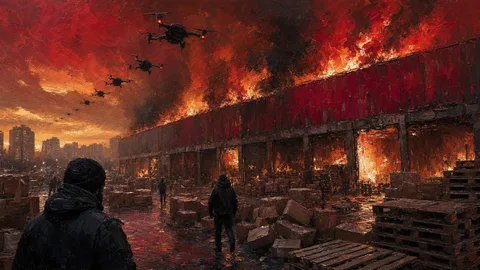
There is a war being waged without the sound of cannons. Without drone footage. Without columns of black smoke over refineries. It is the war of sanctions — and Volodymyr Zelensky is winning it with a clinical, relentless, terrifyingly effective method. At the end of March 2026, he signed two decrees from Ukraine's National Security and Defense Council (NSDC). First decree: 26
- There is a war being waged without the sound of cannons. Without drone footage. Without columns of black smoke over refineries. It is the war of sanctions — and Volodymyr Zelensky is winning it with a clinical, relentless, terrifyingly effective method. At the end of March 2026, he signed two decrees from Ukraine's National Security and Defense Council (NSDC). First decree: 26
- ESSAY: Zelensky Tightens the Vise — the Ukrainian Sanctions Strangling Russia's War Machine
- Introduction: The Silent Weapon That Inflicts More Damage Than Artillery
Facts, quotes, and cited links remain in the body. Interpretations are framed as analysis or opinion according to the format.
ESSAY: Zelensky Tightens the Vise — the Ukrainian Sanctions Strangling Russia's War Machine
Introduction: The Silent Weapon That Inflicts More Damage Than Artillery
A president who signs decrees the way others launch missiles
There is a war being waged without the sound of cannons. Without drone footage. Without columns of black smoke over refineries. It is the war of sanctions — and Volodymyr Zelensky is winning it with a clinical, relentless, terrifyingly effective method. At the end of March 2026, he signed two decrees from Ukraine's National Security and Defense Council (NSDC). First decree: 26 individuals and 31 legal entities targeted — manufacturers of drones, electronic warfare systems, armored vehicles, submarines, helicopters from the Mi-8, Mi-17, Mi-171, Mi-172, and Mi-14 families. Second decree: 7 individuals and 11 entities linked to sanctions evasion — including component suppliers for Kh-101, Kh-59M2/M2A, and Iskander-K missiles, as well as companies involved in the construction of the Crimea Bridge.
These figures seem dry. They are not. Behind each name on these lists, there is a company losing access to international markets, a supply chain unraveling, a Moscow engineer who can no longer order an STMicroelectronics chip to assemble the next Shahed. Vladyslav Vlasiuk, Ukraine's presidential commissioner for sanctions policy, summed up the doctrine in one sentence: "These sanctions strike at the heart of Russia's military-industrial complex — from weapons manufacturers to suppliers of critical components, through the networks enabling sanctions evasion."
The strategy behind the lists
This is not symbolism. This is not political communication to reassure allies. It is an architecture of systemic pressure built on a simple principle: Russia does not manufacture its own critical components. According to data compiled by Ukraine and its partners, 60% of critical components for the Russian defense industry come from China. The remaining 40% must be obtained through evasion circuits — which increases costs, lengthens delivery times, and degrades the quality of finished products. By precisely targeting these supply chains, Kyiv is not seeking to humiliate Putin — it is seeking to asphyxiate him.
In June 2026, a second wave of sanctions struck 67 individuals — including pseudo-ministers, judges, and parliamentarians from occupied territories — as well as one legal entity. Among them: Raisa Prylypko, a kindergarten director accused of helping deport Ukrainian children to Russia. And Soyuzmetalservis, a company supporting metallurgical operations in the occupied Donbas. These names tell something important: the net tightens around collaborators too, not just weapons engineers.
Russia's Military-Industrial Complex — a Fortress on Clay Feet
Drones, missiles, helicopters: the anatomy of a dependency
To understand why Ukrainian sanctions hurt, one must understand how Russia manufactures its weapons. This is not an autonomous, hermetic, self-sufficient industry. It is an assembly industry that depends, for its most sensitive components, on foreign suppliers. Geran-2 drones — the Russian version of the Iranian Shahed-136 — contain microprocessors from Texas Instruments, sensors from STMicroelectronics, components from Xilinx and NXP Semiconductors. Parts manufactured in Switzerland, Germany, Japan, the United States, Taiwan, and the United Kingdom — some with 2025 production dates, therefore after sanctions were imposed. Vlasiuk confirmed this at a presentation to European ambassadors in May 2026: the drones that struck Ukraine the previous week contained brand-new parts fresh from 2025.
This is the central paradox: sanctions exist. They are numerous. They are coordinated among the EU, the United States, the United Kingdom, Canada, and Japan. And yet the parts keep arriving. How? Through sophisticated evasion networks — via intermediaries in the United Arab Emirates, Kazakhstan, Turkey, Armenia. The NSDC decrees target precisely these nodes: the shell companies, traders, fake exporters who transform a paper sanction into an actual delivery to the arms factory.
Missile manufacturers in the crosshairs
The second decree signed in March 2026 introduced something particularly significant: sanctions against component suppliers for Kh-101 missiles — the long-range cruise missile that Russia fires at Ukrainian cities — and for the Iskander-K, the cruise variant of the ballistic system that regularly strikes Kharkiv and Zaporizhzhia. Striking these supply chains means striking directly at Moscow's capacity to sustain its air terror campaigns over the medium and long term. Missiles are complex. They require precision components. And Russia cannot improvise with low-quality Chinese parts — not for terminal guidance systems, not for seeker heads.
North Korea delivers artillery shells; Iran supplies cheap drones. But for precision weapons — the ones that truly frighten, the ones that target bridges, hospitals, command centers — Russia remains dependent on Western technologies. This dependency is what Ukrainian sanctions seek to erode, methodically, decree by decree. Since the start of 2026, Ukraine has synchronized 13 sanction packages with its partners — the United Kingdom, Canada, the United States, Japan, and the European Union.
Vlasiuk — the Quiet Architect of Economic Warfare
One man, one mission: shut off the supply lines
Vladyslav Vlasiuk is not a general. He does not command tanks. He does not pilot a drone. But in the war Ukraine is waging, his role may be as decisive as that of an army corps commander. Presidential commissioner for sanctions policy since the beginning of the full-scale invasion, he is the discreet architect of an economic strangulation strategy that is beginning to produce measurable effects. Zelensky said so himself in May 2025: starting from summer 2026, the Russian economy will begin to feel strongly the cumulative impact of already-imposed sanctions. Reserves will no longer grow — they will shrink. And they will keep shrinking.
What Vlasiuk does concretely is map the supply chains. When a Russian drone is shot down over Kyiv, his teams analyze its components — every chip, every circuit board, every sensor. They identify the manufacturer, the distributor, the intermediary reseller. They transmit the information to partners. They propose names to add to sanction lists. It is painstaking work, systematic, unglamorous. And it works. Concrete proof: Vlasiuk noted that Russian drones now contain practically zero components coming from the Netherlands — the result of targeted work with Dutch authorities. One channel closed. Another to close.
Long-range sanctions — an evolving doctrine
But Vlasiuk introduced something even bolder into the Ukrainian lexicon: "long-range sanctions." This term, initially used by Zelensky to designate drone strikes on Russian refineries, took on a double meaning. The physical strike AND the economic sanction are both instruments of the same strategy: reducing the resources that Russia devotes to its war machine. In the night of June 27 to 28, 2026, two Russian refineries were struck — the Slavyansk refinery in Krasnodar Krai and a refinery in Yaroslavl Oblast, 700 km from the Ukrainian border. Zelensky commented: "Each of our long-range sanctions means fewer resources for the Russian war machine, and one more step toward peace."
The economic "long-range sanctions" target the oil and gas sectors. In November 2025, Decree No. 870/2025 imposed sanctions on 26 Russian legal entities in the energy sector — including Rosneft, its subsidiaries, and companies from the Lukoil group. These entities are responsible for 55% of Russian oil production. Targeting them legally sends a signal to banks, insurers, and maritime transporters: every transaction with these entities carries a risk of secondary sanctions. Russia exports its oil less easily. It earns less money. It has less to finance the war.
International Synchronization — the Collective Weapon
Ukraine does not sanction alone
The strength of the Ukrainian strategy lies in its collective dimension. Ukraine does not impose sanctions in a vacuum — it synchronizes them with its partners. Since the start of 2026, thirteen packages have been aligned with the United States, the United Kingdom, Canada, Japan, and the European Union. The decree of May 30, 2026 (Decrees No. 447/2026 and No. 448/2026) synchronized sanctions with the EU's 20th package — adding 16 Russian citizens and 31 companies from Russia, Belarus, the United Arab Emirates, Kyrgyzstan, Kazakhstan, Uzbekistan, and occupied territories. Among them: Atlant Aero LLC, an aerospace and drone component manufacturer, and Irz-Svyaz LLC, a manufacturer of communications components, UAVs, and missiles.
This synchronization has immense practical value. When Ukraine sanctions a company, it can still trade with third countries. When the EU sanctions it, access to the European market — and the euro — is cut off. When the United States does the same, access to the dollar and the international banking system is severely compromised. Together, these sanctions create a near-hermetic financial cage. In July 2025, a coordinated wave of sanctions targeted 45 Russian nationals and 50 companies linked to the military-industrial complex — all aligned with the 18 European packages then in force.
The 21st package in preparation
The machine does not stop. Vlasiuk confirmed in May 2026: his team is already finalizing joint work on the next EU's 21st sanction package. The priorities? More pressure on Russian banks. The definitive dismantling of sanctions evasion via cryptocurrencies and stablecoins — an infrastructure that Russia has set up for transactions estimated at several billion dollars. And a reinforcement of measures against the Russian shadow fleet — the tankers that transport sanctioned oil under flags of convenience.
China poses a particular challenge. Kyiv has sanctioned several Chinese companies since 2025 — including Ningbo BLIN Machinery and Suzhou ECOD Precision Manufacturing, found in the debris of Russian drones shot down in July 2025. But Beijing continues to supply Moscow with dual-use goods. China now represents the primary source of Russian critical components — up to 60% of the total. As long as this dependency persists, Western and Ukrainian sanctions will have to compensate. This is a race between closing circuits and their creative reopening.
Collaborators Under Fire — a Often-Forgotten Dimension
Pseudo-ministers and kindergarten directors
Ukrainian sanctions do not only target engineers and industrialists. They also target — and increasingly so — civilian collaborators in occupied territories. The June 2026 decree targeting 67 individuals is revealing of this evolution. Raisa Prylypko, a kindergarten director in the occupied territories of Donetsk, is now sanctioned for helping in the illegal abduction and transfer of Ukrainian children to Russia. This may be the most mundane name on all Ukrainian sanction lists. And yet it is also symbolically one of the most important.
Ivan Dotsenko, director of the agricultural company MIR, also sanctioned — allegedly encouraging farmers in Kherson Oblast to serve Russia. Soyuzmetalservis, supporting metallurgical operations in the occupied Donbas. These names say something essential: collaboration is a crime, whether armed or administrative. And Ukraine is building a file on each of these individuals — a file that will also serve in the international judicial proceedings that will inevitably follow.
The message to potential collaborators
Vlasiuk was clear on this point in his June 2026 communiqué: "Anyone who helps Russia wage war against Ukraine — whether on the battlefield, in the offices of occupation administrations, or in the media — should prepare for new sanctions. The pressure on these individuals will keep increasing, both on our side and on that of our partners." This is a deterrent message as much as a punitive one. For those still hesitating in the grey cities of eastern Ukraine, between resistance and compromise, these words have concrete resonance: to collaborate is to condemn oneself to international financial isolation. To see one's name appear in a database shared with Washington, Brussels, and London.
There is a logic of moral territory in this approach. Ukraine cannot, militarily, control all occupied territories. But it can build a regime of accountability that will apply on the day of liberation — and that already applies in international financial systems. This is a form of projected sovereignty, exercised through the instruments of international law in the physical spaces it does not yet control.
Technology Smuggling — the Other Front
Chips that cross seven borders to end up in a missile
How does a chip manufactured in Austin, Texas end up in a Russian missile striking Kharkiv? The answer is one word: evasion. Russia has built, since 2022, a remarkably sophisticated logistical network for importing the components it needs despite sanctions. The typical path: a wholesaler in Dubai buys semiconductors from an authorized distributor, resells them to a shell company in Kazakhstan, which sells them to another company in Belarus, which ultimately delivers them to a drone factory in Yelabuga or Alabuga. Each step appears legal. The whole is not.
It is precisely to cut these circuits that the Ukrainian decrees target entities located in the United Arab Emirates, Kyrgyzstan, Kazakhstan, and Uzbekistan. These countries are not enemies of Ukraine — but some of their companies play an active role in sanctions evasion. By putting pressure on them, through synchronization with European and American lists, Ukraine and its allies send a message to these governments: turn a blind eye and you will yourself become a target of international financial restrictions.
The activation of the "Transit Brd" unit — a new alarm signal
In May 2026, Vlasiuk flagged a new and troubling fact: for the first time, Russian drones shot down over Ukraine contained an element never seen before — an activation unit labeled "Transit Brd." This component represents an evolution in the architecture of Russian drones, likely designed to circumvent certain detection or jamming protocols. Its presence in the wreckage of a drone that had just penetrated Ukrainian defenses confirms that Russia is not merely importing existing parts — it is adapting, modifying, innovating, drawing on its capacity to procure fresh components despite sanctions. All data have been transmitted to partners, said Vlasiuk. But the challenge is accelerating.
The race is on: Ukraine and its allies close supply circuits. Russia opens new ones. The ability to close these circuits faster than they reopen will determine, in part, the outcome of the war. And in this invisible space — banking networks, customs blacklists, compliance alerts for European exporters — Ukraine wages a battle as decisive as the one being fought in the streets of Kostyantynivka.
The Economic Impact — What the Numbers Say
$7 billion in losses — and counting
Vlasiuk put forward a figure in May 2026: Ukrainian long-range sanctions have already cost Russia at least $7 billion in losses. This figure deserves context. Russia's war budget for 2026 is estimated at more than 40% of the federal budget. The Russian economy is under structural pressure — high inflation, benchmark interest rates at record levels, dwindling reserves. Western sanctions have already altered the behavior of many foreign banks, even those not legally required to comply. The fear of secondary sanctions is a powerful regulator of global financial behavior.
Zelensky predicted it in May 2025: starting from summer 2026, Russia would begin to feel strongly the cumulative impact of already-imposed sanctions. June 2026 is here. We have arrived. The Russian economy has not collapsed — but it is in the process of transforming into a total war economy, unable to grow, unable to invest in anything other than tanks and drones. This is an incomplete victory. But it is a victory.
Refineries — the nerve of war
Ukrainian strikes on Russian refineries add a physical dimension to the economic war. The Kapotnya refinery in Moscow — put out of service until 2027 after two strikes in June 2026, covering 40% of Moscow's fuel needs and processing 11 million tonnes per year. The Slavyansk refinery in Krasnodar — struck in the night of June 27 to 28, 2026. The one in Yaroslavl — 700 km from the border, struck in the same night. These strikes are not isolated military exploits. They are part of the same logic: reducing the resources that Russia can mobilize to finance and fuel its war.
The combination of legal sanctions and physical strikes creates dual pressure on the Russian energy sector — which represents, according to estimates, between 40 and 50% of Moscow's federal budget revenues. Reducing these revenues means reducing Putin's capacity to pay his soldiers, finance his missiles, buy the complaisance of elites. This is the strategy in its totality. And it is applied with remarkable coherence.
The Judicial Dimension — Building the Case for Tomorrow
Sanction lists as archives of guilt
There is a less often discussed dimension of Ukrainian sanctions: their archival value. Each individual listed, each entity targeted, represents a file built — with evidence, sources, documentary chains. These files do not only serve to freeze bank accounts today. They serve to document crimes for the international judicial proceedings of tomorrow. The International Criminal Court, the special tribunals created or being created to judge Russian aggression, will need solid evidence. Ukrainian sanction lists are part of this evidentiary architecture.
Vlasiuk said so explicitly: "Ukraine will provide all relevant information to its partners to support efforts to align sanctions in different international jurisdictions." This is not merely administrative cooperation. It is the construction of a network of national and international legal actors who share the same databases, the same evidence, the same lists. When Putin loses, the foundations of the judgment will already be in place.
Individual accountability as principle
The decision to target individuals — not just companies — is philosophically important. It affirms the principle of individual accountability that has been at the heart of international criminal law since Nuremberg. An engineer who designs a drone component knowing it will be used to strike Ukrainian civilians is complicit. A kindergarten director who facilitates the deportation of children is a criminal. A judge who issues politically motivated rulings in an occupied territory is an agent of oppression. By naming them, by sanctioning them, Ukraine refuses the depersonalization of crime. It says: these are people who made choices. And these choices will have consequences.
This is a strong moral position, and it is correct. It contrasts with the tendency in some Western chancelleries to treat Russia as an abstract monolith — "the Russian people" or "the Russian regime" — without distinguishing those who passively obey from those who actively participate. Ukraine makes that distinction. And it documents it.
China in the Crosshairs — the Battle to Come
The great supplier that still escapes sanctions
The great unresolved problem of anti-Russian sanctions is China. Beijing supplies Moscow with the bulk of the critical components its defense industry needs — we are talking about 60% of the total. But unlike European or American companies that supply their components through civilian circuits and resellers, Chinese companies often do so with clear knowledge of the final destination. Zelensky said so in May 2025: Beijing blocked the sale of drones to Ukraine while continuing to supply them to Russia. This is not naivety. It is a strategic choice.
Ukraine responded by sanctioning several Chinese companies directly: Ningbo BLIN Machinery, Suzhou ECOD Precision Manufacturing, Shenzhen Royo Technology, Shenzhen Jinduobang Technology, and others. These sanctions have no direct value since these companies have no assets in Ukraine. But they send a signal to Western partners: here are the names, here is the evidence, here are the chains. Your turn to act. And increasingly, some partners are acting — notably the United States and the European Union, which have begun imposing restrictions on Chinese exporters supplying dual-use goods to Russia.
Beijing's impossible equation
China is playing a dangerous game. It wants Russia maintained as a counterweight to American power. It does not want to see Moscow militarily collapse. But it also does not want to face massive secondary sanctions that would weaken its economy and its exports to Western markets. This calculation constrains it to maintain support for Russia below a certain threshold of visibility. This threshold recedes as the documented evidence — like that which Vlasiuk regularly presents to ambassadors — accumulates.
International pressure on China is real but insufficient. The next great diplomatic battle of this war will be fought on this front: how far are Western democracies prepared to go in their confrontation with Beijing to cut the last technological lifeline of the Russian war machine? This is not a question that Zelensky alone can answer. It is a question for Washington, Brussels, and Tokyo.
The Crimea Bridge — Symbol and Target
Sanctioning the builders of a violation of international law
The second decree signed in March 2026 targets among other things companies involved in the construction of the Crimea Bridge — the infrastructure that Putin built to physically connect Russia to an illegally annexed Ukrainian peninsula since 2014. The bridge is both a political symbol — Putin personally inaugurated it behind the wheel of a truck — and an essential military infrastructure, used to channel troops and equipment toward Crimea and the southern front.
Sanctioning it is not solely a matter of military logistics. It is a legal affirmation: this bridge was built in violation of international law, on occupied Ukrainian territory, by companies that knew what they were doing. By targeting them, Ukraine sets a marker for the post-war period: infrastructure built on illegally occupied territories is not legitimate, and those who built it know it and bear the responsibility. This is the doctrine of non-recognition carried to its logical conclusion.
Physical strikes and legal pressure — the vise
The Crimea Bridge was already struck twice by Ukrainian missiles in 2022 and 2023, causing significant damage and disrupting its operation. Since then, Russia has reinforced its defenses around the bridge. Sanctions against the participating construction companies constitute another front: they make it more difficult and expensive for Russia to repair and maintain this infrastructure, by targeting the suppliers of specialized materials and equipment that repairs would require importing.
Discover

INVESTIGATION: Beijing cuts Africa to 2.1 billion in loans…
2.1 billion — the lowest figure in almost twenty years, according…

SPECIAL REPORT: Beijing Promises Stimulus as Its Households Give…
That is the growth rate of Chinese industrial output in July,…

INVESTIGATION: Two Chinese Ex-Soldiers Arrested in Seoul as 18,000…
For five years, a man ran a military-supply shop at the…
The vise — physical strikes and legal pressure — is the signature of the Ukrainian strategy. It leaves no respite. It does not allow Russia to stabilize a situation simply by repairing its losses. It creates constant multi-axis pressure that forces Moscow to spend resources in several directions simultaneously, preventing it from concentrating its efforts where they would be most militarily effective.
The Future of Sanctions — Faster, Wider, Deeper
Accelerating the pace
Sanctions are not a static instrument. They must evolve in response to the evolving behavior of those they target. Russia adapts its evasion circuits. Sanctioned entities create new shell companies. Informal banking networks and cryptocurrencies create new channels for illicit transactions. Faced with this adaptability, the response must be acceleration: more decrees, more frequent, targeting actors more quickly after their identification.
Vlasiuk announced in July 2025 that Ukraine was working on a new NSDC package covering "one of the highly specialized sectors" of the Russian defense industry. The sector was not specified, but known priorities include refinery equipment, precision guidance systems, and propulsion technologies for cruise missiles. This surgical precision in targeting is the key: strike what hurts most, where Russia is most vulnerable, at the moment when the marginal effect is greatest.
The Ukrainian model — a lesson for the West
There is something that Western democracies should learn from the Ukrainian approach to sanctions. Ukraine does not merely adopt its partners' lists. It enriches them, refines them, complements them with field intelligence that only a nation at war can obtain. It extracts from drone debris evidence that Western intelligence services could not otherwise obtain. It builds individual files on thousands of individuals who will be essential in future judicial proceedings. It wages economic warfare with the same intensity and precision it applies to its military war.
This is a model. A model of total engagement across all domains of conflict, without hierarchy between the weapon and the law, between the missile and the decree. Zelensky does not choose between "waging war" and "imposing sanctions." He does both, simultaneously, with the same intensity, because he understands that this war is won or lost on multiple fronts at once. This may be the most important strategic lesson this war has produced.
Russian Resistance to Sanctions — the Limits of Adaptation
What Russia cannot substitute
It would be false to pretend that sanctions have already defeated Russia. They have not. Moscow continues to produce drones and missiles, in quantities sufficient to maintain its air terror campaigns. The Russian economy has not collapsed — it has resisted better than many hoped, partly thanks to oil revenues maintained by the shadow fleet and buyers like India and China. These facts are real and must not be minimized.
But there are limits to Russian adaptation. Some components are not easily substituted. High-precision semiconductors for guidance systems, composite materials for long-range missile structures, precision optics for reconnaissance drones — these elements cannot be manufactured at Yelabuga or any renovated Soviet substitute factory. Russia can improvise for crude weapons. It cannot improvise for its precision weapons. And this is where sanctions bite deepest.
The 2026–2027 horizon — the pressure arriving
Experts and Zelensky himself predicted it: the cumulative impact of sanctions should become significantly more visible in the second half of 2026. Russian reserves are dwindling. Evasion circuits are progressively becoming more costly and less reliable. Foreign companies continuing to trade with Russia face growing pressure from their governments and shareholders. Delivery times for critical components are lengthening. The quality of substitutes is degrading. All of this ultimately translates into less precise drones, less reliable missiles, less effective defenses.
This is not the end. It is the beginning of the end. And this end will partly be the silent work of Vladyslav Vlasiuk and his teams, of Volodymyr Zelensky who signs the decrees, of Western partners who align their lists — and of all those engineers, diplomats, jurists, and financial analysts who wage, in the shadows, an economic war as intense as the one being fought on the battlefields.
Sanctions and the Russian Financial Sector — Cryptocurrencies and Stablecoins
The new frontier of financial evasion
Russia has developed since 2022 a parallel payment infrastructure to circumvent SWIFT sanctions. This infrastructure relies on cryptocurrencies and stablecoins — digital assets pegged to stable currencies. Vlasiuk estimated the scale of these transactions at several billion dollars, noting that this domain is paradoxically more transparent than the defense sector. Crypto exchanges in non-sanctioning countries serve as intermediaries. Shell companies exchange cryptocurrencies for local currencies in third countries, then use these currencies for legal purchases of dual-use goods. Kyiv and its partners have begun working on measures targeting these circuits — the EU's 21st sanction package should include provisions in this direction.
This is not an abstract threat. Data shared between Ukrainian financial intelligence and its Western partners have identified flows of several tens of millions of dollars per month transiting through these channels to finance component purchases for the Russian defense industry. China, India, and certain Central Asian countries host a significant portion of this parallel infrastructure. Neutralizing these flows requires coordination among financial regulators from several countries — coordination not yet equal to the challenge.
Targeting Russian banking arteries — the next step
Despite multiple sanction packages, several major Russian banks maintain partial access to the international financial system via subsidiaries in non-sanctioning countries. Sberbank, VTB, and other major financial institutions have operations in countries that have not joined the Western sanction regime. The next step in the Ukrainian strategy is to target these arteries more aggressively — by convincing partners to create secondary sanction mechanisms that deter financial institutions from third countries from dealing with sanctioned Russian banks.
This is not simple: it involves complex diplomatic negotiations with countries like India, the United Arab Emirates, and Turkey, which have significant commercial interests with Russia. But this is the direction in which Vlasiuk is pushing his partners — because without cutting the financial arteries, other sanctions remain porous. Putin's war financial architecture is not monolithic. It has vulnerability points that targeted, coordinated, well-documented sanctions can exploit with growing effectiveness.
The Moral Dimension — the Meaning of Economic Pressure
Punishment is not enough — the calculations must change
The moral justification for sanctions goes beyond punishment. They are an attempt to alter the rational calculations of actors participating in a war of aggression. When a Moscow engineer knows that his company is sanctioned, that he cannot travel to Europe, that his overseas assets are frozen, that he faces the risk of international judicial proceedings — he begins to reconsider his participation. This calculation is not immediate. It does not guarantee a collective resignation. But it creates friction, internal resistance, that at the margin reduces the system's efficiency.
There is also a dimension of justice — imperfect, incomplete, but real. The victims of Russian bombing in Kyiv, Kharkiv, Odesa, Zaporizhzhia cannot be compensated by financial sanctions. Their deaths cannot be tallied in decrees. But there is something fundamentally just about naming those who killed them, drawing a line between perpetrators and victims, inscribing their crimes in international archives that will survive the end of the conflict. This is a form of transitional justice in real time — imperfect, but preferable to silence.
Sanctions and peace — a tension to resolve
One question inevitably arises: can sanctions coexist with a peace process? Zelensky's answer is nuanced but clear. Sanctions are not an end in themselves. They are an instrument of pressure. If Russia withdraws its troops from Ukrainian territory and respects credible security guarantees, certain sanctions could be lifted — progressively, conditionally, in exchange for verifiable behaviors. But the lifting of sanctions cannot precede peace. It cannot be a condition imposed before negotiations even begin, as some international actors have sometimes suggested.
On the same topic
ANALYSIS: 800 drones over Russia in one night —…
More than eight hundred drones, in a single night, August 14…

ANALYSIS: 313 Votes, a 20th Extension — Ukraine Keeps…
313 votes to approve the presidential decree extending martial law by…

ANALYSIS : Taiwan Puts NT$1,122.5 Billion Into Defence, Over…
Hold that number for a moment, because it marks the crossing…
Zelensky warned his allies: lifting sanctions on Russia now would allow Moscow to continue the war. This is a fact that some governments, tempted by commercial normalization with Russia, prefer not to hear. But the geopolitical reality is unambiguous: as long as Russia has not accepted just and verifiable peace conditions, sanctions are the necessary counterpart to the absence of decisive military solutions. They keep the cost of aggression at a level high enough that peace remains the most attractive rational option.
Conclusion: The Weapon History Will Remember
When decrees are worth battles
The history of this war is not being written only on the battlefields of eastern Ukraine. It is also being written in the offices of Kyiv where Vladyslav Vlasiuk maps supply chains. In the rooms of the National Security and Defense Council where decrees are prepared, argued, signed. In European and American capitals where these decrees become real financial constraints for industrialists and traders who hoped that Putin's war would pass unnoticed.
These decrees — 26 individuals, 31 entities, 7 more, 11 more still, 67 collaborators — are not abstract figures. They are the contours of a systemic pressure regime that erodes, slowly but surely, Russia's capacity to finance, equip, and sustain its war of aggression. Zelensky understood this from the beginning: victory does not come from a single weapon. It comes from the combination of all available weapons — military, economic, judicial, diplomatic. And in that combination, sanctions play a role that only those who have never run short of fuel, electronic chips, or international credit can afford to neglect.
What the world must retain
The Ukrainian sanctions model will merit serious study when this war is over. For the first time in modern history, a nation directly attacked used the instruments of international economic law not only to defend itself, but to simultaneously build the foundations of a post-conflict peace based on individual accountability and documented justice. This is a strategic innovation. And if the West is wise, it will remember it for the crises to come — because they will come, and China, Iran, North Korea are watching closely what their Russian allies have endured.
Ukrainian sanctions will never replace the Patriot systems, the F-16s, or the cruise missiles. But they are the long arm of justice in a world where geography still prevents justice from being done weapons in hand. And that arm is growing longer every month. Every decree extends it a little further. Until the moment when it will be long enough to reach peace.
By Maxime Marquette, columnist
Columnist's transparency note
My sources and their scope
This essay draws on primary official sources — Ukrainian presidential decrees, communiqués from Presidential Commissioner for Sanctions Policy Vladyslav Vlasiuk, reports from Ukrinform, the Kyiv Independent, and Euromaidan Press. The figures cited — sanctioned individuals, targeted entities, estimated economic losses — come from official declarations or analyses by experts cited in these sources. No figure is invented.
The question of the actual impact of sanctions on the Russian economy is complex and debated. The estimates cited reflect the assessments of Ukrainian and Western experts at the time of publication — they are not scientific certainties. I write from my perspective as a columnist committed to truth and to Ukraine, and my biases in that direction are acknowledged and declared.
My declared editorial biases
I am pro-Ukrainian. I consider Zelensky a leader defending his country with remarkable strategic consistency in extraordinary circumstances. I consider Putin the principal author of a crime against international peace. These positions influence my angle but not my facts — all factual elements in this article are corroborated by multiple sources. My function as a columnist is to analyze and interpret, never to invent.
Sources
Primary sources
Secondary sources
Get the geopolitics analyses
Conflicts, powers, alliances: the MadMax thread without the noise.
Cite this article
Maxime Marquette (2026). ESSAY: Zelensky Tightens the Vise — the Ukrainian Sanctions Strangling Russia's War Machine. MadMax. https://mad-max.co/en/article/essai-zelensky-serre-l-etau-les-sanctions-ukrainiennes-qui-etouffent-la-machine-
Read next
INVESTIGATION: Beijing cuts Africa to 2.1 billion in loans…
2.1 billion — the lowest figure in almost twenty years, according…
SPECIAL REPORT: Beijing Promises Stimulus as Its Households Give…
That is the growth rate of Chinese industrial output in July,…
INVESTIGATION: Two Chinese Ex-Soldiers Arrested in Seoul as 18,000…
For five years, a man ran a military-supply shop at the…
Enjoyed this piece? Get the next one.
One chronicle a week, straight to your inbox. No noise.
This article was generated with AI assistance, under human supervision.
Comments
Be the first to weigh in.