

EDITORIAL: Gdańsk 2026 — 160 Agreements and €10 Billion, but the War Still Burns
I acknowledge that there is something absurd about commenting from the outside on a conference aimed at rebuilding a country fighting for its existence. But the absurd does not excuse one from analysi
- I acknowledge that there is something absurd about commenting from the outside on a conference aimed at rebuilding a country fighting for its existence. But the absurd does not excuse one from analysi
- Introduction: The Most Practical Conference in History — Is That Enough?
- What Gdańsk delivered on June 25 and 26, 2026
Facts, quotes, and cited links remain in the body. Interpretations are framed as analysis or opinion according to the format.
Introduction: The Most Practical Conference in History — Is That Enough?
What Gdańsk delivered on June 25 and 26, 2026
On June 25 and 26, 2026, the city of Gdańsk hosted the Ukraine Recovery Conference (URC 2026). The official results are impressive: 160 agreements signed for a value of over €10 billion. A first tranche of €3.2 billion under the new European Union financial instrument. A $3.4 billion agreement with the World Bank. The launch of the European Flagship Fund for Ukraine's Reconstruction and the Ukraine Transport Support Fund. A separate tranche of €6 billion announced by Ursula von der Leyen specifically for Ukrainian drone production. Prime Minister Yuliia Svyrydenko, according to Interfax Ukraine, called this gathering "the most practical conference in history."
That is not nothing. It would even be impressive if the war were not there, burning in the background — roughly 200 combat engagements per day, according to Euromaidan Press. But the war is there, precisely. And it is from that tension between the air-conditioned conference rooms of Gdańsk and the trenches of Pokrovsk that this editorial wants to speak.
Where I stand from the outset
I will be direct: I believe this conference represents real progress. I also believe it remains insufficient in the face of the scale of the challenge. Both things are true simultaneously, and pretending one cancels the other would be dishonest. My role as a columnist is to hold that tension without resolving it too quickly in either direction.
What the €10 Billion Conceals
The $52 billion external financing gap
To understand what €10 billion truly means, it must be placed against its context. Ukraine's external financing gap for 2026 is estimated at $52 billion, according to Euromaidan Press. Even with the €28.3 billion in defence support envisaged within the €90 billion EU package, a significant portion of Ukraine's needs remains unfunded. The €10 billion from Gdańsk, symbolically important as it is, represents only a fraction of what Ukraine needs in a single year.
This arithmetic is uncomfortable. It must not lead to disparaging what was accomplished — it must lead to measuring the gap that remains. The 160 agreements are not empty promises: some involve concrete projects, such as the Italian investor's factory built in the Bila Tserkva Industrial Park within a year of the Rome conference. But others are political commitments whose translation into actual projects will take years.
The notable absentee — Zelenskyy and security guarantees
Volodymyr Zelenskyy was not in Gdańsk. His absence, highlighted by Euromaidan Press, kept the conference at the level of a prime ministers' forum — useful, but insufficient to address issues that only a head of state can advance: security guarantees, the pace of EU integration, defence coordination at the highest level. Prime Minister Svyrydenko was not invited to the EU Eastern Flank Summit held in parallel. Her confirmed bilateral meetings were limited to representatives from the Czech Republic, Finland, Estonia, and host Donald Tusk. For the most threatened nation in Europe, that level of attention is insufficient.
The €6 Billion for Drones — the Real Advance
Ursula von der Leyen and the acknowledgment of reality
The most concrete announcement at Gdańsk — the one that seems most operationally significant to me — is the separate tranche of €6 billion announced by Ursula von der Leyen specifically for Ukrainian drone production. This is not reconstruction in the traditional sense. It is defence. It is a recognition that Ukraine cannot rebuild if it is not able to defend itself, and that funding its drone production is an investment in European security as much as in Ukrainian survival.
Ukraine already produces roughly 4 to 5 million drones per year, according to estimates from the Council on Foreign Relations cited by Euromaidan Press. The Ukrainian Ministry of Defence's target is 7 million. Von der Leyen's €6 billion is intended to finance the scale-up needed to reach that target — and potentially beyond. This is industrial wartime policy, and it is exactly what the situation demands.
The main obstacle: not engineers, but capital and certification
The analysis from Euromaidan Press is nuanced, however: "The main obstacle to drone production scale-up is not a shortage of engineers or ideas, but capital, certification, and the absence of integration into EU and NATO procurement ecosystems. The agreements signed have not removed these obstacles." This analytical honesty is valuable. Money alone is not enough if European certification procedures and NATO supply chains remain poorly adapted to the speed of Ukrainian innovation.
What the Conference Does Not Say Enough — Defence as Reconstruction
Defence had its parallel event, not its own line in the communiqué
A revealing detail from Euromaidan Press deserves direct quotation: defence "had its own parallel event, but not its own line in the final communiqué." This imbalance between defence's symbolic presence on the agenda and its absence from written commitments is significant. It reflects a political discomfort: simultaneously rebuilding and defending is a Ukrainian reality that European partners still struggle to fully integrate into their conceptual framework for reconstruction.
Reconstruction, in the traditional conceptual framework, is imagined after the war. Ukraine, however, rebuilds during the war — under bombardment, with workers who can hear air raid sirens on their construction sites. This gap between donors' mental categories and Ukrainian reality creates friction in resource allocation. Von der Leyen's €6 billion for drones may be the first sign that this mental barrier is beginning to fall.
The 15 Ukrainian-Polish agreements — a model of genuine partnership
Among the 160 Gdańsk agreements, 15 were Ukrainian-Polish government-to-government agreements, including cooperation between state enterprises and credit agencies, according to Euromaidan Press. This figure deserves emphasis: Poland is the partner that has most thoroughly integrated Ukrainian reality into its own security and economic policies. Its geographic proximity to the conflict, its own history, and its acute awareness of the Russian threat make it a model of what European engagement with Ukraine can produce in concrete terms.
Trump, NATO, and the Transactional Equation
Rutte and the 195,000 American jobs
On the same topic

REPORT: One Year Past the August 18 Ultimatum, Ukraine's…
At midnight on August 18, 2025, the deadline expired that the…
ANALYSIS: 800 drones over Russia in one night —…
More than eight hundred drones, in a single night, August 14…

INVESTIGATION: Beijing cuts Africa to 2.1 billion in loans…
2.1 billion — the lowest figure in almost twenty years, according…
In the context of Gdańsk and reconstruction efforts, the statement by NATO Secretary General Mark Rutte in the Financial Times of July 1 is directly relevant. Rutte argues that European arms orders in the American market reach $300 billion, supporting "nearly 195,000 American jobs." This is the economic argument designed to convince Donald Trump to maintain American engagement in the alliance. For Rutte, Ukraine's reconstruction is inseparable from American military support — the two reinforce each other within a transactional framework that Trump can understand.
I feel ambivalent about this transactional rhetoric. It is politically necessary to sustain the engagement of an administration that reasons in terms of immediate returns. But it narrows the moral frame of the debate — Ukraine is not just an American arms market, it is a democracy fighting for shared values. Trump is a necessary evil for the West in this context: his transactional frame compels allies to quantify and justify every commitment, which is exhausting but not entirely without use.
The 0.25% GDP aid plan — the failure before the summit
Rutte's plan to require NATO members to devote 0.25 percent of their GDP to direct Ukrainian aid failed even before the Ankara Summit of July 7. It was blocked by the United Kingdom, France, Spain, Italy, and Canada — five of the alliance's most influential members. This failure does not invalidate Gdańsk's accomplishments, but it underlines the difficulty of converting political commitments into binding obligations. Without rigid collective commitment mechanisms, international coordination remains hostage to each government's goodwill in the face of domestic constraints.
What I Expect from the Ankara Summit
The questions that will remain open after Gdańsk
The NATO Ankara Summit, opening on July 7, 2026, is the next opportunity to measure the solidity of Western commitment. Several questions will remain open after Gdańsk: long-term security guarantees for Ukraine — what form, what duration, what obligation? — were not resolved in Gdańsk. The question of Ukrainian NATO membership officially remains on the table but without a timeline. Defence funding for Ukraine beyond current commitments remains insufficient against the €136 billion total needs for 2026.
Ankara will not resolve all of this in two days. But Ankara can send a signal about the direction the alliance is heading — toward greater support, toward greater clarity on guarantees, toward a more binding framework for member contributions. Or toward a status quo that translates into Ukrainian fatigue on the ground.
What the editorialist in me demands
I write this editorial with the conviction that Gdańsk's 160 agreements are real and important — but insufficient. That the €6 billion for drones is progress — but must be accompanied by procurement procedure reform. That Rutte's 0.25 percent GDP decision should be retried at Ankara with greater political resolve. And that Zelenskyy should have a full seat, with full authority, at every meeting concerning his country's future.
The Lessons of Gdańsk for Future Reconstruction
Rebuilding while burning — a world first
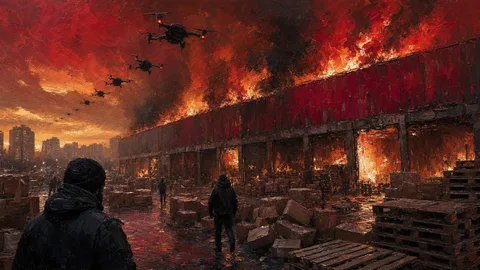
What happened in Gdańsk is, in a sense, without precedent in modern history. Rarely has a reconstruction conference been held for a country actively at war, simultaneously seeking to fund both its defence and its rebuilding. The formulation from Euromaidan Press is striking: "Rebuilding Ukraine while it burns." Rebuilding while it burns — an image that captures all the heroic absurdity of Ukraine's situation.
This situation imposes adaptations that classical international reconstruction mechanisms are not designed to manage. Projects must be conceived to withstand potential new destruction. Investments must be secured against strike risks. Supply chains must route around active combat zones. These constraints are not reasons not to invest — they are design parameters that must be integrated from the outset.
Discover

EDITORIAL: Trump approves H200 chips for Beijing and takes…
On December 8, 2025, two announcements landed in Washington, the same…
INVESTIGATION: Beijing cuts Africa to 2.1 billion in loans…
2.1 billion — the lowest figure in almost twenty years, according…

SPECIAL REPORT: Beijing Promises Stimulus as Its Households Give…
That is the growth rate of Chinese industrial output in July,…
The Rome conference as precedent — and its lessons
The reconstruction conference in Rome, which preceded Gdańsk, produced one directly measurable concrete result: a factory built in the Bila Tserkva Industrial Park by an Italian investor, completed in under a year. That is the kind of result Ukraine's reconstruction needs to multiply — concrete, rapid projects with documented outcomes. Gdańsk's ambition to be "the most practical in history" must be measured in the coming months against the number of such concrete projects actually implemented, not merely against the number of agreements signed.
The Commitments That Must Survive Gdańsk
From agreements on paper to projects on the ground
The history of reconstruction conferences is littered with commitments that did not survive the return of delegates to their capitals. The post-Gdańsk challenge is precisely that: transforming 160 signed agreements into projects effectively funded, launched, and monitored. Euromaidan Press notes that some agreements are already tied to concrete projects — but others are political commitments whose translation into actual construction will demand sustained pressure from civil society, institutions, and the media.
The Ukrainian arms export mechanism adopted on July 1, 2026 — under which 20 percent of revenues from finished goods and 30 percent from components feed the State Defence Fund — is precisely the kind of durable institutional structure that can extend Gdańsk's effects beyond the final communiqué. It transforms a conference into a mechanism. That is the model that must be replicated.
The role of civil society and the media
Ukraine's reconstruction cannot be solely the business of governments and international financial institutions. Ukrainian civil society — NGOs, journalists, entrepreneurs, local communities — plays an indispensable role in monitoring the implementation of commitments, preventing corruption, and adapting projects to real on-the-ground needs. The 160 Gdańsk agreements need 160 field teams to turn them into concrete reality.
Conclusion: Gdańsk, the Necessary but Insufficient Step
What the conference actually accomplished
Ultimately, Gdańsk 2026 accomplished something important: it transformed the discourse on Ukraine's reconstruction from a post-war hypothesis into an ongoing reality. The 160 agreements, the €10 billion, the €6 billion for drones, the World Bank agreement — all of it is real, concrete, and directly useful to Ukraine. The political dynamic of the conference — governments committing, companies investing, financial institutions activating mechanisms — is itself valuable.
What Gdańsk did not accomplish: significantly reduce the gap between Ukrainian needs ($52 billion external deficit for 2026) and available resources. Produce binding security guarantees. Fully integrate the defence dimension into written commitments. These shortfalls must not be dressed up as successes they are not. Ukraine needs the West to hold a Gdańsk every quarter, not every year.
By Maxime Marquette, columnist
Columnist's transparency note
Who I am and my sources for this editorial
I am Maxime Marquette, analyst columnist for mad-m.ca. This editorial draws primarily on the Euromaidan Press analysis of June 28, 2026 ("Rebuilding Ukraine while it burns — what Ukraine Recovery Conference 2026 actually delivered"), data from Interfax Ukraine on the agreements signed, statements from Prime Minister Svyrydenko and the European Commission, and comments by Mark Rutte in the Financial Times on Ukrainian aid. I have taken care to distinguish documented facts from editorial interpretations that belong to me.
My editorial position is pro-Ukraine and pro-Western engagement. I acknowledge a possible bias toward optimism about Ukraine's reconstruction trajectory — my conviction that Ukraine will win this war may color my reading of Gdańsk's results. What I do not know: the implementation details of the 160 agreements, the actual disbursement timelines for announced funds, the detail of concrete projects that will actually be completed by end of 2026.
My limits as a columnist
I was not in Gdańsk. I did not attend the negotiations, I have no access to the detailed agreement documents. My analysis is based entirely on open sources. On a subject this laden with political and diplomatic significance, this limitation is real. I do my best to distinguish what is established from what is my interpretation — and I state it explicitly in the text.
Sources
Primary sources
Secondary sources
Get the geopolitics analyses
Conflicts, powers, alliances: the MadMax thread without the noise.
Cite this article
Maxime Marquette (2026). EDITORIAL: Gdańsk 2026 — 160 Agreements and €10 Billion, but the War Still Burns. MadMax. https://mad-max.co/en/article/editorial-gdansk-2026-160-accords-et-10-milliards-d-euros-mais-la-guerre-brule-e
Read next
EDITORIAL: Trump approves H200 chips for Beijing and takes…
On December 8, 2025, two announcements landed in Washington, the same…
INVESTIGATION: Beijing cuts Africa to 2.1 billion in loans…
2.1 billion — the lowest figure in almost twenty years, according…
SPECIAL REPORT: Beijing Promises Stimulus as Its Households Give…
That is the growth rate of Chinese industrial output in July,…
Enjoyed this piece? Get the next one.
One chronicle a week, straight to your inbox. No noise.
This article was generated with AI assistance, under human supervision.
Comments
Be the first to weigh in.