

COLUMN: The Slaviansk Refinery Burns — Zelensky Confirms and Russia Begins Running Out of Fuel
At 3:33am local time on June 28, 2026, the Slavyansk ECO refinery in Slaviansk-na-Kubani, deep in Krasnodar Krai, erupted into flames visible for dozens of kilometers. NASA FIRMS satellite sensors detected the thermal anomaly immediately. Thick black smoke rolled over 74 storage tanks, consuming a facility that processes 5.2 million tonnes of fuel per year — one of Russia's lar
- At 3:33am local time on June 28, 2026, the Slavyansk ECO refinery in Slaviansk-na-Kubani, deep in Krasnodar Krai, erupted into flames visible for dozens of kilometers. NASA FIRMS satellite sensors detected the thermal anomaly immediately. Thick black smoke rolled over 74 storage tanks, consuming a facility that processes 5.2 million tonnes of fuel per year — one of Russia's lar
- COLUMN: The Slaviansk Refinery Burns — Zelensky Confirms and Russia Begins Running Out of Fuel
- Introduction: In the night of June 27 to 28, the skies over Krasnodar catch fire
Facts, quotes, and cited links remain in the body. Interpretations are framed as analysis or opinion according to the format.
COLUMN: The Slaviansk Refinery Burns — Zelensky Confirms and Russia Begins Running Out of Fuel
Introduction: In the night of June 27 to 28, the skies over Krasnodar catch fire
A strike that rewrites the war's geography
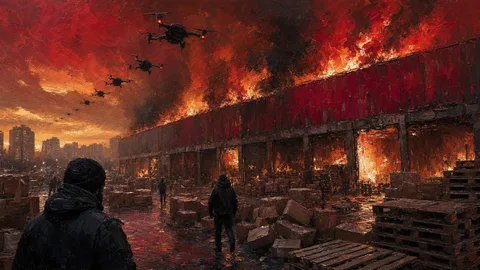
At 3:33am local time on June 28, 2026, the Slavyansk ECO refinery in Slaviansk-na-Kubani, deep in Krasnodar Krai, erupted into flames visible for dozens of kilometers. NASA FIRMS satellite sensors detected the thermal anomaly immediately. Thick black smoke rolled over 74 storage tanks, consuming a facility that processes 5.2 million tonnes of fuel per year — one of Russia's largest independent refineries and a critical supply artery for occupied Crimea. The strike was not a coincidence. It was a mission.
The same night, a second refinery in Yaroslavl Oblast, roughly 700 kilometers from the Ukrainian border and a mere 250 kilometers northeast of Moscow, also went up in flames. Governor Mikhail Yevrayev confirmed the incident on Telegram, offering only the official Russian line about "intercepted debris." By dawn, Volodymyr Zelensky had confirmed both strikes. Vladimir Putin, for the first time, acknowledged publicly that Ukrainian operations were contributing to Russia's fuel tensions. That admission alone changed the entire narrative of this war.
A campaign that no longer hides its ambition
These strikes do not belong to a spontaneous night raid. They are part of a deliberate, structured 40-day pressure campaign approved by Zelensky on June 25, built around three target categories: fuel infrastructure, defense industrial capacity, and military logistics. In less than three weeks, Ukrainian forces have hit refineries in Voronezh, Orenburg, Novomoskovsk, Krasnodar, and Yaroslavl. The geography is expanding with every operation. Russia's rear is no longer safe.
What happened in those early morning hours of June 28 was not merely a military operation. It was a demonstration of strategic reach. Ukraine is no longer defending its territory — it is reshaping Russia's ability to sustain a war. Every burning tank farm is a calculation: fewer barrels of fuel means fewer armored vehicles that can advance, fewer jets that can fly, fewer supply convoys that can roll. Zelensky put it plainly: "We will continue our operations that weaken Russia's capacity to wage war." Those words deserve to be read as a doctrine, not a press release.
Who is Slavyansk ECO? Anatomy of a strategic target
A refinery at the heart of Russia's southern supply chain
Slavyansk ECO sits in Krasnodar Krai, approximately 400 to 450 kilometers from the Ukrainian border. It is one of Russia's largest independent refineries — meaning it operates outside the direct management of the major state vertically integrated companies, while still feeding into the same national fuel supply network. Its annual processing capacity of 5.2 million tonnes places it firmly among the industrial anchors of Russia's southern fuel architecture. Its roughly 74 storage tanks made it a high-value, low-hardening target once Ukrainian long-range capability reached this range.
The facility's strategic value goes beyond raw output. Slavyansk ECO has served as a key fuel supplier for occupied Crimea, the peninsula that Russia has held illegally since 2014 and that depends almost entirely on mainland supply chains. Destroying or severely degrading this refinery does not merely reduce Russia's national fuel output by a percentage point — it cuts a specific artery that feeds a specific peninsula that anchors Russia's entire southern military posture. This is precision targeting in the truest operational sense: not just damage, but disruption of a defined supply system.
Why this target now, this night
Ukrainian intelligence clearly understands the geometry of Russian supply lines. Crimea's dependency on mainland fuel makes every southern refinery a pressure point. After the destruction of the Kerch Bridge rail and road capacity in earlier phases of the war, Russian forces have had to improvise logistics across the peninsula. Slavyansk ECO was a remaining pillar. Striking it in the same night as the Yaroslavl facility — nearly 700 kilometers from the front, a short drive from Moscow's industrial suburbs — sent a message with two audiences: Russian military planners who need fuel, and Russian civilians who thought the war was happening somewhere else entirely.
The choice of 3:33am was not random. Night strikes reduce the effectiveness of air defense by limiting visual identification windows and straining radar operators who have been on alert for hours. The NASA FIRMS detection confirms the intensity of the fire was substantial enough to register on thermal satellite arrays in real time. Thick black smoke over multiple storage tanks means fuel was burning at industrial volume. The operation succeeded. The question now is how Russia absorbs the loss — and whether it can.
The Yaroslavl refinery: a second fire, 700 kilometers from the front
Reaching beyond the expected strike radius
While Krasnodar Krai had already appeared on the map of Ukrainian strikes, Yaroslavl Oblast represented a new category of target depth. Approximately 700 kilometers from the Ukrainian border and only 250 kilometers northeast of Moscow, the refinery hit that night was inside the zone that Russian authorities — and many Western analysts — had considered beyond practical reach of sustained Ukrainian drone operations. That assumption is now obsolete. Governor Mikhail Yevrayev confirmed the incident on Telegram, framing it with the standard Russian deflection about intercepted projectiles. The fires told a different story.
The significance of striking at this depth extends far beyond the individual refinery's output. It creates an entirely new problem for Russian civil defense and military logistics planners: the need to protect industrial infrastructure at distances that were, until recently, considered safe by definition. Yaroslavl is industrial heartland Russia — the kind of city where refinery workers and their families have watched this war on television for two years without feeling its physical presence. June 28 changed that. The psychological weight of that change cannot be quantified, but it cannot be dismissed either.
The compound effect of simultaneous strikes
The decision to execute two major refinery strikes in the same night, in two different regions, hundreds of kilometers apart, reflects Ukrainian operational sophistication that has grown dramatically since 2022. Simultaneous multi-front drone operations force Russian air defense to allocate assets across a vast geographic arc simultaneously — an impossible optimization problem at any scale. When both targets burn, the message to Russian military planners is unambiguous: there is no safe depth. There is no rear. There is only variable exposure.
The Yaroslavl strike also fits into a pattern visible across June 2026. Ukrainian operations have touched Voronezh at 500 kilometers, Orenburg at 1,200 kilometers, Novomoskovsk/Tula at 200 kilometers, and now Yaroslavl at 700 kilometers. The range distribution is not random — it is a deliberate demonstration of multi-depth capability designed to force Russian planners to defend everywhere and concentrate nowhere. A force that must defend everything defends nothing effectively. Ukraine is teaching Russia this lesson one refinery at a time.
Putin admits the fuel crisis — an extraordinary admission
When the Kremlin can no longer deny what it burns
Perhaps the most remarkable development of June 28, 2026 was not the fires themselves but the words that followed them. Vladimir Putin, according to reporting by The Guardian, publicly acknowledged that Ukrainian strikes were contributing to fuel tensions inside Russia. For a regime that has spent two years insisting that its economy, its military, and its morale are absorbing the war without structural damage, this admission represented a crack in the official narrative of invulnerability. The Kremlin has denied, minimized, and deflected every setback. This time, it acknowledged the pain.
Regional authorities in Krasnodar immediately blamed "debris from intercepted drones" for the damage at Slavyansk ECO — the standard operational deflection that Russian officials deploy whenever acknowledging a successful strike would be more damaging than admitting limited effectiveness of air defenses. But Putin's parallel comment about fuel tensions created a contradiction that no press secretary can paper over: you cannot simultaneously claim your air defenses intercepted the threat and admit that the fuel crisis is being driven by the strikes. Both things cannot be true at once. Russia chose to say both. That is its own kind of signal.
What the admission reveals about Russian strategic economics
Russia's fuel situation in June 2026 is not a crisis that emerged overnight. Zelensky himself uses the formulation "long-range sanctions" to describe these strikes — and the language is precise. Each destroyed refinery acts as an economic sanction delivered by drone rather than by Brussels: it reduces output, disrupts supply chains, raises domestic fuel prices, and degrades the military's operational logistics baseline. Putin's admission means that cumulative effect has become impossible to hide from the domestic audience, let alone from Russia's military industrial planning apparatus.
The downstream implications are tangible. Fewer operational refineries means reduced aviation fuel for sorties over Ukraine. It means fewer diesel supplies for armored vehicle columns. It means the Russian military must choose between fuel uses in a way it has not had to since the early months of the war. This is not an existential crisis — Russia's energy infrastructure remains vast and partially distributed — but it is a measurable strategic degradation. And degradation compounds. Every month the strikes continue, the base from which Russia operates its war narrows slightly further.
Simultaneous operations: far beyond the refineries
A night of five parallel targets
Slavyansk ECO and the Yaroslavl refinery were not the only targets struck in the night of June 27 to 28. Ukrainian forces simultaneously hit a Crimea railway bridge near Ichky, an ammunition depot near Amvrosiivka in Donetsk Oblast, and three workshops at the Titan-Barrikady industrial complex in Volgograd. A petroleum hub supplying Moscow was struck for the second time that month. Five simultaneous, geographically dispersed operations on a single night. This is not guerrilla raiding — this is coordinated multi-domain strategic pressure at scale.
The Titan-Barrikady complex is particularly significant. It is one of Russia's major producers of large-caliber artillery shells and rocket systems — the industrial backbone of the ground campaign Ukraine has been absorbing for two years. Striking it is not a symbolic gesture. It is an attempt to reduce the throughput of a factory whose output kills Ukrainian soldiers on the front lines every day. Similarly, the ammunition depot near Amvrosiivka represents a logistics chokepoint: shells that never reach the gun cannot be fired. The geography of the campaign is both deep and precise.
The Crimea railway bridge and the logic of access denial
Striking the railway bridge near Ichky in Crimea adds another layer to Ukraine's strategic logic. The peninsula's land connections have been systematically targeted since the partial destruction of the Kerch Bridge. Every rail link that carries fuel, munitions, or personnel to Crimea is a node in a supply network that Ukraine is systematically degrading. The bridge near Ichky serves overland resupply routes that bypass the more vulnerable coastal approaches. Targeting it reflects a detailed understanding of Russian logistics routing — and a commitment to forcing Russian engineers into ever more complex and costly workarounds.
Five simultaneous operations in one night require drone coordination at a level that NATO analysts openly acknowledge surprised many observers earlier in the conflict. Ukraine has developed a genuine multi-front drone campaign doctrine that combines long-range strike assets, medium-range loitering munitions, and tactical units in ways that overwhelm point-defense systems. The night of June 27 to 28 is a case study in what that doctrine looks like when all its components operate at full tempo simultaneously. Russia's air defense network, despite its scale, cannot be everywhere at once. Ukraine exploits that arithmetic relentlessly.
The 40-day campaign: Slaviansk as a perfect illustration
A doctrine approved, then immediately executed
On June 25, 2026, Zelensky officially approved a 40-day operational pressure campaign coordinated by the SBU — Ukraine's Security Service — and military intelligence. The campaign is built around three target categories: fuel infrastructure, defense industrial capacity, and military logistics corridors. Within 72 hours of that approval, the Slavyansk ECO refinery was burning. The speed of execution signals that the campaign did not begin with the approval — it was already in motion, and the official framework was placed around operations already underway.
The 40-day structure is not arbitrary. It aligns with the lead-up to the NATO Ankara summit of July 7 to 8, 2026, where Zelensky is seeking a €70 billion military aid package. The campaign serves a dual function: it degrades Russian operational capacity materially while simultaneously demonstrating to NATO allies that Ukraine is actively using the capabilities it already has to maximum effect. Every burning refinery is also an argument: give us more tools, and watch what we do with them. The strategic communication dimension of the campaign is inseparable from its military logic.
The target selection logic behind 40 days
Fuel infrastructure, defense industry, logistics: these three categories are not chosen randomly. They represent the three legs of a stool that holds up sustained conventional warfare at scale. Remove the fuel, and mobility collapses. Destroy the factories, and munitions production falls. Cut the logistics corridors, and the front lines starve. Ukraine cannot execute a conventional counteroffensive against Russia's 1,200-kilometer defensive line with the forces it currently fields. But it can execute a systematic dismantling campaign that makes every day of Russia's offensive more expensive and less effective. Slaviansk ECO was leg one of that stool. Titan-Barrikady was leg two. Amvrosiivka was leg three. All in one night.
June 2026 already tells the story of this campaign's early success. Russian forces captured only approximately 30 square kilometers during the month — a dramatic reduction from the same period in 2025. Correlation is not causation, but the timing is notable: as Ukraine's deep strike tempo has intensified, Russia's ground advance rate has slowed. Fewer operational refineries mean fewer fuel deliveries to frontline units. Fewer functional ammunition plants mean fewer shells arriving at battery positions. The mathematics are not perfect, but the direction is clear. Ukraine is making Russia's war more expensive with every drone it launches.
The Russian response: missiles on Kyiv that same night
Retaliation as reflex, not strategy
Russia did not absorb the strikes passively. The same night that Slavyansk ECO and the Yaroslavl refinery burned, Russian forces launched a missile salvo against Kyiv. This has become the predictable cadence of this phase of the war: Ukraine strikes deep, Russia strikes Kyiv. The response is less strategic than reflexive — a demonstration of continued offensive capability in the face of an adversary that has just proven it can reach 700 kilometers into Russian territory. But reflexive responses reveal something important about decision-making: they show what a system does when it is not thinking, only reacting.
The missile strike on Kyiv the night of June 27 to 28 caused damage and casualties, as Russian missile strikes on Ukrainian cities routinely do. It did not stop the drone operations. It did not repair the burning refineries. It did not restore the fuel supply to Crimea. It was, in the arithmetic of strategic logic, an expensive gesture — each cruise missile or ballistic warhead fired at a Ukrainian city is a significant cost in both money and production capacity that Russia can barely afford to sustain at current attrition rates. Russia is trading high-cost missiles for symbolic impact while Ukraine trades lower-cost drones for structural damage. The exchange rate does not favor Moscow.
The rhetoric of escalation without the substance
Russian officials also invoked nuclear deterrence rhetoric in the wake of the June 28 strikes — as they have done at multiple inflection points since 2022. There was no actual escalation. There was no change in posture beyond the words themselves. The pattern has become recognizable: when Ukraine achieves a significant strike at depth, Russia's first response is a missile salvo on civilian infrastructure, and its second response is a statement about nuclear capability. Neither response addresses the actual problem, which is that Ukraine has demonstrated the ability to reach and destroy industrial targets deep inside Russian territory with increasing regularity and precision.
The nuclear rhetoric serves a specific political audience: Western governments that must authorize the weapons Ukraine uses. Every mention of escalation is an implicit warning to NATO capitals not to give Ukraine more capability. But the evidence of June 2026 suggests that Western governments have either concluded the rhetoric is not credible, or have judged that the cost of restraint now exceeds the risk of response. The weapons are flowing. The strikes are deepening. Russia's escalation rhetoric has not stopped either trend.
Context: the Rybinsk refinery destroyed three weeks earlier
June 14 — the precedent that made June 28 possible
The strikes of June 28 did not emerge from a vacuum. On June 14, 2026, Ukrainian drones struck the Rybinsk Kombinat Temp facility — a strike that destroyed 15 storage tanks, a loss confirmed definitively by satellite imagery released on June 22. Rybinsk sits in the same strategic depth as Yaroslavl: the industrial belt north of Moscow, far from any frontline, in territory that Russian authorities had designated as permanently safe. The Rybinsk strike was the proof of concept. The June 28 operations were the doctrine in practice.
The sequence matters. June 14: Rybinsk. June 22: satellite confirmation of 15 destroyed tanks. June 24: Orenburg helium plant struck for the fourth time. June 26: drones strike the Azot chemical plant in Novomoskovsk. June 28: Slavyansk ECO and Yaroslavl simultaneously. This is not a series of isolated events — it is an accelerating rhythm. Each successful strike validates the targeting methodology and operational security that enabled it. Each burned tank farm maps the next target set. Ukraine is running a deliberate cycle: strike, confirm damage, refine targeting, strike again. The tempo is increasing because the process is working.
Building a body of evidence for Western audiences
The satellite confirmation pattern is itself strategically significant. When Ukrainian forces struck Rybinsk on June 14, it was the public release of NASA FIRMS and commercial satellite data on June 22 that turned a claim into a documented fact for Western governments and media. Ukraine has learned that its deep strike campaign must be evidentiarily credible to maintain Western political support for the capabilities that enable it. Every satellite image of a burning tank farm is a slide in the briefing that justifies the next authorization for long-range weapons. This is information warfare and military operations as a single integrated system.
By June 28, the body of evidence was substantial. Multiple refineries struck, multiple confirmed by satellite, a Russian president publicly acknowledging fuel tensions, a governor confirming a strike his own air defenses were supposed to have prevented. The campaign had achieved not just physical damage but documented, irrefutable proof of effectiveness. For the NATO Ankara summit less than ten days away, that documentation arrives at exactly the right moment. Zelensky does not go to Ankara to ask for weapons as a supplicant. He goes as a commander with receipts.
International implications: the NATO summit and delivery decisions
Ankara, July 7–8: Zelensky arrives with leverage
The NATO Ankara summit of July 7 to 8, 2026 will be the most consequential allied gathering since the war began. Zelensky is seeking a €70 billion military aid package — a figure that would represent a step-change in the scale and formalization of Western support. In prior summits, Ukraine's requests were met with pledges that materialized slowly and incompletely. In Ankara, Zelensky arrives with the June 2026 strike record as his most powerful argument: here is what Ukraine does with what it has. Imagine what it would do with more.
The timing of the 40-day campaign relative to the summit is almost certainly not coincidental. Military planning in Ukraine has become increasingly sophisticated in its integration of operational tempo with diplomatic calendar. Operations that demonstrate reach, precision, and strategic effect in the days before a major allied summit are not just military events — they are negotiating assets. Every burning Russian refinery is a data point in the Ankara conversation. Every confirmed factory strike is an argument for the next tranche of long-range capability. The summer of 2026 is both a military campaign and a strategic communication campaign running in parallel.
On the same topic

ANALYSIS : Taiwan Puts NT$1,122.5 Billion Into Defence, Over…
Hold that number for a moment, because it marks the crossing…

ANALYSIS: 313 Votes, a 20th Extension — Ukraine Keeps…
313 votes to approve the presidential decree extending martial law by…
ANALYSIS: 800 drones over Russia in one night —…
More than eight hundred drones, in a single night, August 14…
Western authorization dynamics and the threshold question
The strikes of June 28 also reopen the question of Western authorization limits. Many of Ukraine's long-range drone operations are conducted with indigenous capabilities developed specifically to avoid triggering the conditions under which Western governments restrict use of their own weapons systems. Ukraine's ability to strike at 700 kilometers with drones it built itself gives it operational freedom that does not depend on NATO authorization at every step. This independence is both a military asset and a political one: Ukraine can demonstrate strategic effect without putting Western governments in the position of having explicitly approved each target.
But the authorization dynamics for Western-supplied systems also shift with demonstrated Ukrainian effectiveness. When Ukraine proves it can hit and hold accountable targets at 700 kilometers with its own systems, the argument for restricting Western systems to shorter ranges becomes harder to sustain politically. The evidence of June 2026 is changing the terms of the debate in NATO capitals. The refineries burn regardless of which government issued which authorization. The political consequence is that the authorization becomes easier to justify retroactively — and proactively for the next request.
Zelensky's mindset: we will not stop
"Long-range sanctions" — a precise choice of words
Volodymyr Zelensky's June 28 statement confirming the strikes deserves close reading. "We will continue our operations that weaken Russia's capacity to wage war," he said. "Every long-range sanction reduces the resources feeding Russia's war machine and brings us one step closer to peace." The phrase "long-range sanctions" is not accidental — it is a deliberate reframing of military strikes as economic instruments, positioning them within the same conceptual frame as Western financial sanctions rather than as acts of military aggression. It is language engineered for Western political audiences that worry about escalation but support economic pressure on Russia.
The framing also reveals something about Zelensky's strategic theory of the case. He does not present these strikes as retaliatory or emotional. He presents them as structural — as operations that reduce the physical capacity of Russia's war economy to sustain the campaign. This is a significant rhetorical and doctrinal evolution from the early months of the war, when Ukrainian messaging focused heavily on territorial defense and moral outrage. The Zelensky of June 2026 speaks the language of strategic economics: resources, capacity, reduction, peace. It is the language of a leader who has studied what moves Western governments, and adapted his communication accordingly.
The psychology of a president who has stopped waiting
There is something qualitatively different about Zelensky's posture in June 2026 compared to earlier phases of the war. In 2022 and 2023, much of his public communication was directed at persuading Western governments to act — to send weapons, to impose sanctions, to close the sky. By June 2026, he has stopped waiting for permission and started building facts on the ground. The 40-day campaign was not pre-announced to NATO allies for approval. It was announced to the world as an ongoing operation. The order of operations has inverted: Ukraine acts, then invites its partners to acknowledge the results.
This shift reflects a strategic maturation that goes beyond personality or politics. Ukraine has developed genuine independent deep strike capability. It has built its own drone industry. It has trained its own targeting teams. It has learned to work around restrictions by developing systems that do not require authorization to use. Zelensky in June 2026 is not asking for permission to fight his war. He is fighting it, documenting it, and inviting the world to watch. That self-sufficiency changes the dynamic of the entire Western alliance relationship — and it changes it in ways that are permanently irreversible.
The geopolitical context: Russia facing a growing production deficit
Three industries under simultaneous pressure
The June 2026 strike campaign has hit Russia's defense-adjacent industrial infrastructure across three distinct categories simultaneously. The VZPP-S semiconductor factory in Voronezh was partially destroyed — damaging Russia's ability to produce the guidance components needed for precision munitions. The Azot chemical plant in Novomoskovsk was struck by drones on June 26 — degrading production of propellant precursors essential for artillery and rocket propellants. The Orenburg helium plant — Russia's only major helium production complex — was struck for the fourth time, each strike adding cumulative structural damage that may eventually become irreparable within any reasonable timeline for the current conflict.
These three target categories — semiconductors, propellants, specialty gases — are not chosen for symbolic effect. They are the industrial inputs that convert raw Russian energy wealth into deployable military capacity. Russia cannot replace destroyed semiconductor manufacturing quickly; the global supply chain restrictions imposed since 2022 have cut off most Western and East Asian sources of advanced components. Orenburg's helium is used in both defense production and broader industrial applications. Novomoskovsk's propellants feed artillery lines that have been Russia's primary ground-war instrument. Striking these three simultaneously is not a coincidence — it is a full-spectrum industrial attrition strategy.
The arithmetic of degradation and the Russian window
Russia's defense industry has operated under significant constraint since 2022. Western sanctions have removed access to advanced components, precision machinery, and industrial software. North Korean shell supply has partially offset Russian domestic production deficits in artillery. Iranian drones have augmented strike capacity. But these workarounds have limits: North Korea cannot indefinitely supply the volume of shells Russia is consuming, and Iranian drone technology cannot substitute for the precision guidance systems that Ukrainian strikes are targeting. The cumulative effect of 28 months of sanctions plus the accelerating strike campaign of June 2026 is a Russian defense industry that is producing harder, spending more, and achieving less per unit of input.
The 30 square kilometers captured by Russia in June 2026 compared to far greater advances in June 2025 reflects this degradation at the operational level. Whether the reduction is attributable to the deep strike campaign, improved Ukrainian defensive capability, Western weapons deliveries, or some combination of all three is a question for analysts. But the direction is clear: Russia is getting less ground per month as Ukraine's campaign of deep attrition intensifies. At some point, the arithmetic of degradation overcomes the arithmetic of mass. June 2026 may be the month that calculation begins to tip.
What the geography of strikes tells us over time
From 200 to 1,200 kilometers — the expanding arc
Mapping the June 2026 strikes by distance from the Ukrainian border reveals a deliberate expansion strategy that has progressed with each operational cycle. Novomoskovsk/Tula at roughly 200 kilometers: the edge of immediate deep strike range since early in the war. Voronezh at 500 kilometers: an intermediate depth target set that became routinely accessible by late 2023. Krasnodar/Slaviansk-na-Kubani at 400 to 450 kilometers: southern arc extension targeting Crimea supply routes. Yaroslavl at 700 kilometers: the new northern-arc reach extension pushing toward Moscow's industrial ring. Orenburg at 1,200 kilometers: the extraordinary deep strike that rewrote the expected limits of Ukrainian range entirely.
The Vtorovo pumping station in Vladimir region — approximately 200 kilometers from Moscow — was struck earlier in June, demonstrating that even central Russia's energy infrastructure is within reach. The geographic arc of Ukrainian strikes now encompasses essentially the entire populated European territory of Russia. There is no industrial city, no refinery, no munitions plant in European Russia that Ukrainian planners cannot plausibly target. That is not hyperbole — it is the conclusion that flows directly from the operational record of June 2026. The map has changed permanently. Russia cannot unlearn this vulnerability.
What this means for Russian civilian psychology
Discover

COLUMN : Europe Moved 8.5 Billion Euros in a…
That is what the European Commission says it has disbursed for…

INVESTIGATION: Beijing cuts Africa to 2.1 billion in loans…
2.1 billion — the lowest figure in almost twenty years, according…

SPECIAL REPORT: Beijing Promises Stimulus as Its Households Give…
That is the growth rate of Chinese industrial output in July,…
The expanding geographic arc of strikes has a dimension beyond military logistics: it is reaching into the daily consciousness of Russian citizens in ways that two years of frontline reporting never did. When Yaroslavl burns — a historic Russian city, 250 kilometers from the capital — it means the war has entered a geography that Russian state television has spent years insisting was irrelevant, distant, and victorious. When the governor of Krasnodar confirms a refinery fire on Telegram, it means the official narrative of impregnable rear areas has collapsed in real time. Russia's civilian population is increasingly confronting a reality that their government's information apparatus cannot suppress entirely.
This psychological dimension matters for long-term conflict dynamics. Wars are ultimately sustained by populations willing to absorb their costs. A population that believed itself geographically insulated from a "special military operation" now watches industrial fires at 700 kilometers from the front. The political consequences of that shift — in pressure on Putin's administration, in elite calculations about the cost-benefit of continuation, in the fragility of the narrative that Russia is winning — are not immediately quantifiable. But they are real. Ukraine is not only degrading Russia's hardware. It is degrading Russia's story about itself.
Long-term implications for European security architecture
Ukraine's campaign reshapes the continent's strategic calculus
The June 2026 strike campaign is not only a Ukrainian military operation. It is an event with permanent consequences for European security architecture. Every burning Russian refinery reduces the material capacity of the state that European defense planners have spent three years redesigning their security frameworks to deter. A Russia with degraded fuel infrastructure, damaged semiconductor manufacturing, and disrupted propellant production is a Russia that approaches any future conventional conflict with a significantly weakened baseline. The SAFE program, ReArm Europe, and Readiness 2030 were designed to create deterrence at scale. Ukraine is simultaneously building the empirical case that active degradation works faster.
European defense planners are absorbing the operational lessons of Ukraine's deep strike campaign in real time. The Gripen pilot training programs, the 45-year SAFE financing guarantees, the institutionalized support frameworks that now embed Ukraine's defense into European planning cycles — these are all responses to a strategic reality that June 2026's operations are reinforcing: Russia is not an abstract threat. It is a state whose industrial infrastructure can be systematically degraded by determined, capable, well-equipped defenders. That lesson is the most important single output of the summer 2026 campaign for European strategic thinking.
The institutionalization of deep strike doctrine
One of the lasting consequences of Ukraine's June 2026 campaign will be the normalization of deep strike operations as a legitimate and effective instrument of conventional warfare for a state defending its sovereignty against a larger aggressor. Before Ukraine demonstrated it, the operational doctrine of striking an adversary's industrial infrastructure at 700+ kilometers with autonomous systems was considered a capability limited to major powers with significant air forces. Ukraine has proven it is achievable with drone technology, indigenous targeting capability, and strategic patience. That proof of concept will be studied in every serious military academy on the continent.
The implications for smaller NATO and EU member states along Russia's western periphery are immediate and practical. If Lithuania, Estonia, Latvia, or Finland ever faced a conventional threat from the east, the Ukrainian model offers a template for how a smaller military force can impose disproportionate costs on a larger adversary's industrial base without requiring air superiority. The combination of long-range autonomous systems, satellite-coordinated targeting, and systematic industrial prioritization represents a new form of strategic deterrence that does not require nuclear weapons or a large conventional army. Europe is watching Ukraine write the textbook in real time.
The international response and Atlantic community support
How allies read Zelensky's June 2026 operations
Within Western governments, the June 28 strikes were received with a combination of public restraint and private acknowledgment of effectiveness. No NATO government officially endorsed the specific operations — that is not how the alliance works, and Ukraine's indigenous drone capability deliberately exists in a space where such endorsement is not legally required. But the absence of criticism was telling. Western governments that once urged Ukraine to exercise restraint in targeting Russian territory have gone conspicuously quiet as the strikes deepen and demonstrate results. Silence, in diplomatic terms, is a form of consent.
The alignment of the deep strike campaign with the NATO Ankara summit timeline ensures that Western defense ministers arriving in Turkey on July 7 will have processed the imagery of burning Russian refineries for ten days before they sit down to discuss Zelensky's €70 billion aid request. The psychological impact of demonstrated capability on aid authorization decisions is not a minor consideration. Governments that fund Ukraine are governments that face domestic publics who want to know whether the investment is working. June 2026 provides an unusually clear answer.
The Atlantic community's evolving threshold of support
The trajectory of Western support for Ukraine's deep strike operations has followed a consistent pattern since 2022: initial reluctance, then quiet authorization, then normalized acceptance, then eventual institutional embedding. Long-range artillery. HIMARS. Patriot. F-16s. Each capability followed the same arc: denied, debated, authorized, delivered, integrated. The question for the post-Ankara period is whether Ukraine's demonstrated deep strike effectiveness will accelerate the remaining capability authorizations — including longer-range Western systems currently held back by political caution that the June 2026 record increasingly undermines.
The Atlantic community's support for Ukraine has also evolved qualitatively, not only quantitatively. SAFE's €150 billion framework, the 45-year financing instruments now embedded in EU defense planning, the bilateral agreements between Ukraine and multiple NATO members that include production of Ukrainian weapons on allied soil — these represent a permanent institutionalization of Ukraine's defense into Europe's strategic architecture. Ukraine does not just receive weapons from Europe. It is increasingly a partner in producing, testing, and deploying the next generation of European defense technology. That relationship does not end with a ceasefire. It defines what European security means after this war.
Conclusion: Slavyansk ECO, symbol of a war changing in nature
The fire that marked a turning point
When the Slavyansk ECO refinery ignited at 3:33am on June 28, 2026, it did not simply add another facility to the list of Russian infrastructure degraded by Ukrainian operations. It marked a threshold moment in the evolution of the war. The combination of a strike at unprecedented depth, a public Russian acknowledgment of fuel crisis, a second simultaneous strike near Moscow, and five parallel operations across the same night announced — to anyone paying attention — that the strategic logic of this conflict had fundamentally shifted. Ukraine is no longer defending against Russia's war. It is conducting its own war against Russia's capacity to fight.
The 40-day campaign approved by Zelensky on June 25 will continue through late July. More refineries will likely burn. More factories will be damaged. The satellite images will keep accumulating. Putin will keep acknowledging, through tightly controlled official statements and involuntary factual admissions, that the strikes are having effect. The NATO summit in Ankara will negotiate a new scale of support. And Ukraine will arrive at that summit not as a supplicant asking for survival — but as a strategic partner demonstrating, refinery by refinery, that it knows how to change the course of a war it was never supposed to be winning.
What comes after the 40 days
The deeper question raised by the June 2026 campaign is not what happens in the next 40 days, but what happens after. If the campaign achieves its stated goals — measurable degradation of Russian fuel output, defense industrial capacity, and logistics networks — the question becomes whether that degradation accelerates a path to negotiation or simply resets the baseline for the next phase of the conflict. Wars do not end because one side runs low on fuel. They end when the arithmetic of continuation becomes worse than the arithmetic of settlement. Ukraine's deep strike campaign is not a ceasefire strategy. It is a cost-imposition strategy designed to change that arithmetic progressively, over time, until the calculation in Moscow changes.
The night of June 27 to 28 was a data point in that calculation. So was the Putin admission. So was the Yaroslavl fire. So was the satellite confirmation that 15 tanks at Rybinsk are permanently gone. Each data point narrows Russia's operational margin slightly. The margins are still wide — Russia's geographic scale and energy wealth give it a resilience that no single strike campaign will break quickly. But resilience is not invulnerability. And Slavyansk ECO is evidence that Ukraine has found the formula for compressing those margins, systematically, one tank farm at a time.
By Maxime Marquette, columnist
Columnist's transparency note
Sources and methodology
This column is based exclusively on publicly available sources: verified media reports from Militarnyi, the Kyiv Independent, The Guardian, Euromaidan Press, and official statements from Ukrainian and Russian authorities as reported by those outlets. All specific figures — refinery capacity, strike timing, geographic distances, tank counts — are drawn from these sources and are cross-referenced where possible. No anonymous sources were used. No scenes were reconstructed or invented.
Editorial position
I write from a pro-Ukraine editorial position, which I do not disguise. I believe Ukraine's sovereignty and territorial integrity matter and that supporting its defense is in the interest of the liberal democratic order. That position shapes the framing of this column, not the facts it contains. The distinction between editorial perspective and factual accuracy is one I take seriously. Readers who disagree with the framing are welcome to contest the argument — but the facts stand independently of the editorial position.
Sources
Primary sources
Secondary sources
Get the geopolitics analyses
Conflicts, powers, alliances: the MadMax thread without the noise.
Cite this article
Maxime Marquette (2026). COLUMN: The Slaviansk Refinery Burns — Zelensky Confirms and Russia Begins Running Out of Fuel. MadMax. https://mad-max.co/en/article/chronique-la-raffinerie-slaviansk-brule-zelensky-confirme-et-la-russie-commence-
Read next
COLUMN : Europe Moved 8.5 Billion Euros in a…
That is what the European Commission says it has disbursed for…
INVESTIGATION: Beijing cuts Africa to 2.1 billion in loans…
2.1 billion — the lowest figure in almost twenty years, according…
SPECIAL REPORT: Beijing Promises Stimulus as Its Households Give…
That is the growth rate of Chinese industrial output in July,…
Enjoyed this piece? Get the next one.
One chronicle a week, straight to your inbox. No noise.
This article was generated with AI assistance, under human supervision.
Comments
Be the first to weigh in.