

COLUMN: Zelensky mocks Putin's 15 missed deadlines — and Russia burns
On June 29, 2026, in his nightly address, Ukrainian President Volodymyr Zelensky laid a number on the table with surgical precision: 15.
- On June 29, 2026, in his nightly address, Ukrainian President Volodymyr Zelensky laid a number on the table with surgical precision: 15.
- Introduction: a wartime president's very public countdown
- Fifteen deadlines for the Donbas — all in history's dustbin
Facts, quotes, and cited links remain in the body. Interpretations are framed as analysis or opinion according to the format.
Introduction: a wartime president's very public countdown
Fifteen deadlines for the Donbas — all in history's dustbin
On June 29, 2026, in his nightly address, Ukrainian President Volodymyr Zelensky laid a number on the table with surgical precision: 15. That is the count of successive deadlines the Kremlin has set — and missed — for capturing the Donbas over more than four years of war. Donetsk, Luhansk, Zaporizhzhia, Kherson — the four regions Vladimir Putin illegally annexed on paper in September 2022 and still does not fully control on the ground. Fifteen promises. Fifteen failures.
This number did not come from nowhere. It is the sum of four years of Russian announcements, self-imposed military deadlines, announced offensives and documented setbacks. Zelensky delivered it publicly, before the entire world, with the calm that leaders acquire only after learning to live under bombs: "If Russia does not end the war, it will have to postpone that deadline once again." This is not bravado — it is bookkeeping.
Mockery as a political weapon
Wielding mockery against a dictator who controls his country's media, courts and army is a deliberate political act. Zelensky is not trying to humiliate — he is naming. Naming Russian military incompetence before his Western partners, his own people, and above all before the Russians who still have access to independent sources. Every missed deadline is a lie Putin told his own citizens. Zelensky is keeping the tally.
This is also an indirect reply to Putin who, in a televised interview the day before, had dismissed a Ukrainian proposal to de-escalate as a "ploy" designed to ease military pressure on Kyiv. Zelensky responds: "Ukraine has put forward proposals — and Russia rejects them every time." The world is watching. The verdict is in the count: fifteen times.
Fuel shortages in 70 Russian regions: Ukraine strikes the economy
A petroleum state running short of gas
In the same June 29 address, Zelensky pointed to a chilling irony: "Even a petroleum-producing state, often called a 'gas station,' now faces fuel shortages." Those shortages now reach 70 regions of Russia. Long lines at gas stations, visible and documented by Russians themselves on social media before censorship removed the posts. This is not Ukrainian propaganda — it is a reality that Vladimir Putin himself acknowledged in his June 28 interview.
Putin did acknowledge that fuel shortages existed. He minimized them, attributed them to logistical factors — but he did not deny them. That acknowledgment, however modest, is significant in the context of a regime that habitually denies every setback. It confirms that Ukraine's campaign of strikes on Russian oil infrastructure is producing real, measurable economic effects on the daily lives of ordinary Russians.
Ukraine's drone sanctions logic
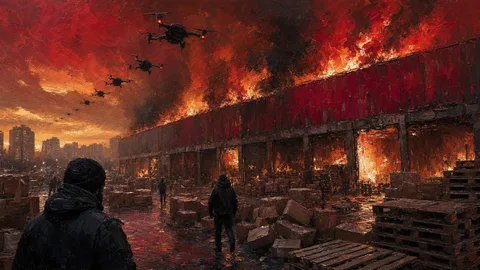
What Zelensky calls Ukraine's "long-range sanctions" is in reality an economic war strategy: strike refineries, fuel depots and Russian energy infrastructure to deny Putin's army the resources it needs for its offensive. On June 25, 2026, Ukrainian drones struck two of the three plants in the Bashneft complex in Ufa, more than 1,300 kilometers from the front line. On July 1, a second strike hit the same refinery.
Russia cannot simply route around this campaign. Refineries do not move. Fuel depots can only be dispersed at considerable logistical cost. And every liter of fuel missing from a Russian tank at the front is one less liter to push that tank toward Donetsk or Zaporizhzhia. Zelensky said it plainly: "This is a direct consequence of the war. One way Ukraine responds — with precision, not terrorism."
Russian advances slowed but not stopped
The Donetsk front: slow gains in a quagmire
Despite economic setbacks and fifteen missed deadlines, Russia continues to advance in Ukraine. Russian forces control the entire Luhansk region and significant portions of the Donetsk and Zaporizhzhia regions. Their westward push in Donetsk is slow, but it continues. Intellectual honesty requires naming this reality: Ukraine is holding, but it is not yet recovering lost ground.
What Ukraine's long-range strikes accomplish is slowing that advance by creating friction in the Russian logistical chain. Less fuel means fewer operational armored vehicles. Fewer spare parts means tanks breaking down on the roads. Disrupted satellite communications means slower command responses. Ukraine's drone campaign does not immediately halt the Russian advance — but it slows it, and every day gained is one more day to reinforce Ukrainian defenses.
The 2026 balance of forces: a war of attrition changing character
The dynamic of this war has fundamentally changed since 2022. Russia still holds numerical superiority in personnel and equipment — but it is losing its advantage in strategic depth. Burning refineries, neutralized communications centers, destroyed fuel depots — all of this creates logistical constraints that limit Russia's ability to mount simultaneous offensives on multiple axes. Ukraine, for its part, has acquired a superiority in precision and technological innovation that no one anticipated.
The June 29, 2026 assessment by the Institute for the Study of War confirms that while Russia is advancing slowly, the pace of that advance has slowed considerably as Ukraine intensifies its medium- and long-range strike campaign. This slowdown carries a human and economic cost for Moscow that the Kremlin downplays in its official communications but that fuel shortages across 70 regions make difficult to deny entirely.
Ukraine's peace proposals and Russia's wall
Kyiv extends its hand — Moscow slams the door
Zelensky was clear on June 29: Ukraine has put forward proposals to advance toward an end to the war. Those proposals have been rejected by Moscow"every time." This is not news — since 2022, Russia has rebuffed every diplomatic initiative that did not guarantee permanent territorial gains over the four illegally annexed Ukrainian regions. Moscow's position is simple: capitulation or war. Ukraine chose war.
Putin, in his June 28 interview, labeled Ukraine's latest proposal a "ploy" to ease military pressure on Kyiv. This framing is revealing: it assumes that any Ukrainian peace proposal is necessarily a trap. This is the logic of a man who does not want peace — who wants victory. And who, after four years and 15 missed deadlines, has not achieved it.
The West caught between peace pressure and ground reality
Some Western capitals have periodically pressured Ukraine to negotiate. These pressures ignore a documented reality: Russia does not negotiate in good faith. It uses ceasefires to rearm, as it did after 2014 under the Minsk agreements. Ukraine's lived experience of those agreements — signed under international pressure, systematically violated by Moscow — is the reason Kyiv insists on real security guarantees, not promises on paper.
On June 29, 2026, Zelensky was not asking the West to stop seeking peace. He was asking it to understand that peace cannot be achieved on Putin's terms — because those terms would amount to a disguised Ukrainian capitulation, and because such a capitulation would only delay the next conflict by a few years. Lasting European security runs through a sovereign and strong Ukraine.
Zelensky's messages to ordinary Russians
Speaking to those waiting at the pump
One of the most striking passages in the June 29 address is where Zelensky speaks directly to non-mobilized Russians: "Russians who are not yet subject to mobilization and who are currently waiting in line at gas stations should think carefully about what awaits them." This is a message to those who still believe the war does not concern them personally — that it is something happening far away, in Ukraine, with volunteer soldiers.
Those Russians exist. They live in the 70 regions affected by fuel shortages. They see the lines. They hear air raid sirens in Moscow. They read the obituaries of young men who died somewhere in eastern Ukraine. Zelensky holds up a mirror: this is the real cost of the war your president chose. This is what it already costs. Imagine what it will still cost.
A president who trusts ordinary Russians' intelligence
In a country where state propaganda presents Zelensky as a NATO puppet and Ukraine as a country that does not really exist, this direct address to Russian citizens is a bet. It is the bet that beneath the propaganda, the fear and the resignation, there are people capable of doing their own math. People who can count missed deadlines. People who know that their son, husband or brother died for objectives that change name every quarter — denazification, demilitarization, protection of the Donbas — without ever being achieved.
This bet may be naive. Russian propaganda is powerful, media alternatives are blocked or dangerous, and fear of the regime is real. But history has shown that authoritarian regimes that promise quick victories and deliver gas shortages eventually lose the trust of their populations. Zelensky knows this. He is planting seeds in soil that may, in time, bear fruit.
What this column says about Ukrainian resilience
Four years under bombs — and the ability to count the enemy's missed deadlines
We should pause on what it means that a Ukrainian president can, on June 29, 2026, publicly count the military failures of his invader. In March 2022, many Western capitals gave Kyiv days before it fell. In 2023, Ukrainian exhaustion was predicted. In 2024, a decisive Russian breakthrough was announced. In June 2026, Zelensky is counting Putin's missed deadlines the way you keep score in a game.
This capacity to name, count, stand upright and stay clear-eyed after four years of total war is itself a form of victory. Not a territorial victory — the war is not over and the occupied territory remains vast. But a victory of the Ukrainian collective spirit, which has not been broken by bombs, shortages, incalculable human sacrifice, and sometimes ambiguous international pressure. That resilience deserves to be named.
The narrative Putin wanted to write — and that was never written
Putin wanted to write the story of a rapid reconquest, of a Ukrainian people welcoming its liberators and a NATO paralyzed by its divisions. None of that happened. Ukraine held. NATO grew stronger. Finland and Sweden joined the Alliance. European armies are rearming at a pace unseen since the Cold War. And at the Ankara summit on July 7-8, 2026, the Atlantic Alliance is set to formalize a new collective defense doctrine — NATO 3.0 — in which Europe takes on the conventional defense of the continent.
Each of these developments is the exact opposite of what Putin intended to produce by invading Ukraine. Zelensky's mockery of the 15 missed deadlines is therefore far more than a rhetorical flourish. It is the documented record of a Russian strategic gamble that has failed — not only on the battlefield, but across every political, diplomatic and security dimension of this war.
The Donbas in 2026: what Putin controls and what he does not
Annexation on paper, reality on the ground
On the same topic

INVESTIGATION : Russia's FSB Erases 4 Ukrainian Regions' Border…
Not an assault, not an ultimatum, not a televised proclamation from…

DOSSIER: 60,000 Russian passports in Transnistria — the annexation…
More than sixty thousand applications for Russian citizenship in three months,…
ANALYSIS: 800 drones over Russia in one night —…
More than eight hundred drones, in a single night, August 14…
In September 2022, Vladimir Putin organized sham referendums in the four Ukrainian regions of Donetsk, Luhansk, Zaporizhzhia and Kherson, declaring them annexed to Russia. Except that Russia does not control the entirety of these territories. In June 2026, significant portions of these regions remain under Ukrainian control — notably areas of the Kherson region on the right bank of the Dnipro and zones of Zaporizhzhia. Legal annexation and military reality are two very different things.
This is the heart of Zelensky's mockery: Russia has officially annexed territories it does not control, then set itself deadlines to control them entirely. Those deadlines have been missed fifteen times. There is no more eloquent formulation of Russian strategic failure than this gap between legal annexation and ground reality. Putin governs, on paper, territories his soldiers have not yet conquered.
Ukrainian resistance in the occupied zones
Beyond the formal front lines, Ukrainian resistance in the temporarily occupied territories complicates the picture further for Moscow. Civil resistance networks, sabotage operations against Russian supply lines, intelligence passed to Ukrainian armed forces — all of this means that even where Russia physically controls territory, it does not control it completely. The Ukrainian population in the occupied zones has not submitted.
This fact — that Ukrainians in the occupied zones resist rather than accept — is the most direct refutation of the Russian thesis that these populations were waiting to be "liberated." The reality documented by journalists, human rights organizations and accounts from evacuees is very different: a population that suffers, resists, and waits for liberation — but not the kind Putin claims to offer.
The military international assessment of June 29, 2026
What independent analysts confirm
The June 29, 2026 assessment of the Russian offensive campaign published by analysts at the Institute for the Study of War confirms the broad strokes of Zelensky's address: while Russia is advancing slowly in Donetsk, the pace of that advance has slowed considerably as Ukraine intensifies its medium- and long-range strike campaign. This independent judgment adds factual weight to the Ukrainian presidential mockery.
Russia remains obsessed with capturing the Donbas, these analyses confirm. It is concentrating its efforts on advancing toward Pokrovsk and other key towns in the Donetsk region. But this concentration carries a cost: considerable human losses, equipment consumption that exceeds Russian industrial output in several categories, and a logistics chain increasingly frayed by Ukrainian strikes on the Russian rear.
Russian losses and the question of sustainability
Russia has sustained its offensive in Ukraine through a combination of North Korean munitions, a war-footing defense industry, and the forced mobilization of its male population. This strategy has a ceiling. North Korean artillery shells are not unlimited. Russian male manpower is not either. And an economy devoting more than 30% of its budget to military spending while absorbing sanctions and infrastructure strikes will eventually reach its limits.
This context makes the fifteen missed deadlines even more revealing. Putin did not need to win quickly because he could afford to lose slowly. He needed to win quickly because enduring is costly for him too. Fuel shortages in 70 regions, social tensions, war-economy inflation — all of this signals that Russia's attrition strategy has internal limits the Kremlin would prefer not to expose.
Conclusion: the count goes on — and Russia has run out of excuses
Discover

COLUMN : Europe Moved 8.5 Billion Euros in a…
That is what the European Commission says it has disbursed for…

INVESTIGATION: Beijing cuts Africa to 2.1 billion in loans…
2.1 billion — the lowest figure in almost twenty years, according…

SPECIAL REPORT: Beijing Promises Stimulus as Its Households Give…
That is the growth rate of Chinese industrial output in July,…
A sixteenth deadline, or the end of the war?
On June 29, 2026, Zelensky closed his address with a simple alternative: "If Russia does not end the war, it will have to postpone that deadline once again." Sixteen, seventeen, twenty missed deadlines — at some point, the very credibility of a Russian victory collapses. The Donbas remains Putin's obsession, in the Ukrainian president's own words. But obsession does not equal capability. Russia can keep wanting the Donbas — it can no longer claim to have a credible timeline for taking it.
What the West must take away from this count
For Ukraine's Western partners who still wonder about the outcome of this conflict, Zelensky's tally should serve as a reference point. Fifteen missed deadlines, a Russian army whose logistics are burning, an economy whose gas stations run dry across 70 regions, and a Ukraine that develops drones capable of striking at 3,000 kilometers. This is not the portrait of a victorious military power. It is the portrait of a power that endures — not because it is winning, but because it refuses to admit it is not. The West must hold until that reality imposes itself on Moscow.
By Maxime Marquette, columnist
Columnist's transparency note
My biases and my stance
I am a columnist on international affairs, pro-Ukrainian in this conflict. I believe that Ukrainian resistance is a moral and strategic necessity for the West. These biases influence the tone of this column — but the facts I use (military deadlines, fuel shortages, statements by Zelensky and Putin) come from verified primary sources and public records.
What I do not know and my method
I cannot independently verify the precise count of 15 deadlines cited by Zelensky — it is his own formulation, not a list published by an independent body. I accept his formulation as politically significant while noting this limit. Information about refinery strikes, fuel shortages and Putin's statements comes from Reuters, Ukrainian Pravda, Euromaidanpress and the military sources listed below.
Sources
Primary sources
Secondary sources
Get the geopolitics analyses
Conflicts, powers, alliances: the MadMax thread without the noise.
Cite this article
Maxime Marquette (2026). COLUMN: Zelensky mocks Putin's 15 missed deadlines — and Russia burns. MadMax. https://mad-max.co/en/article/chronique-zelensky-moque-les-15-delais-rates-de-poutine-et-la-russie-brule
Read next
COLUMN : Europe Moved 8.5 Billion Euros in a…
That is what the European Commission says it has disbursed for…
INVESTIGATION: Beijing cuts Africa to 2.1 billion in loans…
2.1 billion — the lowest figure in almost twenty years, according…
SPECIAL REPORT: Beijing Promises Stimulus as Its Households Give…
That is the growth rate of Chinese industrial output in July,…
Enjoyed this piece? Get the next one.
One chronicle a week, straight to your inbox. No noise.
This article was generated with AI assistance, under human supervision.
Comments
Be the first to weigh in.