

At Kapotnya, Ukrainian drones strike the heart of Russian oil
Introduction: a night of fire fifteen kilometers from the Kremlin
- Introduction: a night of fire fifteen kilometers from the Kremlin
- What happened on the night of June 18
- On the night of June 18, 2026 , Ukraine launched hundreds of drones against more than a dozen Russian regions, including Moscow itself, in one of the most massive long-range attacks carried out by Kyiv since the start of the Russian invasion more than four years ago, according to information reported by ABC News and confirmed by CNN .
Facts, quotes, and cited links remain in the body. Interpretations are framed as analysis or opinion according to the format.
Introduction: a night of fire fifteen kilometers from the Kremlin
What happened on the night of June 18
On the night of June 18, 2026, Ukraine launched hundreds of drones against more than a dozen Russian regions, including Moscow itself, in one of the most massive long-range attacks carried out by Kyiv since the start of the Russian invasion more than four years ago, according to information reported by ABC News and confirmed by CNN.
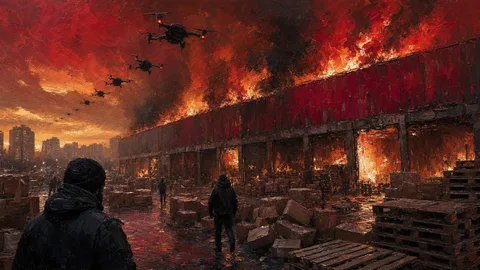
The most symbolic target of this strike was the Moscow oil refinery, located in the Kapotnya district, just fifteen kilometers from the Kremlin, a facility operated by a subsidiary of the state energy giant Gazprom and already damaged by a previous Ukrainian strike earlier the same week.
Why this report focuses on this specific night
I chose to reconstruct this night of attack hour by hour, source by source, because it illustrates with rare clarity the new Ukrainian doctrine of striking directly at the energy infrastructure that fuels Russia's war machine, rather than limiting itself to strictly military targets on the front line.
This strike also comes at a charged diplomatic moment, just hours before the opening of a NATO defense ministers' summit in Brussels, where Ukraine's security was among the priority topics of discussion among Western allies.
The target: the Kapotnya refinery, Moscow's energy lung
A strategic facility tied to the Russian war effort
The Kapotnya refinery, operated by a Gazprom subsidiary, is not a trivial civilian target: according to Ukrainian statements reported by ABC News, this facility directly supports the logistics of the Russian military apparatus, producing fuel essential to the ongoing operations of the Russian army on the Ukrainian front.
Video footage verified by ABC News and CNN shows precise explosions within the Kapotnya complex, with large columns of black smoke rising above the Russian capital, while a missile launched from the ground was filmed as the drones approached the refinery.
The second strike in a week on the same site
President Volodymyr Zelensky stated that this attack marked the second time in one week that Kyiv had specifically targeted the Moscow oil refinery, a deliberate repetition that suggests a strategy of systematic harassment rather than an isolated, symbolic strike against this critical Russian energy infrastructure.
This Ukrainian insistence on a single target, struck twice in such a short time, reveals a clear intent to maximize cumulative damage on a facility whose full repair likely requires weeks, if not months, given the scale of destruction already documented by several independent sources.
The scale of the attack: hundreds of drones over twelve regions
A massive deployment across Russian territory
This Ukrainian offensive targeted more than a dozen Russian regions simultaneously, a massive deployment that considerably tested Russian air defense systems, forcing Moscow to spread its defensive resources across an immense territory rather than concentrating protection solely on the capital.
The Russian Defense Ministry claimed to have shot down at least 555 Ukrainian drones during this night of attack, a figure that, even though it comes from an official Russian source potentially inclined to exaggerate its defensive successes, nonetheless testifies to the considerable scale of the Ukrainian offensive that night.
One hundred eighty drones intercepted near Moscow
Moscow Mayor Sergei Sobyanin confirmed on Telegram that approximately one hundred eighty drones had been shot down as they specifically approached the Russian capital, a figure that illustrates the deliberate concentration of the Ukrainian effort on Moscow rather than a simple random dispersion of strikes across the whole of Russian territory.
This concentration on the capital, despite the scale of the Russian air defenses deployed to protect it, confirms that Kyiv now considers Moscow itself a legitimate and reachable target, a major strategic evolution compared to the early years of the conflict, when deep Ukrainian strikes remained much rarer.
Collateral damage in the Russian capital
Residential buildings hit, according to Moscow
Moscow's public prosecutor's office confirmed that several districts of the city were hit by drones, with damage reported to residential buildings, a consequence that illustrates the risks inherent in any long-range strike campaign carried out in an urban environment as densely populated as the Russian capital.
Russian authorities also reported casualties without specifying the exact number or severity, a usual opacity in official Russian communications regarding civilian losses, which complicates any independent and precise assessment of the real human impact of this strike on the Muscovite population.
Seventeen wounded according to Russian authorities
According to figures reported by CNN, at least seventeen people were wounded in this attack, a toll that, although limited compared to the scale of the Ukrainian offensive deployed that night, is a reminder that these deep strikes inevitably carry a risk of civilian casualties, even when the targets remain military-industrial infrastructure.
This reality, which I must report honestly despite my acknowledged support for the Ukrainian cause, illustrates the moral complexity of any modern war where even the most precisely targeted strikes on military infrastructure can cause collateral damage in surrounding urban areas.
Moscow's airports paralyzed
A major disruption of air traffic
Moscow's main airports temporarily suspended operations during this night of attack, according to information reported by Reuters and cited by CNN, a disruption that illustrates the tangible impact of this Ukrainian offensive on the daily functioning of the Russian capital, well beyond direct material damage alone.
This air paralysis, even if temporary, reminds ordinary Russian citizens that the war launched by their own government against Ukraine now carries direct and tangible consequences for their daily lives, a reality that Russian state propaganda usually tries to minimize or conceal entirely.
A signal sent well beyond the refinery alone
This Ukrainian ability to simultaneously disrupt Moscow's commercial air traffic while striking a strategic energy facility demonstrates the growing operational sophistication of Ukrainian forces, capable of conducting complex, coordinated operations far from their own territory, right at the heart of the Russian defense apparatus.
This technical sophistication, acquired after more than four years of war and constant innovation in the field of drones, confirms that Ukraine has developed a long-range strike capability that seriously worries Russian military planners, forced to continually rethink their defensive systems.
Zelensky's words: "it is time for the war to end"
A statement that sums up Ukrainian doctrine
President Volodymyr Zelensky described this strike as a "fully justified response to Russian attacks on our cities and our communities," adding that it was "another important result of the work of our fighters against facilities that support the Russian war machine," according to the exact words reported by ABC News.
This precise phrasing, which emphasizes the defensive justification for the strike rather than its offensive character, is consistent with Zelensky's constant messaging since the start of the invasion: every deep Ukrainian action is presented as a proportionate response to ongoing Russian aggression rather than a unilateral escalation by Kyiv.
The diplomatic message behind the military strike
Zelensky also stated that these medium- and long-range Ukrainian strikes aimed to "push Moscow toward diplomacy," noting that Ukraine's Western partners had "noted the precision and effectiveness" of this strategy of continuous military and economic pressure on Russian infrastructure.
Discover

INVESTIGATION: Beijing cuts Africa to 2.1 billion in loans…
2.1 billion — the lowest figure in almost twenty years, according…

SPECIAL REPORT: Beijing Promises Stimulus as Its Households Give…
That is the growth rate of Chinese industrial output in July,…

INVESTIGATION: Two Chinese Ex-Soldiers Arrested in Seoul as 18,000…
For five years, a man ran a military-supply shop at the…
This statement confirms that Kyiv views these strikes not as an end in themselves, but as a negotiating lever meant to convince Moscow that continuing the war now carries a growing economic and symbolic price, a calculated pressure strategy rather than a simple gratuitous show of force.
Russia's response: seven missiles and 239 drones on Ukraine
An immediate counterattack on Ukrainian territory
In retaliation, Russia launched at least seven ballistic missiles and two hundred thirty-nine drones against Ukrainian territory during the same night, according to figures reported by ABC News, explicitly targeting, according to the Russian Defense Ministry, "fuel and energy facilities used by the Ukrainian armed forces."
This immediate, symmetrical retaliation illustrates the reciprocal escalation dynamic that characterizes this phase of the war: every Ukrainian strike on Russian energy infrastructure triggers a similar Russian response targeting Ukrainian energy capabilities, in a cycle of retaliation that shows no sign of slowing after more than four years of conflict.
A Ukrainian defense that limits the damage
Ukraine claimed to have intercepted or destroyed at least two hundred sixteen Russian drones or missiles during this counterattack, a high interception rate that testifies to the growing effectiveness of Ukrainian air defense systems, strengthened over the years by continuous Western aid, including American Patriot systems.
This Ukrainian defensive capability, though never perfect or total, contrasts with the country's initial vulnerability at the start of the invasion in 2022, illustrating a gradual buildup of Ukrainian resilience in the face of Russian attacks that nonetheless remain massive and destructive every night.
The bigger picture: targeting energy to strangle the war
A strategy pursued openly for several weeks
This strike on Kapotnya is part of a broader Ukrainian strategy pursued openly: intensifying long-range strikes against Russian energy infrastructure, an approach that Zelensky himself has described as essential to exerting sufficient pressure on Moscow to end its military operations in Ukraine.
This energy doctrine, documented by CNN as a growing priority for Kyiv in recent weeks, specifically targets refineries, fuel depots, and logistical infrastructure that allow the Russian army to continue its operations on the front, rather than limiting itself to military targets directly engaged in combat.
A response to the Russian strike on a Kyiv monastery
Zelensky presented this June 18 strike as a "justified" response to a recent Russian attack on a historic monastic complex in Kyiv recognized by UNESCO, according to details reported by CNN, a reference that places this strike within a broader cycle of mutual retaliation that also affects the cultural and religious heritage of both nations.
This heritage dimension of the conflict, often overshadowed by military and energy tallies, is a reminder that this war also continues to inflict irreversible damage on the shared cultural heritage of the region, one more tragic aspect of a Russian invasion that respects no moral or historical limit.
Diplomatic timing: a NATO summit in the background
A strike that came just before Brussels
This massive attack on Moscow occurred in the hours preceding the opening of a NATO defense ministers' summit in Brussels, where Ukraine's security was explicitly among the priority topics of discussion among representatives of the Atlantic Alliance's member states.
This timing, whether deliberate or simply coinciding with the Ukrainian operational calendar, sends an implicit message to Western allies gathered in Brussels: Ukraine retains significant offensive capability and continues to demonstrate its determination to strike deep into Russian territory despite more than four years of a war of attrition.
A message with two recipients
This strike, occurring at such a charged diplomatic moment, seems to send a dual message: to Moscow, that no energy infrastructure remains out of reach of Ukrainian drones; and to Western allies gathered in Brussels, that their continued support produces tangible and measurable operational results on the ground.
This dual strategic communication, skillful and calculated, illustrates the growing maturity of Ukrainian military diplomacy, able to synchronize operations on the ground with its international diplomatic calendar to maximize the political impact of every military action undertaken against Russia.
What this strike reveals about current Ukrainian capabilities
A drone industry that has matured in four years
This ability to simultaneously launch hundreds of drones against more than a dozen Russian regions, while maintaining enough precision to specifically target a particular refinery in Kapotnya, illustrates the impressive maturation of the Ukrainian drone industry since the start of the invasion, largely developed in direct response to urgent battlefield needs.
This industry, largely domestic and developed under the constant pressure of war, now represents one of Ukraine's most valuable strategic assets, a capacity for rapid innovation that partially offsets the gap in material and human resources against a Russia with a much larger population and industrial base.
A lesson for the entire West
This demonstration of Ukrainian capability also offers a valuable lesson for all Western armed forces, which face having to fundamentally rethink their own air defense doctrines in light of the growing threat of cheap but numerically overwhelming drone swarms, a technological shift that redefines the standards of modern warfare well beyond the Ukrainian theater alone.
On the same topic

INVESTIGATION : Russia's FSB Erases 4 Ukrainian Regions' Border…
Not an assault, not an ultimatum, not a televised proclamation from…

DOSSIER: 60,000 Russian passports in Transnistria — the annexation…
More than sixty thousand applications for Russian citizenship in three months,…
ANALYSIS: 800 drones over Russia in one night —…
More than eight hundred drones, in a single night, August 14…
This Ukrainian innovation, born of necessity and survival, could thus durably influence Western military doctrine for decades to come, a strategic legacy that will far outlast the timeframe of this specific war against Russian aggression.
The limits of this energy-strike strategy
Real but not yet decisive pressure
Despite the impressive scale of this strike and its documented immediate effects on Kapotnya, I must honestly acknowledge that this strategy of repeated energy strikes has not yet produced the decisive effect that Kyiv seems to hope for: Russia continues its military operations in Ukraine with no visible sign of a significant slowdown in its overall war effort.
This reality, which I must name without excessive indulgence toward the Ukrainian cause I otherwise support, is a reminder that Russia's industrial and logistical resilience, despite very real localized damage, remains sufficient to absorb this type of repeated strike without an immediate collapse of its war machine.
A war of attrition being fought on several fronts
This limitation does not, however, diminish the strategic value of these repeated strikes: every damaged refinery, every air defense system mobilized to protect Moscow, every temporarily closed airport represents a cumulative cost that Russia will have to keep absorbing as long as this war of attrition continues without a negotiated diplomatic resolution.
This energy war of attrition, waged alongside traditional ground combat on the Donbas front and elsewhere, could ultimately weigh more heavily in the long run on Russia's ability to sustain this invasion than any single battle, however spectacular it may appear in the media in the short term.
The international reaction and the cautious silence of some allies
Washington and Brussels remain measured in the face of escalation
Faced with this spectacular escalation directly targeting the Russian capital, the reaction from Western capitals remained notably measured, with American and European spokespeople limiting themselves to generic calls for de-escalation without explicitly condemning either the Ukrainian attack on Kapotnya or Russia's massive retaliation against Ukrainian civilian infrastructure.
This diplomatic caution, which contrasts with the strike's media prominence, illustrates the persistent difficulty facing Western allies in formulating a clear position when Ukraine itself strikes deep into Russian territory, a strategic gray zone that Kyiv now exploits with growing confidence.
A Ukraine that alone claims responsibility for its strikes
Unlike some previous operations where ambiguity persisted over the origin of the attacks, Ukrainian authorities this time openly claimed the strike on Kapotnya, a communication choice that reflects a deliberate intent to show the entire world, and the Russian population itself, that Moscow is no longer safe.
This public claim, owned by the highest levels of the Ukrainian government, marks a significant shift from the early years of the conflict, when Kyiv generally avoided directly commenting on deep operations on Russian soil so as not to trigger an uncontrolled escalation.
What this strike means for civilian populations on both sides
Moscow residents discover an unprecedented vulnerability
For millions of Muscovite residents accustomed for decades to considering their capital completely sheltered from the conflicts Russia wages at its borders, this night of sirens, air disruptions, and documented damage fifteen kilometers from the Kremlin represents a psychological rupture whose exact scale remains difficult to measure from the outside.
This newly felt vulnerability among the Russian population, largely shielded from the daily realities experienced by Ukrainian civilians since 2022, could gradually erode the tacit or passive support that Vladimir Putin's regime still enjoys among part of its population.
Ukrainian civilians continue to pay the heavy price
While Moscow discovers a relatively new vulnerability, Ukrainian civilians continue to endure, night after night for more than four years, far more destructive and systematic bombardments targeting their energy infrastructure, their hospitals, and their homes, an asymmetry of suffering this report must name without ambiguity.
This fundamental asymmetry between a Russia discovering occasional discomfort and a Ukraine living daily horror for years remains the central fact of this war, regardless of the spectacular scale of an isolated strike on Kapotnya.
The role of Western intelligence in strike precision
Discreet but decisive cooperation since 2022
Although Kyiv claims full operational credit for this strike on Kapotnya, several defense analysts note that the remarkable precision of this type of operation relies heavily on years of Western intelligence sharing, particularly American and British, cooperation that has deepened considerably since the start of the invasion in 2022.
This structural dependence on Western intelligence, rarely acknowledged publicly by Ukrainian authorities for obvious operational sovereignty reasons, nonetheless illustrates just how much this war remains fundamentally a collective Western effort to contain Russian aggression, well beyond Ukraine's national capabilities alone.
Persistent uncertainty under the Trump administration
This intelligence cooperation, essential to the success of strikes as precise as the one on Kapotnya, nonetheless remains subject to the unpredictable political fluctuations of the Trump administration, whose mixed signals toward Kyiv continue to fuel a strategic uncertainty that neither European allies nor Ukraine itself can fully anticipate.
This American uncertainty, which I consider one of the most serious structural risks weighing on Ukraine's ability to sustain this pace of deep strikes, underscores the urgency for Europeans to develop their own autonomous intelligence capabilities, without excessive dependence on Washington.
Conclusion: Kapotnya, one more symbol in a war with no visible end
What this night of attack will mean for history
The night of June 18, 2026 will go down in the history of this conflict as one of the clearest demonstrations of Ukraine's ability to strike at the symbolic and logistical heart of Russia, just fifteen kilometers from the Kremlin, confirming that Moscow itself is no longer an untouchable sanctuary in the face of Ukrainian determination.
This strike, however impressive operationally, does not end the war: it is instead part of a continuous cycle of escalation and reciprocal retaliation that will likely continue to define this conflict as long as no lasting diplomatic solution has been found between Kyiv and Moscow.
A sentence that sums it all up: it is time for the war to end
Volodymyr Zelensky's words, stating that it is "time for the war to end," resonate as both a call and a warning: Ukraine has once again demonstrated its ability to make Russia pay a tangible price for continuing this unjustifiable invasion, but that capability alone will not be enough to bring peace without an equivalent political will on the Russian side.
This report ends on this complex reality: every night of strikes, every damaged refinery, every paralyzed airport may bring Moscow closer to a rational calculation favoring negotiation, but nothing yet guarantees that day will come before more lives, on both sides of this tragic war, are sacrificed.
By Maxime Marquette, columnist
Columnist's transparency note
My limits and my acknowledged biases
I write this report with an acknowledged bias in favor of Ukrainian resistance to the Russian invasion, which inevitably colors my favorable interpretation of this strike against the Kapotnya refinery, despite the documented collateral damage in residential areas of Moscow.
I am not a military expert or a specialist in Russian energy issues, and I rely primarily on reporting already published by ABC News and CNN, without direct access to the ground or the ability to independently verify the casualty figures put forward by Russian or Ukrainian authorities.
What I don't know and my method
I cannot confirm the exact extent of the damage suffered by the Kapotnya refinery, nor can I assess with certainty the real impact of this strike on Russian energy production capacity in the medium term, as both sides have an interest in exaggerating or minimizing these effects according to their respective communication goals.
My method relies on cross-referencing two independent journalistic sources, ABC News and CNN, both of which verified video footage of the strike, supplemented by official statements directly attributed to Volodymyr Zelensky and the relevant Russian authorities.
Sources
Primary sources
Secondary sources
Get the geopolitics analyses
Conflicts, powers, alliances: the MadMax thread without the noise.
Cite this article
Maxime Marquette (2026). At Kapotnya, Ukrainian drones strike the heart of Russian oil. MadMax. https://mad-max.co/en/article/reportage-a-kapotnya-les-drones-ukrainiens-frappent-le-cur-petrolier-russe
Read next
INVESTIGATION: Beijing cuts Africa to 2.1 billion in loans…
2.1 billion — the lowest figure in almost twenty years, according…
SPECIAL REPORT: Beijing Promises Stimulus as Its Households Give…
That is the growth rate of Chinese industrial output in July,…
INVESTIGATION: Two Chinese Ex-Soldiers Arrested in Seoul as 18,000…
For five years, a man ran a military-supply shop at the…
Enjoyed this piece? Get the next one.
One chronicle a week, straight to your inbox. No noise.
This article was generated with AI assistance, under human supervision.
Comments
Be the first to weigh in.