

ACCOUNT: Moscow on Fire — The Night Ukraine Struck the Heart of the Russian Capital
During the night of June 17 to 18, 2026, an air raid siren wailed across the Moscow region shortly after midnight. For
- During the night of June 17 to 18, 2026, an air raid siren wailed across the Moscow region shortly after midnight. For
- Introduction: The Night Moscow Stopped Believing It Was Untouchable
- Midnight on the Boulevard of Impunity
Facts, quotes, and cited links remain in the body. Interpretations are framed as analysis or opinion according to the format.
Introduction: The Night Moscow Stopped Believing It Was Untouchable
Midnight on the Boulevard of Impunity
During the night of June 17 to 18, 2026, an air raid siren wailed across the Moscow region shortly after midnight. For the majority of Muscovites, these alerts had become almost routine — something abstract, a signal that the war was happening elsewhere, far away, in the Ukrainian steppes, in the trenches of Donetsk, hundreds of kilometers from the Kremlin. That night, that illusion came to a spectacular end. What would follow would be the largest drone attack ever conducted against the Russian capital since the start of the full-scale war.
On Russian social networks, the first videos began to circulate around 1 AM: points of light streaking through the Moscow night sky, accompanied by dull thuds. Residents of the southern suburbs — Kapotnia, Lyubertsy, Zhukovsky — described the incomprehensible: Ukrainian drones, circling over their neighborhoods with virtually no visible opposition. This wasn't a movie. It was war knocking on the door of thirteen million people.
The Chronicle of a Predictable Escalation
To understand this night, one must go back to June 14-15, 2026. Russia had then launched an attack of rare brutality against Kyiv, targeting, among others, the Kyiv Pechersk Lavra, one of the most sacred monasteries in the Orthodox Christian world and a UNESCO World Heritage site. Fragments of a Shahed-type drone had pierced the roof of the main cathedral. Five people had been killed in the Ukrainian capital, thirty-five wounded. This was not collateral damage — it was a message. On June 16, in response, Ukraine had already struck the Moscow refinery in Kapotnia for the first time, damaging the AVT-6 processing unit and forcing a halt in operations. The retaliation on June 18 would be far more devastating.
The Ukrainian Arsenal Takes Flight
Five Hundred and Fifty-Five Drones in the Russian Night
According to the Russian Ministry of Defense, its air defense systems intercepted a total of 555 Ukrainian drones across Russian territory and annexed Crimea during the night of June 17 to 18. A staggering number — which, according to analysts at the Institute for the Study of War (ISW), represents roughly double the number of drones Russia had launched against Ukraine that same night. The Kremlin was used to counting its adversary's weapons. That night, the numbers reflected a deeply unflattering image of its own air defenses.
The Ukrainian drones employed in this operation represented a formidable technological array: the FP-1, a long-range attack drone developed in Ukraine; the Liutyi (AN-196), a fixed-wing craft with a 6.7-meter wingspan, comparable in size to a compact car; and above all the Bober, a jet-powered drone, faster, harder to intercept, and capable of carrying a larger explosive payload. The Guardian also mentioned the use of Bars hybrid drone-missiles, with an estimated range of 560-800 kilometers. This combination of systems forced Russian anti-aircraft defense to simultaneously handle threats with vastly different speeds and radar signatures — a nearly impossible mission at such a large scale.
Strategic Objective: Suffocating the Russian War Machine
The Ukrainian strategy of striking Russian oil infrastructure was not new, but on June 18, it reached an unprecedented symbolic dimension. Since the spring of 2026, Kyiv had systematically targeted refineries, fuel depots, and oil terminals — from Krasnodar on the Black Sea to Perm in the foothills of the Urals, 1,500 kilometers from Ukraine. The stated goal: to dry up the funding of the war. The Russian state draws about a third of its federal budget from oil and gas revenues. Every refinery taken out of service is a crack in the financial engine that fuels the Iskanders, the Shaheds, and the Zircons.
The Kyiv Independent had documented as early as June 16 that the oil company Tatneft had imposed national restrictions on fuel purchases at all its gas stations following earlier strikes. Scenes of rationing at gas stations were multiplying in dozens of Russian regions. Economist Sergei Vakulenko of the Carnegie Eurasian Center confirmed to the independent Russian agency Agentstvo that the two consecutive strikes on June 16 and 18 would keep the refinery out of service for several days.
The Kapotnia Refinery: Primary Target, Round Two
A Complex at the Heart of Daily Muscovite Life
The Moscow oil refinery, known by its acronym MNPZ, is located in the Kapotnia district, just 15 kilometers southeast of the Kremlin. Operated by Gazprom Neft, it processes more than 12 million metric tons of crude oil per year. It provides about 40% of the gasoline and 50% of the diesel consumed in the Moscow region. It supplies aviation fuel to the capital's four major airports: Domodedovo, Vnukovo, Zhukovsky, and Sheremetyevo. This refinery is not just an economic asset: it is the energy lung of a megacity of thirteen million people.
During the night of June 18, Ukrainian drones reached this facility for the second time in less than forty-eight hours — the first strike occurring on June 15-16, which had already damaged the ELOU-AVT-6 distillation unit and caused a temporary halt in operations. This time, the attack was deeper, more destructive. The Ukrainian General Staff confirmed that fires had broken out in five distinct locations on the site: the combined refining unit, secondary processing units, and an oil storage farm including several large-capacity tanks (RVS-10000 and RVS-30000).
The Flying Lid, The Sky Ablaze
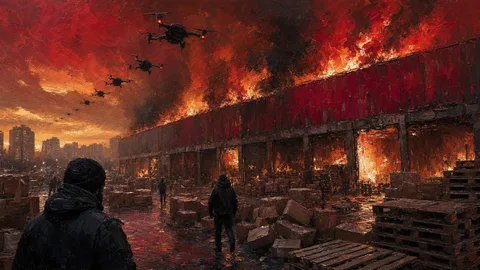
The image that went around the world was not that of a commonplace explosion. It was that of a cylindrical tank lid — a metal structure weighing several tons — launched into the air like a frisbee during the impact of a drone on a storage tank. Dozens of videos, verified by CNN and other media outlets, captured the moment: the fireball, the column of black smoke rising into the Moscow sky, the flames spreading from one tank to another within the complex. The Wall Street Journal noted that the scene looked more like a Hollywood disaster movie than an ordinary dawn over a European capital.
Sources from the Reuters agency within the Russian oil industry confirmed that the June 18 strike had damaged the Euro+ combined refining unit, as well as auxiliary equipment and storage vats. Expert Vakulenko specified that the main crude processing unit had been hit. The refinery had planned to restart Euro+ mid-week after the June 16 strike — that hope vanished in the flames of June 18. According to the Ukrainian General Staff cited by the Kyiv Independent, the refinery suspended its operations for an indefinite period.
2:10 AM — Midnight, the Alert Spreads on Telegram
Moscow Discovers in Real-Time What Its Media Conceals
At 12:10 AM local time (ten past midnight, on the night of the 17th to the 18th), the aerial surveillance channel Exilenova-Plus and other Telegram channels published the first images of drones flying over Moscow's southern outskirts. Within minutes, these posts were relayed by hundreds of thousands of subscribers. The internet censorship imposed by the Kremlin since 2022 cannot erase what residents see from their own windows. At 4:39 AM, Moscow Mayor Sergei Sobyanin published his first official statement on Telegram: air defenses were "actively repelling a massive attack." He admitted that drones had reached the city.
At 8:17 AM, Sobyanin updated his tally: approximately 180 drones were reportedly shot down on the approaches to Moscow, and "air defense operations continue." An hour later, the total climbed to 194 drones intercepted — an absolute record for the capital, eclipsing the previous attack in March 2026 where 74 drones were shot down, which was already a record. But "intercepted" does not mean "neutralized": several drones reached their targets. The Ukrainian General Staff reported fires in at least six locations within the refinery perimeter.
Plan "Carpet" and Airport Paralysis
Faced with the scale of the attack, Russian authorities triggered the emergency plan dubbed "Carpet" (Kovyor), an airspace restriction protocol activated during major aerial threats. The four Moscow airports simultaneously suspended operations: Vnukovo as of midnight, Sheremetyevo (Russia's largest) around 1 AM — its agents evacuated passengers to "secure areas," with some even being deplaned. Domodedovo and Zhukovsky followed. Queues of passengers formed in the parking lots.
The toll of the aerial disruption was colossal. Aeroflot and its subsidiary Rossiya announced the cancellation of more than 170 flights and the delay of over 110 others to and from Moscow. The Association of Tour Operators of Russia put the figures at 120 flights canceled and 160 flights delayed. Temporary flight restrictions were also imposed in Kazan, where the summit of Asian leaders presided over by Putin was precisely taking place. The Moscow Belt Road (MKAD), the capital's vital artery, was partially closed to traffic in areas near the refinery.
Black Rain: When War Invades the Apartments
Residents Woken by the Smell of Burning Oil
In the Kapotnia neighborhood, residents described a scene worthy of an industrial apocalypse. One resident named Natalia Klim, 25, told CNN: "The smell is unbearable. We closed the windows, but it’s still hard to breathe in the apartment. It’s truly terrifying." She said she heard at least ten explosions, and took refuge in her bathroom as the building shook with each impact. Another resident, Maria, said she fled to her mother's house in the countryside, noting that this was not the first time the refinery had been targeted.
But the most striking phenomenon — which spread across Russian social networks despite censorship — was what residents called the “black rain.” Dark droplets, loaded with soot and oil residue, fell onto cars, sidewalks, and apartment windows within a several-kilometer radius of the flaming refinery. In the Balashikha sector, east of Moscow, images showed entire vehicles covered in a blackish, oily film. Local authorities advised residents to limit their time outdoors and wear masks if necessary. Russian authorities officially denied any "oil rain" phenomenon — but videos and photos posted by thousands of Muscovites told a completely different story.
The Governor and the Map of Collateral Damage
The governor of the Moscow region, Andrei Vorobyov, provided the territorial assessment of the damage. At least five districts in the region were hit: Ramenskoye, Solnechnogorsk, Lyubertsy, Dzerzhinsky, and Kotelniki. In the city of Lyubertsy, an industrial area and a fitness center were damaged. A fire broke out on the roof of the Belaya Dacha shopping center. Debris from drones and Russian anti-aircraft missiles (the Kremlin refers to "falling debris") caused damage in about ten sites according to authority reports and analysis of geolocated videos by the ISW.
In the Zhukovsky district, a multi-story residential building was damaged and its residents evacuated. A strike, or debris, also hit the Sadovod shopping center, one of Moscow's largest wholesale markets. The official human toll — 17 injured including two children in the Moscow region according to Governor Vorobyov — was deemed remarkably low given the intensity of the attack. No deaths were reported in the capital or its immediate suburbs, although one person was killed in the Rostov region during related strikes the same night.
Putin in Kazan: The War Leader Absent at the Crucial Moment
Discover

INVESTIGATION: Beijing cuts Africa to 2.1 billion in loans…
2.1 billion — the lowest figure in almost twenty years, according…

SPECIAL REPORT: Beijing Promises Stimulus as Its Households Give…
That is the growth rate of Chinese industrial output in July,…

INVESTIGATION: Two Chinese Ex-Soldiers Arrested in Seoul as 18,000…
For five years, a man ran a military-supply shop at the…
700 Kilometers Away, Zero Comments
While Moscow burned, Russian President Vladimir Putin was presiding, 700 kilometers to the east, over the ASEAN summit in Kazan, welcoming leaders from Southeast Asia to the banks of the Volga. According to Le Monde, it was the first time in seven months that Putin had left Moscow and Saint Petersburg. The occasion had been carefully chosen to project the image of a leader in control, engaged in multilateral diplomacy. The Kapotnia refinery in flames, visible for miles around, offered a brutal counter-narrative.
Putin did not say a word publicly about the strikes during the first hours of the attack. This silence — in a country where the official narrative is meticulously controlled — was itself telling. It was Foreign Minister Sergei Lavrov, from his own platforms, who delivered the Kremlin's rhetorical response: Russia would now conduct regular “massive group strikes” against Ukraine, he promised, in direct response to the attacks on Moscow. A threat that Ukraine and its partners had known by heart for four years — and which dozens of Ukrainian missiles had just transformed into an admission of relative powerlessness.
The G7 Summit Backdrop
The June 18 attack occurred in a dense diplomatic context. Volodymyr Zelensky was precisely in Brussels that day, meeting with NATO officials during a meeting of the Alliance's defense ministers. A few days earlier, he had participated in the G7 summit in France, where he met with U.S. President Donald Trump — describing that conversation as having resulted in a "positive" response from Trump to his proposals. Zelensky told reporters in Brussels that "everyone" had agreed to help Ukraine acquire strengthened air defense systems.
The United Kingdom announced in those very same days a military aid package of 752 million pounds sterling (approximately one billion dollars), including the delivery of 150,000 drones to Ukraine by the end of the year. This announcement, reported by Al Jazeera, illustrated the extent to which the Ukrainian drone campaign was now at the heart of the Western strategy to support Kyiv. Zelensky had repeatedly stated that the strikes on Moscow were intended to demonstrate — to Westerners as much as to Russians — that Ukraine was capable of carrying the war to the territory of its aggressor.
Zelensky's Retaliation: "If Ukraine Burns, Moscow Does Too"
The Answer to the Kyiv Pechersk Lavra
In a social media statement published in the hours following the strike, Ukrainian President Volodymyr Zelensky personally confirmed the attack: "Last night, our long-range weapons again reached the Moscow region — for the second time this week, the Moscow refinery was hit." He explicitly named the Russian strike on the Kyiv Pechersk Lavra of June 14-15 as the direct trigger. This monastery, founded in the 11th century and a UNESCO World Heritage site, is one of the most sacred sites of Slavic Orthodox Christianity. A Russian Shahed drone had pierced its roof during a massive attack in which five civilians were killed in Kyiv and thirty-five wounded.
In a voice message addressed to journalists in Brussels, Zelensky formulated what was perhaps the sharpest statement of his presidency since the start of the full-scale war: "We never wanted this war — this is known to all, including our partners. But if Ukraine is devastated, Moscow will be too. We repeat, therefore, that it is time to cease the aggression and end this war." The equation was set with a clarity that did not exist in 2022: the symmetry of pain as a lever for peace.
The Strategic Dimension of "Long-Range Sanctions"
Zelensky and his military advisors had rebranded the drone strikes in Russia with deliberately legal and economic terminology: “long-range sanctions.” This phrase, taken up by the Ukrainian Chief of Staff, rhetorically transformed the drone war into an instrument of economic policy — a Ukrainian response to the sanctions that the West sometimes hesitated to strengthen. According to data published by Bloomberg and energy experts cited by the New York Times, the Ukrainian campaign had disabled facilities representing about a third of Russia's total refining capacity, affecting more than 25 regions facing fuel shortages.
The ISW noted in its June 18 assessment that repeated Ukrainian strikes against defended areas of the Russian rear, like Moscow, "continue to expose Russia's weaknesses and its inability to protect its own civilian population." A formulation that turned one of the Kremlin's main propaganda arguments back against it: the Russian state as the guarantor of national security.
The Drones That Crossed the Sky Without Being Shot Down
The Blatant Failures of Russian Air Defense
The figure of 555 drones intercepted proclaimed by the Russian Ministry of Defense was immediately subjected to critical analysis by military experts. A pro-Kremlin milblogger, cited by the ISW, himself acknowledged an interception rate of about 90% — which mechanically means that some 10% of the drones reached their targets in a country that spends colossal sums on its air defense. Geolocated videos from open sources showed Ukrainian drones flying over the heart of Moscow at low altitude, with almost zero opposition.
The Guardian noted that residents of Moscow's eastern suburbs saw drones passing overhead "with minimal resistance," some only realizing an attack was underway when observing the craft from their windows. A video, verified by CNN, showed a portable air defense operator attempting to intercept a Ukrainian drone from a road — seconds before the craft reached the refinery. The ISW concluded that the attack had "generated substantial damage, even if Russian forces achieved a high interception rate" — emphasizing that Ukraine was increasing its drone capabilities to the point that even a small penetration percentage was enough to produce significant effects.
The Russian Debris Paradox
A thorny question quickly emerged in the analyses: was part of the damage caused to residential buildings and shopping centers in Moscow due to the Ukrainian drones themselves, or to Russian anti-aircraft missiles which, missing their targets, fell back onto the city? The Kremlin systematically attributed all civilian damage to "falling debris" — implying: from Ukrainian drones. But the video published by Russian sources showing a portable missile fired from a Moscow road, combined with ballistic analysis of the impacts, suggested that several of the damaged buildings were hit by Russia's own interceptors. The ISW explicitly formulated this possibility in its assessment.
This phenomenon — known as "friendly fire" — posed a major political problem for Moscow: admitting that its own defense systems were wounding its own citizens would have been catastrophic for domestic morale. The solution: attribute everything to Ukraine, without distinction. A mechanism of state lies which, precisely because Russian social networks were fed with videos filmed from balconies, became less and less credible for Muscovites themselves.
The Chronicle of Six Fires at the Refinery
Five Simultaneous Fire Points Across the Complex
The General Staff of the Ukrainian Armed Forces was precise in its operational assessment: fires had broken out in five distinct locations within the Kapotnia refinery complex. These five hotspots corresponded to specific targets: the combined refining unit (the complex's most important), secondary processing units, and a storage farm including several large-capacity cylindrical tanks. Industrial sources cited by Reuters confirmed that the Euro+ unit — the highest value-added processing unit on the site — had been damaged.
The independent Russian agency Agentstvo, meanwhile, mentioned at least six fires on the refinery site, based on analysis of open-source videos. These flames, visible from several Moscow districts, burned for hours. Dense black smoke covered the sky over the south of the capital throughout the morning of June 18, visible on satellite imagery. Traffic on the MKAD road was interrupted in areas near the complex. Large numbers of firefighting teams were deployed, but access to the refinery's internal fire points remained complex due to the risk of secondary explosions.
The Euro+ Unit: The Hardest Hit
Expert Sergei Vakulenko of the Carnegie Eurasian Center explained to Agentstvo that the targeting of the Euro+ unit represented a particularly severe blow to the complex's operational capacity. This unit was the one that had been prepared to restart after the damage of June 16. Its destruction on June 18 meant the refinery could not quickly resume partial production. According to Reuters sources in the industry, the two combined strikes were going to keep the entire refinery out of service for several days, perhaps longer. For a facility that provides fuel for all the Russian capital's airports, the consequences for national air logistics would be lasting.
In light of this data, the economic and operational impact of the night of June 18 went far beyond the symbolic. The annual processing capacity of the Moscow refinery represents 11.6 million metric tons of crude oil, or 2.9 million tons of gasoline and 3.2 million tons of diesel according to the latest available data. Its prolonged shutdown exerted direct pressure on the Russian domestic fuel market, already weakened by months of Ukrainian strikes on other refineries across the country.
On the same topic

ANALYSIS: 313 Votes, a 20th Extension — Ukraine Keeps…
313 votes to approve the presidential decree extending martial law by…

REPORT: One Year Past the August 18 Ultimatum, Ukraine's…
At midnight on August 18, 2025, the deadline expired that the…
ANALYSIS: 800 drones over Russia in one night —…
More than eight hundred drones, in a single night, August 14…
Reactions in Russia: Between Censorship and the Flight from Reality
Sobyanin on Telegram: Between Admissions and Downplaying
Moscow Mayor Sergei Sobyanin was the most visible Russian official during this night of attacks. His successive posts on Telegram — at 4:39 AM, then 8:17 AM, then throughout the morning — constituted an involuntary narrative of the attack's progression. His initial phrasing — that air defenses were "actively repelling" — gradually gave way to admissions of penetration: "several drones reached the oil refinery." He admitted to "minor damage" to a building at the Sadovod shopping center. But he carefully avoided giving any specifics on the scale of the fires at the refinery itself, preferring to reassure the public about the measures taken.
The governor of the Moscow region, Andrei Vorobyov, was more precise about human and material damage in the suburbs, confirming the 17 injuries in five districts. But the official line remained constant: downplay, attribute damage to debris, insist on the efficiency of air defense. This communication strategy, however, ran into an insurmountable problem: thousands of Muscovites were publishing in real-time what they saw with their own eyes — the flames, the smoke, the drones crossing the sky. Reality overflowed the dam of propaganda from all sides.
Muscovites in Messaging Groups
International correspondents present in Moscow on June 18 noted an unusual atmosphere in the city. According to the Guardian, "the magnitude of the Ukrainian long-range operation... surprised many in a city that does not usually alert its residents with air raid sirens. This unexpected attack caused widespread panic on social media as residents expressed their shock." Private messaging groups — Telegram, WhatsApp — became the true locus of information. Residents reported seeing drones fly over their neighborhoods "practically without resistance."
The newspaper Le Monde collected testimonies from Muscovites expressing their fear and frustration discreetly, via messaging apps. Zelensky himself cited this dimension in his post-strike statement: "The main thing is that the residents of Russia are beginning to feel that one man, Putin, is leading this war, while ordinary people pay the price." This was the ultimate political goal: to dissociate the Russian people from their leader in the perception of responsibility for the war.
ISW Deciphers: Russian Strategic Flaws Exposed
An Air Defense at Its Breaking Point
The Institute for the Study of War, in its June 18, 2026 campaign assessment written by analyst Adam Grace and his team, was particularly severe in its diagnosis: “Repeated Ukrainian strikes against heavily defended Russian rear areas like Moscow continue to expose Russia’s weaknesses and its inability to defend its own civilian population.” The ISW emphasized that Ukraine was increasing its drone capabilities to the point that "even a relatively small number of craft reaching their targets generates significant effects." In other words: the fact that 90% of drones are intercepted is no longer enough to protect strategic targets — it only takes a few to put a refinery out of service.
This analysis had profound implications for the strategic balance of the war. The Russian S-400 and Pantsir systems, presented for years as the most sophisticated air defenses in the world, were showing their limits against a massive number of low-cost flying machines. Ukraine had adapted its doctrine accordingly: sending hundreds of drones simultaneously, on varied vectors and altitudes, combining slow craft (FP-1) and fast jet-powered craft (Bober), to saturate the opposing interception systems. A doctrine of saturation which, according to ISW analysts, was going to prove increasingly difficult to counter without a radical modernization of Russian air defense.
Moscow's Dilemma Facing Public Opinion
The ISW also pointed to the political dilemma these attacks created for the Kremlin: “Ukraine is demonstrating the increasing vulnerability of Russian air defenses and the dilemmas in how the Kremlin chooses to interact with the domestic costs of the war it started.” In plain language: every drone that gets through sends a message to Russian citizens about their state's incompetence in protecting them. And the more Moscow officially downplays the damage, the more the discrepancy with videos circulating on social media erodes the power's credibility.
This dilemma was all the more acute because the Kremlin had built a significant part of its internal legitimacy on the promise of a quick and clean military victory, without damage to deep Russia. Four years after the start of the full-scale war, with lines at gas stations in more than 25 regions, flights canceled at all Moscow airports, and black rain on the cars of Kapotnia, that promise lay in tatters.
The Regional Context: A Nationwide Campaign Across Russian Territory
Rostov, Yaroslavl, Crimea: The Strike Was Nationwide
The June 18 strike was not limited to Moscow. During the same night, Ukraine also struck the Gukovo oil depot in the Rostov region, triggering a fire confirmed by geolocated images and acknowledged by the regional governor. Traffic restrictions were imposed on the Yaroslavl-Moscow highway after Ukrainian drones forced the temporary closure of the road, according to Yaroslavl Governor Mikhail Evrayev. In occupied Crimea, Ukraine simultaneously continued its campaign of logistical disruption, striking a railway bridge over the North Crimean Canal according to the Ukrainian General Staff.
This nationwide character of the operation — 555 drones over numerous regions in a single night — illustrated the Ukrainian doctrine of “multi-point pressure”: forcing Russian air defense to disperse across the entire territory, to create windows of penetration toward priority targets. On the night of June 17 to 18, according to the Russian Ministry of Defense itself, Ukrainian drones were intercepted over the Sea of Azov, in central regions of Russia, in Crimea, and in the regions surrounding Moscow. This deployment over such a vast geographic area demonstrated the growing operational autonomy of the Ukrainian drone force.
Pressure on Oil Infrastructure Since Spring 2026
To understand the June 18 strike in its context, one must look back at the trajectory of the Ukrainian campaign against Russian energy infrastructure. Since the spring of 2026, according to data compiled by Reuters and energy experts cited by the New York Times, the number of strikes on Russian refineries had doubled compared to the beginning of the year. The targeted facilities — from Krasnodar to Perm, from Tatarstan to Saint Petersburg — cumulatively represented a considerable share of national refining capacity. The New York Times described the new Ukrainian strategy as a “logistics lockdown” (logistics lockdown), targeting not only refineries but also unarmored transporters behind the front lines.
The consequences were measurable: Russian fuel production was down, shortages were affecting "practically the entire country" according to DW, and the first signs of official rationing were appearing. The company Tatneft had already imposed a limit of 30 liters of gasoline per vehicle at all its stations following previous strikes. Russia, the world's third-largest oil producer, was now forced to import fuel by sea to meet its internal needs — an unprecedented economic humiliation.
Final Chronology: From Midnight to the Moment of Truth
Key Milestones of a Historic Night
To reconstruct the exact sequence of the night of June 17 to 18, 2026, here are the chronological benchmarks confirmed by primary sources. 12:10 AM: first air raid alert in the Moscow region, first Telegram videos of drones over the southern suburbs. 4:39 AM: first statement from Mayor Sobyanin: "defenses are actively repelling a massive attack." 6:00 AM: according to The Moscow Times, Sobyanin admits that "several drones" hit the Gazprom Neft refinery in Kapotnia. 8:17 AM: Sobyanin announces 180 drones intercepted on the approaches to Moscow, stating that defense operations continue. 9:30 AM: official confirmation of the closure of the four Moscow airports (Vnukovo, Domodedovo, Zhukovsky, Sheremetyevo). Approx. 10:00 AM: total raised to 194 drones intercepted over Moscow alone.
During the morning of June 18, Zelensky confirmed the attack on social media, calling it a “fully justified response.” The Ukrainian General Staff detailed the targets hit at the refinery. Aeroflot and Rossiya announced the cancellation of more than 170 flights and the delay of over 110 others. Sheremetyevo — Russia's largest airport — reopened around 11:00 AM Moscow time. Fires at the refinery continued to burn hours after the end of the attack, with columns of black smoke remaining visible from the city center until early afternoon.
The Aftermath: Lavrov Threatens, Ukraine Strikes Again
In the hours following the attack, Minister Lavrov announced that Russia would conduct regular massive strikes against Ukraine in response. A familiar threat — and one that materialized: on the night of June 17 to 18, Russia had already launched seven Iskander-M/S-400 ballistic missiles and 239 drones of the Shahed, Gerbera, Italmas, and Parodiya types against Ukraine according to Ukrainian Air Force figures. Damage was recorded in the Dnipropetrovsk, Kyiv, and Poltava oblasts. The Ukrainian Ministry of Energy reported power outages in five regions. One Ukrainian was killed and nine wounded in Dnipro. The war continued, in both directions.
On June 19, the day after the record strike, Ukraine hit Moscow again — targeting the refinery grounds a third time according to Kyiv Independent sources. On June 20, Ukrainian drones attacked four gas compressors in occupied Crimea and a refinery in the Siberian city of Tyumen, 2,000 kilometers from the Ukrainian border. The campaign showed no sign of pausing. It was expanding.
Conclusion: Moscow Is Not Burning Yet — But It Is Beginning to Smell the Smoke
What This Night Changed
On June 18, 2026, Ukraine fractured one of the last myths of this war: that of Moscow as an unassailable sanctuary, of the Russian capital as a protected space where war was just an image on a television screen. Thirteen million Muscovites woke up that morning with black smoke in the sky, the smell of burning oil in the air, and the confirmation that Ukrainian drones could pierce the country's densest air defenses and strike one of their city's most critical infrastructures — fifteen kilometers from the Kremlin. This reality, however difficult it may be for the Putin regime to accept, is now inscribed in the Russian collective memory.
For Ukraine, this night represents much more than a tactical victory. It is the concrete demonstration that the strategy of direct economic pressure works — that drones developed and manufactured in Ukraine can carry the war to the very heart of the aggressor country, force its airports to close, disrupt its fuel supply chain, and compel its government to publicly downplay a humiliation that its own citizens filmed from their balconies. Zelensky, in Brussels, was absolutely right: it is time for the war to end, and it is Russia that must take the necessary steps in diplomacy. The Kapotnia refinery in flames was an invitation — brutal, factual, unavoidable — to take this truth seriously.
What the World Remembers
Beyond the military theater, the June 18 strike sent a clear signal to the international community: Ukraine now possesses an autonomous deep-strike capability that is transforming the strategic balance of the conflict. It no longer needs to beg the West for every missile, for every authorization to fire into Russian territory. Its own engineers, its own forces — the SBU, the Unmanned Systems Forces, the HUR military intelligence, the Special Operations Forces — have built the instruments of a long-range war that strikes at the source of enemy financing.
This reality — a Ukraine capable of striking Moscow, paralyzing its airports, and setting its main refinery ablaze — deserves to be understood in its full dimension. It does not make peace impossible. It makes it, perhaps, finally necessary in the eyes of those who wage war from the Kremlin. It is perhaps the only thing Putin truly understands: the balance of power. On June 18, 2026, that balance shifted just a little bit more.
Signed Maxime Marquette, columnist
Sources
Primary Sources
Secondary Sources
Get the geopolitics analyses
Conflicts, powers, alliances: the MadMax thread without the noise.
Cite this article
Maxime Marquette (2026). ACCOUNT: Moscow on Fire — The Night Ukraine Struck the Heart of the Russian Capital. MadMax. https://mad-max.co/en/article/recit-moscou-qui-brule-la-nuit-ou-l-ukraine-a-frappe-au-c-ur-de-la-capitale-russ-2
Read next
INVESTIGATION: Beijing cuts Africa to 2.1 billion in loans…
2.1 billion — the lowest figure in almost twenty years, according…
SPECIAL REPORT: Beijing Promises Stimulus as Its Households Give…
That is the growth rate of Chinese industrial output in July,…
INVESTIGATION: Two Chinese Ex-Soldiers Arrested in Seoul as 18,000…
For five years, a man ran a military-supply shop at the…
Enjoyed this piece? Get the next one.
One chronicle a week, straight to your inbox. No noise.
This article was generated with AI assistance, under human supervision.
Comments
Be the first to weigh in.