

COMMENTARY: Ukraine strikes Moscow where it hurts most — the economy and the prestige
In the night of June 17 to 18, 2026, nearly 200 Ukrainian drones targeted Moscow and its surrounding region, triggering one of the most massive aviation disruptions ever recorded in Russia. 527 flights cancelled or delayed across the four airports of the Russian capital — Shereme
- In the night of June 17 to 18, 2026, nearly 200 Ukrainian drones targeted Moscow and its surrounding region, triggering one of the most massive aviation disruptions ever recorded in Russia. 527 flights cancelled or delayed across the four airports of the Russian capital — Shereme
- Introduction: When Ukrainian drones reshape the economic war
- A June night that will go down in history
Facts, quotes, and cited links remain in the body. Interpretations are framed as analysis or opinion according to the format.
Introduction: When Ukrainian drones reshape the economic war
A June night that will go down in history
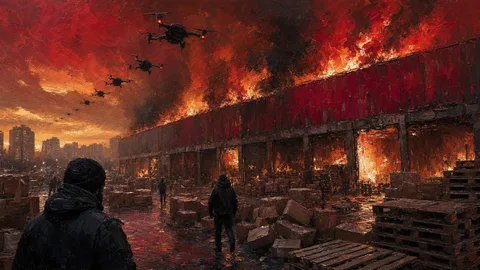
In the night of June 17 to 18, 2026, nearly 200 Ukrainian drones targeted Moscow and its surrounding region, triggering one of the most massive aviation disruptions ever recorded in Russia. 527 flights cancelled or delayed across the four airports of the Russian capital — Sheremetyevo, Domodedovo, Vnukovo, and Zhukovsky — according to data compiled by the Russian newspaper Kommersant. Tens of thousands of stranded passengers. A country supposedly winning its war, suddenly unable to get its planes off the ground.
The attack also set fire to the Kapotnya refinery, the capital's only major refinery, which supplies more than a third of Moscow's fuel needs. It will be out of service for at least six months, according to industry sources cited by Reuters. This was no accident — it is a strategy. Kyiv has decided to bring the war where it hurts most — into the Russian economy, into its citizens' daily lives, into financial markets, and into the Kremlin's national pride.
The shift in Ukrainian doctrine
President Volodymyr Zelensky was explicit: Ukraine will carry out preemptive strikes against every installation Russia uses to sustain its war. This is no longer simply military against military. It is a deliberate economic campaign, planned and executed with drones capable of striking at more than 2,000 kilometres from the border. In June 2026, 28 long-range strikes on Russian oil infrastructure were recorded by the Institute for the Study of War (ISW), compared to 33 in May and 18 in April.
A Russian economy under fuel pressure
Oil production in free fall
The data are eloquent. According to Bloomberg, Russian gasoline production has fallen 15% since June 2025 and 9% since May 2026. The main cause? Repeated Ukrainian strikes on refineries. Facilities hit in June 2026 include the Kapotnya refinery in Moscow, struck on June 12 and 18, as well as the Ufaneftekhim and Bashneft-Novoil refineries in Ufa, in Bashkiria, more than 1,500 kilometres from the border, struck on June 25. The TANECO refinery in Tatarstan was also hit, with a cumulative processing capacity of approximately 600,000 barrels per day taken offline, according to Carnegie Endowment.
The concrete result: fuel queues at petrol stations across 25 Russian regions, panic buying of fuel, rising prices at the pump. Russia's war economy, already under pressure from inflation and sanctions, is now facing additional strain of a different nature — no longer coming from the outside, but from within its own territory. The Kremlin can no longer shield its citizens from the consequences of the war it triggered.
The impact on Russia's military logistics
Beyond civilian petrol stations, Russian armed forces also depend on domestic refineries. Scarcer and more expensive fuel complicates resupply for front-line units, lengthens logistical timelines, and raises the operational costs of an army already under strain. ISW documented that Operation Torch, launched by the Russia Freedom Legion (RFL) on June 24, targeted six gas distribution facilities in the Moscow and Tver oblasts, disrupting the energy supply to military infrastructure.
Four paralysed airports: the capital as psychological battleground
Moscow's airspace under de facto Ukrainian control
That four major international airports had to suspend operations simultaneously is the most visible proof: Moscow is no longer a protected city. On June 18, during the war's largest strike on the Russian capital, airports shut down for hours. 50 outbound flights cancelled and 71 delayed at Sheremetyevo alone. Passengers evacuated to shelter areas inside terminals. Israeli airline El Al suspended its Tel Aviv–Moscow route on June 26, explicitly citing "recent aviation incidents."
The signal is global. When a foreign airline suspends a route to a supposedly secure capital, it means the international perception of Russian aviation security has fundamentally changed. Insurance premiums, risk tariffs, the commercial reputation of Russian civil aviation take a hit that goes well beyond the symbolic. Moscow is becoming more isolated.
The psychological effect on the Russian population
Kremlin propaganda presents the war as distant, waged somewhere in the east against an "artificial regime." But when Moscow's skies are crossed by drones, when columns of black smoke rise from the southern suburbs of the capital, when 17 people are wounded, including children — and a girl of 8 is killed by debris according to Meduza — the official narrative collapses. Mayor Sergei Sobyanin posted dozens of messages on Telegram throughout the nights of attacks, each acknowledging new drones shot down, each claiming "no damage." The reality filmed by Moscow residents contradicts this version.
Ukraine's strategy: targeting what finances the war
A cold, rational logic
Discover

INVESTIGATION: Beijing cuts Africa to 2.1 billion in loans…
2.1 billion — the lowest figure in almost twenty years, according…

SPECIAL REPORT: Beijing Promises Stimulus as Its Households Give…
That is the growth rate of Chinese industrial output in July,…

INVESTIGATION: Two Chinese Ex-Soldiers Arrested in Seoul as 18,000…
For five years, a man ran a military-supply shop at the…
Ukraine's strategy is not improvised. It follows a rigorous economic logic: oil revenues finance 35% of Russia's federal budget. Reducing refining capacity reduces exports, reduces revenues, and dries up the financing of the war. Every refinery struck is a budgetary victory as much as a military one. The strikes on Krasnodar's oil depots, Orenburg's gas facilities, the Vladimir space centre — all these targets share one thing in common: they directly or indirectly fuel Russia's war machine.
On June 25, Ukrainian drones struck the Bashneft refineries in Ufa (Bashkortostan), more than 1,500 km from the front. That same night, an oil depot in Krasnodar supplying Russian forces in occupied Ukrainian territory was hit. This is no coincidence — it is a precise mapping of Russian logistical flows, targeted with surgical precision that took months to prepare.
Russia's response: permanently inflated interception figures
Against this campaign, Russia responds with two tools: air defence and communications. On the first point, the Russian Ministry of Defence claimed to have shot down 555 drones on June 18, then 660 on June 26. These figures are unverifiable, often inflated, and include occupied territories Moscow claims to have annexed. On the second point, the Kremlin continues to insist that the strikes have "no significant impact" — while its own citizens queue at petrol stations.
Russia repositions its air defences to protect Moscow
A telling set of priorities
According to President Zelensky, Russia has massively redirected its air defence systems to protect Moscow, St. Petersburg, and a handful of strategic sites. This move leaves other Russian regions more vulnerable — exactly what Ukraine had hoped to trigger. The Washington Times confirmed that air defence assets stripped from the front line were repositioned to protect the capital.
This means that Ukrainian pressure produces a multiplier effect: not only does it strike infrastructure, but it forces Russia to strip certain defensive positions to reinforce others. Every drone sent toward Moscow is a drone that forces the adversary to choose what it truly wants to protect. And Moscow's answer is revealing: the elite first, the country second.
The limits of Russian defence against swarms
Military experts consulted by The Moscow Times note that Ukrainian drone swarms are difficult to intercept precisely because they saturate detection and neutralisation systems. On June 18, Russian soldiers were filmed firing handheld missiles from a motorway crowded with civilians in Moscow — an image symptomatic of an overwhelmed system. Ukraine produced 100,000 interceptor drones in 2025 and doubled that output in just four months in 2026, according to Ukrainian minister Mykhailo Fedorov.
The impact on Russia's international credibility
An international summit disrupted
On the same topic
ANALYSIS: 800 drones over Russia in one night —…
More than eight hundred drones, in a single night, August 14…

INVESTIGATION : Russia's FSB Erases 4 Ukrainian Regions' Border…
Not an assault, not an ultimatum, not a televised proclamation from…

COLUMN : Europe Moved 8.5 Billion Euros in a…
That is what the European Commission says it has disbursed for…
The timing of Ukrainian strikes is not accidental. The major attack of June 2026 on Moscow coincided, like the St. Petersburg strike earlier that month, with an international summit hosted by Russia. The suspension of flights at Moscow's four airports directly disrupted foreign delegations. That world leaders and diplomats experienced in real time the closure of airports in the supposed "world capital" was no accident — it was an unambiguous diplomatic message sent without words.
The El Al suspension fits this context: airlines don't do politics, they calculate risk. When Moscow's skies become a danger zone for international civil aviation, Russia loses its status as a global aviation hub, with all that this implies for its commercial, diplomatic, and cultural connections with the rest of the world.
A message to the entire world
Ukraine is also sending a message to its Western allies, who sometimes hesitate over the scale of support to provide. The demonstration of capability — striking a refinery 15 kilometres from the Kremlin, paralysing the airspace of a capital of 12 million inhabitants, triggering a fuel shortage in a war economy — proves that Kyiv can achieve tangible strategic results with the tools provided by the West, and even with its own domestic production.
Ukraine intensifies its 40-day campaign: calculated pressure
Zelensky's announcement: forcing Russia to negotiate
On June 26, 2026, President Zelensky announced a "40-day influence operation" designed to "force Russia to end the war." This declaration, made on X (Twitter), marks a turning point in Ukrainian communications: for the first time, Kyiv publicly announced an intensive pressure campaign with a defined timeline. The stated goal is to use Ukraine's superiority in long-range drones to degrade Russian infrastructure sufficiently to compel Moscow back to the negotiating table.
The logic behind this operation is simple but bold: every week of intensive strikes on refineries, fuel depots, and communications centres increases the economic cost of the war for Russia. As fuel shortages worsen, transport costs rise, and the Russian population feels the consequences in their daily lives, internal pressure on the Kremlin to find a way out of the conflict builds. This is a strategy of calculated economic attrition, and the first results are already measurable.
The Russia Freedom Legion and Operation Torch
A new dimension of war against gas infrastructure
On June 24, 2026, the Russia Freedom Legion (RFL), a pro-Ukrainian paramilitary unit composed of Russian nationals opposed to Putin's regime, announced the launch of "Operation Torch." Its objective: to strike gas distribution facilities in the Moscow and Tver oblasts to "significantly degrade Russian energy infrastructure." ISW confirmed that the RFL targeted six gas distribution facilities, disrupting the functioning of certain infrastructure.
This operation adds a new dimension to the Ukrainian economic campaign: beyond the drone strikes carried out by the regular armed forces and Ukrainian intelligence services (SBU, GUR), anti-Putin Russians are actively participating in the degradation of their own country's economic infrastructure. This phenomenon — Russians fighting the Putin regime from within and from without — reveals an internal fracture within Russian society that Moscow cannot paper over with propaganda alone.
Conclusion: An economic war that Ukraine is winning
The irreversibility of the damage inflicted
The Kapotnya refinery will be out of service for at least six months. The two Bashneft refining units in Ufa were taken offline simultaneously. The Orenburg gas processing plant halted production after the June 24 strikes. These repair timelines accumulate, and Russian refining capacity does not rebuild overnight. Ukraine strikes faster than Russia repairs — that is the definition of successful economic attrition.
What Putin did not foresee
When he launched his full-scale invasion in February 2022, Vladimir Putin had calculated a swift victory. Four years later, his own refineries are burning, his own airports are closing, his own citizens are queuing for petrol. Ukraine has transformed the high-intensity war into a war of economic attrition, and the strategy is working. The question is no longer whether Russia can hold militarily — it is how long its economy can absorb these blows without cracking under the combined pressure of sanctions and Ukrainian drones.
Signed Maxime Marquette, columnist
Columnist's transparency box
Who I am and my acknowledged biases
I am a columnist and analyst, not a field military expert. I have never set foot in Ukraine or Moscow. My analysis relies entirely on published sources: Reuters, Bloomberg, ISW, Kommersant, Meduza, Kyiv Post, The Moscow Times, Le Monde, and others. I am pro-Ukraine and I own that: I believe Ukrainian resistance is just and that Russian aggression constitutes an existential threat to the European order.
What I don't know and my method
I do not know with precision which Russian interception figures are reliable — nobody really does, including the experts. Casualty and damage figures are often contradicted depending on the source. I have chosen to cite the most cross-referenced data, flagging uncertainties where they exist. The fuel crisis in 25 Russian regions is documented by independent Russian sources such as Meduza and Kommersant — I trust them far more than the Russian Ministry of Defence.
Sources
Primary sources
Secondary sources
Get the geopolitics analyses
Conflicts, powers, alliances: the MadMax thread without the noise.
Cite this article
Maxime Marquette (2026). COMMENTARY: Ukraine strikes Moscow where it hurts most — the economy and the prestige. MadMax. https://mad-max.co/en/article/l-ukraine-frappe-moscou-la-ou-ca-fait-vraiment-mal-a-l-economie-et-au-prestige
Read next
INVESTIGATION: Beijing cuts Africa to 2.1 billion in loans…
2.1 billion — the lowest figure in almost twenty years, according…
SPECIAL REPORT: Beijing Promises Stimulus as Its Households Give…
That is the growth rate of Chinese industrial output in July,…
INVESTIGATION: Two Chinese Ex-Soldiers Arrested in Seoul as 18,000…
For five years, a man ran a military-supply shop at the…
Enjoyed this piece? Get the next one.
One chronicle a week, straight to your inbox. No noise.
This article was generated with AI assistance, under human supervision.
Comments
Be the first to weigh in.