

NARRATIVE: Ukraine burns Russia's refineries — shortages, panic, and Putin cornered
This is the scene that Kremlin propaganda cannot erase: Muscovites standing in line for an hour to fill their tanks, while half the stations in their neighborhood remain closed — pumps empty, tanks dry. Residents of Saratov capped at 30 liters per person. Stations in Irkutsk authorized to suspend civilian sales entirely to prioritize emergency services. Crimea without fuel sinc
- This is the scene that Kremlin propaganda cannot erase: Muscovites standing in line for an hour to fill their tanks, while half the stations in their neighborhood remain closed — pumps empty, tanks dry. Residents of Saratov capped at 30 liters per person. Stations in Irkutsk authorized to suspend civilian sales entirely to prioritize emergency services. Crimea without fuel sinc
- NARRATIVE: Ukraine burns Russia's refineries — shortages, panic, and Putin cornered
- Introduction: When fuel becomes a weapon of war
Facts, quotes, and cited links remain in the body. Interpretations are framed as analysis or opinion according to the format.
NARRATIVE: Ukraine burns Russia's refineries — shortages, panic, and Putin cornered
Introduction: When fuel becomes a weapon of war
June 2026: Russia looks for gas
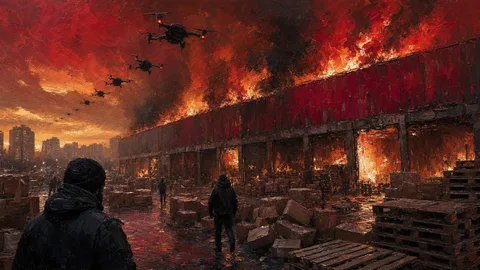
This is the scene that Kremlin propaganda cannot erase: Muscovites standing in line for an hour to fill their tanks, while half the stations in their neighborhood remain closed — pumps empty, tanks dry. Residents of Saratov capped at 30 liters per person. Stations in Irkutsk authorized to suspend civilian sales entirely to prioritize emergency services. Crimea without fuel since June 21 except for the military. And a phone app called "Where to find gas?" mapping in real time the rare stations still supplied across Russia's major cities.
This is the story of a transformation that few observers had anticipated: in less than three months of intensive campaign, Ukrainian drones reduced between a quarter and a third of Russia's total refining capacity, according to independent sources cited by Le Monde. Russia — an oil power that draws a critical share of its revenues from hydrocarbon exports — now faces fuel shortages on its own territory. This is the war coming home to the daily lives of Russians who had been supporting it from the comfort of their own homes.
The campaign: three months, thousands of kilometers, refineries in flames
Since the end of March 2026, Ukrainian long-range drones have been systematically targeting Russian oil installations — refineries, export ports, depots, pipelines. The military logic is clear: strike the Russian energy supply chain, reduce fuel deliveries to the front, slow down Russian tanks and logistics convoys, and create economic and social pressure on the Russian population that has been passively supporting this war regime.
June 2026 marked the apex of this campaign. The strike on the Kapotnya refinery 15 km from the Kremlin on June 17. The strike on the Tyumen refinery 2,000 km from the Ukrainian border on June 20. At least 13 strikes on industrial defense installations in a single month. A toll that forced Putin himself to acknowledge on June 23, before his own military cadres, that the Ukrainian strategy "destabilizes society."
Kapotnya: the refinery 15 km from the Kremlin in flames
June 17, 2026: Moscow sees the flames of its own war
On the night of June 17–18, 2026, Ukrainian drones struck the Kapotnya refinery in southeastern Moscow, just 15 kilometers from the Kremlin. This installation covered between 33% and 40% of the Russian capital's fuel needs according to market data. Images posted on Russian social media before being massively deleted showed immense columns of black smoke visible from downtown, flames reaching dozens of meters high, and what residents of neighboring districts described as an "oil rain" falling on their streets.
A second strike on Kapotnya followed the very next night, on June 18–19 — part of the wave of 555 drones launched that night over Russian territory. Striking the same strategic installation twice in two nights illustrates Ukrainian doctrine: the first strike degrades, the second prevents repairs. Together, they took the Russian capital's main refinery offline for an indefinite period.
The immediate effect on life in Moscow
Dmitri, a Muscovite quoted by Le Monde, describes his daily life after the strike: half the gas stations in his district closed, the stations still open unable to provide the full range of fuel grades, queues stretching an hour. The app "Where to find gas?" appeared in app stores. Tutorials on siphoning fuel tanks circulated. Videos show strangers stealing gas from parked cars.
These images — which millions of Russians see on their phones despite censorship — tell the story of a war that state propaganda had presented as distant, clean, victorious. By July 2026, the war is in Moscow's gas stations. It is in the morning queues. It is in the empty tanks of families heading on vacation. This perceived reality is a psychological defeat for Putin that no military communiqué can correct.
Tyumen at 2,000 km: Ukraine reaches the Urals
June 20, 2026: a strike that redefines the reach of the war
On June 20, 2026, Zelensky announced a strike on the Tyumen refinery in the Ural region, roughly 2,000 km from the Ukrainian border. This is one of Russia's most important installations — a refining complex capable of processing approximately 151,000 barrels of crude per day according to Bloomberg, and one of the major domestic fuel suppliers for the Russian market. Zelensky declared that Ukraine had developed new long-range drones capable of operating over more than 3,000 km.
This strike fundamentally changes the psychology of the conflict inside Russia. If a refinery at Tyumen — deep in Russian geography, far from anything previously considered reachable — can burn, then no installation is sanctuarized. Factory managers, refinery directors, infrastructure administrators across Russia's entire strategic depth must now live with this reality: distance is no longer protection.
The new long-range drones: a Ukrainian technological leap
The Tyumen strike confirmed the existence of a new generation of Ukrainian drones capable of operating at distances exceeding 3,000 km — well beyond what analysts had previously attributed to Ukrainian capabilities. Zelensky described these systems as enhanced "FP" drones, likely developed by Fire Point or equivalent industrial partners as part of Ukraine's defense revolution of 2025–2026.
This technological leap is no surprise to those who have been following Ukrainian defense industry: the +12.7% per month growth in drone production, the certification of 1,000 new weapons systems in 2026, continuous innovations in autonomous navigation and resistance to electronic warfare — all of this creates a trajectory of continuous improvement that regularly pushes the known limits of Ukrainian capabilities.
The 13 strikes on defense installations: targeting the military supply chain
June 2026: the most intense month yet against Russia's war industry
Beyond the refineries, June 2026 saw Ukraine conduct at least 13 strikes on Russian industrial defense installations — the most intensive month since the start of 2026, surpassing the previous record of 11 strikes set in March. Since January 2026, a total of 48 confirmed strikes have hit Russian military-industrial facilities. This is no longer an opportunistic campaign — it is a systematic strategy to degrade the Russian industrial base of war.
Targets identified by analysts at Agentstvo reveal the doctrinal precision of Ukraine's strategy: the Titan-Barrikady plant in Volgograd that manufactures launcher systems for Yars, Topol-M, and Sarmat intercontinental ballistic missiles, as well as Iskander-M systems. The VNIIR-Progress plant in Cheboksary that produces satellite navigation receivers used in Kalibr cruise missiles and Iskander ballistic missiles. Striking these installations means striking the missiles that fall on Ukrainian cities at their production source.
The list of struck installations: from Volgograd to Orenburg
The full list of installations struck in June 2026 maps the depth of Ukraine's penetration into the Russian military-industrial complex: the Progress plant in Michurinsk that manufactures flight-control systems for aircraft and missiles; the Elastik factory in the Ryazan region that produces aerial bombs, artillery munitions, and components for guided bombs; the Azot plant in Novomoskovsk — struck twice in June — that produces chemical components for explosives manufacturing; the Ekran Optical Systems facility that makes night-vision components.
These are joined by the Zaliv shipyard in occupied Crimea, where two naval support vessels were damaged, and gas processing facilities in the Orenburg region — whose plants produce sulfur and other materials used in the Russian defense industry. This map of strikes is that of an army that has done its homework: it knows the enemy military supply chain better than many Western intelligence agencies.
Regional restrictions: a map of shortages spreading outward
15 regions under fuel emergency on June 23
On June 23, 2026 — the same day as Putin's public acknowledgment — at least 15 Russian regions had imposed emergency restrictions on fuel sales. The list was growing by the hour: Omsk, Irkutsk, Saratov, Voronezh, Amur, Tambov, then Kursk, Bryansk, Kurgan. The Tomsk region, one of Russia's main oil-producing territories, began imposing its own sales restrictions, according to independent Russian media Astra.
The Russian government took cascading emergency measures: a ban on gasoline exports until July 31, 2026, authorization for fuel tankers to circulate in Moscow without permits to resupply the capital, discussions on possible increases in fuel imports. Tatneft, one of Russia's oil giants, imposed per-person purchase limits of 30 liters of gasoline and 60 liters of diesel. These measures reveal the true scale of the shock: you do not ban exports and ration purchases for a marginal shortage.
Impact on agriculture and the economy: accumulating pressure
Energy expert Sergey Vakulenko, quoted by Le Monde, estimated the impact at 1.3 million barrels per day of lost refining capacity — with cascading economic effects on transport, logistics, and agriculture. The 2026 harvest opens against a backdrop of more expensive, less available diesel for tractors and trucks. Russia's agricultural sector, already under pressure, enters its most critical season of the year with one more major constraint.
The economist also notes that supply disruptions are feeding already-troubling inflation and could force the Russian Central Bank to scale back its plans to cut interest rates — which remained at elevated levels. A central bank that cannot lower its rates because Ukrainian drones destroyed refineries — that is a textbook illustration of how a military campaign creates second- and third-order economic effects.
Putin cornered: the admission of June 23
Before graduating military academy cadets: words that betray
On June 23, 2026 at the Kremlin, during a video conference with graduates of Russian military academies, Vladimir Putin spoke words that constitute probably the most significant admission of his political career regarding the effectiveness of the enemy's strategy. He stated that Ukrainian strikes on Russian oil infrastructure had achieved their stated goal of "destabilizing society." He described the campaign as "a relentless stream of drones" designed to "create uncertainty about the actions of our armed forces."
These words are extraordinary in context. Putin never admits his enemies' successes. Kremlin rhetoric had presented Ukrainian attacks as failures or marginal footnotes for two years. That day, before his own military cadres, he acknowledged that Kyiv's strategy works. The reassuring phrases that followed — "this will not sow doubt," "we will achieve our objectives" — could not erase the weight of the initial admission.
Zelensky responds: the war must end
In his nightly address to the nation on the evening of June 23, Zelensky responded to Putin's admission with a formulation that summarizes his entire theory of change: "The majority in Russia is beginning to have problems with Putin because there is no end in sight to his war. And all the difficulties that Russians are experiencing today should bring them closer to realizing that their war is real, that these are not just stones falling from the sky, and that their war must end."
This message — addressed as much to the Russian population as to the international community — articulates the logic of Ukraine's campaign with a clarity rare in wartime. The objective is not to destroy all Russian refineries. The objective is to make the war real and costly enough that Russians — individually, collectively — begin to demand that their president bring it to an end. It is a strategy of regime change through internal friction, pursued by military force.
The September elections: fuel as a domestic political issue
Postponing elections to avoid discontent
Among the most significant internal political consequences of the fuel shortages, Le Monde cites discussions at the Kremlin about possibly postponing the parliamentary elections scheduled for September 20, 2026. The reasoning is that popular discontent tied to fuel queues, rationing, and station closures could affect the electoral results of Putin's party.
This is information of considerable importance. An authoritarian regime that contemplates postponing its own elections out of fear of its own electorate is not a regime governing from a position of confidence. Russian elections have long been exercises in formal legitimation rather than genuine political competition — but they serve their symbolic utility to the regime. The idea of postponing them to prevent fuel shortages from translating into protest votes says something fundamental about the growing fragility of the Putinist political edifice.
On the same topic

INVESTIGATION : Russia's FSB Erases 4 Ukrainian Regions' Border…
Not an assault, not an ultimatum, not a televised proclamation from…
ANALYSIS: 800 drones over Russia in one night —…
More than eight hundred drones, in a single night, August 14…

INVESTIGATION: 316 political cases in Crimea — the occupation…
Three hundred and sixteen people are being prosecuted on political grounds…
Supporting the war now comes with a cost at the pump
For millions of Russians who had been passively supporting the war without feeling its direct effects, the spring and summer of 2026 introduced a new reality: supporting the war now carries a visible, immediate cost, felt at every fill-up. Fuel purchase restrictions do not strike abstract adversaries — they strike the motorists, farmers, tradespeople, and merchants who had until now experienced the war as a television event.
This shift in perception is exactly what the Ukrainian campaign sought to trigger. Not the immediate collapse of the regime — an objective out of reach in the short term — but the progressive erosion of passive support. A population that is paying an increasingly concrete price for a war it does not understand and does not truly want is a population that becomes less reliable for its government in moments of crisis.
Crimea under siege: fuel suspended, power cut
June 21, 2026: fuel sales suspended in Crimea
In occupied Crimea, the effects of the Ukrainian campaign were even more brutal than in continental Russia. On June 21, 2026, Moscow-appointed governor Sergey Aksyonov suspended fuel sales to the general public, restricting distribution to the military and essential services. In Sevastopol, stations had nearly run out of gasoline despite rationing measures already in place.
Simultaneously, the Ukrainian drone campaign was striking the peninsula's electrical infrastructure: the main power station of Simferopol suffered explosions, and Sevastopol's main substation was struck multiple times, plunging the entire city into darkness. Crimea — presented by Russian propaganda as a seaside paradise under Russian protection — was living through a summer of 2026 of power outages and fuel shortages.
The Crimean bridge and severed supply lines
Ukraine also struck a bridge crossing the North Crimean Canal during the June campaign, reinforcing the logic of cutting the supply lines linking the peninsula to continental Russia. The Kerch Bridge — already damaged in earlier strikes — remains a priority target both for its logistical function and for its symbolic value as the great engineering achievement of the 2014 annexation that Putin presented to his nation.
For Russians who settled in Crimea since 2014, the reality of summer 2026 is a complete rupture with the promises of annexation. They had been promised a Russian paradise under imperial protection. They are living on a besieged peninsula, without reliable fuel, without stable electricity, with Ukrainian drones striking ships in the port of Kerch and air defense radars along the entire coastline.
Impact on the front: fuel as a military force multiplier
Less fuel means less mobility for the Russian army
The fundamental military objective of the refinery strike campaign is to degrade the Russian army's mobility at the front. Tanks, armored vehicles, supply trucks, mobile defense systems — all consume fuel. If logistical supply chains are disrupted by widespread shortages, if fuel earmarked for the armed forces competes with growing civilian needs, if prices rise and reserves shrink — all of this creates logistical friction that slows Russian military operations.
The Institute for the Study of War noted in its June 2026 assessments that Ukrainian strikes had "slowed Moscow's efforts at the front" — a careful but significant formulation from an analytical institution that does not make statements without supporting data. This is not that the Russian army is running out of gas for its tanks. It is that the campaign is creating tensions throughout the supply chain that complicate operations and reduce the flexibility of Russian commanders.
Converging pressures: combat drones + deep strikes
The deep strike campaign does not operate in a vacuum — it works in conjunction with growing pressure at the front. In June 2026, Ukrainian advances at Borova and Kostyantynivka, the defense of Kharkiv, operations in the Zaporizhzhia region — all of this creates a set of simultaneous pressures that the Russian army must manage. Deep strikes on refineries and the defense industry add a dimension of systemic degradation to these tactical and operational pressures.
This convergence is what makes Ukraine's June 2026 strategy qualitatively different from that of previous years. In 2022 and 2023, Ukraine was defending. In 2024, resisting. In 2025, counterattacking. In 2026, it is conducting a multi-level simultaneous campaign: tactical at the front, operational in border regions, strategic deep inside Russia. This is an army that has fundamentally transformed over four years of war.
Impact on Russian oil exports: a doubled economic weapon
Between domestic shortages and export losses
Russia finds itself in a paradoxical and painful position: fuel shortages on its domestic market while its economy depends on hydrocarbon exports to fund the war. The ban on gasoline exports until July 31, 2026 is an emergency measure responding to domestic shortages — but it simultaneously reduces the export revenues that feed the war budget.
This contradiction is at the heart of the structural vulnerability that the Ukrainian campaign exploits. A war economy that depends on oil exports but whose refineries are burning cannot do both simultaneously: supply its citizens AND export. It must choose. And whichever choice it makes, it loses something essential — either domestic social peace, or the revenues that fund its armies.
The Central Bank caught in a vise
The effect on Russian monetary policy is also documented. Sergey Vakulenko notes that supply disruptions are feeding overall inflation and could force the Russian Central Bank to slow or reconsider its plans to cut the benchmark interest rate — which remained at elevated levels. Inflation accelerating because of Ukrainian drones, a central bank unable to normalize its monetary policy — these are second-order economic consequences that create friction throughout the Russian economy.
For Russian businesses planning their investments, for consumers facing persistent inflation, for farmers entering harvest season — the accumulation of these pressures creates a degraded economic environment that erodes the material base of support for the war. Not immediately and spectacularly. But cumulatively, persistently, and increasingly difficult to ignore.
Refining rates at their lowest in 20 years
Data confirming the scale of the disruption
Bloomberg reports that Russia's crude refining rate fell to its lowest level in 20 years during June 2026. This figure — which accounts for the country's total refining capacity, not just the installations directly struck — illustrates the systemic scale of the disruption created by the Ukrainian campaign. This is not one refinery burning. This is Russia's entire refining industry operating at a reduced capacity the country had not seen since the post-Soviet economic crisis of the early 2000s.
This historic low has immediate implications for military production, logistical deliveries, agriculture, and the civilian economy. But it also has longer-term implications for Russia's ability to maintain oil exports at levels sufficient to fund its war budget. A country that refines less produces fewer value-added products — it exports more unrefined crude at lower margins.
Effects on trading partners and smuggling dynamics
Russian gasoline export restrictions also create supply chain tensions in countries that depend on Russian exports for their domestic markets — notably certain Central Asian countries and others in Russia's economic orbit that had adapted to Western sanctions. These partners, who had viewed discounted Russian exports as a commercial opportunity, now face a Russia that has no surplus to export.
This reduction in Russian exports is a collateral effect of the Ukrainian campaign that Kyiv's planners had likely anticipated. A Kremlin less able to distribute cheap hydrocarbons to its partners is a Kremlin less able to buy their complicity or their diplomatic neutrality. The drone campaign simultaneously strikes the Russian economy and Russian diplomacy.
Ukrainian resilience: striking under bombs to strike further
Producing drones while receiving drones
The most striking paradox of this campaign may be this: Ukraine is striking Russian refineries at 2,000 km with drones it manufactures on its own territory, while Russia strikes that same territory with its own drones. Ukraine's drone industry learned to disperse, fragment, operate in spaces that do not look like factories but that produce critical components. This industrial resilience is the prerequisite for the entire deep strike campaign.
Production figures confirm this resilience: +12.7% per month growth in drone production in the first half of 2026. 660 drones launched in one night on June 26. This is not the output of an industry passively absorbing bombardment — it is the output of an industry that has integrated the threat and keeps growing despite it.
Innovation as survival: the 3,000 km drones
The Tyumen strike revealed drones capable of operating at 3,000 km — a capability that did not exist eighteen months ago. This progression in range — from 300–500 km in 2022, to 1,000 km in 2024, to 3,000 km in 2026 — illustrates the speed of innovation under constraint. When survival depends on the ability to strike further, Ukrainian engineering finds solutions. This is not magic — it is necessity transformed into technical excellence.
This 3,000 km capability changes the calculus of the entire campaign. No Russian installation is now out of reach. Industrial complexes in Siberia, oil facilities in Yakutia, military bases in the Russian Far East — all are theoretically accessible. This potential threat forces Russia to defend a territory whose surface area no air defense system in the world can cover entirely.
Zelensky, the allies, and the debate over the limits of strikes
Ukraine uses its own weapons: no Western restrictions apply
One crucial aspect of the June 2026 campaign is that the Ukrainian long-range drones striking refineries 2,000 km away are Ukrainian weapons — not systems supplied by Western allies that could have imposed geographic restrictions on their use. Kyiv has circumvented the fundamental political limitation of Western support — prohibitions on striking Russian territory with American or European weapons — by developing its own long-range strike capability.
This operational sovereignty is a major strategic achievement. Debates in Western capitals about what to permit or prohibit Kyiv from striking no longer apply to Ukrainian drones. Zelensky needs no permission to launch his own weapons against Russian military infrastructure. This independence reduces the ability of hesitant allies to constrain Ukraine's strategy.
Discover

INVESTIGATION: Beijing cuts Africa to 2.1 billion in loans…
2.1 billion — the lowest figure in almost twenty years, according…

SPECIAL REPORT: Beijing Promises Stimulus as Its Households Give…
That is the growth rate of Chinese industrial output in July,…

INVESTIGATION: Two Chinese Ex-Soldiers Arrested in Seoul as 18,000…
For five years, a man ran a military-supply shop at the…
Trump, negotiations, and pressure on Kyiv
Donald Trump, who presses Zelensky to negotiate an end to the war, finds himself in an uncomfortable position: how do you ask a military partner to stop when that partner is achieving indisputable successes? The refinery strikes, Putin's acknowledgment, fuel shortages in 15 regions — these are powerful arguments that Kyiv can deploy against any pressure to cease deep strikes in the name of negotiations whose outcome remains uncertain.
Zelensky has long understood that his best negotiating position is one of military strength. The deep strike campaign of June 2026 is as much a demonstration for the negotiating table as a real military operation. It says to every potential interlocutor — Putin, Trump, European mediators — that Ukraine can continue costing Russia more and more. That is the only form of bargaining power that counts.
The West facing the campaign: admiration, caution, and strategic realignment
Allies confronting a strategy they did not authorize but admire
Ukraine's deep strike campaign on Russian refineries has created a diplomatic paradox in Western capitals. On one hand, allies provide components, intelligence data, and capabilities that make these strikes possible. On the other, several governments officially continue to maintain restrictions on using their own weapons against Russian territory — restrictions that Ukraine has bypassed by developing its own long-range drones. This situation creates a convenient space of strategic ambiguity: allies can applaud the results without assuming responsibility for the means.
This ambiguity is likely to narrow. The successes of June 2026 — the ability to strike Tyumen at 2,000 km, to saturate Russian defenses with 660 drones in one night, to create fuel shortages in 15 regions — are changing the perception of Western decision-makers about what Ukraine can accomplish. This reassessment could unlock more explicit support for strikes that some had still hesitated to endorse publicly.
Lessons for European defense: a new paradigm
Beyond the ongoing war, Ukraine's June 2026 campaign delivers fundamental lessons for European defense. The capacity to strike massively and deeply inside enemy territory with low-cost drone swarms — without strategic aviation, without submarine-launched cruise missiles, without the expensive weapons systems that conventional armies consider indispensable — is a doctrinal revolution that no one can afford to ignore.
European armies that have been investing for decades in sophisticated, expensive weapons systems are now watching a Ukrainian army that, with mass-produced drones and a swarm doctrine, inflicts strategic damage exceeding what many European armies could achieve with their complete conventional arsenals. This lesson will reshape defense procurement debates in Europe for decades to come.
Conclusion: three months, an empire under pressure — and the war that continues
What June 2026 proved
Ukraine's campaign of strikes on Russian refineries and industrial installations from March to June 2026 proved several fundamental things. That Ukraine can reach targets 2,000 km from its border. That this strike capability can reduce between a quarter and a third of a major energy power's refining capacity. That this reduction creates real, documented shortages affecting the daily lives of citizens in a country of 140 million people. That even Putin acknowledges the "destabilization."
What June 2026 did not prove is that this pressure will be sufficient to end the war. Putin has demonstrated a capacity to absorb considerable costs without changing strategic course. Russia has resources, resilience, and a political control system that can maintain cohesion under adverse conditions. Ukraine's campaign is a powerful tool — not a magic weapon.
What comes next: escalation, negotiation, or stalemate
The coming months will determine whether the accumulated pressure — fuel shortages, degraded defense industries, threatened elections, discontent population — eventually creates the conditions for a war exit. The trajectory drawn by the June 2026 campaign is one of continuous escalation: Ukraine has the capability and the will to go further. The question is whether Putin will find an acceptable exit before the cost becomes unbearable — or whether he will continue until a breaking point that no one can yet locate with precision.
By Maxime Marquette, columnist
Columnist's transparency note
What I assert and what I do not know
The data on refining capacity loss (a quarter to a third) comes from independent sources cited by Le Monde — I cannot fully independently verify these estimates. The Tyumen strike and the 3,000 km drone capability are confirmed by Zelensky's statement via NDTV/Bloomberg — but the technical details of the drones remain partially verifiable. Regional fuel restrictions are documented by independent Russian sources (Astra, regional data) reprinted by United24 and Le Monde.
I am Maxime Marquette, pro-Ukraine. I support the legitimacy of the campaign of strikes against Russian military-industrial infrastructure under the international law of armed conflict. I acknowledge that the civilian impacts of fuel shortages in Russia affect people who do not decide war policy — but the responsibility for this situation rests with Putin and those who keep this regime in power.
Limits of this analysis
This analysis does not cover the full range of the campaign's effects on the Russian economy — some second- and third-order effects will only become visible in the months ahead. Russian economic data are partly opaque, and official Kremlin figures are structurally unreliable. This narrative draws on the best sources available at the time of writing — it could be supplemented or nuanced by subsequent information.
What remains certain: the documented facts — the shortages, Putin's admission, the Tyumen strike, the 13 industrial strikes of June — are solid and confirm the documented effectiveness of Ukraine's deep strike strategy.
Sources
Primary sources
Secondary sources
Get the geopolitics analyses
Conflicts, powers, alliances: the MadMax thread without the noise.
Cite this article
Maxime Marquette (2026). NARRATIVE: Ukraine burns Russia's refineries — shortages, panic, and Putin cornered. MadMax. https://mad-max.co/en/article/recit-l-ukraine-brule-les-raffineries-de-russie-penuries-panique-et-poutine-accu
Read next
INVESTIGATION: Beijing cuts Africa to 2.1 billion in loans…
2.1 billion — the lowest figure in almost twenty years, according…
SPECIAL REPORT: Beijing Promises Stimulus as Its Households Give…
That is the growth rate of Chinese industrial output in July,…
INVESTIGATION: Two Chinese Ex-Soldiers Arrested in Seoul as 18,000…
For five years, a man ran a military-supply shop at the…
Enjoyed this piece? Get the next one.
One chronicle a week, straight to your inbox. No noise.
This article was generated with AI assistance, under human supervision.
Comments
Be the first to weigh in.