

ESSAY: Konstantynivka Burns — and Russia Advances, Block by Block
Some figures do not lie. Fifty-six combat engagements recorded in a single day on the Ukrainian front — nine simultaneously active sectors
- Some figures do not lie. Fifty-six combat engagements recorded in a single day on the Ukrainian front — nine simultaneously active sectors
- Introduction: The Donetsk Front, a Furnace That Will Not Die Down
- Fifty-six engagements in a single day
Facts, quotes, and cited links remain in the body. Interpretations are framed as analysis or opinion according to the format.
Introduction: The Donetsk Front, a Furnace That Will Not Die Down
Fifty-six engagements in a single day
Some figures do not lie. Fifty-six combat engagements recorded in a single day on the Ukrainian front — nine simultaneously active sectors — that is what the Institute for the Study of War documents in its assessment of June 21, 2026. This is no longer a classic war of position. It is a continuous, methodical, industrial machine of destruction that grinds down Ukrainian defenders hour after hour, relentlessly, without respite.
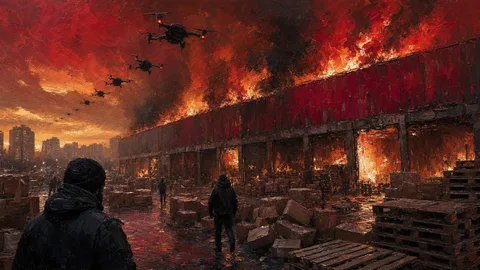
At the heart of this firestorm: Konstantynivka, a city in Donetsk oblast, whose historic center and several residential neighborhoods are now under Russian control or direct pressure. OSINT observers and ISW analysts report a sustained, methodical Russian advance, street by street, building by building. This city is not symbolic by accident — it is a logistical lock, a supply nexus, a potential tipping point for the entire Ukrainian defense in central Donetsk.
A front that bleeds every hour
Russian losses are considerable — 1,260 soldiers killed or wounded in 24 hours according to Ukrainian data from June 24, 2026 — but Moscow appears to accept this price as a standard operating cost. Putin's logic is brutal in its simplicity: send human waves until the defenders are exhausted, run out of ammunition, or lose the will to fight. It is a strategy of total attrition, with no regard for the lives of Russian soldiers sent to the front.
Meanwhile, Ukrainian civilians pay an unbearable price. Ten Russian glide bombs struck Zaporizhzhia on June 20, killing 5 civilians and wounding 12 others. In Sumy, on June 22, a Russian drone killed a 13-year-old boy, his 36-year-old father, and his 73-year-old grandmother. An entire family. Three generations wiped out in a single strike. And in Kryvyi Rih, on June 23, a Russian ballistic strike killed 3 people and wounded 25. These figures are not abstract statistics — they are lives, bereavements, scars that will never heal.
Konstantynivka: The Geography of a City Under Rubble
A key city in central Donetsk
Konstantynivka — home to 70,000 people before the war — is far more than a name on a map. It is a major road junction, a link between several Ukrainian supply routes in central Donetsk. Its fall — even partial — would degrade Ukraine's ability to maintain support lines to forward-contact units further east. Ukrainian strategists know this. Russian strategists do too. That is precisely why Moscow's forces concentrate such intense pressure there.
The ISW documents that Russian forces have taken control of the historic center and several neighborhoods. This advance is not accidental — it results from a coordinated effort combining assault infantry, FPV guidance drones, precision artillery, and glide bomb strikes. The Russian military, despite colossal losses, has developed an urban assault doctrine refined by accumulated experience since Bakhmut, Avdiivka, and Marinka.
OSINT pressure reveals the true scale
OSINT analysts — civilian observers who reconstruct the front from satellite imagery, geolocated videos, and military Telegram channels — confirm a picture that official communiqués sometimes downplay. The nine simultaneously active sectors documented on June 21 illustrate a Russian strategy of defensive overload: attack everywhere at once to prevent Ukraine from concentrating reserves and reinforcing a specific point.
This saturation doctrine carries a staggering human cost for the attacker. But it is effective when the attacker has a nearly inexhaustible human reservoir — or at least one perceived as such by the Kremlin. Russia is betting that Ukraine will exhaust itself first. That bet is immoral. It may also be wrong — but it demands a Western response commensurate with what is at stake.
The Russian Attrition Doctrine: A Deliberate Strategy of Exhaustion
Losses as an acceptable adjustment variable
The loss of 1,260 Russian soldiers killed or wounded in 24 hours is a figure that Moscow's authorities never publish. They never will. Because if Russian families truly understood the scale of casualties — which, accumulated since February 2022, number in the hundreds of thousands — social tolerance for this war would become unmanageable. Putin governs through silence, censorship, and fear.
This attrition doctrine is ancient in Russian military tradition — one can see the shadows of Zhukov, of Second World War operations where massive Soviet losses were accepted as the price of victory. Except here, the aim is not to liberate a territory invaded by fascists — it is to invade a sovereign country, destroy its cities, kill its civilians, in the name of a neocolonial imperial fiction that has no legitimacy under international law.
The unbearable human cost for Ukraine
But attrition also carries a Ukrainian cost. The defenders of Konstantynivka and the entire Donetsk front are real men and women, exhausted, who have been holding out for months in extreme conditions. Ukrainian losses are not officially published, but they are real. Holding the front demands a titanic human and logistical effort, made all the more difficult when Western aid trickles in, conditioned by slow parliamentary processes and domestic political debates that sometimes seem trivial in light of what is at stake at Konstantynivka.
This is where the West bears direct responsibility. Every delay in delivering artillery systems, ammunition, and armored vehicles translates into Ukrainian lives lost and territory ceded. This is not an abstract equation — it is a concrete, measurable reality documented by ISW analysts and war correspondents on the ground.
Zaporizhzhia and Sumy: When Strikes Target Civilians
Ten glide bombs on an already battered city
Zaporizhzhia is no longer a city "behind the front." It has become a permanent, systematic, methodical target. The 10 Russian glide bombs of June 20 — which killed 5 civilians and wounded 12 others — are part of a long series of attacks against this industrial city that the Russians failed to capture militarily. So they destroy it from a distance.
Glide bombs — FAB-500 or FAB-1500 munitions modified with wings and guidance systems — are among the deadliest weapons in the conflict. They are cheap, difficult to intercept, and the Russian military has launched thousands of them since their systematic deployment began. Ukraine lacks the interception systems needed to neutralize them at scale. Every bomb that falls is a failure of air defense — not due to any lack of courage from the defenders, but from a lack of equipment.
Sumy: the death of an entire family
The Russian drone strike on Sumy on June 22 has something particularly unbearable about it. A drone — perhaps guided from an apartment in Moscow by an operator who will never see the consequences of his act — killed a 13-year-old teenager, his 36-year-old father, and his 73-year-old grandmother. Three members of the same family. Three generations. The photographs of the city after the strike, the faces of neighbors bearing witness — these images circulate on Ukrainian and Western social media, but they no longer seem to shock with the same intensity as in 2022.
This is one of the great tragedies of this war over the long term: the progressive normalization of horror. The figures become routine. Daily casualty reports pile up. And meanwhile, in Sumy, a family was erased from the face of the earth by a wartime decision made in a Russian headquarters, in the name of an imperial ideology that the international community continues to tolerate far too weakly.
Kryvyi Rih: Ballistic Death Strikes Again
A ballistic strike in a city that holds on
Kryvyi Rih — Volodymyr Zelensky's hometown, which therefore carries considerable symbolic weight in Russian propaganda — was struck on June 23 by a Russian ballistic missile. Toll: 3 dead, 25 wounded. An attack that fits the trend documented by the ISW: Russia launches an average of 74 ballistic missiles per month against Ukraine in 2026, and Ukraine intercepts only about one third of them.
This interception deficit is the most serious structural vulnerability Ukraine faces right now. Ballistic missiles — particularly the Iskander-M and, increasingly, the hypersonic Zircon — fly at speeds and on trajectories that exceed the capabilities of HAWK systems and even Patriot PAC-2. Only the Patriot PAC-3 can engage them effectively — and Ukraine does not have enough of them to cover its entire territory.
The president's hometown as a symbolic target
Russia targets Kryvyi Rih repeatedly. This is no geographical accident — it is a political and psychological decision. Striking Zelensky's hometown sends a message: we can reach you anywhere, even where you were born. It is a strategy of psychological terror as much as a military one, aimed at demoralizing the population and putting the president under personal pressure.
This perverse logic says much about the nature of Putin's regime. An army that respects international law targets legitimate military objectives. An army that deliberately targets civilian cities, markets, hospitals, cultural sites, and families — that army is committing war crimes. The documentation of these crimes by journalists, the ISW, the UN, and humanitarian organizations will be essential for future judicial proceedings. Impunity must not have the last word.
Russia's Saturation Strategy Across Nine Sectors
Attacking everywhere to defend nowhere
Russia's current military doctrine in Ukraine rests on a simple but brutally effective principle: maintain simultaneous pressure on as many sectors as possible to prevent Ukraine from building strategic reserves and practicing elastic defense. The 56 daily engagements across nine active sectors documented by the ISW on June 21 illustrate this approach.
This strategy forces the Ukrainian general staff into painful trade-offs. Reinforcing Konstantynivka may mean weakening Pokrovsk, Lyman, or Kherson. Every decision to redeploy reserves is a strategic bet made in conditions of total uncertainty. Ukrainian officers make these decisions under extreme time and psychological pressure, often with incomplete information about the adversary's true intentions.
The nine sectors: a map of horror
The nine active sectors on June 21 covered a considerable arc of the front, from northern Kharkiv to southern Kherson. This geographic breadth is itself a weapon — it forces Ukraine to maintain forces across thousands of kilometers of front, making any massed concentration difficult. Russia, with its theoretical numerical superiority, can afford this dispersion. Ukraine cannot.
That is why Western deliveries of armored vehicles, long-range artillery systems, and reconnaissance drones are so critical. They allow Ukraine to partially offset Russia's numerical superiority with qualitative and technological superiority. Without this support, the defense becomes mathematically untenable over time.
The ISW as the War's Compass: Merits and Limits
The indispensable mapping of the war
The Institute for the Study of War, based in Washington, publishes a daily campaign assessment that has become the global reference for following the Russo-Ukrainian conflict. Its daily maps, terrain analyses, and assessments of adversary capabilities are cited by journalists, analysts, and policymakers on both sides of the Atlantic.
The quality of the ISW's work is real and documented. Its assessments of June 21, 2026, detailing the 56 engagements, the nine active sectors, and the advance at Konstantynivka, are the product of rigorous analytical work cross-referencing multiple sources: commercial satellite imagery, OSINT data, official statements from both sides, and field reports.
The inherent limits of remote analysis
Discover

INVESTIGATION: Beijing cuts Africa to 2.1 billion in loans…
2.1 billion — the lowest figure in almost twenty years, according…

SPECIAL REPORT: Beijing Promises Stimulus as Its Households Give…
That is the growth rate of Chinese industrial output in July,…

INVESTIGATION: Two Chinese Ex-Soldiers Arrested in Seoul as 18,000…
For five years, a man ran a military-supply shop at the…
But all remote analysis has its limits. The ISW has no permanent observers on the ground at Konstantynivka. Its assessments rely on sources that may be incomplete, biased, or deliberately manipulated. The information war is a major component of the conflict, and both sides seek to influence external perceptions of the situation.
This does not disqualify the ISW — quite the contrary. It remains the most reliable source publicly available for tracking front-line developments. But its assessments must be read with appropriate epistemic humility: they describe the best available estimate of a chaotic reality, not an absolute truth. In the fog of war, even the best analysts sometimes navigate by sight.
The Human Dimension: Soldiers, Civilians, Witnesses
The defenders of the shadows
Behind the ISW's statistics, there are faces. The defenders of Konstantynivka are volunteers, conscripts, professionals — men and women aged 20 to 50 who chose or were called to hold a line in a city in ruins. Their accounts, when they filter through, speak of sleepless nights, lost comrades, insufficient rotation, and a tenacious faith in the Ukrainian cause.
These fighters are not strategic abstractions. They are citizens of a sovereign country defending its right to exist. Their courage deserves to be named, recognized, and concretely supported — not merely celebrated in diplomatic rhetoric at Western summits, before returning to national budget debates.
Civilians caught in the crossfire
The civilians who remained in Konstantynivka — by choice, for lack of means, or out of attachment to their homes — are living in inhuman conditions. Basements converted into shelters, intermittent water and electricity, the constant sound of shelling, the absence of medical security. Some refuse to leave because they do not want to surrender their homes to Russian forces. Others because they have nowhere to go.
The Geneva Conventions are clear on the protection of civilians in wartime. Russia violates them systematically, deliberately, from the first day of its invasion. The glide bombs on Zaporizhzhia, the drones on Sumy, the ballistic missiles on Kryvyi Rih — these are not "collateral damage." These are attacks on civilian populations. The distinction deserves to be hammered home, again and again.
Ukraine's Response: Hold, Counter-attack, Innovate
Active defense as doctrine
In the face of this pressure, Ukraine does not simply absorb the blows. Its current military doctrine is one of active defense: hold ground to the maximum, inflict maximum casualties on the attacker, and seek opportunities for local counter-attacks to disrupt adversary formations. This approach explains the massive Russian losses documented — 1,260 in 24 hours on June 24 — despite Moscow's limited but real geographic advance.
Ukraine also employs its FPV drones offensively to destroy Russian equipment before it reaches the front line. Dozens of Russian tanks, armored vehicles, and artillery systems are destroyed each week by these cheap but lethal drones. This is a form of asymmetric technological warfare that partially compensates for the adversary's numerical superiority.
Innovation under constraint
Constraint breeds innovation. The Ukrainian military has developed a remarkable capacity for adaptation over two years of war: new anti-drone tactics, improvised jamming systems, rapid fortifications, resilient communications networks. This tactical agility is one of the major assets of the Ukrainian defense against a Russian military that is often more rigid in its doctrine.
But tactical innovation cannot indefinitely compensate for a deficit in heavy equipment. Ukrainian soldiers are creative, courageous, motivated. They cannot work miracles without artillery shells, anti-aircraft missiles, and armored vehicles in sufficient quantities. Ingenuity has its physical limits. This is where Western responsibility becomes absolutely decisive.
The West Faces the Konstantynivka Test
What the fall of Konstantynivka would mean
If Konstantynivka fell entirely into Russian hands — which has not yet happened, but which the current trajectory makes possible if nothing changes — the consequences would be significant. Strategically, the city controls important supply routes for central Donetsk. Its loss would facilitate the Russian advance toward Kramatorsk and Sloviansk, the two large cities still under Ukrainian control in the region.
Psychologically, the loss of such a visible city would send a strong negative signal — to Ukrainian populations, Western partners, and to states that still hesitate to commit fully. The conflict map has a considerable psychopolitical dimension that Russian strategists understand perfectly and exploit deliberately.
Western support at a crossroads
Western support for Ukraine, though significant, remains insufficient given what is at stake. The $4 billion in commitments announced at Ramstein 35 in June 2026 are a positive signal — but delivery delays, restrictions on the use of certain weapons, and the sluggishness of political approval processes considerably dilute their operational impact.
The time for half-measures is over. If the West wants to maintain its strategic credibility — and avoid setting a precedent that would encourage other revisionist powers to test the resolve of democracies — it must support Ukraine with the full intensity the situation demands. Konstantynivka is burning. The Western response must be commensurate with that fire.
The Question of Duration: Who Exhausts First?
Ukrainian resistance over the long term
The great question of 2026 is not tactical — it is temporal. Who will hold out longer? Ukraine, defending its national existence with variable external support? Or Russia, paying a colossal human and economic price for marginal territorial gains? Analysts are divided, but recent trends offer some clues.
Ukraine has demonstrated remarkable institutional resilience. Despite four years of total war, its institutions function, its economy adapts, its civil society remains active. The population's morale, tested to its limits, remains — according to available polls — predominantly in favor of resistance. This resistance is not merely military: it is a civilizational decision.
The progressive cracking of the Russian machine
On the Russian side, signs of strain are accumulating. Colossal human losses, recruitment difficulties, fuel shortages in 53 regions documented in May 2026, the economic tensions linked to sanctions — all of this paints a portrait of a war economy under growing pressure. Putin can still hold on, thanks to repression, residual oil revenues, and the support of partners such as China, Iran, and North Korea. But the cracks are real, and they are widening.
The Ukrainian campaign against Russian refineries, deep strikes on transport infrastructure, attacks on arms factories — all of this aims precisely to accelerate that cracking. It is a strategy of progressive strangulation, patient and methodical. And it is bearing fruit, even if the results are not immediate.
Regional Alliances and the Systemic Threat
The Russia-China-Iran-North Korea axis
The war in Ukraine is not an isolated conflict. It is the armed and visible branch of a systemic challenge to the liberal international order by an autocratic axis comprising Russia, China, Iran, and North Korea. These four powers do not share the same objectives or the same ideology — but they share a common interest in weakening the institutions and norms that limit their room to maneuver.
North Korea supplies artillery shells and drones to Russia. Iran provides Shahed drones in large quantities. China maintains discreet but substantial economic and technological support for Moscow, enabling it to partially circumvent sanctions. This de facto coalition represents a major strategic challenge for the West — which cannot respond to each of these threats in isolation.
The NATO response: necessary but insufficient
NATO has made significant progress since 2022: reinforcement of the eastern flanks, increased defense spending, the integration of Sweden and Finland. But the collective response remains below what the threat requires. Divergences among members on the level of aid to Ukraine, restrictions on the use of delivered weapons, the sluggishness of decision-making processes — all of this undermines the coherence of the Western response.
Trump, in this context, is indeed the "necessary evil" some analysts describe. His pressure on European allies to increase their defense spending is producing concrete results. But his fundamental ambivalence toward Ukraine — alternating between support and pressure for concessions — creates a strategic uncertainty from which Moscow knows how to profit. Predictability is a virtue in geopolitics. Trumpian unpredictability is its antithesis.
The Essay as a Genre: Why Write About War
The moral obligation to put things into words
People sometimes ask me why I write about a war I am not directly experiencing, from a desk far removed from the trenches of Donetsk. The answer is simple: because silence is a form of complicity. When a 13-year-old boy is killed by a Russian drone in Sumy, the minimal duty of a columnist is to name him, to make him visible, to refuse that his death be swallowed up in the information flow that covers everything and explains nothing.
The essay as a genre seems particularly suited to this war — because it allows the blending of documented facts with personal reflection, strategic analysis with moral emotion, journalistic rigor with intellectual commitment. This is not propaganda — it is an attempt to understand and to make others understand a conflict of exceptional historical complexity and importance.
The limits of the remote analyst
I do not claim to know everything. I do not have access to briefings from Ukrainian general staffs. I have no contacts in Konstantynivka. I work from open sources — ISW, Kyiv Independent, Euromaidan Press, Ukrainska Pravda — which are themselves the product of journalistic work, often heroic, carried out in conditions of real danger. My debt to these journalists and ground-level analysts is immense.
This epistemic humility does not prevent me from having clear positions on substance: Ukraine has the right to defend itself, Russia is waging a criminal war of aggression, the West has the moral and strategic responsibility to support Ukrainian democracy through to victory. These positions are not propaganda — they derive from an honest reading of international law, history, and documented facts.
The Historical Responsibility of Our Generation
Ukraine as a test of our proclaimed values
There is a question every Western citizen should ask themselves when confronted with casualty reports from the Donetsk front: what do our declared values mean if we do not defend them when the cost is real? The charters of rights, the declarations of principles, the speeches about democracy and national sovereignty — all of it rings hollow if, when a democracy is attacked and asks for help, we respond with delays, procedures, and budgetary hesitations.
Ukraine is not asking us to die in its place. It is asking us to provide the tools to defend itself. This distinction is fundamental. The human cost of Ukrainian resistance is borne by Ukrainians — not by us. What we are asked for is military equipment, funding, sustained sanctions. That is the minimum our values demand.
What tomorrow's historians will retain
The historians who study this period will look on with incredulity at how the wealthiest democracies in history delayed delivering ammunition to a country fighting for the same values they proclaimed. They will note the parliamentary debates over sums derisory compared to national military budgets. They will document the delivery delays measured in months while Ukrainians were dying in days.
This historical perspective is not comfortable. It is not meant to be. Moral discomfort in the face of our own inadequacy is precisely the engine that should push us to do better. Not sterile guilt — but mobilizing responsibility. The front at Konstantynivka is watching us. Our response will be recorded.
Conclusion: Hold the Line, Stay the Course
What Konstantynivka represents
On the same topic

INVESTIGATION : Russia's FSB Erases 4 Ukrainian Regions' Border…
Not an assault, not an ultimatum, not a televised proclamation from…
ANALYSIS: 800 drones over Russia in one night —…
More than eight hundred drones, in a single night, August 14…

COLUMN : Europe Moved 8.5 Billion Euros in a…
That is what the European Commission says it has disbursed for…
Konstantynivka is not merely a Ukrainian city under Russian pressure. It is the symbol of something broader: the resistance of a sovereign people against an attempt at erasure by force. Every day its defenders hold, every building they keep out of Russian reach, every civilian they manage to evacuate — that is a victory of law over brute force, of human dignity over imperial barbarism.
The 56 engagements per day, the 1,260 Russian losses in 24 hours, the glide bombs on Zaporizhzhia, the family massacred in Sumy — these figures must resonate in the corridors of Western parliaments, in the offices of defense ministers, in NATO general staffs. They must produce decisions, deliveries, concrete commitments. Not tomorrow. Now.
History will judge us on what we do
In a few decades, when historians write the account of this period, they will judge Western societies not on their declarations of support for Ukraine — but on the concrete actions they took when it still mattered. When the window of opportunity was open. When each additional week of support could still change the trajectory of the conflict.
At Konstantynivka, right now, Ukrainian men and women are holding a line. They hold it for their people, for their country, for a vision of the world where borders are not redrawn by the missiles of empires. This line deserves our full support. Without delay. Without ambiguity. Without reservation.
Signed Maxime Marquette, columnist
Columnist's transparency box
Editorial positioning
This essay expresses a clearly pro-Ukrainian, anti-Russian-aggression viewpoint, grounded in the principles of international law and the defense of sovereign democracies. Maxime Marquette is not a neutral observer — he believes that Ukraine has the right to defend itself and that the West has a duty to support it. This positioning is assumed and transparent.
Method and sources
All figures and facts cited in this article come exclusively from the sources identified in the Sources section. No figure has been invented, extrapolated, or attributed to fictional contacts. Analytical assessments and judgments are those of the author, based on his reading of the available primary and secondary sources. No confidential sources were used.
Limits of the analysis
This article was written from open sources, at a distance from the front. The author did not have direct access to the combat zones and does not claim to have exhaustive knowledge of the situation on the ground. The fog of war necessarily affects all remote journalistic analysis, even when conducted with rigor. The reader is invited to consult the primary sources cited to deepen their own analysis.
Sources
Primary sources
Kyiv Independent: Russian ballistic missile strike on Kryvyi Rih kills 3, injures 25 — June 23, 2026
Secondary sources
Get the geopolitics analyses
Conflicts, powers, alliances: the MadMax thread without the noise.
Cite this article
Maxime Marquette (2026). ESSAY: Konstantynivka Burns — and Russia Advances, Block by Block. MadMax. https://mad-max.co/en/article/essai-konstantynivka-brule-et-la-russie-avance-quartier-par-quartier
Read next
INVESTIGATION: Beijing cuts Africa to 2.1 billion in loans…
2.1 billion — the lowest figure in almost twenty years, according…
SPECIAL REPORT: Beijing Promises Stimulus as Its Households Give…
That is the growth rate of Chinese industrial output in July,…
INVESTIGATION: Two Chinese Ex-Soldiers Arrested in Seoul as 18,000…
For five years, a man ran a military-supply shop at the…
Enjoyed this piece? Get the next one.
One chronicle a week, straight to your inbox. No noise.
This article was generated with AI assistance, under human supervision.
Comments
Be the first to weigh in.