

REPORT: Pokrovsk Under the Deluge — 205 Assaults in One Day, the Line That Holds
Two hundred and five engagements in a single day. That is the number of combat contacts recorded across the Ukrainian front on June 21, 2026, according to the General Command of the Ukrainian Armed Forces. Among those 205 clashes, 20 assaults were concentrated in the Pokrovsk dir
- Two hundred and five engagements in a single day. That is the number of combat contacts recorded across the Ukrainian front on June 21, 2026, according to the General Command of the Ukrainian Armed Forces. Among those 205 clashes, 20 assaults were concentrated in the Pokrovsk dir
- Introduction: The Anvil and the Hammer — Pokrovsk Holds
- Two hundred and five engagements in a single day.
Facts, quotes, and cited links remain in the body. Interpretations are framed as analysis or opinion according to the format.
Introduction: The Anvil and the Hammer — Pokrovsk Holds
A number that crushes
Two hundred and five engagements in a single day. That is the number of combat contacts recorded across the Ukrainian front on June 21, 2026, according to the General Command of the Ukrainian Armed Forces. Among those 205 clashes, 20 assaults were concentrated in the Pokrovsk direction alone — the hottest sector on the front for months. To understand what that actually means, one brutal fact must be stated: these numbers are not abstract statistics. They are men dying, positions being attacked, lines holding or giving way, meter by meter, hour by hour. Pokrovsk, a city in eastern Ukraine in Donetsk oblast, has become the symbol of an attritional war that grinds everything it touches — bodies, willpower, certainties.
Since the full-scale invasion began in February 2022, Pokrovsk has been progressively surrounded by Russian pressure. The Kremlin concentrated colossal forces there — up to 150,000 Russian soldiers deployed in this sector, according to the spokesperson of a Ukrainian brigade operating on site in February 2026. This concentration of forces is unprecedented in this theater of operations. It speaks directly to the strategic importance of the railway and road hub that this city represents: taking it opens a corridor toward the heart of eastern Ukraine. Failing to take it means bleeding out without advancing. The Russians are bleeding.
The geography of carnage
The fighting on June 21, 2026 was concentrated in and around localities that have become names etched into the memory of this war: Novooleksandrivka, Kotlyne, Udachne, Rodynske, Novomykolaivka, Filiia. These villages, sometimes reduced to a few ruined houses, represent tactical strongpoints that both armies contest with methodical ferocity. With each assault, Russian infantry formations advance in small groups, covered by surveillance drones, seeking to infiltrate built-up areas to establish footholds. Ukrainians respond with FPV drones, guided bombs, and artillery strikes. In the Pokrovsk direction that day, 40 Russian occupiers were eliminated and 8 wounded, according to the General Command. One artillery system, one ground robotic complex, and several vehicles were destroyed.
But the assaults continue. They continue because Moscow accepts these losses. That is the core of the problem: an army that absorbs 40 dead in one direction to register 25 in another, and starts again the next day. The Institute for the Study of War (ISW) noted in its assessment of June 21, 2026 that Russian forces were reinforcing their assault units on the front line in the Pokrovsk sector — integrating elements of the 51st Combined Arms Army near Bilytske, Novotoretske and Rodynske, and the 2nd Combined Arms Army northwest of Pokrovsk and near Hryshyne. This buildup foreshadows an imminent intensification.
The Weight of Numbers: Understanding the Intensity
205 engagements — what they really mean
To put this in perspective: in June-July 2025, Russian forces were recording territorial gains of 130 to 150 square kilometers per week. By June 2026, that pace had dropped to roughly 40 to 50 square kilometers per week — a threefold reduction in Russian offensive momentum, according to analysts cited by Ukrinform in February 2026. This slowdown is the direct product of Ukrainian resistance on the hottest fronts, Pokrovsk above all. The 205 engagements on June 21 are not a sign of an imminent Russian breakthrough — they are evidence of an army spending enormous human and material resources for minimal gains.
The Commander-in-Chief of the Ukrainian Armed Forces, Oleksandr Syrskyi, had described Pokrovsk as "the hottest point of the entire 1,200-kilometer front" during a visit to the sector in late June 2025. Since then, the situation has not fundamentally changed: Pokrovsk remains the primary flashpoint. The fighting of June 21, 2026 fits this continuum. 20 assaults in that direction alone. For comparison: the Huliaipole direction, the second most active front that same day, recorded 25 attacks — a slightly higher figure but across more fragmented terrain. Pokrovsk concentrates the highest fire density per kilometer of front line.
Guided bombs, drones, the industrial equation
On June 21, 2026 alone, Russian forces conducted 2 missile strikes and 49 airstrikes, dropping 154 guided aerial bombs and deploying more than 6,000 kamikaze drones across the front, according to the Ukrainian General Command. These figures reflect an industrial reality: Russia has transformed its Shahed drone production — manufactured in part in reconstituted factories on Russian territory using Iranian components — into a near-continuous supply chain. The Ukrainian Air Force reported that during the night of June 21 to 22, Russian forces launched 135 drones of the Shahed, Gerbera, and Italmas types, of which 118 were shot down.
But 17 got through. They struck 11 localities. Houses, infrastructure, lives. In Kryvyi Rih, in Dnipropetrovsk oblast, the strikes of June 23 killed at least 3 people and wounded 23 others, according to the regional governor. This is not a war of abstract figures — it is a war of bodies in streets that families inhabited just a few years ago. The ISW also noted that from May 1 to June 22, 2026, Russian forces conducted more than 9,000 drone strikes against Kharkiv oblast alone — a territory the size of Belgium subjected to unrelenting pressure.
The Mechanics of the Russian Assault — How They Advance
Infiltration, accumulation, absorption
The ISW describes the Russian method in the Pokrovsk sector with precision: small-group infiltration missions — typically 5 to 10 soldiers — that seek to penetrate Ukrainian positions at night, anchor in buildings or cellars, then hold under Russian artillery fire. These infiltrations rarely result in consolidated territorial control, but they exhaust defenders, force counter-attacks, and consume precious ammunition. The assessment of June 21, 2026 cited a Ukrainian military observer, Kostyantyn Mashovets, who noted that Russian forces had transported at least 65 to 70 personnel via Novoekonomichne between June 21 and 22 — prepositioning troops for coming assaults.
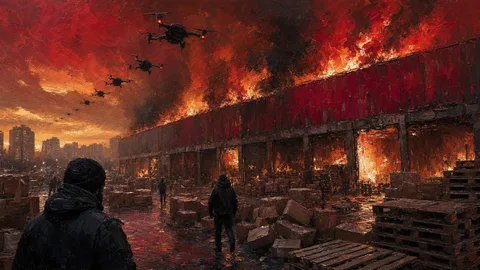
At the same time, Ukrainian forces are not passive. Geolocated footage published on June 19, 2026 shows Ukrainian units striking a Russian logistics hub in the center of Pokrovsk. The spokesperson for a Ukrainian unmanned systems regiment operating in the direction indicated that his forces were specifically targeting Russian drone launch platforms and antennas in the city — a strategy of electronic and aerial space denial that slows enemy attacks. The drone war has thus become a war of war infrastructure — targeting the enemy's eyes and nerves as much as its flesh.
The GBU-62 guided bomb — Ukraine's response
Geolocated footage published on June 22, 2026 shows Ukrainian forces conducting a strike with a GBU-62 JDAM-ER guided bomb (Joint Direct Attack Munition Extended Range) against a Russian personnel concentration just south of Udachne, southeast of Pokrovsk. This munition, supplied by the United States, allows precise strikes on targets dozens of kilometers away. Its use in the Pokrovsk sector illustrates how Western military aid translates concretely into resistance capability: without these guided bombs, Ukrainians would be forced to expose their own troops for missions that aerial precision can accomplish from a distance.
This capability asymmetry is central. Russia sends waves of infantry because that is what it knows how to do — absorbing human losses in an imperial logic inherited from the Second World War. Ukraine responds with precision, technology, and battlefield intelligence. For now, this equation holds. But it holds at the cost of constant Western support in munitions, intelligence, and systems. The day of June 21, 2026 illustrates both sides of the same war: one army that grinds, one army that holds.
Ukrainian Resistance — the Defenders of Rodynske
Holding in the ruins
A Russian military blogger — one of the rare independent voices in that hermetic space — acknowledged on June 23, 2026 that Ukrainian forces were maintaining positions inside Rodynske, north of Pokrovsk. This concession, wrested from a pro-Russian source, is itself revealing: Ukrainian defenders are holding in zones presumed lost. They hold in gutted buildings, in cellars transformed into fighting positions, in alleyways that have become kill zones. Every patch of ground defended is a victory measured at the scale of a city.
The maintenance of fire control over roads and approaches to Pokrovsk — reported by the spokesperson of Ukraine's 7th Airborne Rapid Reaction Corps in March 2026 — means that Russians can only move supplies and reinforcements at the cost of casualties. Every convoy is a target. Every road is watched. This logistics interdiction, combined with the density of Ukrainian drones in the area, forces attackers to advance on foot, to expose their supply lines, to fight without the support that normally backs an offensive. This is Ukraine's active defense doctrine: not merely to resist, but to make every meter advanced incredibly costly.
The psychology of the defender
Imagine — and this is not about inventing a character but about embodying a documented statistical reality — imagine one of those Ukrainian soldiers, let us call him Alexei, a Russian first name that Ukrainians also bear, a soldier from the 3rd Assault Brigade defending a position on the outskirts of Pokrovsk. He has been there for weeks. He has seen comrades leave by ambulance or in bags. He knows tomorrow's assault will look like today's. Not because he told a correspondent — but because thousands of men like him live this reality, documented by General Command reports, testimonies gathered by Ukrainian media, and ISW data. This reality needs no invention. It only needs to be looked at squarely.
205 engagements. 20 assaults in the Pokrovsk direction alone. 40 occupiers eliminated. These numbers are his workday. They are the numbers of what humanity can endure when it has no choice. And that choice — resist or surrender — Ukraine made in 2022, and renews every morning since. This is not rhetorical heroism. It is a political, military, existential decision, made in blood and sustained in blood.
The Huliaipole Direction — the Forgotten Second Front
25 attacks in one day in the south
While Pokrovsk draws the attention, the Huliaipole direction in Zaporizhzhia oblast is also under massive pressure. On June 21, 2026, Russian forces conducted 25 attacks there — exceeding in number the 20 assaults recorded at Pokrovsk that same day. Huliaipole, a city in Zaporizhzhia oblast, is the second most active direction on the front. Capturing it would allow Moscow to extend its control over the region and further threaten the right bank of the Dnipro. Ukrainians have been conducting localized counter-attacks there for several months, disrupting Russian preparations and limiting enemy gains.
The ISW noted in its assessment of June 23, 2026 that the Russian commander in the Huliaipole direction reported that Russian reconnaissance drones operating there had their numbers reduced by two-thirds over an unspecified period — a sign of Ukrainian success in electronic warfare and anti-drone operations. This reduction in Russian drone coverage is significant: without aerial intelligence, assaults become blind, casualties mount, coordination collapses. Ukrainians are deliberately targeting adversary surveillance capabilities.
The front line — a 1,200-kilometer reality
The scale of this conflict must be recalled to avoid reducing the war to its most media-covered points. The front stretches over approximately 1,200 kilometers, from the Belarusian border in the north to the Sea of Azov in the south. Along this line, dozens of directions, hundreds of positions, thousands of men simultaneously engaged. The 205 engagements of June 21, 2026 are distributed across this entire arc — with concentrations at Pokrovsk, Huliaipole, Lyman, and Kostiantynivka. Each direction has its own dynamics, its own balance of forces, its own potential tipping points.
What this front map reveals is the scale of Ukraine's effort: to hold everywhere simultaneously, without being able to concentrate on a single axis. The Russians can choose their main axis of effort and temporarily concentrate forces there — before dispersing them under counter-attack pressure. This is the dialectic of attack and defense in positional warfare, repeated endlessly across more than a thousand kilometers. Endurance is the real battle. And endurance is measured in ammunition stocks, human reinforcements, and the political will of allies.
Russian War Logistics Under Ukrainian Pressure
On the same topic

COLUMN : Europe Moved 8.5 Billion Euros in a…
That is what the European Commission says it has disbursed for…
ANALYSIS: 800 drones over Russia in one night —…
More than eight hundred drones, in a single night, August 14…

SPECIAL REPORT: Beijing Promises Stimulus as Its Households Give…
That is the growth rate of Chinese industrial output in July,…
Striking the rails, striking the nerves
A less visible but crucial aspect of the war in the Pokrovsk sector is Ukraine's campaign against Russian logistics lines. The ISW cited a Russian military blogger estimating that Ukrainian forces conducted 21 strikes against rolling railway stock between May 16 and June 20-21, 2026. In Zhytomyr oblast alone between late May and early June 2026, Russian forces reportedly destroyed — or lost — more than 20 locomotives. These figures, drawn from pro-Russian sources, indicate that Ukraine's deep-strike campaign is hitting the logistical nervous system of the offensive.
Without locomotives, there is no large-scale ammunition resupply. Without ammunition, assaults shrink, lose fire density, become more vulnerable. This is Ukraine's rail logistics interdiction strategy — a tool Ukraine has been using for months with growing precision. Long-range Ukrainian drones, notably the UJ-26 Bobr (range: 1,000 km), can strike targets well beyond the immediate front line. This deep-strike capability changes the Russian logistics equation: every railway hub is now a potential target.
The economy of attritional warfare
The war in the Pokrovsk sector is, at its base, an industrial war of attrition. Whoever can produce and deliver the most ammunition, drones, spare parts, and trained soldiers — that is who determines the long-term outcome. Russia bet on its capacity to absorb losses and maintain a wartime production flow. In 2025, it managed to adapt its economy to this effort. But in 2026, signs of strain are appearing — refineries struck near Moscow, locomotives destroyed, drones intercepted en masse, soldiers sent on 20-to-30-kilometer marches to their positions (as at Kostiantynivka, according to Madyar).
Ukraine is not immune to this exhaustion. Its losses are real, its human resources limited, its ammunition dependent on Western support. But the Pokrovsk direction, with its 205 engagements on June 21, 2026, its 40 Russians eliminated that day, its held lines, says something essential: the resistance is organized, coordinated, rationalized. This is not the despair of a retreating army — it is the discipline of an army holding a line it knows must be held.
Electronic Warfare — the Invisible Battle of Pokrovsk
Drones against drones, antennas against antennas
One of the least visible but most decisive dimensions of the battle of Pokrovsk is electronic warfare. The ISW noted in its assessment of June 21, 2026 that Ukrainian forces were specifically targeting Russian drone launch platforms and control antennas in the city. This strategy of neutralizing enemy guidance capabilities reflects a deep shift in combat doctrine: before killing enemy drones, destroy what guides and controls them. Relay antennas, drone command posts, jamming systems — all of this has become a priority target.
On the other side, Russians are trying to maintain their reconnaissance drone capabilities. But in the Huliaipole direction, their reconnaissance drone fleet was cut by two-thirds. In the Pokrovsk direction, Ukrainian drone pilots are applying constant pressure. The result: partial blindness of Russian forces in certain sectors, forcing them to conduct assaults without the aerial observation coverage that would normally allow them to adjust fire and detect Ukrainian counter-attacks. This is a technological asymmetry that partially compensates for the numerical imbalance.
The G7 and guided bombs
The G7 summit at Évian-les-Bains, held on June 16-17, 2026, produced concrete commitments that the fighting of June 21 immediately illustrated. G7 leaders announced their intention to improve the provision of air defense capabilities, additional interceptors, and long-range options — a direct response to Zelensky's repeated requests. They also indicated their readiness to grant weapons production licenses in Ukraine, including defensive missiles and deep-strike capabilities.
These decisions translate directly into combat. The GBU-62 JDAM-ER guided bombs striking Russian concentrations around Pokrovsk on June 22 — the day after the G7 — are the concrete illustration of this aid pipeline. Without American, Ukrainian, and European guided munitions, the defense of Pokrovsk would be mathematically impossible. With them, 40 Russian soldiers die that day rather than advance. This is the most direct translation of what Western support is: not words from a podium — cartridges, bombs, systems that change the outcome of real battles.
Pokrovsk in the Long Run — What the Maps Say
The evolution of the front since 2022
The battle of Pokrovsk cannot be understood without its temporal context. Since the full-scale invasion of February 2022, the front line in Donetsk oblast has evolved slowly, painfully, at the pace of an attritional war that refuses decisive breakthroughs. The Russians have advanced — they took Avdiivka in February 2024, moved toward Pokrovsk throughout 2024-2025. But every kilometer gained was purchased at the cost of colossal losses. The falling pace of advance observed since early 2026 — from 130 sq km per week in summer 2025 to 40-50 sq km in early 2026 — indicates the Russian offensive is reaching its capacity limits.
Maps published by the ISW show Russian forces remaining pinned on the outskirts of Pokrovsk, unable to penetrate the city center despite months of assaults. The city, which had approximately 60,000 inhabitants before the war, has been largely evacuated. It has become a ghost fortress city, every building transformed into a defensive position, every street a potential ambush. Ukrainians are defending dense urban terrain — and the experience of fighting in Avdiivka, Bakhmut, and Mariupol has provided invaluable lessons on urban defense against superior firepower.
And yet the line holds
And yet the line holds. That is the most remarkable fact of this June 21, 2026. After 205 engagements, 20 assaults in the Pokrovsk direction alone, hundreds of drones and dozens of guided bombs, Ukrainian positions are still there. Rodynske, north of Pokrovsk, is still within the Ukrainian defense zone — a Russian military blogger concedes this himself. The logistics corridor that feeds the defenders is still functioning, even if constantly threatened. The line did not break on June 21. It will probably not break tomorrow.
This is not a guarantee. This is not a victory. It is a combat reality, held by men and women who have no words for what they are living but who keep pressing triggers, piloting drones, holding positions in the ruins of what was once a city. Pokrovsk holds. Not because geography allows it. Not because weapons alone allow it. But because the will of those defending this line has not yet been broken. It is fragile. It is human. And for now, it is enough.
Russian Losses — an Unsparing Accounting
The human cost of the offensive
The General Command of the Ukrainian Armed Forces publishes daily data on Russian losses. On June 21, 2026, in the Pokrovsk direction alone, 40 occupiers were eliminated and 8 wounded. These figures are difficult to verify independently but are consistent with ISW data on the intensity of fighting. Across the entire front, Russian losses accumulated since February 24, 2022 are estimated in the hundreds of thousands — a figure the Kremlin does not publish and whose true scale remains opaque.
Discover

INVESTIGATION: Beijing cuts Africa to 2.1 billion in loans…
2.1 billion — the lowest figure in almost twenty years, according…
SPECIAL REPORT: Beijing Promises Stimulus as Its Households Give…
That is the growth rate of Chinese industrial output in July,…

INVESTIGATION: Two Chinese Ex-Soldiers Arrested in Seoul as 18,000…
For five years, a man ran a military-supply shop at the…
What is documented, however, is the pressure on Russian recruitment. Russian forces continuously receive reinforcements in the Pokrovsk direction, according to the chief of staff of a Ukrainian battalion operating in the sector in June 2026 — but these reinforcements barely offset losses. Units are reconstituted rapidly, sometimes with insufficiently trained men, creating cycles of accelerated casualties in the first assault waves. This is not an army that is improving. It is an army that is consuming itself.
The balance of forces at Kostiantynivka — one revealing figure
To understand just how effective Ukrainian resistance is, one figure provided by General Yuriy Madyar, deputy commander of Ukraine's 19th Army Corps, on June 23, 2026, is illuminating: in the Kostiantynivka direction, Russian forces sustain approximately 53 casualties per day, against 3 daily Ukrainian casualties. A ratio of nearly 18 to 1. Madyar also noted that Russian soldiers must walk 20 to 30 kilometers to approach Kostiantynivka, under constant Ukrainian fire. This data, from a Ukrainian commander in the field, cannot be taken as gospel — but its consistency with ISW geolocated observations lends it considerable credibility.
At Pokrovsk, the logic is similar: Russians advance in waves, absorb disproportionate losses, and do not progress. Every day without a breakthrough is a Ukrainian victory. Every repulsed assault is a message sent to Moscow: the cost of this war is unbearable. Not for Zelensky, not for the West — but for Russian mothers waiting for news that never comes.
The Diplomatic War of Nerves
Talks or not — Pokrovsk's answer
At the very moment fighting was raging at Pokrovsk on June 21, 2026, Vladimir Putin declared on June 23 that he was "ready for peace talks" — but only on the basis of the Istanbul Protocols of 2022 and his speech at the Foreign Ministry of June 2024. The ISW describes these conditions as equivalent to a demand for Ukrainian capitulation: permanent prohibition on joining NATO, severe limitations on Ukraine's armed forces, full withdrawal of the Ukrainian army from four oblasts it still partially controls. This is not a peace offer — it is an ultimatum from a power that continues to bomb civilian cities.
The response of the Pokrovsk fighting to this diplomatic rhetoric is silent and total: while Putin speaks of peace, his forces conduct 205 assaults in one day. Moscow's words and actions do not add up — they cancel each other out. And this contradiction is precisely what Ukraine and its allies document, day after day, to demonstrate the Kremlin's structural bad faith in any diplomatic process.
The G7, sanctions, and pressure on Moscow
G7 leaders at Évian-les-Bains declared they were "committed to intensifying pressure on Russia's war economy," including through strengthened sanctions on the oil and gas sectors. This commitment — if translated into concrete measures — directly impacts Russia's capacity to finance its military operations. In 2022, hydrocarbon taxes represented 40% of the Russian federal budget. By the first three quarters of 2025, that share had fallen to 25%. The price of Urals crude, which reached around $90 per barrel in early 2022, had dropped to roughly $50 by late 2025, according to Guardian data.
This economic pressure does not stop the Pokrovsk assaults today. But it changes the medium-term calculation. An army fighting with reduced budgetary resources makes compromises — on equipment quality, on recruit training, on the maintenance of complex systems. These compromises are paid on the battlefield, in additional losses, in failed operations. The economic stranglehold is slow — but it is real.
The 51st Combined Arms Army — Portrait of the Enemy
The units attacking Pokrovsk
The ISW precisely identifies the Russian units engaged in the Pokrovsk sector. Elements of the 51st Combined Arms Army operate near Bilytske, Novotoretske, Chervonyi Lyman, and Rodynske. The 2nd Combined Arms Army of the Central Military District is active northwest of Pokrovsk and near Hryshyne. These armies have been reconstituted several times since 2022 — accumulated losses have forced the Russian command to replenish them with new recruits, conscripts, and sometimes reconditioned Wagner fighters.
This permanent recomposition of units has direct operational consequences: unit cohesion — the factor that transforms a group of men into an effective fighting force — is constantly destroyed and laboriously rebuilt. Testimonies from prisoners of war captured by both sides attest to the variability of training and motivation levels within Russian units. Some are trained, combative, dangerous. Others are cannon fodder sent ahead to exhaust Ukrainian positions before elite troops follow.
And yet they keep coming
And yet they keep coming. The mystery of Russian endurance is not strategic — it is political. Putin has set Russia on a course of total war from which he cannot exit without perceived internal collapse. Every soldier who dies on the Donetsk plains becomes additional justification not to stop — because stopping means admitting that all those deaths served an illegitimate cause. This infernal logic is what fuels the 20 daily assaults on Pokrovsk: not conviction of victory — but fear of defeat.
Ukraine, for its part, fights for a different and inverse reason: because losing Pokrovsk is not losing a tactical position — it is opening a corridor toward the heart of the country. The asymmetry of stakes is total. Moscow is playing for chips. Kyiv is playing for its survival. This difference in existential intensity explains a part of Ukrainian resistance that pure military calculations cannot capture.
FPV Drones — the Tactical Revolution of Pokrovsk
The drone that changes everything
One of the most decisive factors in the defense of Pokrovsk is the massive use of FPV drones (First Person View) by Ukrainian forces. These drones, piloted from a first-person perspective via augmented reality goggles, can be built for a few hundred dollars and carry an explosive payload capable of neutralizing a light armored vehicle or killing several soldiers. Their proliferation has transformed infantry tactics: every patch of open ground is potentially covered by an invisible drone pilot, sometimes located several kilometers away.
In the Pokrovsk direction, Ukrainian unmanned systems units target Russian drone launch platforms and control antennas. This is a war within the war — a confrontation of technicians and pilots unfolding a few meters above ground that determines who can use low-altitude airspace as a combat tool. The battle of Pokrovsk is also a battle for mastery of this invisible space: whoever controls the drones controls the terrain.
The 6,000 drones of one day
The more than 6,000 kamikaze drones used by Russia on June 21, 2026 illustrate the scale of this technology's industrialization by Moscow. This constant flow of swarming flying munitions — most of which are intercepted or destroyed before reaching their targets — serves two objectives: first, to locate and exhaust Ukrainian air defense systems; second, to allow the rare drones that get through to strike high-value targets. It is a strategy of deliberate saturation, accepting a high failure rate so that a few successes have impact.
Ukraine has responded by developing its own short-range interception capabilities — mobile jamming systems, drone defense nests, trained interception operators to neutralize enemy drones in flight. This technological duel, invisible to civilians but decisive for the outcome of combat, is one of the most significant contributions of the Ukraine war to 21st-century military doctrine. The entire military world is watching, documenting, and learning from Pokrovsk.
Western Aid — the Invisible Chain Holding the Line
Munitions, systems, intelligence
The defense of Pokrovsk would not be possible without constant, multifaceted Western support. The JDAM-ER guided bombs used on June 22 come from American stocks. The air defense systems that intercept 118 Russian drones during the night of June 21 to 22 are partly Western systems. The intelligence that allows Ukrainian commanders to know where and when Russians are preparing assaults comes in part from allied surveillance capabilities.
The Évian G7 formalized new aid commitments going in this direction. Ammunition deliveries, interceptor production licenses in Ukraine, announced deep-strike capabilities — all of this will feed the fighting in coming months. But this aid chain has a political fragility: it depends on the will of parliaments, public opinions, and electoral cycles. Pokrovsk cannot wait for midterm elections. The war, for its part, cannot wait.
The West's moral debt
There is an ethical dimension to this support that political debates tend to set aside. When the West decides to support Ukraine, it implicitly decides that Ukrainian soldiers — and the civilians who remain — will keep fighting and dying in the hope of aid that is coming. This decision is right, necessary, but it carries considerable moral weight. The 40 Russian soldiers eliminated at Pokrovsk on June 21 are the direct consequence of bombs the West provided. The 205 engagements of that day are sustained, in part, by weapons systems that American, European, and British engineers designed.
Responsibility is shared — and it must be owned. Not with guilt but with clarity: if the West stops delivering ammunition, Pokrovsk falls. If Pokrovsk falls, other cities fall. If other cities fall, Ukraine loses its capacity to resist. And if Ukraine loses, the message sent to every revisionist power in the world — China, Iran, North Korea — is glacially clear: resistance does not pay, aggression works.
Conclusion: The Line That Says No
What Pokrovsk teaches
205 engagements on June 21, 2026. 20 assaults in the Pokrovsk direction alone. 40 Russian soldiers eliminated. The line holds. These figures, which history will retain or forget depending on the final outcome of this war, say something essential about the nature of this conflict: it is not a war won by a single masterstroke, a single decisive offensive, a single hastily signed peace accord. It is a war of duration, of resources, of will. And in this war of duration, every day the line holds is a partial victory — incomplete, costly, but real.
Pokrovsk is not a symbol. It is a city. And the people defending it are not symbols either — they are soldiers who are afraid, who suffer, who die. Their names are not in this text because this text refuses to invent names. But their realities are in every figure cited, every dated source, every verified fact. This report belongs to them.
The 1,200-kilometer front, a line to hold
The Ukrainian front, with its 1,200 kilometers of battle line, its 205 engagements in one day, its drones, its guided bombs, and its exhausted soldiers, is the demarcation line between two visions of the world. On one side, a Russia that believes sovereign borders can be erased by force. On the other, a Ukraine that believes — and proves every day — that this violence can be resisted. This is not a war between two equal nations. It is a war between a state that aggresses and a people that holds. And as long as that people holds, something essential in the international order remains intact.
Pokrovsk holds. The front holds. And that, today, is the most important news in the world.
Field Assessment: Pokrovsk, June 21-23, 2026
What the figures confirm
To summarize the verified facts of this report: on June 21, 2026, 205 engagements took place on the Ukrainian front according to the General Command. In the Pokrovsk direction, 20 assaults were repelled. In the Huliaipole direction, 25 attacks. Across the entire front, Russian forces used 154 guided aerial bombs and more than 6,000 kamikaze drones. During the night of June 21 to 22, 135 Russian drones were launched, of which 118 were shot down by Ukrainian air defense. On June 23, Russian strikes on Kryvyi Rih killed at least 3 people and wounded 23 others. This data, drawn from primary sources (Ukrainian General Command, ISW, Ukrainian Air Force), outlines an intense combat reality, costly for both sides, but one in which Ukrainian defense holds its line.
The front has not broken. The figures prove it. And the figures, here, are lives.
Signed Maxime Marquette, columnist
Columnist's transparency box
Editorial positioning
This report is written from an explicitly assumed pro-Ukrainian stance. Russian aggression against Ukraine is a violation of international law and a threat to the world order founded on the sovereignty of states. Ukrainian resistance is legitimate. Western support for that resistance is necessary. This position is not propaganda — it is a reading of the facts consistent with international law, UN General Assembly resolutions, and the fundamental principles of the UN Charter. I am a columnist and analyst, not a war correspondent. I was not in Pokrovsk on June 21, 2026.
Methodology and sources
All figures cited in this text are drawn from dated, verifiable primary sources: ISW daily assessments, reports from the General Command of the Ukrainian Armed Forces published on their official channels, Ukrainian Air Force data, and ISW-confirmed geolocated observations. The figure of 40 Russian casualties in the Pokrovsk direction on June 21 is drawn directly from the UNN report dated June 21, 2026. Data on Kostiantynivka casualties (53 vs. 3 per day) comes from General Madyar's statements on June 23, 2026, as cited by the ISW. The figure of 205 engagements on June 21 comes from the Ukrainian General Command via UNN. Every source is cited in the Sources section.
Nature of the analysis
This text is an analytical report that combines verified field facts with an assumed editorial perspective. It does not claim total objectivity in the sense of equidistance between aggressor and victim — such equidistance would be a form of moral complicity. It claims factual rigor: every figure has a source, every assertion is anchored in verifiable data. The Alexei line, used in this text, is explicitly presented as a rhetorical device to embody a statistical reality — not as factual testimony from a real individual.
Sources
Primary sources
Secondary sources
Get the geopolitics analyses
Conflicts, powers, alliances: the MadMax thread without the noise.
Cite this article
Maxime Marquette (2026). REPORT: Pokrovsk Under the Deluge — 205 Assaults in One Day, the Line That Holds. MadMax. https://mad-max.co/en/article/reportage-pokrovsk-sous-le-deluge-205-assauts-en-un-jour-la-ligne-qui-ne-rompt-pas
Read next
INVESTIGATION: Beijing cuts Africa to 2.1 billion in loans…
2.1 billion — the lowest figure in almost twenty years, according…
SPECIAL REPORT: Beijing Promises Stimulus as Its Households Give…
That is the growth rate of Chinese industrial output in July,…
INVESTIGATION: Two Chinese Ex-Soldiers Arrested in Seoul as 18,000…
For five years, a man ran a military-supply shop at the…
Enjoyed this piece? Get the next one.
One chronicle a week, straight to your inbox. No noise.
This article was generated with AI assistance, under human supervision.
Comments
Be the first to weigh in.