

INVESTIGATION: At the OSCE, the EU denounces Russia's hybrid threats — and Moscow's isolation
On June 24, 2026, in Vienna, at the OSCE Forum for Security Cooperation (session N°1140), the European Union and its member states took the floor to strongly condemn the Russian escalation in Ukraine. This official statement, published on June 26, follows the OSCE Annual Security Review Conference of June 17-18, during which Russia's position had been condemned by a "large majo
- On June 24, 2026, in Vienna, at the OSCE Forum for Security Cooperation (session N°1140), the European Union and its member states took the floor to strongly condemn the Russian escalation in Ukraine. This official statement, published on June 26, follows the OSCE Annual Security Review Conference of June 17-18, during which Russia's position had been condemned by a "large majo
- INVESTIGATION: At the OSCE, the EU denounces Russia's hybrid threats — and Moscow's isolation
- Introduction: Vienna, June 24 — Europe speaks with one voice against Moscow
Facts, quotes, and cited links remain in the body. Interpretations are framed as analysis or opinion according to the format.
INVESTIGATION: At the OSCE, the EU denounces Russia's hybrid threats — and Moscow's isolation
Introduction: Vienna, June 24 — Europe speaks with one voice against Moscow
One forum, one platform, one collective condemnation
On June 24, 2026, in Vienna, at the OSCE Forum for Security Cooperation (session N°1140), the European Union and its member states took the floor to strongly condemn the Russian escalation in Ukraine. This official statement, published on June 26, follows the OSCE Annual Security Review Conference of June 17-18, during which Russia's position had been condemned by a "large majority" of participating states.
These institutional moments can seem abstract, far from the bombs and trenches. They are not. The OSCE — Organization for Security and Co-operation in Europe — is the only pan-European organization that includes both NATO member countries, neutral states, and Russia itself. When a "large majority" of its members condemns Russia within this organization and describes it as "the greatest threat to security in the OSCE area," that is a diplomatic signal of considerable significance.
Ukraine at the center of all European concerns
The European declaration at the OSCE Forum arrives in a context of strong Russian military pressure on Ukraine. In May 2026, the latest United Nations report on civilian casualties in Ukraine recorded 274 civilians killed and 1,763 wounded in a single month — with long-range weapons (missiles and drones) as the primary cause of civilian mortality. This context of daily violence gives full force to the condemnations issued in Vienna.
The EU did not confine itself to general diplomatic formulas. Its statement listed with precision the facts being condemned: mass missile and drone strikes against civilians, attacks on the Kyiv-Pechersk Lavra (a site on the UNESCO World Heritage List), threats against European diplomatic missions in Ukraine, repeated violations of EU member state territory, and military support from North Korea, Iran, and Belarus for Russia's war machine.
Russia's hybrid threats: a documented strategy
The EU's definition of hybrid threats
The concept of "hybrid threats" is central to the European declaration at the OSCE. By this expression, the EU designates a combination of destabilization methods that blend conventional military actions, cyberattacks, disinformation, infrastructure sabotage, instrumentalization of migration, and influence operations targeting the democratic processes of targeted states. This Russian doctrinal approach, sometimes called "non-linear warfare" by its theorists, aims to weaken adversaries while staying below the threshold that would trigger a direct military response.
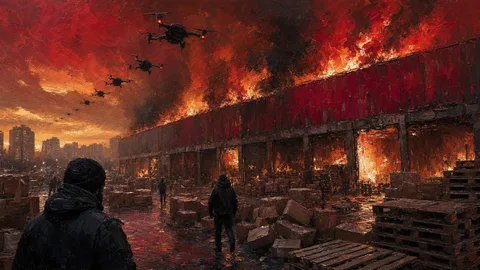
The EU has documented numerous incidents fitting this hybrid strategy since 2022: sabotage of railway and port infrastructure in member states, suspicious fires in logistics depots linked to aid for Ukraine, coordinated disinformation campaigns targeting European public opinion, pressure on Russian-speaking minorities in the Baltic states. Condemning these practices at the OSCE aims to document them within a recognized multilateral framework.
Russia's "aggressive, irresponsible, and reckless" behavior
The wording of the European declaration is intentionally strong: the EU condemns Russia's "increasingly aggressive, irresponsible and reckless" behavior toward EU member states. This diplomatic language, normally measured, reflects growing frustration in the face of provocations that keep intensifying — flights by Russian aircraft over Baltic airspace, maritime incidents in the Baltic Sea, intimidation attempts against diplomatic personnel.
The reference to "repeated violations of EU member state territory" is a grave formulation. It points to documented incidents in Poland, Estonia, and other border countries — missile or drone debris landing on their territory, potentially following Russian strikes against Ukraine. These incidents directly raise the question of the application of Article 5 of the North Atlantic Treaty.
Russia's isolation at the OSCE: a measurable reality
An isolation confirmed at the Annual Security Review Conference
The OSCE Annual Security Review Conference, held on June 17-18, 2026 in Vienna, provided a precise barometer of Russia's level of isolation within this organization. According to the European declaration of June 24, "last week also showed how the Russian Federation continues to be isolated in its position," with participating states having "overwhelmingly condemned its war of aggression against Ukraine" and largely considered this war "the greatest threat to security in the OSCE area."
This is an important diplomatic indicator. The OSCE includes states that are neither in the EU nor in NATO — Central Asian countries, Caucasus nations, Balkans states, countries that maintain significant economic relations with Russia. When even these states join in the condemnation, it means that Russian isolation extends beyond the Western perimeter alone.
The OSCE architecture facing Russian paralysis
The OSCE operates on consensus — meaning that Russia, as a member, can theoretically block any formal decision. In practice, Russia has used this veto numerous times to prevent the adoption of resolutions condemning its actions. This institutional paralysis has led to a debate within the OSCE on reforming its decision-making mechanisms, or on the possibility of acting outside formal consensus.
The EU's declaration at the June 24 Forum is itself a partial workaround of this paralysis: rather than a formal resolution that Russia would block, it is a collective statement of the EU member states, recorded in the Forum's minutes, and publicly documenting each party's positions. Russia can block votes — it cannot prevent public statements.
Strikes on UNESCO sites: a symbol of Russian barbarism
The attack on the Kyiv-Pechersk Lavra
The specific mention in the European declaration of "strikes against the UNESCO World Heritage Site of the Kyiv-Pechersk Lavra" (in Ukrainian: Kyivo-Pecherskaya Lavra) deserves particular attention. The Lavra is one of the oldest and most venerated monasteries in Slavic Orthodoxy — founded in the 11th century, it is listed as a UNESCO World Heritage Site and carries fundamental cultural and religious importance not only for Ukraine, but for the entire Christian Orthodox world.
Striking this place — whether deliberately or negligently — constitutes a violation of international humanitarian law, which specifically protects cultural and religious sites. The 1954 Hague Convention for the Protection of Cultural Property in the Event of Armed Conflict and its additional protocols are explicit on this point. Ukraine has asked UNESCO to document and condemn these strikes.
Russia's strategy of cultural erasure
Strikes on Ukrainian cultural sites fit within a broader strategy of erasing Ukrainian national identity — a strategy that historians and jurists are beginning to qualify as culturicide. By destroying Ukrainian monuments, archives, religious sites, and cultural institutions, Russia seeks to erase the traces of a distinct Ukrainian civilization — thereby denying the very existence of the Ukrainian people as a separate historical and cultural entity.
This strategy is documented by UNESCO, by heritage preservation organizations, and by specialized jurists. It adds to conventional war crimes — killings of civilians, deportations, torture — as an additional dimension of a crime of aggression of a scope and brutality without equivalent in Europe since 1945.
Threats against European diplomatic missions
An unprecedented provocation in international law
The EU's condemnation of "threats against European diplomatic presence in Ukraine" refers to serious incidents documented in 2025 and 2026. Russian missiles struck in the immediate vicinity of diplomatic buildings in Kyiv. Direct threats against EU country embassies were conveyed through official or semi-official channels. These acts constitute direct violations of the Vienna Convention on Diplomatic Relations, which protects diplomatic premises and personnel with the greatest firmness.
The inviolability of diplomatic missions is one of the most fundamental principles of international law. It ensures that even states in a state of war can maintain communication channels and on-site observers. Russia, by threatening diplomatic missions in Ukraine, seeks to terrorize states maintaining their diplomatic presence in Kyiv despite the war — and thus to further isolate Ukraine from its international partners.
Diplomatic resilience as an act of resistance
Despite these threats, the vast majority of EU member state embassies have remained open in Kyiv since 2022 — some after a brief initial closure in February 2022. This continuous diplomatic presence is an act of political and symbolic resistance of the first order: it means that the international community refuses to regard the Ukrainian government as besieged or illegitimate, and continues to treat Ukraine as a sovereign and respected interlocutor.
The EU declaration at the OSCE, in explicitly defending its diplomatic presence in Ukraine, sends a clear signal: Russian threats will not work. Europe will not close its embassies in Kyiv under the pressure of missiles or diplomatic threats.
North Korea, Iran, and Belarus: Russia's support network
Allies of isolation in service of the war
The explicit condemnation by the EU of the military support provided to Russia by North Korea, Iran, and Belarus is an important political statement. It acknowledges that Russia's war against Ukraine is no longer a bilateral war — it is a confrontation between the West and an authoritarian axis that includes Moscow, Pyongyang, Tehran, and Minsk.
Discover

INVESTIGATION: Beijing cuts Africa to 2.1 billion in loans…
2.1 billion — the lowest figure in almost twenty years, according…

SPECIAL REPORT: Beijing Promises Stimulus as Its Households Give…
That is the growth rate of Chinese industrial output in July,…

INVESTIGATION: Two Chinese Ex-Soldiers Arrested in Seoul as 18,000…
For five years, a man ran a military-supply shop at the…
North Korea has supplied artillery ammunition in massive quantities and sent troops to fight alongside the Russians. Iran has supplied Shahed drones that daily terrorize Ukrainian cities. Belarus under Lukashenko serves as a rear logistics base and has been building military infrastructure at the Ukrainian border. These supports extend Russia's war-making capacity and are therefore legitimate targets of sanctions and Western diplomatic pressure.
Implications for Western deterrence strategy
The formation of this authoritarian axis poses considerable challenges to Western deterrence strategy. How do you deter Russia when its allies compensate for losses in equipment and ammunition? How do you economically isolate a country that markets its oil through a global network of non-Western partners? The West has responded by broadening its sanctions to third-party entities that facilitate circumvention — notably Chinese, Emirati, and Turkish companies.
But this response has structural limits: the West cannot sanction all of global trade, and countries like China and India refuse to accept a sanctions regime they view as an expression of Western economic dominance. The war in Ukraine has thus become the revealing lens of a global fracture between liberal democracies and a broader set of powers that refuse their leadership.
Criminal accountability: a reaffirmed commitment
The ICC and international justice mechanisms
One of the most important points of the European declaration at the OSCE is the reaffirmation of the EU's commitment to "full accountability for war crimes and other most serious crimes committed in the context of Russia's war of aggression against Ukraine." This formulation encompasses both the crimes prosecuted by the ICC — war crimes, crimes against humanity — and the crime of aggression itself, for which a special tribunal is being created.
The EU has actively supported the ICC's work in Ukraine since 2022: funding investigative teams, sharing evidence gathered by its members' intelligence services, training Ukrainian lawyers in international judicial documentation standards. Thousands of pieces of evidence documenting Russian war crimes have been collected and archived.
The special tribunal for the crime of aggression
Alongside the ICC, Ukraine's allied nations have been working since 2022 toward creating a special tribunal charged with judging the crime of aggression against Ukraine. This crime — deliberately launching an illegal war against another state — falls outside the direct jurisdiction of the ICC, whose competence for the crime of aggression is limited to states parties. The special tribunal would aim to fill this legal gap.
The creation of this tribunal is the subject of complex international negotiations. Questions of jurisdiction, funding, composition, and location remain to be resolved. But the political commitment of many states — including all EU members — is clearly expressed. This tribunal is one of the most structurally significant dimensions of the post-war international legal framework the West is seeking to build.
EU enlargement: a structural response to Russian threats
Opening the first cluster of negotiations with Ukraine
The European Council of June 18-19, 2026 brought concrete news of considerable strategic importance: the EU "warmly welcomed" the opening of the first cluster of accession negotiations with Ukraine and Moldova. This is the first time all 27 member states have adopted common conclusions on Ukraine since March 2025 — a unity restored that is itself a powerful political message.
Ukraine's accession to the European Union is both a long-term prospect and an immediate strategic response to Russian ambitions. By integrating Ukraine into European institutions, the EU definitively removes it from the sphere of influence that Russia claims. This is precisely why this accession is so fiercely opposed by Moscow.
More investigation
INVESTIGATION: Beijing cuts Africa to 2.1 billion in loans…
2.1 billion — the lowest figure in almost twenty years, according…
SPECIAL REPORT: Beijing Promises Stimulus as Its Households Give…
That is the growth rate of Chinese industrial output in July,…
INVESTIGATION: Two Chinese Ex-Soldiers Arrested in Seoul as 18,000…
For five years, a man ran a military-supply shop at the…
The momentum on enlargement: a strategic signal at continental scale
Beyond Ukraine and Moldova, the June 2026 European Council registered "a sense of new momentum on enlargement, also for the Western Balkans countries." This general movement toward enlargement is an indirect response to Russia's destabilization strategy: by integrating countries on Europe's periphery into the EU, Europe reduces the zones of instability that Moscow seeks to exploit.
This is a long-term strategy, taking years to produce its effects. But it is also the most durable response to the structural insecurity of Eastern Europe: not only defending borders by military means, but integrating vulnerable countries into political, economic, and institutional structures that make their destabilization far more difficult.
Mass strikes on civilians: the documented reality
274 civilians killed in a single month — the UN report
The citation in the European declaration of the latest UN report records 274 civilians killed and 1,763 wounded in Ukraine for the month of May 2026 alone. These figures, collected by the UN Human Rights Monitoring Mission in Ukraine (HRMMU), represent confirmed civilian casualties — the reality is probably higher, as not all victims are documented in active conflict zones.
Identifying long-range weapons — missiles and drones — as the primary cause of these casualties is a direct confirmation of Russia's aerial terror strategy. Unlike ground combat that can be militarily justified even when it causes civilian losses, missile and drone strikes on cities behind the front are deliberate acts against civilian populations. These are documented war crimes.
Russia's strategy of civilian exhaustion
Russia's aerial terror campaign against Ukrainian cities follows a clear strategic logic: break civilian morale, destroy energy infrastructure to make daily life unbearable, force massive population displacements that destabilize rear cities, and compel the government to devote an increasing share of its resources to civil defense at the expense of the military effort.
This strategy is failing in Ukraine — the morale of the Ukrainian population is remarkably resilient, as regularly attested by surveys by the Kyiv International Institute of Sociology. But it fails at the cost of considerable human suffering, and it creates permanent pressure on the Ukrainian government, armed forces, and civil society that has lasted more than four years.
The 21st sanctions package: toward a reinforced sanctions wall
The June European Council: a hardening of the European position
At the European Council of June 18-19, 2026, EU heads of state and government adopted a symbolically important decision: renewing economic sanctions against Russia for 12 months instead of the previous 6 months. This apparently technical modification is in reality a strong political signal: Europe is committing for the long term, not seeking a quick exit from sanctions, and signaling to Moscow that the restrictive measures will not disappear at the first sign of superficial de-escalation.
This annual renewal had been sought by several countries on the EU's eastern flank — Poland, the Baltic states, Finland — who wanted to show that the European position would no longer depend on the threat of a veto from countries like Hungary, which can theoretically block a six-monthly renewal but finds itself more politically isolated if it blocks an annual renewal voted unanimously.
The coherence of sanctions as a credibility factor
The credibility of a sanctions policy rests on its consistency over time. If actors seeking to circumvent sanctions think they might be lifted in six months, they take calculated risks. If sanctions are renewed for a year and strong political signals indicate they could last even longer, the calculation changes. The June 2026 European Council decision aims precisely to anchor this credibility over time.
It is in this context that the EU's declaration at the OSCE on June 24 gains its full coherence: it is inscribed in a moment of collective reinforcement of the European position — more sanctions, for longer, with more precise and more thoroughly documented condemnations. This is the portrait of a Europe that has chosen to hold, even if the effort is long and costly.
Ukraine's resilience against hybrid threats
A society that has adapted to every form of aggression
Ukraine is today probably the society most resilient to hybrid threats in the entire world. Since 2014 — and at a dramatically accelerated pace since 2022 — it has developed responses to every dimension of Russia's hybrid strategy: early detection of cyberattacks, resistance to disinformation, maintaining critical infrastructure under bombs, continuation of democratic processes in wartime. These experiences are of inestimable value for allies.
Countries like Estonia, Latvia, Lithuania, and Poland have developed close cooperation with Ukraine on these questions for years. These countries, who know the Russian threat intimately, have been among the most active in transferring resources, expertise, and equipment to Ukraine since 2022. This is not altruism — it is intelligent collective security.
The Ukrainian model as a reference for democratic defense
Ukraine's experience facing Russian hybrid threats should inspire a thorough revision of Western democracies' defense doctrines. Not only at the military level — air defense, cyber defense — but also at the societal level: how does a democracy maintain its citizens' trust, the functionality of its institutions, and the cohesion of its social fabric under a prolonged hybrid aggression?
Ukraine has answers to these questions — answers acquired at the cost of blood and suffering. The West would be gravely irresponsible not to take hold of them. The EU's declaration at the OSCE of June 24, 2026 is not only a diplomatic document — it is also a collective profession of faith on the necessity of maintaining this collective resistance, whatever the cost.
Long-term implications for European security architecture
A structural turning point in continental security relations
The developments described in this article fit within a broader transformation of European security architecture. The European Union, long perceived as an essentially normative and economic power, is acquiring a real and substantial military dimension. The instruments created since 2022 — SAFE, APF, reinforced PESCO, bilateral industrial cooperation — constitute together an institutional foundation for a European defense that did not exist five years ago.
This structural change is irreversible to the extent that it responds to real, documented, and growing security needs. As long as Putin's Russia maintains an aggressive posture and the democracies of Europe's eastern periphery are threatened, the movement toward a more robust European defense will continue. Debates over national sovereignty, cost-sharing, and national priorities will remain — but they will not reverse the underlying trend. Collective security requires collective structures. And Europe is building them.
What this evolution means for Ukraine
For Ukraine, these developments are directly linked to its immediate security and long-term future. In the short term, every billion invested in European defense, every military capability developed, every contract signed with Ukrainian producers strengthens its capacity to resist. In the longer term, a solid European defense is the best guarantee that Western support for Ukraine will not evaporate with the next change of government in the United States or elsewhere.
Ukraine is not only a beneficiary of these developments — it is also an essential driver of them. Its combat experience, its growing industries, its technological innovations in drones and electronic warfare systems directly feed the investment choices and operational doctrines of allies. Europe learns from Ukraine as much as it brings to Ukraine. And this mutual learning partnership is one of the most durable legacies this war will leave to the continent's collective security.
The international response and the support of the Atlantic community
Allies facing the evolution of the situation
Western partners of Ukraine have followed the latest developments closely. European chancelleries, NATO general staffs, and allied intelligence services have integrated this information into their analyses and planning. The decisions described in this article are not made in a strategic vacuum — they fit within a permanent dialogue between Kyiv and its partners, a technical, political, and military dialogue conducted through dozens of formal and informal channels.
This dialogue has produced concrete results visible in arms deliveries, soldier training, intelligence sharing, and coordinated diplomatic decisions. The institutional framework of this support — NATO, EU, bilateral coalitions — has grown considerably since 2022 and today functions with an effectiveness no one would have predicted at the start of the conflict. Ukraine is no longer alone. And this reality fundamentally changes the strategic equation facing Russia.
Future commitments: sustainability and depth
The sustainability of Western support is a legitimate question Ukraine raises regularly. Political changes in allied democracies — elections, changes of government, public budget pressures — can cause fluctuations in commitment levels. This is why Ukraine seeks to institutionalize support in bilateral treaties, multi-year industrial contracts, and financing mechanisms with long-term commitments that transcend electoral cycles.
The investment in Ukraine's defense industry, the training of pilots on Gripen aircraft, the 45-year SAFE financing guarantees — all these decisions aim at exactly this objective: creating irreversible commitments that can only be undone by a deliberately costly political decision. This is conscious institutional strategy. And it reflects the maturity that Ukrainian decision-makers and their partners have acquired since the beginning of the conflict.
The regional geopolitical context and its ramifications
Regional instability with multiple dimensions
The Ukrainian conflict cannot be understood in isolation. It is part of a broader regional geopolitical context that includes tensions between Russia and its immediate neighbors, the internal dynamics of Atlantic democracies, and the calculations of emerging powers seeking to profit from Western instability. China, Iran, North Korea — all these actors are watching closely what happens in Ukraine and drawing lessons for their own strategies toward the West.
Ukrainian resistance is therefore not only important for Ukraine or for Europe. It is a global signal addressed to all those who might consider challenging the rules-based international order. If Russia obtains durable gains in Ukraine through aggression, it sends a devastating message: violating international law is profitable. If Ukraine resists successfully, the message is the opposite: democracies defend their values, and aggressors pay the price.
Sanctions as a tool of systemic pressure
The economic sanctions maintained by the European Union and its partners against Russia remain one of the most important pressure instruments available. They do not end the war in the short term, but they constrain the resources available to finance Russia's war effort, they raise the economic costs of aggression for the Russian population, and they maintain international pressure on Moscow. The renewal of sanctions for 12 additional months until July 2027 testifies to allies' determination to maintain this pressure over time.
On the same topic

COLUMN : Europe Moved 8.5 Billion Euros in a…
That is what the European Commission says it has disbursed for…

ANALYSIS: 313 Votes, a 20th Extension — Ukraine Keeps…
313 votes to approve the presidential decree extending martial law by…
ANALYSIS: 800 drones over Russia in one night —…
More than eight hundred drones, in a single night, August 14…
The effectiveness of sanctions is debated — Russia has partially adapted its economy to this reality. But adaptation has a cost. Import substitution, the turn toward less reliable and less technologically advanced partners, the reorientation of energy exports toward less lucrative markets — all of this represents a real deterioration of Russia's economic position. This deterioration will not trigger the collapse of Putin's regime in the short term. It contributes nonetheless, over time, to the strategic exhaustion of Russia's war machine.
Conclusion: The OSCE as a mirror of the world and its choices
The European Union chose its side — without ambiguity
The EU declaration at the OSCE of June 24, 2026 is a document of political clarity: Europe condemns Russia without ambiguity, names its crimes precisely, supports Ukraine without reservation, and stakes its credibility in the construction of a framework of international accountability. This is a position that would have seemed unimaginable ten years ago, when European diplomacy sought to accommodate Moscow at any cost.
The war in Ukraine has achieved what years of diplomacy had failed to do: clarify Europe's fundamental values and interests. It has forced a unity that, while fragile at the margins, is real at its core. And it has demonstrated that democracies can choose to defend their values when sufficiently compelled to do so — even if the price is high.
The long road to a just peace
Russia's growing isolation at the OSCE, sanctions renewed for a year, sustained support for Ukraine's EU membership, and renewed commitment to criminal accountability constitute together a message to Moscow: no return to normalcy is possible without a just peace. No reintegration into international institutions, no lifting of sanctions, no economic normalization — until Ukraine has recovered its sovereignty and war crimes have been judged.
This message is more credible today than two years ago, precisely because Europe has demonstrated its capacity to sustain pressure despite economic and political costs. But it is not sufficient. Diplomatic and economic pressure must be accompanied by continued military support for Ukraine — because Putin ultimately understands only the balance of force.
By Maxime Marquette, columnist
Columnist's transparency note
Positioning and sources
This article is based on the official EU statement at the OSCE Forum of June 24, 2026, the European Parliament briefing on the European Council of June 18-19, and verified media sources. I did not attend these meetings, I am not a diplomat, and I have no contacts in diplomatic delegations. My reading is that of a columnist who analyzes public documents and puts them in perspective.
Assumed biases
I am convinced that Ukraine's resistance is just and necessary, that Western support for Ukraine must be maintained, and that Russia must be held accountable for its crimes. These convictions orient my analysis. I strive, however, not to invent facts to serve these convictions: everything I advance is based on identifiable and verifiable sources.
Sources
Primary sources
Secondary sources
Get the geopolitics analyses
Conflicts, powers, alliances: the MadMax thread without the noise.
Cite this article
Maxime Marquette (2026). INVESTIGATION: At the OSCE, the EU denounces Russia's hybrid threats — and Moscow's isolation. MadMax. https://mad-max.co/en/article/enquete-a-l-osce-l-ue-dresse-le-bilan-des-menaces-hybrides-russes-et-l-isolement
Read next
INVESTIGATION: Beijing cuts Africa to 2.1 billion in loans…
2.1 billion — the lowest figure in almost twenty years, according…
SPECIAL REPORT: Beijing Promises Stimulus as Its Households Give…
That is the growth rate of Chinese industrial output in July,…
INVESTIGATION: Two Chinese Ex-Soldiers Arrested in Seoul as 18,000…
For five years, a man ran a military-supply shop at the…
Enjoyed this piece? Get the next one.
One chronicle a week, straight to your inbox. No noise.
This article was generated with AI assistance, under human supervision.
Comments
Be the first to weigh in.