

EDITORIAL: Ukraine Built a Drone Nation — And No One Can Take That Away
On June 22, 2026, Ukraine's Ministry of Defence announced that 95% of all drone procurement is now sourced domestically. That single percentage point, at first glance, sounds like an administrative statistic. It is not. It is a declaration of industrial sovereignty — the moment a country at war told the world that it no longer depends on foreign suppliers to maintain the core o
- On June 22, 2026, Ukraine's Ministry of Defence announced that 95% of all drone procurement is now sourced domestically. That single percentage point, at first glance, sounds like an administrative statistic. It is not. It is a declaration of industrial sovereignty — the moment a country at war told the world that it no longer depends on foreign suppliers to maintain the core o
- EDITORIAL: Ukraine Built a Drone Nation — And No One Can Take That Away
- Introduction: The number that changed the war
Facts, quotes, and cited links remain in the body. Interpretations are framed as analysis or opinion according to the format.
EDITORIAL: Ukraine Built a Drone Nation — And No One Can Take That Away
Introduction: The number that changed the war
95% — the figure that demands an explanation
On June 22, 2026, Ukraine's Ministry of Defence announced that 95% of all drone procurement is now sourced domestically. That single percentage point, at first glance, sounds like an administrative statistic. It is not. It is a declaration of industrial sovereignty — the moment a country at war told the world that it no longer depends on foreign suppliers to maintain the core of its military capability. Ukraine, which had essentially no domestic drone industry in January 2022, now produces 95% of the drones that are keeping it alive.
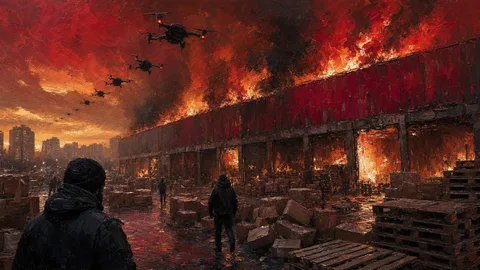
The scale behind that percentage: 485,000 drone systems delivered through the DOT-Chain Defence program in under five months of 2026. A production tempo of approximately 3,000 systems per day. An interceptor force that costs between $1,000 and $2,500 per unit and is achieving a 92% Shahed interception rate — outperforming Patriot PAC-3 missiles costing $3.9 million each against the same class of target. Ukraine has not just built a drone industry. It has engineered a new economics of aerial warfare that makes industrial production the decisive variable in a way that no military doctrine prepared anyone to anticipate.
From emergency imports to industrial base
In early 2022, Ukraine's drone inventory consisted primarily of Turkish Bayraktar TB2 platforms — imported, not produced domestically, and dependent on Turkish manufacturing and supply chains for maintenance and replacement. The TB2 performed well in the early months and established Ukraine's drone doctrine. It was also a visible reminder of dependency: if Ankara changed its supply policy, Ukraine's drone capability would be affected.
The path from 2022 Bayraktar dependency to 2026's 95% domestic production is not a straight line — it is a series of deliberate industrial investments, policy decisions, and wartime improvisations that individually seem incremental and collectively represent one of the fastest defence industrial transformations in modern military history. Army of Drones, launched in 2022 as a crowdfunding initiative, became the foundation of what is now the DOT-Chain programme. The public-private hybrid model it established — state procurement contracts combined with private manufacturer innovation — is the architecture behind 485,000 systems in five months.
The DOT-Chain: how 3,000 systems per day happens
The public-private hybrid
The DOT-Chain Defence program is not a single government factory. It is a network of hundreds of private manufacturers — ranging from established defence companies to small workshops adapted from civilian production — operating under unified procurement standards set by the Ministry of Defence. The key design choice was standardization without centralization: manufacturers can innovate within performance specifications, but components must be compatible with the standardized maintenance and deployment infrastructure. This allows the production network to scale horizontally rather than depending on a single facility's capacity.
The Brave1 ecosystem — Ukraine's defence technology accelerator — feeds new designs into the DOT-Chain through a rapid prototyping and certification pathway. A drone concept that reaches Brave1's testing threshold can enter production within weeks rather than years. This is not the defence procurement timeline of a NATO member state in peacetime — it is the development velocity of a country that discovered it needs to innovate faster than its adversary or die. Existential pressure produces extraordinary institutional creativity.
Key manufacturers in the ecosystem
General Cherry, founded in September 2023 by Yaroslav Gryshyn, is one of the ecosystem's most notable producers. Its portfolio includes the Bullet interceptor drone, various FPV platforms, and the Khmarynka medium-range strike drone. On June 22, 2026 — the same day as the 95% domestic procurement announcement — Russian forces struck General Cherry's production facility. Gryshyn confirmed that all employees were safe and announced that "the enemy will not stop us." The company's resilience — continuing operations after a direct strike on its facility — is a microcosm of the broader industrial doctrine: decentralized production means no single strike shuts down the network.
Kazhan produces electronic warfare systems and counter-UAS platforms that have become integral to Ukraine's integrated air defence architecture. UkrJet specializes in medium-range reconnaissance platforms including the Sweetheart, capable of a 150-kilometre operational range — sufficient to provide battlefield awareness across the full depth of the contact zone and into Russian rear areas. Together with dozens of smaller producers, these companies form a production ecosystem that is more resilient than any single large-format factory because its destruction would require hundreds of simultaneous strikes, not one.
The interceptor revolution: $2,500 vs. $3.9 million
The cost asymmetry that changes everything
Ukraine's domestic interceptor drone program has engineered the most significant cost asymmetry in modern air defence. A dedicated counter-UAS interceptor produced in Ukraine costs between $1,000 and $2,500. A Patriot PAC-3 MSE missile, the NATO standard for ballistic missile and advanced cruise missile interception, costs approximately $3.9 million. When an interceptor drone succeeds against an inbound Shahed at $2,500, it saves the $3.9 million Patriot for a target that genuinely requires it: Iskander ballistic missiles, Kinzhal hypersonics, Zircon.
The 92% Shahed interception rate in May 2026 — achieved primarily by interceptor drones and legacy short-range air defence systems, not Patriot — demonstrates that this triage architecture is working. Russia's Shahed wave attacks, which were designed in part to exhaust the most expensive Ukrainian air defence assets, are being absorbed by a dedicated low-cost layer that Russia did not anticipate when the campaign was designed. The economics have been reversed: Russia spends $20,000–$50,000 per Shahed; Ukraine spends $2,500 to stop it. At scale, that ratio is decisive.
Automation at 95%
Ukraine has achieved approximately 95% automation in the interception sequence for drone threats — meaning that target detection, tracking, engagement authorization, and interceptor launch are handled autonomously in the vast majority of engagements, with human oversight reserved for edge cases and protocol exceptions. This automation rate is not just an efficiency metric. It is the only way to manage the volume of simultaneous incoming threats in a mass salvo attack: human operators cannot process engagement decisions fast enough when hundreds of drones arrive simultaneously.
The automated interception architecture also reduces the cognitive load and fatigue exposure of human operators — a non-trivial factor in a war that has been running continuously for four years. Operator fatigue is a real degradation pathway in sustained high-intensity air defence operations; automation that handles routine engagements while flagging complex ones for human judgment is a force multiplier in the deepest sense — it extends the effective operational capacity of a limited pool of trained operators over a sustained campaign.
800,000 targets in the first half of 2026
The offensive dimension
United24 Media reported that Ukrainian forces struck more than 800,000 Russian military targets in the first half of 2026. This figure encompasses the full range of Ukrainian offensive capability: FPV drones striking individual armoured vehicles, reconnaissance drones guiding artillery fire, medium-range platforms hitting logistics nodes and command posts, and long-range deep-strike drones targeting the strategic infrastructure described elsewhere in this article. The 800,000 number is both a production achievement — you cannot strike 800,000 targets with 100,000 drones — and a strategic statement about the scale of Ukrainian offensive action.
The 800,000 figure also implies something about Russian defensive capacity. Russia has deployed extensive electronic warfare systems, dedicated anti-drone units, and layered air defence networks in an attempt to reduce its vulnerability to Ukrainian drone strikes. That 800,000 targets were struck in six months despite these measures suggests that the offensive production rate and tactical innovation of Ukrainian drone operators are consistently outpacing Russia's defensive adaptation. The attacker's advantage in drone warfare, at current scales, remains with Ukraine.
The offensive-defensive integration
What distinguishes Ukraine's drone program in 2026 from all previous iterations is its integration across the offensive-defensive spectrum. The same production ecosystem that makes the Sea Baby naval drone, the FPV ground attack platform, and the long-range deep-strike platform also makes the interceptor drone that stops inbound Shaheds. The same DOT-Chain procurement architecture that manages offensive systems manages defensive ones. The same Brave1 innovation pathway that certifies new strike drones certifies new interceptor designs.
This integration is a fundamental strategic advantage: it means that investment in one part of the capability set spills over into the other. Improvements in drone navigation for offensive use improve interceptor precision. Lessons from interception patterns improve evasion tactics for offensive drones. The R&D cross-pollination within a unified ecosystem produces a pace of innovation that no siloed programme — separate offensive and defensive R&D tracks — could match. The integration is not accidental. It is the product of deliberate architectural choices made early in the program's development.
Trump's Patriot license — and what it means for the long term
From consumer to producer
Trump's indication at the June 25 G7 that he was considering authorizing Patriot interceptor production under US license in Ukraine — with a memo described as awaiting his signature — would, if realized, represent a structural transformation in Ukraine's air defence posture. Currently, Ukraine consumes Patriot interceptors at a rate that periodically exhausts its inventory — as happened the night of June 15, 2026. Production under license would give Ukraine control over its most critical air defence consumable, removing the political dependency on US Congressional appropriations for resupply.
The broader significance: a Patriot production license is not a temporary supply contract. It is a permanent transfer of manufacturing knowledge and infrastructure. Once Ukraine has the facility and the workforce trained to produce PAC-3 MSE missiles, that capability does not disappear with a change in Washington's political climate. It becomes a permanent asset — precisely the kind of durable security guarantee that treaty membership was supposed to provide and that the Budapest Memorandum conspicuously failed to deliver. Industrial capability is the security guarantee that actually holds under pressure.
Germany's ballistic missile co-development
Following the G7, Germany signed a defence cooperation agreement with Ukraine for joint development of ballistic missile defence capabilities. The agreement, signed in Brussels after the summit, reflects Germany's evolution from its pre-2022 posture of extreme caution on arms transfers to active co-development partnerships on some of the most technically demanding defence systems in existence. For Germany — whose foreign and defence policy was, for decades, premised on avoiding any action that could be perceived as threatening to Russia — the co-development agreement represents a genuine strategic reorientation.
The practical content of the agreement is not fully public, but it is understood to cover both software and hardware development for ballistic missile tracking and interception, potentially including systems that complement rather than duplicate Patriot's capabilities. The specific gap — ballistic interception falling from 63% to 53% in one month — gives the co-development agreement an urgent operational context. Germany's industrial and technological base, brought to bear on Ukraine's specific interception challenge, is a significant addition to the international coalition working on the ballistic missile problem.
The strategic picture: who is winning the industrial war
The production race in 2026
The industrial war — the competition to produce military capability faster than it is destroyed — is the dimension of this conflict that is least visible in daily reporting and most decisive in the long run. Russia retains significant industrial advantages in certain categories: artillery shells (though production rates have been affected by sanctions and component shortages), ballistic missiles (Iskander-M at 55–60 per month), and mass conscript mobilization. Ukraine's advantages are in different categories: drone production rates that exceed Russian interception capacity, electronic warfare innovation, precision strike capability, and the quality of its professional soldier cadre.
The 95% domestic drone production figure is, in this context, a statement about where the long-term industrial war is heading. Russia cannot produce drones at the rate Ukraine is producing them. Russia cannot produce interceptors at the rate Ukraine is consuming them. Russia cannot prevent Ukrainian deep strikes on its own strategic infrastructure. These are not temporary tactical advantages. They are structural features of the industrial competition that will persist as long as Ukraine's production ecosystem is protected and resourced. Ukraine is winning the industrial war in the categories that matter most for the current phase of the conflict.
Discover

EDITORIAL: Trump approves H200 chips for Beijing and takes…
On December 8, 2025, two announcements landed in Washington, the same…

INVESTIGATION: Beijing cuts Africa to 2.1 billion in loans…
2.1 billion — the lowest figure in almost twenty years, according…

SPECIAL REPORT: Beijing Promises Stimulus as Its Households Give…
That is the growth rate of Chinese industrial output in July,…
General Cherry's response as doctrine
Yaroslav Gryshyn's statement after the Russian strike on General Cherry's facility — "the enemy will not stop us" — is not bravado. It is a description of the decentralized industrial doctrine that makes it true. A single factory strike does not stop General Cherry because General Cherry's production is distributed across multiple facilities, backed by a supplier network, and embedded in a procurement system that can reroute orders to alternative producers. The strike imposed a cost. It did not impose a halt.
This is the fundamental resilience architecture of Ukraine's drone industrial base: no single point of failure exists. You cannot end Ukraine's drone production by striking one company, one facility, or one city. You would need to strike the entire ecosystem simultaneously, which is operationally and logistically impossible for Russia given its current strike inventory, Ukraine's air defence layers, and the geographic distribution of production. Russia understands this, which is why the strike on General Cherry was harassment rather than a strategic interdiction. Ukraine understands this, which is why the response was "we will keep building."
What 95% means for negotiations
Leverage and its source
Ukraine's domestic drone production at 95% changes the negotiating landscape in a specific way: it removes the ability of any foreign government to exert pressure on Ukraine by threatening to reduce or halt drone supplies. In 2022 and 2023, when Ukraine was dependent on foreign-supplied drones and munitions, the threat — explicit or implicit — of supply curtailment was a real tool of leverage for Western partners seeking to influence Ukrainian military decisions. The 95% figure effectively neutralizes that tool for drone systems.
This independence is strategically significant not just for Ukraine but for the durability of any eventual peace agreement. A Ukraine that can maintain its military capability without depending on continuous foreign supply is a Ukraine that foreign actors — including potential future US administrations — cannot pressure into abandoning security commitments through supply threats. The 95% is not just about the current war. It is about Ukraine's long-term strategic autonomy.
The postwar industrial legacy
The drone industrial ecosystem Ukraine has built will not disappear when the war ends. The DOT-Chain network, the Brave1 accelerator, the production facilities, the trained workforce, the institutional knowledge of manufacturing at scale under pressure — these are permanent additions to Ukraine's industrial base. In the postwar period, this ecosystem is positioned to compete in global defence markets, supply NATO member states seeking to build their own drone capabilities, and anchor a defence technology sector that will be among Ukraine's most valuable economic assets in reconstruction.
The same applies to the electronic warfare capability, the AI navigation systems, the counter-UAS platforms, and the long-range strike drones that the war has catalysed. Ukraine is not just defending its territory. It is building an industrial and technological base that will define its position in the European security architecture for decades. The June 22 announcement — 95%, 485,000 systems, DOT-Chain Defence — is not just a war milestone. It is a first chapter in a postwar industrial history that has not yet been written.
The strategic context of 2026
Military and diplomatic convergence
The second half of 2026 is shaping up as the most diplomatically significant period of the war. Military pressure, financial architecture, and diplomatic signalling are converging toward a window that both Ukraine and its partners are preparing for. The deep-strike campaign, the EU loan disbursement, and Budanov's September signal are not independent events — they are components of a coordinated strategic posture.
The alignment of military, financial, and diplomatic pressure within the same calendar window reflects a level of strategic coordination between Ukraine, the EU, and the United States that has been building since at least mid-2025. June 2026 is where that coordination became visible in its most developed form.
The convergence of military and diplomatic timelines in mid-2026
The war's fourth year is different from the first three. Ukraine's industrial base is producing at scale. The international financial architecture is institutionalized. The diplomatic signalling has a specific calendar. The military trajectory, per ISW's assessment, favours Ukraine. These are not minor variations on the same theme. They represent a qualitatively different strategic landscape.
Three years of Ukrainian resilience have produced something that was not inevitable and was never guaranteed: an institutional momentum that now operates partly independently of any individual political decision. The EU loan is disbursing. The World Bank is committed for five years. The European Flagship Fund is operating. EU accession negotiations are open. That architecture does not stop because any single government changes its mind.
The cost of continued war for Russia
Economic and military attrition
Russia's economy in mid-2026 is showing the cumulative effects of four years of war, Western sanctions, and sustained Ukrainian deep strikes on industrial and logistics infrastructure. Fuel rationing in Siberia, degraded satellite communications, stopped helium production at Orenburg, and the fiscal cost of maintaining over 600,000 casualties since February 2022 are the measurable indicators of a military economy under strain.
The Douma elections in September 2026 provide a specific domestic political deadline for Putin. The unprecedented use of his personal image in United Russia campaign materials signals that the party's institutional brand is under strain. Fuel rationing, inflation, and the human cost of the war are becoming visible to Russian civilians in ways that no state communication strategy can fully manage.
The sustainability question for Russian war aims
Russia's stated war aims — the demilitarisation and effective subordination of Ukraine — have not been achieved after four years of the largest land war in Europe since 1945. The cost of pursuing those aims has included over $1 trillion in estimated economic losses from sanctions alone, the destruction of significant military equipment, the deaths of hundreds of thousands of Russian soldiers, and the permanent degradation of Russia's relationships with Western technology and capital markets.
Whether Putin's domestic political position can absorb the gap between stated objectives and achieved outcomes indefinitely is the central long-term question of the war. Authoritarian systems can manage this gap for longer than democracies, but not indefinitely. The Douma election is the nearest test. The September ceasefire window is the nearest opportunity.
Ukraine's institutional transformation
From wartime emergency to European integration trajectory
The EU accession negotiations formally opened on June 15, 2026 represent the crystallization of a process that Ukraine has been pursuing since the Orange Revolution of 2004. EU candidate status was granted in June 2022 — four months into the full-scale invasion. The opening of formal negotiations in 2026 transforms the relationship from emergency solidarity to structural integration with a legal and institutional pathway.
The 20 reform conditions met before the World Bank disbursement, the 20 EU loan conditions met before the first tranche, the eRecovery program's 196,067 families served — these are not individual achievements. They are evidence of a Ukrainian state that is simultaneously fighting a war and building the institutional infrastructure of a European democracy. That combination has no modern precedent.
The reform agenda as security architecture
Ukraine's reform program — anti-corruption institutional strengthening, public procurement reform, land registry digitization, SME tax simplification — is simultaneously a World Bank conditionality requirement, an EU accession obligation, and a genuine improvement of the Ukrainian state. The reforms are not performed for external audiences. They are creating the governance infrastructure that a postwar Ukrainian economy will operate within.
Institutional quality is not glamorous. Anti-corruption bureaus and land registries do not make international headlines. But they are the foundation on which private investment, reconstruction finance, and long-term economic growth are built. Ukraine is building that foundation during the war. That is the most important long-term investment it can make.
The Black Sea and maritime doctrine
Ukraine's naval capability without a navy
Ukraine has established de facto operational dominance over the northwestern Black Sea without a surface naval fleet — an achievement that has no modern precedent. The Russian Black Sea Fleet has lost over 30% of its effective combatant strength since 2022, primarily to Ukrainian naval drones and missile strikes. Its surviving assets operate primarily from eastern Crimean ports and Novorossiysk, avoiding the western approaches.
The Sea Baby and Magura V5 naval drone platforms have transformed what was a tactical innovation in 2022 into a strategic asset class by 2026. Their evolution from purely offensive strike platforms to dual offensive-defensive capability — intercepting Russian naval drones near Kinburn while simultaneously threatening Russian naval assets throughout the Black Sea — reflects the same adaptive doctrine that transformed Ukraine's land-based drone operations.
The Starlink gray market and export enforcement
The recovery of Starlink terminals from Russian naval drones intercepted near Kinburn on June 24 provides physical evidence of a gray-market pipeline that has been documented in signals intelligence for months. Approximately 2,000 Starlink terminals per month continue to reach Russian forces through intermediary networks in UAE, Kazakhstan, and Turkey despite SpaceX's February 2026 cutoff.
The enforcement gap has a specific solution: secondary sanctions on the intermediary resellers that form the gray-market pipeline. The US Commerce Department's Bureau of Industry and Security has prosecuted smaller cases with less evidence than the Kinburn recovery provides. Closing the Starlink gray market does not require new legislation. It requires applying existing export control frameworks to a problem that is now evidenced in recovered hardware.
The financial architecture at mid-war
Sovereignty through structured finance
Ukraine's external financing architecture in mid-2026 is more robust than at any point since February 2022. The EU's €90 billion loan, the World Bank's $3.39 billion package, the IMF's Extended Fund Facility, the European Flagship Fund's €265 million initial commitment, and the CEB-Italy housing deal form a multilateral system with different conditionality frameworks, disbursement timelines, and accountability mechanisms operating in parallel.
The interest on the EU loan is financed by windfall profits from frozen Russian sovereign assets at Euroclear. The World Bank package carries UK and Japanese sovereign guarantees that reduce the interest rate to near-prime. The eRecovery program has distributed $2 billion to 196,067 families. Each instrument is designed to be more durable than any individual political cycle in donor capitals.
On the same topic

COLUMN : Europe Moved 8.5 Billion Euros in a…
That is what the European Commission says it has disbursed for…
ANALYSIS: 800 drones over Russia in one night —…
More than eight hundred drones, in a single night, August 14…

ANALYSIS : Taiwan Puts NT$1,122.5 Billion Into Defence, Over…
Hold that number for a moment, because it marks the crossing…
The durability architecture
The key design feature of Ukraine's international financial support is not its scale — though €90 billion over two years is unprecedented — but its institutionalisation. Sovereign loans, multilateral grant facilities, private investment frameworks, and bilateral housing programmes are harder to unwind than emergency appropriations. Getting the EU loan approved, disbursed, and conditions met before any political winds shift was a deliberate front-loading strategy.
The Gdańsk conference of June 25–26, 2026 represented the convergence of multiple instruments in a single public event: the EU first tranche disbursed, the World Bank package announced, the European Flagship Fund launched, the CEB-Italy housing deal signed. The density of commitments at a single conference signals that Ukraine's partners are building permanence rather than managing a temporary crisis.
The strategic context of 2026
Military and diplomatic convergence
The second half of 2026 is shaping up as the most diplomatically significant period of the war. Military pressure, financial architecture, and diplomatic signalling are converging toward a window that both Ukraine and its partners are preparing for. The deep-strike campaign, the EU loan disbursement, and Budanov's September signal are not independent events — they are components of a coordinated strategic posture.
The alignment of military, financial, and diplomatic pressure within the same calendar window reflects a level of strategic coordination between Ukraine, the EU, and the United States that has been building since at least mid-2025. June 2026 is where that coordination became visible in its most developed form.
The convergence of military and diplomatic timelines in mid-2026
The war's fourth year is different from the first three. Ukraine's industrial base is producing at scale. The international financial architecture is institutionalized. The diplomatic signalling has a specific calendar. The military trajectory, per ISW's assessment, favours Ukraine. These are not minor variations on the same theme. They represent a qualitatively different strategic landscape.
Three years of Ukrainian resilience have produced something that was not inevitable and was never guaranteed: an institutional momentum that now operates partly independently of any individual political decision. The EU loan is disbursing. The World Bank is committed for five years. The European Flagship Fund is operating. EU accession negotiations are open. That architecture does not stop because any single government changes its mind.
The cost of continued war for Russia
Economic and military attrition
Russia's economy in mid-2026 is showing the cumulative effects of four years of war, Western sanctions, and sustained Ukrainian deep strikes on industrial and logistics infrastructure. Fuel rationing in Siberia, degraded satellite communications, stopped helium production at Orenburg, and the fiscal cost of maintaining over 600,000 casualties since February 2022 are the measurable indicators of a military economy under strain.
The Douma elections in September 2026 provide a specific domestic political deadline for Putin. The unprecedented use of his personal image in United Russia campaign materials signals that the party's institutional brand is under strain. Fuel rationing, inflation, and the human cost of the war are becoming visible to Russian civilians in ways that no state communication strategy can fully manage.
The sustainability question for Russian war aims
Russia's stated war aims — the demilitarisation and effective subordination of Ukraine — have not been achieved after four years of the largest land war in Europe since 1945. The cost of pursuing those aims has included over $1 trillion in estimated economic losses from sanctions alone, the destruction of significant military equipment, the deaths of hundreds of thousands of Russian soldiers, and the permanent degradation of Russia's relationships with Western technology and capital markets.
Whether Putin's domestic political position can absorb the gap between stated objectives and achieved outcomes indefinitely is the central long-term question of the war. Authoritarian systems can manage this gap for longer than democracies, but not indefinitely. The Douma election is the nearest test. The September ceasefire window is the nearest opportunity.
Conclusion: A nation that built its own shield
The transformation in numbers
From 0% domestic production to 95% in four years. From Bayraktar dependency to 485,000 domestically produced systems. From emergency imports to industrial sovereignty. From 0 interceptor drones to a production rate of 3,000 per day achieving 92% Shahed interception. From no deep-strike capability to strikes on Moscow-area satellite communications, Orenburg's helium plant, and Crimean military airfields in a single week. These numbers describe a transformation that was not planned, not expected, and not yet fully understood — even by the people who produced it.
The drone nation's future
Ukraine's drone nation status is now irreversible. The production capacity exists. The institutional knowledge is embedded. The trained workforce is growing. The innovation ecosystem is self-sustaining. What happens to that capacity when the war ends — whether it becomes a commercial export platform, a NATO supply base, a deterrence infrastructure for a neutral Ukraine, or something not yet imagined — depends on decisions that have not yet been made. What does not depend on any future decision is the existence of the capacity itself. Ukraine built a drone nation. It cannot be unbuilt. That is the most important strategic fact of 2026.
By Maxime Marquette, columnist
Columnist's transparency note
About this article
All production figures, cost data, interception rates, and company-specific information in this article are drawn from the sourced reporting listed below. The General Cherry strike and Gryshyn's statement are based on Kyiv Independent reporting. The 800,000 targets figure is from United24 Media. The Sweetheart drone range specification is from Militarnyi. No capabilities have been invented or inflated.
Editorial position
I support Ukraine's defence industrial development and its strategic autonomy in military production. My analysis of the drone industrial transformation reflects that position. I have attempted to be accurate about both the achievements and the remaining vulnerabilities — particularly the ballistic missile interception gap — rather than presenting a uniformly positive picture.
Sources
Primary sources
Secondary sources
Get the geopolitics analyses
Conflicts, powers, alliances: the MadMax thread without the noise.
Cite this article
Maxime Marquette (2026). EDITORIAL: Ukraine Built a Drone Nation — And No One Can Take That Away. MadMax. https://mad-max.co/en/article/editorial-95-des-drones-ukrainiens-fabriques-au-pays-une-revolution-industrielle
Read next
EDITORIAL: Trump approves H200 chips for Beijing and takes…
On December 8, 2025, two announcements landed in Washington, the same…
INVESTIGATION: Beijing cuts Africa to 2.1 billion in loans…
2.1 billion — the lowest figure in almost twenty years, according…
SPECIAL REPORT: Beijing Promises Stimulus as Its Households Give…
That is the growth rate of Chinese industrial output in July,…
Enjoyed this piece? Get the next one.
One chronicle a week, straight to your inbox. No noise.
This article was generated with AI assistance, under human supervision.
Comments
Be the first to weigh in.