

NOTE : Trump Offers the Keys to the American Arsenal to Europe — Finally, Perhaps
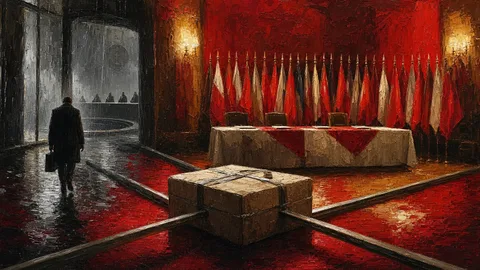
At the G7 in Évian on June 17, 2026, Trump said he would ask U.S. arms makers to consider licensing missile production in Europe and Ukraine. Not a promise. Not yet. But the door is open — and that alone changes everything.
- At the G7 in Évian on June 17, 2026, Trump said he would ask U.S. arms makers to consider licensing missile production in Europe and Ukraine. Not a promise. Not yet. But the door is open — and that alone changes everything.
- Introduction: The Lock That Trembles
- Évian, June 17, 2026: words that change everything
Facts, quotes, and cited links remain in the body. Interpretations are framed as analysis or opinion according to the format.
Introduction: The Lock That Trembles
Évian, June 17, 2026: words that change everything
On the shore of Lake Geneva, in the French spa town of Évian-les-Bains, Donald Trump spoke words no one had dared to hope to hear from him. Asked about the possibility that American arms manufacturers might grant production licenses to European and Ukrainian companies, the President of the United States replied with his characteristic terseness: "They would like to be able to do it, we'll take a look at it." This is not a promise. It is not even a commitment. But in the diplomatic language of 2026, after years of refusals and broken promises, it is an opening. And this opening is not one I am prepared to let pass without measuring its full significance.
The G7 summit in Évian, held from June 15 to 17, 2026, will be remembered as a turning point — perhaps. The seven major democracies published a joint declaration promising to increase deliveries of air defense systems, interceptors, and long-range capabilities to Ukraine. Above all, for the first time, they said they were "prepared to consider" granting Kyiv licenses to increase its own military production. This is the kind of cautious formulation that, in other contexts, would be worth nothing. In this one, it is worth a great deal.
A question of industrial survival
Behind the diplomatic gloss, the reality is brutal. The interceptor missiles Ukraine needs to shoot down Russian ballistic missiles are produced only in the United States. Lockheed Martin manufactures approximately 600 interceptors per year — at best, 60 to 65 missiles per month. Russia, meanwhile, produces roughly 120 ballistic missiles per month, not counting other types of munitions. The arithmetic is simple, and it is merciless: Ukraine is losing the supply chain battle. American stocks, already depleted by the war with Iran — a conflict that strained production lines for fifteen weeks — can no longer absorb simultaneously the needs of Ukraine, Europe, and the Middle East.
It is precisely in this context of structural scarcity that Trump chose to consider the licensing route. Not out of ideological generosity, but out of industrial pragmatism. And that is exactly why this gesture — however conditional, however vague — deserves to be welcomed. The rest will come, or it will not. But the door is ajar.
What the G7 Actually Decided — and What It Avoided Deciding
The joint declaration: between ambition and calculated caution
The G7 joint declaration, adopted in the night of June 16 to 17, is a skillfully drafted compromise document. It states that leaders "agree to increase the delivery of air defense capabilities, additional systems and interceptors, and long-range capabilities" to Ukraine. It adds that they are "also prepared to consider" granting Kyiv licenses to increase its military production. Two radically different levels of commitment: on deliveries, the verb is declarative. On licenses, it remains conditional. This nuance is not trivial.
An anonymous senior European official, cited by the Kyiv Independent, was entirely clear: "The U.S. said they would look at it, but there was no decision." That same official nonetheless acknowledged that the dynamic had changed, adding that "the Iran deal allowed us to bring the focus back to Ukraine" and that "even Trump acknowledged that things had really changed." A weak signal, but a real one, at a moment when every signal counts.
What the text does not contain — and why that is a problem
We must nonetheless name what is missing from this declaration, because the devil is in the details. No timeline is mentioned. No weapons system is specifically named. No manufacturer is identified. The sentence on licenses remains in a space of pure intentionality, without any enforcement mechanism. As Euromaidan Press put it dryly in its June 18 coverage: "Ready to consider is not a license." That is the truth. And it deserves to be repeated until actions follow words.
The declaration also does not address budget financing for Ukraine, despite a $52 billion deficit left open after the €90 billion European loan approved in April 2026. This financial gap, raised by European Commission President Ursula von der Leyen, received no collective response. Western democracies sometimes excel at promising what they will not finance. That is not what Kyiv needs.
Trump, the American Defense Industry, and the Logic of Licenses
Why Washington has always refused — until now
To understand why Trump's signal is significant, one must first understand why Washington has always been so reluctant to grant arms production licenses abroad. The reasons are multiple: intellectual property protection, supply chain security, control over the flow of cutting-edge military technology. The United States has spent decades building technological supremacy in missile systems, and has no desire to dilute it through transfers that could eventually fuel competitors. This is a defensible posture, even if it places allies in a structural dependence that is difficult to justify in wartime.
Yet precedents exist. Germany already manufactures certain Patriot systems under American license — an exception long jealously guarded. This co-production model, limited but existing, constitutes the floor on which current negotiations could build. As Ukrainska Pravda noted in its June 18 coverage, "the U.S. has traditionally protected its license arrangements due to intellectual property and supply chain security concerns" — but war changes the calculations.
The Iran war: an unexpected accelerator
The paradox of this G7 summit is that a conflict foreign to Ukraine created the conditions for this opening. The war between the United States and Iran, in its fifteenth week at the time of the summit, had literally emptied large swaths of American interceptor missile stocks. Munitions intended for Ukraine had been redirected toward operations against Iran. Already-strained production lines had been pushed to their limits. And it is this extreme industrial pressure that finally convinced Trump he could not continue to play the sole supplier for the entire West.
Bloomberg, in its June 17 article that broke the story, noted that Trump "had informed allies that licenses could go faster than building new American capacity." This is not altruism: it is industrial arithmetic. And that is precisely why this opening, however conditional, is different from the previous ones. It meets an American need, not merely a Ukrainian one.
Friedrich Merz and Europe: From Follower to Driver
The German chancellor on the front line
Among the G7 leaders in Évian, it was Friedrich Merz who set the most determined tone on the license question. The German chancellor told reporters that the licenses in question "will be discussed in detail between the participating countries," and that this would involve "granting full licenses to companies that have the necessary technical capabilities." More importantly, he explicitly named the two categories concerned: European companies and Ukrainian companies. This is a position that would have been unthinkable two years ago, when Berlin was agonizing over every tank delivery.
Merz also expressed gratitude toward Trump — a classic but significant diplomatic gesture in context — welcoming his "very great willingness to cooperate" on this file. According to the chancellor, the United States would be particularly well positioned to grant licenses to European manufacturers. He also summarized the challenge with disarming clarity: "We all have the problem that we are currently producing too little — and this can be compensated by granting licenses to companies that have the necessary production capacities."
Europe confronting the mirror of its industrial inadequacy
Merz's stance reveals a deeper awareness: Europe can no longer afford to outsource its security entirely to the United States. Since the start of the Ukraine war in 2022, European allies have drawn heavily on their own stocks — emptying them in some cases to the point of compromising their own defensive capabilities. Britain is sending 150,000 drones to Ukraine drawn from its reserves. Germany has practically exhausted its air defense missile stocks. This painful industrial reality is now inscribed in the collective consciousness of European leaders.
The production license solution — allowing Ukrainian and European factories to manufacture American systems on their own soil — represents a fundamental paradigm shift. It transforms allies from mere arms consumers into partial producers. It distributes the defense industrial chain across multiple continents, reducing the vulnerability caused by concentrating production in the United States. And it theoretically allows a much faster ramp-up than building new American factories.
Zelensky in Évian: the Beggar Become Strategist
A request carried for over a year
Volodymyr Zelensky did not wait for the Évian G7 to demand production licenses. He has been pushing this request since at least the spring of 2025, as Euromaidan Press confirms in its detailed analysis. He has multiplied meetings with American arms manufacturers. He knows that producing Patriots — high-tech anti-ballistic systems — is difficult. He knows the timelines are long. And yet he insists, because he has done the math that his country cannot hold indefinitely waiting for American deliveries.
In Évian, Zelensky held a bilateral meeting with Trump, then participated in an evening phone call with the American president and Emmanuel Macron. His reading of the situation is characteristic of his style: direct, without illusions, but carried by unyielding determination. "American production is not as big as our needs. We need licenses," he declared at an online press conference with Reuters. And on Trump's reaction: "Right now he was positive. And when President Trump is positive, I hope that means yes."
The lesson of dashed hopes — and why Zelensky keeps coming back
Zelensky knows this hope may be disappointed. Washington had already promised licenses for European Patriot production — and had backed down. Germany had been on the verge of launching a production line, before the United States withdrew its agreement, leaving Berlin without missiles and without alternatives. This history haunts the corridors of Ukrainian diplomacy. And yet Zelensky returns to ask again, because he has no choice. Because the alternative — waiting for America to produce enough for everyone — simply no longer exists.
What has changed in 2026 is the global equation. With the Iran war, with American stocks depleted, with the pressure from European allies now demanding production capacities of their own, refusing licenses has become politically and logistically untenable for Washington. Zelensky knows this. He is waiting for his moment with a strategist's patience. And at the Évian G7, his moment may have begun to strike.
Macron and the Mobilization of American Industry
The closing speech of an ambitious host
Emmanuel Macron, as host of the summit, played the role of translator. It was he who, in his final press conference, provided the most optimistic interpretation of the American course change. According to the French president, Trump had "insisted on the mobilization of the American defense industry and its capacity to provide this equipment" — a framing that presents the American position not as a reluctant concession but as a positive initiative. Macron has mastered the art of presenting compromises as victories.
But beyond the rhetoric, Macron also expressed his conviction that something had structurally changed in the American approach. He spoke of a "very profound change" in Washington's policy, a "profound remobilization of the G7." And he noted that the deal with Iran — Trump's first genuine diplomatic victory of the year — had "allowed us to bring the focus back to Ukraine." For Macron, the Évian G7 marks the return of the United States to the camp of those seeking a solution — not a capitulation — in Ukraine.
The French vision of a Europe that produces
France has a particular interest in the production license question. It is home to some of Europe's largest arms manufacturers — Thales, Safran, MBDA — and an American license production policy could either strengthen these actors or bypass them in favor of German or Polish manufacturers. Macron navigates these waters carefully, seeking to position France as the industrial pivot of European defense.
France was also hosting at the same time the Eurosatory 2026 defense show in Paris — described by some observers as the "last chance to buy before the war," according to the show's CEO as cited by Defense News on June 12. This context illustrates the industrial urgency underlying the diplomatic discussions: 80 Ukrainian companies were present at Eurosatory this year, compared to ten in 2024 — a sign that Ukraine is now not only a consumer of arms but a full-fledged military-industrial actor.
The Architecture of Licenses: What This Actually Means
Full licenses, not symbolic ones
When we talk about arms production licenses, we must distinguish between several levels of commitment. A partial license allows a partner to manufacture certain non-critical components. A full license — what Chancellor Merz calls "full production rights" — transfers all manufacturing rights, including cutting-edge technologies, guidance algorithms, and propulsion systems. This is the difference between assembling spare parts and building a missile from scratch.
Merz's words in Évian explicitly invoke full licenses. According to him, the objective is "to grant full licenses to companies that have the necessary technical capabilities" — both European and Ukrainian. This formulation is ambitious. It presupposes that Washington would agree to cede not only assembly rights but the most jealously guarded industrial secrets of American defense. This is a quiet revolution in the doctrine of U.S. arms export controls.
Patriot, ATACMS, and beyond: which systems are at stake?
The G7 declaration names no systems. But informal discussions and diplomatic leaks paint a more precise picture. Patriot interceptor missiles top the list: Ukraine has been demanding the right to produce them for over a year. But an anonymous diplomatic source, cited by Le Parisien and picked up by Euromaidan Press, went further: the United States and several G7 partners were also reportedly considering licenses for long-range strike production in Ukraine. If confirmed, this information would be explosive: it would mean that Ukraine could soon manufacture on its own territory the missiles capable of striking deep into Russian rear areas.
This prospect cuts both ways. On one hand, it would considerably strengthen Ukraine's strike capability. On the other, it represents the most sensitive technology transfer imaginable — and the one most likely to be torpedoed by American intelligence services or by the resistance of defense industrialists anxious to protect their patents. The road to licenses is long, and every step will be contested.
European Strategic Autonomy: From Slogan to Reality
Discover

INVESTIGATION: Beijing cuts Africa to 2.1 billion in loans…
2.1 billion — the lowest figure in almost twenty years, according…

SPECIAL REPORT: Beijing Promises Stimulus as Its Households Give…
That is the growth rate of Chinese industrial output in July,…

INVESTIGATION: Two Chinese Ex-Soldiers Arrested in Seoul as 18,000…
For five years, a man ran a military-supply shop at the…
A French idea that becomes a continental necessity
European strategic autonomy — this grand ambition carried for years by France, often received with skepticism by Eastern countries and by Washington — is moving from slogan to structural necessity. The Ukraine war has finished convincing even the skeptics: if Europe does not manufacture its own weapons — or does not have the right to produce under license the systems it needs — it remains eternally dependent on an America whose political reliability has been called into question under two consecutive presidencies.
It is no coincidence that Zelensky himself, in Évian, called on Europe to develop its own anti-ballistic systems, "stronger and, between us, cheaper" than American ones. This formulation is revealing: the Ukrainian president does not only want licenses for American systems, he wants a European alternative that does not yet exist but must be created. A Europe capable of designing, financing, and producing its own anti-ballistic air defense — without depending on Washington's will or Lockheed Martin's stocks.
The limits of the license model
But we must clearly name the limits of the license model, however attractive it may be: a license is not independence. Producing Patriots under American license means remaining tied to Lockheed Martin for spare parts, software updates, and guidance secrets. It means accepting that Washington retains a supervisory right — even a veto right — over the use of these systems. Dependence changes form; it does not disappear. For genuine European defense autonomy, sovereign technologies will eventually need to be developed. Licenses are a necessary bridge. Not a destination.
This is the tension that Zelensky's positioning perfectly summarizes: on one side, he demands American licenses because that is what Ukraine needs now. On the other, he calls for the emergence of a European alternative because he knows that perpetual dependence is not a defense policy — it is institutionalized fragility. For once, the Ukrainian president's strategic vision is longer-range than that of several European capitals.
Putin, Meanwhile: The Long-Game Strategy
Moscow watches the G7 without trembling — really?
It would be tempting to conclude that Vladimir Putin observes these developments with indifference. That would be a mistake. Every Western commitment to arm Ukraine more durably, every step toward decentralized missile production that no longer depends on American stocks, represents a strategic nightmare for the Kremlin. The war of attrition Moscow has been waging since 2022 rests on a bet: that the West will tire before Russia does. That production lines will seize up. That promises will not be kept. That bet grows a little less solid every day.
Trump himself, at the G7, declared he had a phone call with Putin, adding enigmatically: "Something is going to happen." No one knows what that means. But what is certain is that the negotiation window with Moscow, if it exists, will only remain open as long as Ukraine is strong enough for Putin to perceive it as a durable adversary — not as a state waiting patiently to collapse. The more Ukraine produces, the more it deters.
Russia facing a West that (perhaps) relearns to manufacture
Russia has redirected most of its economy toward war production. Arms factories are running at full capacity. Stocks of munitions — notably ballistic missiles and drones — continue to accumulate. Moscow produces twice as many ballistic missiles per month as Ukrainian forces have interceptors to shoot them down. This fundamental asymmetry is what production licenses seek to correct. Not so Ukraine wins in a day, but so it holds over time — and so deterrence remains credible.
What Putin fears most is not a short-term defeat on the battlefield. It is the prospect of a Western coalition that industrializes its support for Ukraine, that distributes production across ten countries rather than concentrating it in the United States, and that transforms aid to Kyiv into an institutional reflex rather than a permanent political debate. Production licenses, if they materialize, are the beginning of this institutionalization. And that is precisely why Moscow is watching them with anxious attention.
Trump: Necessary Evil or Unexpected Protagonist?
The man who signed — and that is already a great deal
Let us be precise about what Trump did in Évian, and what he did not do. He signed the G7 joint declaration — unlike the previous summit, where he left without putting his signature on it. He declared he would ask American defense companies to explore licenses. He did not demand territorial concessions from Zelensky — a point noted with relief by Bloomberg in its summit analysis. And according to Macron, he actively pushed for "the mobilization of the American defense industry." This is not the Trump of 2017 who dreamed of withdrawing from NATO.
Does this make Trump a champion of Ukrainian democracy? No. His engine is pragmatism: American stocks are depleted, the war with Iran has complicated everything, European allies are pushing, and the American defense industry needs new co-production markets. Trump does what Trump does: he listens to what benefits the United States. And right now, arming Ukraine via licenses presents a clear industrial and strategic advantage for Washington. This may be the best news of the decade: that American and Ukrainian interests are finally aligned.
The guardrails that remain necessary
But the story with Trump is that openings can close as fast as they open. The promise of licenses for European Patriot production had already been made — and withdrawn — before Zelensky even came to power. Negotiating teams will need to work at unusual speed to turn intentions into signed contracts, into built factories, into produced missiles. Every week that passes without a concrete signature is a week in which a tweet, a change of mood, or pressure from American defense lobbies could put everything back in question.
European allies — starting with Germany and France — have the responsibility to hold Trump to his word through concrete parallel commitments: massive investments in their defense industries, firm orders from American manufacturers under license, creation of industrial structures capable of absorbing technology transfers. Diplomatic intent is no longer enough. What is needed is reinforced-concrete diplomacy.
Ukraine as Arms Producer: A Quiet Revolution
From consumer to supplier: the distance traveled
Four years ago, Ukraine was entirely dependent on Western deliveries for its military survival. Today the picture has changed radically. At the Eurosatory 2026 show in Paris, 80 Ukrainian companies were present, compared to ten in 2024 — an eightfold increase in two years. These companies are exhibiting cruise missiles, strike drones, and cutting-edge anti-drone systems. Ukraine has become, de facto, a major military-industrial actor.
According to data cited by Euronews in its June 17 coverage, Ukraine is now supplying air defense systems not only to its own forces but also to countries in the Middle East and Europe. This transformation is spectacular: the most heavily bombed country in Europe has become an exporter of defense technology. In this context, American production licenses would not only be an aid — they would be the lever of an industrial scale-up that changes European geopolitics as a whole.
The concrete challenges of licensed production in wartime
Producing complex interceptor missiles in Ukraine also means producing in a country under permanent bombardment. Ukrainian factories already operate under extraordinary conditions — dispersed, camouflaged, often in underground facilities — but the constraints remain immense. Russia systematically targets Ukrainian industrial infrastructure, and a Patriot missile factory would be a prime target.
This is why the question of production in Western Europe under license is at least as important as production in Ukraine itself. Poland, Romania, Germany, France — all these countries have existing industrial capabilities and greater territorial security. Distributing the production chain across multiple allied countries would create industrial resilience that neither Russia nor any other potential adversary could easily dismantle.
Tightened Sanctions: The G7's Other Pillar
The Russian energy sector in the crosshairs
Production licenses were not the only result of the Évian summit. G7 leaders also confirmed their commitment to tighten sanctions against the Russian war economy, particularly against the oil and gas sectors. Al Jazeera, in its June 17 coverage, notes that the sanctions would particularly aim to tighten restrictions on Russian oil and gas industries — the primary revenue sources that finance Moscow's war machine.
The European Union went a step further on June 18 by deciding to extend its Russia sanctions for an additional twelve months, instead of the usual six — a strong signal of the permanence of economic pressure. Britain, for its part, announced new sanctions targeting Russian financial networks, notably tankers from the shadow fleet used to circumvent oil restrictions. Keir Starmer declared that the new measures brought the number of sanctioned targets to more than 600.
On the same topic

COLUMN : Europe Moved 8.5 Billion Euros in a…
That is what the European Commission says it has disbursed for…
INVESTIGATION: 36 States Sign in Chișinău — and the…
Thirty-four members of the Council of Europe, plus Australia, plus Costa…

ANALYSIS: 313 Votes, a 20th Extension — Ukraine Keeps…
313 votes to approve the presidential decree extending martial law by…
Canada and the Russian shadow fleet in the crosshairs
Canada, under Prime Minister Mark Carney, announced at the summit additional sanctions targeting 162 entities, individuals, and vessels linked to the Russian war machine — with a particular focus on the shadow fleet circumventing oil sanctions. These measures fit within a coordinated strategy by all G7 allies to dry up the revenues Moscow derives from its hydrocarbon exports.
This convergence on sanctions is as important as the weapons license discussions. Depriving Russia of its oil revenues means reducing its capacity to finance ballistic missile production. This is the other side of the equation: if Ukraine produces more interceptors, and if Russia produces fewer missiles for lack of funding, the deadly asymmetry that kills Ukrainian civilians every night can finally begin to close.
What Remains Open: The Unknowns That Will Decide Everything
The manufacturer question: will Lockheed Martin say yes?
Beyond the political declarations, there is one major unknown that all commentators carefully avoided in Évian: Lockheed Martin's position. The company that manufactures Patriot systems and their interceptors will need to be at the heart of any license agreement. But Lockheed Martin — like any industrial actor — reasons in terms of market share, intellectual property protection, and asset valuation. Granting a full license to European or Ukrainian manufacturers is potentially creating long-term competitors for itself.
Trump's political pressure can convince Lockheed Martin's leadership to move in the desired direction. But the actual negotiations will be long, technical, and lined with red lines. No date has been set for an agreement. No licensing fee has been mentioned. Everything remains to be negotiated. And in the American defense industry, "everything remains to be negotiated" can mean years of horse-trading.
The time window: Ukrainian urgency vs. industrial patience
There is a fundamental tension between Ukrainian urgency and the irreducible timelines of the military industry. Even if licenses were signed tomorrow, it would take months to adapt production lines, train teams, and secure supply chains. Missiles produced under license in Europe or Ukraine would not be available in Ukrainian arsenals for at least a year — and probably longer for the most complex systems.
In the meantime, Russian missiles keep falling. Interceptor stocks keep depleting. Ukrainian civilians keep dying. This is why production licenses, however necessary they are in the long run, do not dispense with immediate action on existing deliveries. The G7 promised to increase these deliveries. It must keep that promise while license negotiations run their course. One cannot replace the other. Both are indispensable, simultaneously.
Conclusion: The Conditional Good News
The glass half full — but it needs to be filled
The G7 summit in Évian-les-Bains, June 15 to 17, 2026, will remain a pivotal moment in the history of Western support for Ukraine. For the first time, a collective declaration by the world's major democracies explicitly includes the possibility of granting arms production licenses to Ukraine. Trump signed. Merz translated ambitions into concrete words. Macron celebrated the American course change. And Zelensky, for the first time in a long time, left a Western summit without having to mask his disappointment.
This is good news. Real good news. Conditional, imperfect, incomplete — but real. And in the reality of the 2026 war, conditional good news is the only kind that exists. The alternative — waiting for a perfect agreement that will never come — is to let Ukraine die of a Western perfectionism that only countries not being bombed can afford.
What the West must now do
The path is laid out. The intentions are declared. What remains now is to turn words into concrete actions: sign the license agreements with American manufacturers, identify production sites in Europe and Ukraine, finance the necessary investments, deliver existing interceptors urgently while new production lines ramp up. Each of these steps represents a political, industrial, and logistical battle. None is simple. All are necessary.
The war in Ukraine is not a geopolitical abstraction. It is missiles falling on cities, civilians dying in their basements, an entire country resisting for more than four years against an invader who wanted to liquidate it in 72 hours. That country deserves the G7's promises to become industrial realities. The West has the means to make this happen. The question is whether it has the will. In Évian, something in the balance of power shifted. It will be for the coming weeks to confirm whether that shift endures.
Sources
Primary Sources
Secondary Sources
Get the geopolitics analyses
Conflicts, powers, alliances: the MadMax thread without the noise.
Cite this article
Maxime Marquette (2026). NOTE : Trump Offers the Keys to the American Arsenal to Europe — Finally, Perhaps. MadMax. https://mad-max.co/en/article/billet-trump-offre-les-cles-de-larsenal-americain-a-leurope-enfin-peut-etre
Read next
INVESTIGATION: Beijing cuts Africa to 2.1 billion in loans…
2.1 billion — the lowest figure in almost twenty years, according…
SPECIAL REPORT: Beijing Promises Stimulus as Its Households Give…
That is the growth rate of Chinese industrial output in July,…
INVESTIGATION: Two Chinese Ex-Soldiers Arrested in Seoul as 18,000…
For five years, a man ran a military-supply shop at the…
Enjoyed this piece? Get the next one.
One chronicle a week, straight to your inbox. No noise.
This article was generated with AI assistance, under human supervision.
Comments
Be the first to weigh in.