

FIELD REPORT : The Night the Kyiv-Pechersk Lavra Burned Under Russia's Rain of Fire on Kyiv
In the night of June 14–15, 2026, Russia launched one of the most massive combined attacks of the entire war: 681 weapons — 70 missiles and 611 drones — and a thousand-year-old monastery in flames.
- In the night of June 14–15, 2026, Russia launched one of the most massive combined attacks of the entire war: 681 weapons — 70 missiles and 611 drones — and a thousand-year-old monastery in flames.
- Introduction: A Night of Apocalypse at the Heart of Christendom
- 681 Weapons of Destruction Launched at a Sleeping City
Facts, quotes, and cited links remain in the body. Interpretations are framed as analysis or opinion according to the format.
Introduction: A Night of Apocalypse at the Heart of Christendom
681 Weapons of Destruction Launched at a Sleeping City
In the night of June 14–15, 2026, Russia launched one of the most massive combined attacks of the entire war against Ukraine. The toll is merciless: 681 instruments of death — 70 missiles and 611 drones — were launched toward Kyiv and other Ukrainian cities. Ukrainian air defenses intercepted 632 of those 681 weapons, an extraordinary feat, but the 49 that got through were enough to turn the capital into an inferno. Five people were killed in Kyiv, 35 wounded, including a pregnant woman and two children aged 5 and 6. Never since the start of the full-scale war had the world witnessed such saturation of Ukrainian airspace.
This was the third-largest Russian mass attack since the invasion began in February 2022. Six hypersonic Zircon missiles, 34 Iskander-M and S-400 ballistic missiles, 30 Kh-101 cruise missiles, and a swarm of 611 kamikaze drones — Shahed, Herber, Italmas, Banderol, and Parodiya variants — swept across Ukraine. By the early hours of June 15, more than 50 sites had been struck in the capital. Some 42,000 people, including 3,400 children, took shelter in Kyiv's metro. The city held its breath.
A Millennial Symbol in Russian Crosshairs
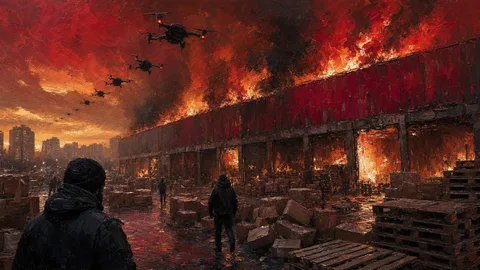
Among the 50 locations struck, one would unleash worldwide outrage: the Kyiv-Pechersk Lavra, a thousand-year-old Orthodox monastery founded in 1051, inscribed on the UNESCO World Heritage List and protected by the 1954 Hague Convention on the Protection of Cultural Property in the Event of Armed Conflict. At 1:50 a.m., a Geran-2 drone — Russia's version of the Iranian Shahed — struck the Stefanivska Chapel of the Dormition Cathedral, the monastery's architectural crown jewel. A fire broke out, engulfing approximately 800 square meters of roofing. Monks and rescuers ran through the night to evacuate ancient icons, antimensions, and other objects of national and universal value.
Ukraine's Security Service (SBU) recovered drone fuselage and engine fragments on the scene, some bearing markings indicating manufacture in the Alabuga Special Economic Zone in Russia. This was not an error. This was not a Ukrainian interceptor gone astray — as Russia's Defense Ministry claimed in its grotesque counter-narrative. This was a deliberate act, documented and criminalized by Ukrainian authorities under the criminal code.
The Arsenal of Terror Deployed in the Night
From Hypersonic Zircons to Kamikaze Drones: Calculated Saturation
The combination of weapons chosen by the Russian general staff for the night of June 15 reveals a strategy of deliberate saturation of Ukrainian air defenses. Six hypersonic Zircon missiles — anti-ship weapons capable of reaching Mach 8 — were launched against Kyiv, a continental city. Five were intercepted. The choice to use an anti-ship weapon against an inland capital is not a targeting error: it is a constant test of Ukrainian air defenses, a search for gaps, for saturation through diversity of vectors.
The 34 ballistic missiles — Iskander-M and S-400 variants — formed the spearhead of the attack: only 15 were shot down, leaving 19 ballistic missiles to strike ground targets. All 30 Kh-101 cruise missiles were intercepted — a remarkable air defense performance. But the real threat came from the 611 drones: 582 were destroyed, a 95% intercept rate, but the remaining 29 were enough to start fires in nearly every district of the capital. The fire at the Lavra, the Mystetskyi Arsenal, the residential buildings in flames — all the result of less than 5% of the drones launched.
The Relentless Mechanics of Mass Terror
What the numbers do not convey is the calculated psychological effect of such raids. The sirens, the cascading explosions, the 42,000 Kyivians sheltering in the metro at two in the morning, the 140,000 subscribers without electricity at dawn — all of it is intentional, planned, documented as a weapon of war. Russia is not only trying to destroy military targets: it seeks to break civilian will, to exhaust a population that must get up early to work, care, teach, fight.
The timing of the attack was noted by President Volodymyr Zelensky himself: Putin had called Trump on June 14 to wish him a happy birthday. "It is not a coincidence that for several days they waited — they had the necessary forces — they waited to not do this before congratulating President Trump," Zelensky declared during his visit to the Lavra. That chilling observation illustrates the geopolitical dimension of every Russian strike: every attack is also a message addressed to Washington.
The Dormition Cathedral in Flames: A Crime Against Humanity
The Greatest Fire Since World War II
The Dormition Cathedral — Dormitio Virginis — is the main church of the Kyiv-Pechersk Lavra. Founded in the eleventh century, destroyed by Soviet explosives in 1941, rebuilt by independent Ukraine, it symbolizes the resilience of a nation that knows how to rise from its ashes. On the night of June 15, 2026, a Geran-2 drone struck the St. Stephen's Chapel, and flames devoured 800 square meters of roofing. Firefighters and monastery staff worked urgently, evacuating priceless relics, including the Reliquary of St. Stephen, an eighteenth-century artifact described by Bishop Avraamiy as one of Orthodoxy's sacred objects.
In total, 80% of the cathedral's roof was damaged, according to Ukrainian authorities. Maksym Ostapenko, Director General of the Kyiv-Pechersk Lavra National Reserve, told Hromadske: "Only the timely actions of the firefighters mean we see the Dormition Cathedral as it is now, because everything could have been much, much worse. The target was absolutely deliberate — to destroy the cathedral." Damage to the entire complex is estimated at 500 million hryvnias. The Lavra had not suffered such destruction since World War II.
The International Reaction: From Shock to Condemnation
President Zelensky personally visited the Lavra and the Mystetskyi Arsenal complex on the morning of June 15. He confirmed that two Russian drones had deliberately targeted the Pechersk district, home to both the Lavra and the Arsenal. "This is one of Russia's most serious attacks on Christian heritage to date," he declared. French President Emmanuel Macron compared the strike to a bombing of Notre-Dame de Paris, calling for stronger European sanctions. EU foreign policy chief Kaja Kallas called the strikes on the cathedral and Ukrainian civilians war crimes. UNESCO condemned the attack on "one of Ukraine's most important spiritual and cultural works."
Meanwhile, Russia persisted in industrial-scale lying. Its Defense Ministry denied any deliberate strike on the Lavra, attributing the damage to "a faulty Patriot interceptor missile." Ukraine's Center for Countering Disinformation documented five Russian propaganda scenarios deployed simultaneously: the fire presented as a "Ukrainian provocation," the Dovzhenko Film Studio declared a "legitimate military target," allegations of false claims about weapons workshops disguised as civilian buildings. The same playbook had been applied after the Mariupol theater, after the Odessa cathedral. Russia refines its lie factory with every crime.
The Pechersk District, Block by Block: A City in Martyrdom
From Residential Buildings to Film Studios: Everything Burns
The June 15 strike spared no district of Kyiv. In the Obolonskyi district, a nine-story residential building was struck, leaving dozens of families homeless and setting some thirty cars ablaze. In the Solomianskyi district, another nine-story residential building was hit: firefighters evacuated 15 people, including two children. A school was also damaged. In the Desnianskyi district, a building caught fire, three private houses were destroyed by debris, and a kindergarten was struck.
The Oleksandr Dovzhenko National Film Studio — the first studio in the post-Soviet space and custodian of Ukraine's largest and oldest costume collection — was partially destroyed. A two-story building housing 100,000 costumes was completely razed. Nearby, the Mystetskyi Arsenal — an internationally renowned cultural complex — was struck twice in the same night, igniting a fire covering approximately 1,000 square meters. More than 1,200 rescuers and police officers were deployed on the ground. More than 1,200 anonymous heroes who, instead of sleeping, were saving fragments of a civilization Russia seeks to erase.
The Victims: Numbers and Faces of Ordinary Terror
Five people were killed in Kyiv — in the Obolonskyi, Holosiivskyi, and Solomianskyi districts. Nationally, the toll reached 11 dead and 53 wounded, according to President Zelensky. In Kharkiv, five first responders perished trying to extinguish fires provoked by what experts identified as a double-tap strike — a criminal war practice of striking a first time, waiting for rescuers to arrive, then striking again. In Sumy, three people were wounded, including a child. In Dnipro, at least one person was injured.
In total, 26 residential buildings were damaged in Kyiv, and 26 fires covering nearly 6,000 square meters were recorded in the capital. The list of symbolic buildings struck is itself an indictment: the Kyiv-Pechersk Lavra, the Mystetskyi Arsenal, the Dovzhenko studio, the High Anti-Corruption Court. Russia is not bombing military targets: it is destroying, methodically, the heritage of a nation it claims to be "liberating."
Russia's Campaign Against Ukrainian Cultural Heritage
Nearly 2,000 Cultural Sites Destroyed or Damaged Since 2022
The strike on the Kyiv-Pechersk Lavra is not an isolated accident. Prosecutor General Ruslan Kravchenko revealed that Russia has damaged or destroyed nearly 2,000 Ukrainian cultural heritage sites since the full-scale invasion began in 2022. He placed the attack on the Lavra in the continuity of a deliberate campaign: strikes on the Transfiguration Cathedral in Odessa, the Hryhorii Skovoroda Museum in Kharkiv Oblast, dozens of archives, libraries, and museums in occupied territories.
More chilling still: since 2014, Russian forces have looted more than 7.8 million artifacts from museums in occupied zones. These objects — icons, manuscripts, artworks, Scythian archaeology — have been transported to Russia. This is not war. It is systematic pillage, a state policy aimed at depriving the Ukrainian people of their memory, their roots, their identity.
The Lavra Under International Protection: What That Changes (and Does Not)
The Kyiv-Pechersk Lavra enjoys dual international protection. It has been listed on the UNESCO World Heritage List since 1990. It also benefits from the enhanced protection regime of the Second Protocol to the 1954 Hague Convention on the Protection of Cultural Property in Armed Conflict. Striking such a site is "one of the gravest crimes against global cultural heritage," according to legal scholar Tetiana Berezhna, Ukraine's deputy prime minister for humanitarian policy and culture.
These legal protections did not stop the Russian drone on the night of June 15. Nor did they prevent the destruction of Mariupol, the Odessa Trade Unions House, the Mariupol theater. What these protections do accomplish, however, is document the crimes for the courts of tomorrow. Ukrainian Foreign Affairs Minister Andrii Sybiha announced that Ukraine would "urgently initiate" actions within UNESCO and other international frameworks to secure an "immediate and appropriate" response. The case file grows thicker. Justice advances, slowly, but it advances.
Ukrainian Air Defense: Prowess and Limits
632 Out of 681: A Heroic Shield That Is Never Enough
On the same topic

COLUMN : Europe Moved 8.5 Billion Euros in a…
That is what the European Commission says it has disbursed for…
ANALYSIS: 800 drones over Russia in one night —…
More than eight hundred drones, in a single night, August 14…

REPORT: One Year Past the August 18 Ultimatum, Ukraine's…
At midnight on August 18, 2025, the deadline expired that the…
The number is impressive: 632 vectors intercepted out of 681 launched, a success rate of 92.8%. Fifty missiles — all 30 Kh-101s and 5 of the 6 Zircons — were shot down. And 582 of the 611 drones were destroyed. This is a considerable operational achievement, made possible by the combination of Patriot, NASAMS, IRIS-T, and other air defense systems delivered by Western allies. Ukrainian crews work around the clock, under extreme conditions, to protect millions of civilians.
But the number that matters is the other one: 49 weapons still hit their targets. Twenty ballistic missiles and 27 attack drones struck 42 sites in Kyiv, with debris falling on 12 additional locations. That is the Kremlin's Saturnian logic: by launching enough vectors, mixing enough weapon types, targeting enough directions simultaneously, something always gets through. Perfect defense does not exist. And Russia knows it.
Structural Limits and the Urgency of Additional Patriots
Iskander-M ballistic missiles are the primary gap. Of 34 launched that night, only 15 were intercepted, leaving 19 to hit their targets. Ballistic missiles fly at speeds and trajectories that make interception extremely difficult, even for the best Western systems. President Zelensky repeated at the Ramstein summit that additional Patriot systems and anti-ballistic capabilities are Kyiv's absolute top priority. After the night of June 15, no one can doubt it.
Ukraine is defending not only its own population — it is defending a principle. If Russia can bomb a UNESCO World Heritage site with impunity using drones manufactured in Iran via a Russian special economic zone, without the international community responding with proportional force, then no protected site anywhere in the world is truly safe. This is not a Ukrainian question. It is a universal one.
The Pechersk Quarter at Sunrise
Bells Ring Through the Smoke
According to correspondents present on the scene, the Pechersk district at sunrise on June 15 presented a tableau of tragic and terrifying beauty. Smoke still rose from the domes of the Dormition Cathedral. Firefighters, exhausted after hours of effort, continued cooling the structures. Monks in black habits walked through the ruins of the roof, their faces marked by disbelief. Journalists from around the world photographed the damage — the gaping hole in one side of the cathedral, the golden dome lying in the street, torn off by a drone that had struck the neighboring Mystetskyi Arsenal.
Then, through that gray June smoke, the Lavra's staff rang the bells. A defiance. An act of resistance. A message sent to Moscow and the world: you can burn our roofs, you will not burn our soul. Ukrainian Prime Minister Yulia Svyrydenko had posted an image of the burning monastery with these words: "A brutal assault on our people and our heritage. This is the face of Russia's Orthodox values."
The Evacuation of Relics in the Night
While missiles were still falling, monastery staff and volunteers organized an emergency evacuation of ancient icons, relics, and other objects of national value. Bishop Avraamiy recounted the efforts made to secure unique pieces, including the famous Reliquary of St. Stephen. Crates loaded with centuries of history were carried through the night, under explosions, toward secured shelters. This anonymous courage is a form of resistance as powerful as that of frontline fighters.
President Zelensky and British Prime Minister Keir Starmer discussed the United Kingdom's role in the restoration of the damaged Kyiv-Pechersk Lavra. That detail says something important: Ukraine's allies are not merely delivering weapons — they are already committing to rebuild what Russia destroys. The Ukrainian victory will not be only military. It will also be cultural, patrimonial, civilizational.
The War on Civilians: Kharkiv, Sumy, Dnipro
Kharkiv: The Double-Tap Strike and Five Dead Firefighters
Kyiv was not the only target of the night of June 15. In Kharkiv, Ukraine's second city and the one closest to the Russian border, at least five people were killed and 13 wounded. According to correspondents present, experts pointed to a double-tap strike: the first strike starts the fire, the second strikes the rescuers who have arrived on scene. This practice, documented and condemned under international humanitarian law as a war crime, has become a recurring method of the Russian army in Ukraine.
The Kharkiv Art Museum was also struck during a drone attack on the evening of June 14, a few hours before the major mass strike. The city, subjected to near-daily bombardment since the invasion began, accumulates a systematic destruction of its urban fabric and cultural heritage. Kharkiv resists, but at what cost? How many dead firefighters? How many museums in ashes?
The Total Price of a Single Night of Russian Terror
Totaling the combined toll of the night of June 14–15, 2026: 11 dead, 53 wounded across Ukraine, dozens of residential buildings destroyed, several emblematic cultural sites damaged or destroyed, 140,000 subscribers without electricity in Kyiv, thousands of families displaced. And that was just one night. In Putin's war of attrition, that night is one episode among thousands — but one that nearly destroyed one of Eastern Christianity's most important monuments.
The Council of All Churches and Religious Organizations of Ukraine called on the governments of democratic countries to intensify sanctions against Russia, its politicians, businesspeople, journalists, and religious officials complicit in crimes against humanity. This is not merely a religious protest — it is a call for concrete, immediate political action commensurate with the crime committed.
Russian Propaganda: Five Scenarios of Industrial Lying
The Disinformation Playbook After Every Crime
Within 24 hours of the Lavra strike, Ukraine's Center for Countering Disinformation (CPD) had documented five Russian propaganda scenarios deployed simultaneously and in coordination. Scenario 1: the Lavra fire is a "Ukrainian provocation" or "self-arson." Scenario 2: Russian conspiracy theories blame Ukrainian authorities for the strike on the High Anti-Corruption Court building. Scenario 3: the Dovzhenko studio is declared a "legitimate military target" because it is allegedly a "propaganda nest."
Scenario 4: false allegations claim Kyiv has weapons production workshops disguised as civilian buildings — under this logic, every building in Kyiv becomes a "military object." Scenario 5: Ukrainian air defense is held responsible for civilian building damage. This disinformation playbook is identical to the one used after Mariupol, after Odessa, after Kharkiv. Russia is perfecting an industrial lie machine — tested, refined, effective against uninformed audiences.
Why Russian Lies Still Work
These disinformation narratives find echo in certain social media echo chambers, in some pro-Russian outlets active in Western Europe, and in American isolationist circles. Their effectiveness rests not on their plausibility — Ukrainian investigators found drone fragments on the scene — but on their capacity to introduce doubt, to create confusion, to exhaust audiences with contradictions. Disinformation does not need to be believed to be effective: it only needs to sow hesitation.
Against this, the CPD was categorical: "No manipulation, no conspiracy theory, no attempt to grant civilian objects 'military status' will help the aggressor conceal another war crime." Those words are right. But they need to be amplified by voices louder than those of Ukrainian counter-disinformation centers. They need Western politicians who dare to name clearly what they see.
International Reactions: From Indignation to Action
Macron, Kallas, UNESCO: Words Without Sufficient Acts
International reactions to the Lavra strike were unanimously condemnatory. French President Emmanuel Macron was most direct, comparing the attack to a bombing of Notre-Dame de Paris and calling for expanded European sanctions. EU foreign policy chief Kaja Kallas called the strikes war crimes. UNESCO condemned the attack on "one of Ukraine's most important spiritual and cultural works."
These condemnations had a concrete political effect: they gave new momentum to discussions on the 21st European sanctions package against Russia. But the gap between declarations and action remains vertiginous. How many cathedrals must burn before Europe stops counting its sanctions in "packages" and begins acting with the speed and force the situation demands? That is not a rhetorical question — it is a real strategic one.
Zelensky at Ramstein: The Military Response Takes Shape
Days after the Lavra strike, President Zelensky participated in the 35th Ramstein summit, the Ukraine Defense Contact Group, in Brussels. Discussions centered on priorities: additional Patriot systems, anti-ballistic capabilities, protection of Ukrainian skies. The allies collectively announced $4 billion in additional military aid. That is not nothing. But against a Russian war industry running at full capacity, it is still insufficient.
The Lavra strike produced the paradoxical effect of barbarity: it strengthened allied resolve. The United Kingdom announced the same day a package of 150,000 drones for Ukraine, funded by frozen Russian assets. Germany delivered new air-to-air missiles and boosted its IRIS-T systems. The Netherlands announced an additional 500 million euros. Every Russian missile on Kyiv generates a Western response. Perhaps that is the only logic Moscow still understands.
Discover

INVESTIGATION: Beijing cuts Africa to 2.1 billion in loans…
2.1 billion — the lowest figure in almost twenty years, according…

SPECIAL REPORT: Beijing Promises Stimulus as Its Households Give…
That is the growth rate of Chinese industrial output in July,…

INVESTIGATION: Two Chinese Ex-Soldiers Arrested in Seoul as 18,000…
For five years, a man ran a military-supply shop at the…
The Deeper Meaning: Why Putin Strikes Symbols
The Identity War Behind the Military War
The strike on the Kyiv-Pechersk Lavra is not a targeting accident. It is a declaration of identity war. The Lavra, founded in 1051 — 36 years before Notre-Dame de Paris — is one of the cradles of Eastern Slavic civilization. For centuries it has been the spiritual center of an Orthodox world that defined itself independently of Moscow. To destroy it, or attempt to destroy it, is to physically erase evidence that Ukrainian civilization precedes, exceeds, and contradicts the Russian imperial narrative that makes Kyiv "the mother of Russian cities."
This message is understood by Ukrainians. "This is a crime against the Christian faith and against global Orthodoxy as a whole," declared Kyrylo Budanov, head of the Presidential Office. He added that Soviet forces had already destroyed the Dormition Cathedral during World War II, but that independent Ukraine had restored it. Moscow destroys. Kyiv rebuilds. That contrast is not incidental: it carries the entire difference between a living civilization and a declining empire that knows only how to destroy what it cannot possess.
The Lavra and the Question of Collective Memory
In the cellars and underground galleries of the Lavra rest the bodies of Ukrainian saints and princes dating to the eleventh century. It is a living museum of the history of Kyivan Rus — the political entity of which Russia claims exclusive inheritance, while in reality Ukraine is its geographic and cultural continuator. In burning the Lavra, Putin is not merely destroying a monument: he is attempting to destroy a historical argument, physical proof that Ukraine existed before Russia and will exist after it.
This symbolic dimension escapes no one. It explains why international condemnation was so immediate and so virulent. It also explains why the Ukrainian response, in the hours following the strike, was both pragmatic (extinguish the flames, evacuate the relics, document the crimes) and deeply human (ring the bells through the smoke). Ukraine knows this war is also a war of memory. And it is determined to win it on all fronts.
The Legal Framework: War Crimes and Accountability
The Lavra Under Dual International Protection: The Texts Are Clear
The Russian strike on the Kyiv-Pechersk Lavra constitutes a manifest violation of several international legal instruments. The 1954 Hague Convention and its 1999 Second Protocol explicitly prohibit any attack against cultural property enjoying enhanced protection, except in cases of "imperative military necessity" — a condition manifestly not met here. The Lavra has been on the UNESCO list since 1990 and has no military function. The Geneva Conventions and their Additional Protocol I, Article 53, complete this protection.
The SBU opened criminal proceedings under Part 1 of Article 438 of the Ukrainian Criminal Code, covering war crimes. The investigation is conducted under the supervision of Kyiv City Prosecutor's Office. The drone fragments recovered on site are direct physical evidence. Witnesses have been identified. The case builds, piece by piece, for the courts of tomorrow — whether in Kyiv, The Hague, or elsewhere. Russia will be called to account.
The Mariupol Precedent and the Jurisprudence of Heritage Crimes
Prosecutor General Kravchenko explicitly placed the Lavra strike in the same category of crimes as the attack on the Mariupol theater, the Transfiguration Cathedral in Odessa, and the Skovoroda Museum. This classification is not only memorial: it aims to establish a systematic pattern of deliberate destruction of Ukrainian cultural heritage, which under international law can constitute an element characterizing cultural genocide or a crime against humanity.
The International Criminal Tribunal for the former Yugoslavia established foundational jurisprudence in this area with the 1991 Dubrovnik destructions. The International Criminal Court convicted Ahmad Al-Faqi Al-Mahdi in 2016 for the destruction of religious and historical sites in Timbuktu. These precedents exist. The legal tools exist. What is sometimes lacking is the political will to deploy them with the force the situation demands.
Ukraine Rises Again: Repair, Memory, Resistance
Starmer, Zelensky, and the Promise of Reconstruction
In the hours following the strike, President Zelensky and British Prime Minister Keir Starmer exchanged on the United Kingdom's role in restoring the damaged Lavra. This is not a protocol detail: it is the commitment of a state to repair what another has destroyed. Ukraine has a long memory and the capacity to rebuild — it proved this after the Soviet destruction of the Dormition Cathedral in 1941, which it patiently restored after independence. It will do so again.
Damage is estimated at 500 million hryvnias for the Lavra complex alone. Add the destruction of the Dovzhenko studio, the Mystetskyi Arsenal, residential buildings across six districts. Reconstruction will take years. But it will happen. And every stone put back in place will be an additional defeat for Putin, who will have spent millions of rubles to create destruction that the entire world will help repair.
Ukrainian Resilience as Strategic Response
What the night of June 15, 2026 demonstrated, beyond the statistics and material damage, is the extraordinary resilience of Ukrainian society. Forty-two thousand people in the metro at two in the morning — they were already there. Twelve hundred rescuers deployed in under an hour — they were ready. Monks evacuating relics in the darkness — they had a plan. Ukraine is not a nation that endures war: it is a nation that has learned to survive it, adapt to it, resist it with growing effectiveness.
This resilience is a weapon. Not in the military sense — but in the strategic sense. The more Putin bombs, the more he strengthens Ukrainian determination. The more symbols he destroys, the more images he creates that reinforce international support. The Lavra strike precipitated the unlocking of new aid packages. The next Russian atrocity will precipitate more. That is the perverse logic into which Putin has locked himself: every crime deepens Russia's isolation and strengthens Ukraine.
Conclusion: The Lavra Burns, Ukraine Holds
What the Night of June 15 Reveals About the Nature of This War
The night of June 15, 2026 revealed, once again and with brutal clarity, the true nature of the war Russia is waging in Ukraine. This is not a special military operation. This is not a war against military installations or an NATO threat. This is a war against a people, its culture, its memory, and its right to exist. Striking the Kyiv-Pechersk Lavra — UNESCO, Hague Convention, a thousand years of history — and then denying and lying: that is the naked face of the Putin regime.
Six hundred and eighty-one attack vectors. Eleven dead. Fifty-three wounded. A thousand-year-old cathedral in flames. A century-old film studio destroyed. Dozens of residential buildings struck. And over all of it, the Russian lie — industrial, coordinated, operational. That night summarizes everything one needs to know about this war and what must be done: arm Ukraine more, sanction Russia harder, and never, never surrender to the moral fatigue that Moscow cultivates as its best ally.
The Legacy of the Lavra: A Resistance That Has Lasted a Thousand Years
The Kyiv-Pechersk Lavra survived the Mongol invasions of the thirteenth century. It survived the Soviet destruction of 1941. It will survive Putin. The flames of June 15 will not have the last word, because Ukraine, its allies, and the international community will not allow it. The reconstruction is already underway — symbolically, in the declarations of Zelensky and Starmer; concretely, in the teams assessing the damage and planning the works. In ten, twenty years, the Dormition Cathedral will stand, restored, more beautiful still. And the name of Vladimir Putin will be inscribed in the annals of vandals who tried, and failed, to erase Ukraine.
Get the geopolitics analyses
Conflicts, powers, alliances: the MadMax thread without the noise.
Cite this article
Maxime Marquette (2026). FIELD REPORT : The Night the Kyiv-Pechersk Lavra Burned Under Russia's Rain of Fire on Kyiv. MadMax. https://mad-max.co/en/article/reportage-la-nuit-ou-la-laure-de-petchersk-a-brule-sous-la-pluie-de-feu-russe-sur-kyiv
Read next
INVESTIGATION: Beijing cuts Africa to 2.1 billion in loans…
2.1 billion — the lowest figure in almost twenty years, according…
SPECIAL REPORT: Beijing Promises Stimulus as Its Households Give…
That is the growth rate of Chinese industrial output in July,…
INVESTIGATION: Two Chinese Ex-Soldiers Arrested in Seoul as 18,000…
For five years, a man ran a military-supply shop at the…
Enjoyed this piece? Get the next one.
One chronicle a week, straight to your inbox. No noise.
This article was generated with AI assistance, under human supervision.
Comments
Be the first to weigh in.