

REPORT: 160 Ukrainian soldiers torn from Russian hell — the slow mechanics of prisoner exchanges
On June 26, 2026, 160 Ukrainian prisoners of war were released from Russian captivity in a prisoner exchange that represented the 75th such exchange since Russia's full-scale invasion of Ukraine in February 2022. They crossed back into Ukrainian-controlled territory in the early morning, in a process mediated by the United Arab Emirates — one of the few non-Western actors that
- On June 26, 2026, 160 Ukrainian prisoners of war were released from Russian captivity in a prisoner exchange that represented the 75th such exchange since Russia's full-scale invasion of Ukraine in February 2022. They crossed back into Ukrainian-controlled territory in the early morning, in a process mediated by the United Arab Emirates — one of the few non-Western actors that
- REPORT: 160 Ukrainian soldiers torn from Russian hell — the slow mechanics of prisoner exchanges
- Introduction: June 26, 2026 — 160 people came home
Facts, quotes, and cited links remain in the body. Interpretations are framed as analysis or opinion according to the format.
REPORT: 160 Ukrainian soldiers torn from Russian hell — the slow mechanics of prisoner exchanges
Introduction: June 26, 2026 — 160 people came home
The exchange that almost did not happen
On June 26, 2026, 160 Ukrainian prisoners of war were released from Russian captivity in a prisoner exchange that represented the 75th such exchange since Russia's full-scale invasion of Ukraine in February 2022. They crossed back into Ukrainian-controlled territory in the early morning, in a process mediated by the United Arab Emirates — one of the few non-Western actors that both Russia and Ukraine have consistently accepted as a reliable intermediary for these operations. The exchange had been weeks in the making, built on a fragile architecture of diplomatic contact, confidential negotiation, and the constant risk of political collapse.
One hundred and sixty names. One hundred and sixty families who spent months, sometimes years, in the particular hell of not knowing — not knowing if their person was alive, if they were being beaten, if they would ever return. The exchange is a bureaucratic event in international law, a logistical operation on the ground, and an act of mercy so ordinary and so extraordinary simultaneously that covering it properly requires holding both dimensions at once.
The mechanics that make exchanges possible
Prisoner exchanges between Russia and Ukraine do not happen spontaneously. They are the result of a sustained, institutionalized process — lists compiled, identities verified, locations confirmed, transfer points agreed, transport arranged — conducted in conditions of active hostility between the two parties and requiring the involvement of neutral intermediaries who maintain working relationships with both sides. The UAE's role in facilitating Ukrainian prisoner exchanges has been one of the quiet diplomatic successes of the Gulf state's effort to position itself as a constructive actor in the conflict without taking an explicit side on its underlying merits.
The institutionalization of prisoner exchange as a recurrent process — 75 exchanges over four years — reflects both the scale of the problem and the existence of a minimal diplomatic infrastructure that neither side has fully dismantled. That infrastructure is fragile, contested, and frequently suspended. But it exists, and it works, often enough that 160 people came home on June 26.
The UAE mediation: a quiet architecture
Why Abu Dhabi plays this role
The United Arab Emirates has emerged as the primary institutional mediator for Ukrainian prisoner exchanges in a role that was not foreordained by its geographic position, its alliance relationships, or its stated foreign policy priorities. The UAE is a close US security partner, an important economic partner for Russia (particularly in the context of sanctions evasion discussions), and a country with historic economic relationships across the Middle East and Central Asia that give it access to communication channels that Western governments cannot maintain directly.
Abu Dhabi's willingness to facilitate Ukrainian prisoner exchanges reflects a specific calculation: that being seen as a constructive humanitarian actor in the conflict serves the UAE's interest in positioning itself as a global diplomatic player, while the specific content of facilitating prisoner returns does not require taking an explicit political position on the conflict's underlying causes or the question of which side is in the right. The UAE has consistently avoided the latter judgment while pursuing the former opportunity. For Ukraine's prisoners, the motivation matters less than the result.
The Istanbul talks: the diplomatic context
The June 26 exchange was built on the foundation of the Istanbul talks of June 2, 2026, where Ukrainian Defense Minister Rustem Umerov and Russian counterpart Vladimir Medinski met for direct discussions about prisoner and body exchange processes. The Istanbul meeting was itself a carefully constructed diplomatic event — held in a city that has been the site of the most substantive direct Russian-Ukrainian contact since the early weeks of the war, in a format that allows both sides to engage without the optics of a full bilateral summit.
Umerov and Medinski represent their respective sides' designated leads on the prisoner exchange file — officials senior enough to make commitments but not so senior that their meeting constitutes a broader diplomatic signal about war termination negotiations. The Istanbul talks are the clearest available evidence that a minimal humanitarian diplomatic channel remains open between Russia and Ukraine even as the military conflict continues at full intensity. That channel is narrow, fragile, and limited in scope. It exists.
The 75th exchange: an accounting of four years
The scale of prisoner capture in this war
The 75th exchange since February 2022 provides the occasion for an accounting of what four years of the largest land war in Europe since World War II has meant in terms of prisoner capture and exchange. Ukraine has publicly acknowledged holding several thousand Russian prisoners of war; Russia is believed to hold a significantly larger number of Ukrainian military personnel and, in contested categories, Ukrainian civilians detained on political charges. The International Committee of the Red Cross has had severely limited access to detention facilities on the Russian side — a violation of the Geneva Conventions that the international community has protested repeatedly without producing the required access.
The 75 exchanges conducted through June 2026 have returned thousands of Ukrainians from Russian captivity — both military personnel captured in combat and civilians detained in occupied territories on charges that Ukrainian and international human rights organizations characterize as politically motivated. Each exchange has followed a pattern of weeks or months of negotiation, a moment of transfer at an agreed crossing point, and the subsequent medical assessment of returned prisoners, many of whom bear the physical marks of the conditions they endured.
The all-for-all proposal and its stalling
Ukraine has consistently advocated for an "all-for-all" prisoner exchange — a comprehensivee release of all prisoners held by both sides simultaneously, bypassing the case-by-case, list-by-list process that characterizes current exchanges and that Russia has used to prioritize the return of its own prisoners while delaying Ukrainian returns. The all-for-all proposal reflects Ukraine's assessment that the current exchange format systematically advantages Russia, which holds more Ukrainian prisoners and can use its selective release decisions as leverage over Kyiv's diplomatic posture.
Russia has not accepted the all-for-all framework, preferring the case-by-case format that gives it maximum control over timing, numbers, and the specific individuals included or excluded from exchange lists. The June 26 exchange of 160 Ukrainians is an expression of the current format's limitations — a meaningful but partial release that leaves thousands of Ukrainian prisoners in Russian custody, their return dependent on a negotiation process that Moscow has every incentive to slow.
Who comes home: categories and conditions
Military personnel and civilians
The 160 Ukrainians returned on June 26 include both military personnel — soldiers, officers, and support staff captured in combat operations — and, in smaller numbers, civilians detained in Russian-occupied territories on charges that range from "terrorism" to "sabotage" to the simple fact of having connections to the Ukrainian state or military. The distinction between categories matters legally — the Geneva Conventions provide specific protections for prisoners of war that do not automatically extend to civilians — but in practice, the exchange format treats both categories as subjects for negotiation.
Among those returned in exchanges are consistently wounded soldiers whose medical conditionsn requires immediate care upon return, soldiers who have been in captivity since the early months of the war, and in some exchanges, the remains of soldiers who died in Russian custody. The inclusion of remains in exchanges is one of the most emotionally weighted aspects of the process — returning the dead to their families for proper burial is itself a humanitarian act, and Russia's willingness or unwillingness to include remains in specific exchanges is both a logistical decision and a political signal.
The Mariupol defenders: a special category
A particular focus of Ukrainian public attention in prisoner exchange negotiations has been the fate of the Mariupol defenders — the soldiers of the Azov regiment, the 36th Naval Infantry Brigade, and other units who held the Azovstal steel plant until their surrender in May 2022, one of the most symbolically charged moments of the war's first year. These soldiers became prisoners in large numbers in a single event, their captivity widely covered, their identity as defenders of a city that became synonymous with Ukrainian resistance giving their case political weight that standard exchange negotiations do not carry.
Russia has used the Mariupol defenders as a specific leverage category in exchange negotiations — slow to include them in standard exchanges, occasionally announcing their inclusion as a goodwill gesture in context of broader diplomatic signaling. The number of Mariupol defenders still in Russian custody as of June 2026 is not fully known publicly — a reflection of the information opacity that characterizes all prisoner exchange negotiations and that Ukraine's government manages carefully to protect ongoing negotiations from public pressure that could complicate them.
Conditions of captivity: what is known
Survivor testimony and documented evidence
What is known about conditions in Russian prisoner of war facilities comes primarily from survivor testimony — statements given by returned prisoners to Ukrainian intelligence, to human rights organizations, and to the media. The picture that emerges from this testimony is consistent across hundreds of accounts: physical violence during interrogation, inadequate food and medical care, psychological pressure and intimidation, use of solitary confinement as punishment, and in documented cases, deliberate neglect of medical conditions that has resulted in preventable deaths.
The UN Human Rights Monitoring Mission in Ukraine and Ukrainian human rights organizations have documented these conditions in reports that draw on survivor testimony and the physical evidence presented by returned prisoners. Many of those returned in exchanges show signs of malnutrition, untreated injuries, and the physical deterioration consistent with the conditions described. These are war crimes under international humanitarian law — violations of the Geneva Conventions' requirements for the treatment of prisoners of war that Russia has made no genuine effort to remedy.
The ICRC access problem
The International Committee of the Red Cross — the institution specifically mandated by international law to monitor prisoner of war conditions — has been systematically denied access to Russian detention facilities holding Ukrainian prisoners. Russia has invoked procedural objections, security claims, and bureaucratic obstruction to prevent ICRC inspectors from conducting the visits that the ICRC has a right to conduct under the Geneva Conventions. This access denial is itself a violation of international humanitarian law — and it has practical consequences: without ICRC monitoring, the deterrence effect of international accountability is removed, and the risk of abuse escalates accordingly.
The international community's response to Russia's ICRC access denial has been largely confined to diplomatic protests and reports — insufficient to force compliance but sufficient to document the violation for future accountability proceedings. Russia knows this. It has calculated that the cost of ICRC access denial is lower than the cost of having inspectors document what is happening in its detention facilities. That calculation is a statement about what those facilities contain.
The UAE's role: what neutral mediation produces
The practical value of neutrality
The UAE's effectiveness as a prisoner exchange mediator rests on its ability to maintain working relationships with both Ukraine and Russia at a level that allows practical negotiation to proceed. The UAE does not call Russia's actions in Ukraine a war crime in its official statements. It does not impose sanctions on Russian entities in the way that Western states have. It does not condition its mediation on political positions that either party would find unacceptable as prerequisites for engagement. This political neutrality — which is itself a political choice, with its own moral dimensions — is the operational foundation of its mediation effectiveness.
For Ukraine, the trade-off is explicit: accepting the mediation of a country that does not endorse Ukraine's position in exchange for the practical benefit of prisoner returns. Ukraine has made this trade-off consistently and without public complaint — a pragmatic acknowledgment that the humanitarian imperative of prisoner return justifies engaging with mediators whose political neutrality involves not condemning Russian conduct in terms that Kyiv would consider appropriate.
The mechanics of a transfer
Discover

INVESTIGATION: Beijing cuts Africa to 2.1 billion in loans…
2.1 billion — the lowest figure in almost twenty years, according…

SPECIAL REPORT: Beijing Promises Stimulus as Its Households Give…
That is the growth rate of Chinese industrial output in July,…

INVESTIGATION: Two Chinese Ex-Soldiers Arrested in Seoul as 18,000…
For five years, a man ran a military-supply shop at the…
The practical mechanics of a prisoner transfer illustrate the bureaucratic and logistical complexity involved. Lists of prisoners are compiled and verified by both sides — Ukrainian and Russian officials confirm the identities, prison locations, and status of individuals proposed for exchange. Transfer points are agreed — usually crossing points in areas where ceasefire arrangements or de facto separation of forces make physical handover possible without military risk to the exchange process itself. Medical teams are positioned on the Ukrainian side to receive returnees, conduct immediate health assessments, and triage those requiring urgent care.
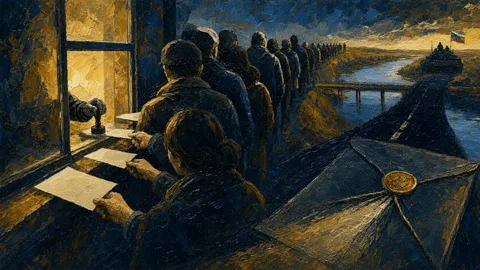
The transfer itself takes hours — individuals are transported to the crossing point, their identities confirmed against the lists by officials from both sides, and the physical handover conducted. The moments of crossing — individuals walking across a line from captivity into freedom — have been captured in images that carry more weight than any diplomatic communiqué. They are the operational endpoint of a process that begins in diplomatic corridors and ends in the bodies of human beings crossing a line.
The political context: exchanges as diplomatic currency
How Russia uses prisoner exchange as leverage
Russia has consistently used its control over prisoner exchange processes as diplomatic leverage — signaling willingness to engage or disengage from exchanges in response to broader political developments, timed releases to coincide with diplomatic moments, and deliberate delays when bilateral tensions are elevated. The June 2026 exchange followed the Gdańsk recovery conference and the E5 Berlin declaration — a period of intensified Western commitment to Ukraine that Russia had every interest in responding to with a gesture that allowed it to present itself as engaged in humanitarian processes even as it continued military operations.
Ukraine's management of this dynamic — navigating the political instrumentalization of prisoner exchange by Russia without allowing that instrumentalization to become a reason to refuse negotiations — is one of the most difficult moral and strategic calculations in its diplomatic portfolio. Every exchange that Russia agrees to serves Ukraine's humanitarian imperative. Every exchange that Russia conditions on political concessions presents Ukraine with an impossible choice. The June 26 exchange appears to have been conducted without attached political conditions — a relatively clean humanitarian transaction in a context where such transactions are rarely clean.
The information dimension of exchanges
Returned prisoners are also a source of intelligence about Russian detention practices, Russianssian military capabilities and morale, and the operational conditions in Russian-controlled territories. Ukrainian intelligence debriefings of returned prisoners are a systematic part of the post-exchange process — gathering information about what prisoners observed during their captivity, what Russian officers told them, and what they witnessed about Russian military organization and morale. This intelligence dimension does not diminish the humanitarian purpose of exchange negotiations; it is an additional layer of value that the process produces.
Russia is aware that returned prisoners carry intelligence value — and this awareness shapeses which prisoners Russia releases and on what timeline. The most strategically valuable prisoners — senior officers, intelligence personnel, soldiers with specific knowledge of Ukrainian military systems — are least likely to appear early in exchange lists. Their eventual return, when it comes, reflects either a shift in Russian calculations about their information having been fully extracted or a diplomatic situation that raises their exchange value to Russia.
The families: the invisible stakeholders
What families endure during captivity
The families of Ukrainian prisoners of war are the invisible stakeholders in every exchange negotiation — present in every calculation about list composition, in every decision about which exchange to prioritize, in every diplomatic moment where prisoner return could be traded for something else of value. Ukrainian civil society organizations representing these families have advocated persistently for the all-for-all exchange, for ICRC access to Russian facilities, and for the international community's sustained attention to the prisoner issue even as other dimensions of the conflict dominate media coverage.
The Bring Them Home movement and similar organizations have documented cases, maintained public pressure, and provided families with the support and information that official channels often cannot. Their work is the human infrastructure that sustains the political pressure on Ukrainian negotiators to prioritize prisoner return even when other diplomatic priorities compete. Without organized family advocacy, the political weight of prisoner return in Ukraine's diplomatic priorities would be lower. With it, it is one of the most morally urgent items on Kyiv's agenda.
The moment of return
On the same topic

COLUMN : Europe Moved 8.5 Billion Euros in a…
That is what the European Commission says it has disbursed for…

REPORT: One Year Past the August 18 Ultimatum, Ukraine's…
At midnight on August 18, 2025, the deadline expired that the…
DOSSIER: 60,000 Russian passports in Transnistria — the annexation…
More than sixty thousand applications for Russian citizenship in three months,…
The moment when a returned prisoner is reunited with their family — the phone call confirming they have crossed, the arrival at the processing center, the physical meeting after months or years — is the human endpoint of the entire diplomatic and logistical process. Ukrainian media covers these reunions with care, and they serve an important function beyond the individual: they demonstrate to Ukrainian society that the prisoner exchange process works, that the government is pursuing it, and that the national effort to bring everyone home is real and not merely rhetorical.
One hundred and sixty reunions happened on or after June 26, 2026. Each one is the proof of concept for the entire architecture — the UAE mediation, the Istanbul talks, the exchange mechanics, the diplomatic investment. The proof is in the reunions. The 160 people who came home are both the purpose and the validation.
The accountability horizon: what justice requires
Documenting abuse for future prosecution
The conditions that returned prisoners describe — the physical abuse, the medical neglect, the violations of international humanitarian law — are being documented systematically by Ukrainian human rights organizations, the UN Human Rights Monitoring Mission, and international legal teams preparing cases for eventual prosecution. The International Criminal Court has already issued arrest warrants relating to Ukrainian prisoner transfers; the documentation of prisoner abuse conditions is part of a broader accountability process that Ukraine's government and its international partners are building toward.
This accountability work is proceeding alongside the exchange negotiations — not in opposition to them. Ukraine is simultaneously working to return prisoners through negotiation and to document the conditions of their captivity for future prosecution. These goals are not contradictory; they reflect Ukraine's dual commitment to immediate humanitarian relief and long-term justice accountability that the situation simultaneously requires.
The precedent being set
The documentation of Russian prisoner treatment — however difficult to compile in real time — is building a legal and historical record that will matter long after the active conflict ends. The individuals responsible for the conditions in Russian detention facilities — from the guards who administered beatings to the commanders who ordered systematic neglect to the political leadership that authorized the detention of civilians on fabricated charges — are creating a legal record that will eventually be available to accountability processes even if those processes take decades to conclude.
Ukraine's commitment to documentation, even as it conducts the exchange negotiations that return its prisoners, is evidence of a long-term accountability vision that should be recognized and supported. The justice dimension of prisoner treatment is inseparable from the humanitarian dimension, and both are being pursued simultaneously by a government that has chosen to do more than survive — it has chosen to bear witness.
The future of exchanges: toward "all for all"?
Ukraine's proposal for a total exchange
Zelensky has reiterated his demand for an all-for-all exchange — the simultaneous release of all prisoners on both sides. This proposal is symbolically powerful. It says: we make no distinctions, we want all our soldiers, now. But it runs into practical obstacles: the two parties disagree on the numbers, on the identity of certain detainees, on the status of civilians and paramilitaries.
Russia, for its part, claims different figures from those acknowledged by Ukraine. It includes in its demands Ukrainian civilians it presents as combatants. It excludes from its lists soldiers whose detention it sometimes denies. This calculated opacity is an additional form of pressure on Kyiv: you can never be certain the exchange is complete, that the list is exhaustive, that no men remain in undeclared prisons.
The next exchanges: a question of Russian political will
The pace of exchanges ultimately depends on the political will of Moscow. The UAE can facilitate. The United States can apply pressure. Turkey can host talks. But if Putin decides to interrupt exchanges — as he did in 2023 and during part of 2024 — no one can stop him directly. Dependence on Russian good will is the structural limit of this entire mechanism.
What can change the equation: the Ukrainian military pressure that costs Russia in human resources and troop morale, the economic pressure of Western sanctions, and the diplomatic pressure of actors like the UAE and Turkey who have concrete interests in keeping this channel open. This triptych — military, economic, diplomatic — is the only coherent strategy for securing the release of the greatest number.
Memory and dignity: naming the living and the dead
The register of the missing: a colossal undertaking
Ukraine keeps a register of its missing soldiers, prisoners, or killed. This documentation work is colossal. On certain fronts — notably at Mariupol — the confusion of the invasion's first weeks created blind spots that persist. Soldiers listed as missing whose fate is unknown — whether dead, captive, or in rare cases entirely unknown. Families live with this uncertainty.
The Istanbul accord on the exchange of 6,000 bodies is an attempt to reduce this uncertainty for families of the dead. It is a form of partial closure — identifying a body, organizing a burial, being able to grieve. In a war where the dead accumulate on both sides by the tens of thousands, the question of dignity for the dead is also a major political and humanitarian question.
Documentation as an act of resistance
Ukrainian and international organizations that document the names, faces, and stories of prisoners perform an act of resistance against erasure. Russia would prefer these men and women remain abstract numbers. By naming them, by publishing their photos, by recounting their capture, families and human rights organizations restore their humanity. It is also a way of maintaining international pressure: behind the figure 160 of June 26, there are 160 individual stories that the Russian bureaucratic machine wanted to erase.
Ukraine's Coordination Headquarters published, for each exchange, the list of units and fronts represented — without publishing individual names for security reasons. This partial transparency is the right approach: it informs without exposing. It tells each family: your loved one could be in this group. It keeps hope alive.
The geopolitical context: exchanges and pressure on NATO
Russian hybrid threats as backdrop to negotiations
These exchanges unfold in a tense geopolitical context. On June 26 — the same day as the prisoner exchange — Latvian intelligence warned that Russia is preparing military provocations against the Baltic states or Poland. Hybrid attacks: missiles, drones, operations designed to send a signal — stop supporting Ukraine or face your own problems. This dual movement — humanitarian exchanges and military threats — is characteristic of Russian strategy: maintaining multiple registers simultaneously to create confusion.
NATO held its annual summit in Ankara this month in a context of uncertainty about American commitment. Trump said he felt "betrayed." Europeans are seeking to consolidate their strategic autonomy. Meanwhile, Ukrainian soldiers return home draped in flags. These two realities coexist: great power politics and the most concrete human reality.
What exchanges reveal about the state of the war
Prisoner exchanges are also an indicator of the psychological state of the conflict. When both parties exchange, it is because they believe it is in their interest to keep minimum channels open. When exchanges stop — as in 2023 for several months — it is a signal of escalation or total diplomatic rupture. The fact that exchanges continue in June 2026, despite the resumption of intense combat and the Ukrainian 40-day operation, indicates that both parties maintain a minimal line of communication.
This is not sufficient good news. It is not a sign that peace is near. But it is proof that the conflict has not yet tipped into a phase of total and uncontrolled rupture. As long as soldiers can come home, there remains a window — infinitesimal, fragile, but real — toward something other than permanent war.
Mariupol and the unhealed wounds of the war
The defenders who remain unaccounted for
Each exchange reopens the wound of Mariupol. The defenders of Azovstal — the soldiers of the Azov regiment and regular army who surrendered in May 2022 after an epic resistance that captivated the world — remain a special category. Some have been exchanged in previous rounds. Others remain in Russian captivity, sometimes in isolation, sometimes as subjects of particular harassment by Russian authorities who regard them as special trophies.
The families of Mariupol defenders have organized, lobbied, and kept their loved ones' names in public consciousness with a tenacity that is itself an act of resistance. Their effort is a reminder that behind each prisoner number, there is a story that predates the captivity — a soldier who chose to resist when resistance seemed impossible, who held a steel plant against a besieging army, who became a symbol of Ukrainian defiance.
The "1,000 for 1,000" ambition and its limits
The proposal for a "1,000 for 1,000" large-scale exchange has circulated in various forms in diplomatic discussions. The scale of ambition reflects the depth of the problem: thousands of Ukrainians in Russian captivity, thousands of Russian soldiers in Ukrainian hands. A simultaneous mass release — coordinated through UAE or Turkish mediation — would transform the humanitarian dimension of the conflict overnight.
But the obstacles are significant. Verification of numbers. Agreement on identities. The logistics of simultaneous large-scale transfers. The political symbolism for both sides. And the fundamental asymmetry: Ukraine has an interest in showing its soldiers being cared for and returned; Russia has a different calculus about what the return of tens of thousands of prisoners tells its domestic population about the cost of the war.
The international dimension: who watches and who counts
Western allies and the humanitarian obligation
Western allies who provide military and financial support to Ukraine also carry a humanitarian obligation: to maintain pressure on Russia for the treatment and release of prisoners. This is not only a moral imperative — it is a strategic interest. Ukrainian soldiers who know that their allies are fighting for their return are more motivated fighters. The connection between front-line morale and the prisoner exchange effort is real and documented.
The United States, the United Kingdom, and the EU have included prisoner treatment and release in their diplomatic engagement with Russia and with mediating countries. The G7 declaration in June 2026 mentioned Ukrainian POW conditions. This multilateral pressure complements the bilateral mediation of the UAE and Turkey.
The ICC and the documentation of war crimes
The International Criminal Court has opened investigations into the treatment of Ukrainian prisoners of war by Russian forces. The evidence accumulated in testimony from returned prisoners — about torture, starvation, psychological abuse, and summary executions — forms part of the evidentiary record that will eventually support war crimes proceedings. This documentation is the legal foundation for a future accountability that the current political environment makes practically difficult to achieve.
The gap between documentation and accountability is not a reason for despair — it is a reason for persistence. Every exchange brings more witnesses. Every witness adds to the record. Every record strengthens the legal case. Justice in war crimes is slow. But it is not impossible, and the Ukraine war will ultimately test whether the international community's commitment to accountability is real or merely declaratory.
Conclusion: the 75th exchange and what it means
A process that must continue
The 75th prisoner exchange of this war — 160 Ukrainians returned from Russian captivity on June 26, 2026 — is both a milestone and an obligation. A milestone because 75 exchanges over four years represents a sustained institutional investment in the humanitarian architecture of a war that has otherwise resisted all attempts at humanitarian constraint. An obligation because the thousands of Ukrainians still in Russian captivity require the 76th exchange, and the 77th, and as many as it takes until everyone is home.
The work that remains
The UAE mediation, the Istanbul talks, the list negotiations, the transfer logistics — all of it must continue, quarter after quarter, exchange after exchange, until either the all-for-all comprehensive release that Ukraine advocates is achieved or the end of the war creates the conditions for a mass prisoner release as part of a peace settlement. Until then, the slow mechanics of prisoner exchange represent the most direct expression of humanitarian obligation in this conflict. Each exchange is an act of witness to the human cost of a war that was chosen by one side and has been paid for, disproportionately, by another.
By Maxime Marquette, columnist
Columnist's transparency note
Editorial position
This report covers the June 26, 2026 prisoner exchange and the broader mechanics and context of Ukrainian prisoner exchanges with Russia. The columnist strongly supports Ukraine and documents the human rights violations involved in Russian prisoner treatment. All factual claims are drawn from sources cited below or from established patterns in public reporting on prior exchanges. The columnist has no direct access to exchange negotiations or to the facilities where Ukrainian prisoners are held.
Scope and limitations
The specific composition of the June 26 exchange — the number of military versus civilian returnees, the presence or absence of Mariupol defenders — was not fully detailed in sources available at publication. The total number of Ukrainian prisoners currently held by Russia is subject to classification by the Ukrainian government. Survivor testimony cited is representative of patterns documented across multiple sources rather than specific to the June 26 returnees.
Sources
Primary sources
Secondary sources
Get the geopolitics analyses
Conflicts, powers, alliances: the MadMax thread without the noise.
Cite this article
Maxime Marquette (2026). REPORT: 160 Ukrainian soldiers torn from Russian hell — the slow mechanics of prisoner exchanges. MadMax. https://mad-max.co/en/article/reportage-160-soldats-ukrainiens-arraches-a-l-enfer-russe-la-lente-mecanique-des
Read next
INVESTIGATION: Beijing cuts Africa to 2.1 billion in loans…
2.1 billion — the lowest figure in almost twenty years, according…
SPECIAL REPORT: Beijing Promises Stimulus as Its Households Give…
That is the growth rate of Chinese industrial output in July,…
INVESTIGATION: Two Chinese Ex-Soldiers Arrested in Seoul as 18,000…
For five years, a man ran a military-supply shop at the…
Enjoyed this piece? Get the next one.
One chronicle a week, straight to your inbox. No noise.
This article was generated with AI assistance, under human supervision.
Comments
Be the first to weigh in.