

Niger State — a land dispute, eighteen dead, and the world's indifference
Introduction: the night Godoro tipped over
- Introduction: the night Godoro tipped over
- An ordinary Monday until it wasn't
- There are places in the world where the death of a single man can plunge entire villages into violence within hours.
Facts, quotes, and cited links remain in the body. Interpretations are framed as analysis or opinion according to the format.
Introduction: the night Godoro tipped over
An ordinary Monday until it wasn't
There are places in the world where the death of a single man can plunge entire villages into violence within hours. The village of Godoro, in Katako district, Rafi local government area, in Niger State in northwestern Nigeria, became one of those places on Monday, June 29, 2026. That day, unidentified gunmen shot dead Ibrahim Musa, a 25-year-old man from the Fulani community. That killing, apparently linked to an old and persistent land dispute between two ethnic groups in the region, would trigger a spiral of reprisals that left at least 18 people dead in three days, according to local police (The Washington Post).
The Niger State police spokesman, Wasiu Abiodun, confirmed the timeline of events: a first killing, retaliation by local vigilantes known as the Yansakai, which reportedly claimed one additional life, then a brutal escalation on Wednesday, July 1, when a deadly fire killed fifteen more people in a two-bedroom apartment in the community of Angwan-Baago (Vanguard News).
A number that never tells the whole story
Eighteen dead is the figure police officially maintain. But in this part of Nigeria, official tallies and residents' accounts almost systematically diverge. A resident of Tegina, Ibrahim Sani, told Reuters that the real toll could reach 56 people (Reuters). A report prepared for the United Nations, reviewed by AFP, cites an even heavier toll, describing a machete-wielding herder militia that attacked farmers from the Kamuku ethnic group in Tegina, killing at least 42 people, before a counterattack that reportedly killed six herders working on a plantation (Vanguard News).
Godoro, Angwan-Baago, Tegina: anatomy of an escalation
From a single killing to collective fury
According to the detailed police account, delivered to the national news agency NAN, the logic of reprisal spiraled with frightening speed. After Ibrahim Musa's death on Monday, Yansakai vigilantes blocked a road and killed a 28-year-old man, Bashir Mazi, in what police describe as a retaliatory attack. That counterattack, far from easing tensions between the two tribes involved, opened the door to a much wider outbreak of violence that killed 16 more people, bringing the total toll to 18 (Vanguard News).
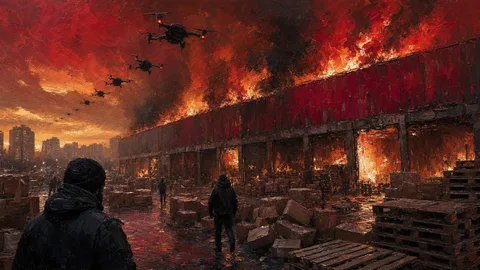
The climax of this escalation came on the night of July 1, around 10 p.m., when 15 people died, burned inside a two-bedroom apartment in Angwan-Baago, near the village of Godoro. A sixteenth person was killed elsewhere at the same time, bringing the police toll at that point to 18 (Vanguard News). China's official Xinhua news agency confirms this same account, noting that the violence began on Monday and worsened on Wednesday (Xinhua).
The land dispute, an old engine of new violence
What is striking about this tragedy is the tragic banality of its origin: an old and persistent land dispute between two ethnic groups. This is neither an organized Islamist insurgency nor a banditry operation driven by profit — it is a fight over land and grazing rights that spiraled out of control, as regularly happens in this part of Nigeria. The Washington Post described the incident as "clashes linked to a land dispute," confirming that the land issue remains the primary trigger (The Washington Post).
The Fulani and the Kamuku: two communities, one contested land
Herders and farmers, a structural rivalry
The conflict pits, according to various sources, the Fulani community, traditionally associated with transhumant herding, against sedentary farming communities such as the Kamuku. This kind of antagonism between herders and farmers is one of the oldest and deadliest fault lines in north-central Nigeria, fueled by population pressure, degradation of arable land, and the shrinking of traditional grazing routes.
The report intended for the United Nations, cited by AFP via Vanguard, describes a "herder militia" armed with machetes that raided Kamuku farmers, while a local community leader, Abdullahi Alhassan, said Fulani herders had invaded the area, attacking residents with machetes and burning people inside their own homes (Vanguard News).
A region already marked by repeated cycles of violence
Niger State is no stranger to communal violence. In October 2025, a clash between the Nupe and Fulani communities had already killed at least four people in the village of Ezhigi, in Edati local government area (Head Topics). More broadly, Rafi local government area, the scene of this week's violence, had already witnessed a clash in July 2025 between the Garun-Gabas and Yakila communities, killing three people.
A country in a state of permanent security emergency
Northern and central Nigeria, epicenter of multiple simultaneous crises
This outbreak of violence in Niger State did not happen in a vacuum. It is part of a chronic pattern of violence affecting all of northern and north-central Nigeria. The Los Angeles Times reported on June 27, 2026 — just days before the Godoro clashes began — that an armed bandit attack on a farming community in the neighboring state of Zamfara had already killed at least 15 people (Los Angeles Times). The same outlet reported that earlier in June, 17 farmers had been killed and at least 13 wounded in the village of Goron Namaye, also in Zamfara.
According to a count cited by Truth Nigeria for mid-June 2026, attacks across the north of the country had already killed 50 people in a single week, with at least 40 people kidnapped, affecting farming communities, schools, security patrols and isolated villages across several states.
The Nigerian state, overwhelmed but not absent
Facing this outbreak, local authorities say they have responded. Police spokesman Wasiu Abiodun said a reconciliation committee, led by local government council officials, is now working with security agencies to defuse the crisis, and that joint security operatives, combining police and military forces, have been deployed to the affected area to restore order (Vanguard News). The federal government, for its part, had not yet issued a separate public statement on this specific episode at the time of writing.
The political backdrop: Tinubu, security priorities and the American drawdown
Washington tightens its military footprint in Nigeria
This episode of violence comes against a particular political and diplomatic backdrop. According to a news summary published by Punch Newspapers, the United States has begun withdrawing troops from Nigeria, a decision that shifts security responsibilities onto local forces already stretched thin by multiple simultaneous crises — banditry in the northwest, residual insurgency in the northeast, land conflicts in the middle belt (Punch Newspapers).
President Tinubu, between crisis management and the election calendar
President Bola Tinubu governs a country where domestic security remains one of the most politically sensitive issues, even as attention already turns to the 2027 election. According to the same Punch Newspapers summary, political figures such as Atiku Abubakar have already announced their intention to contest that election, a sign that political competition is resuming even as entire villages burn in Niger State.
Daily life under threat, a shattered way of living
Fleeing home, a choice that is no choice at all
Beyond the numbers and the police statements, there is a simpler and more heartbreaking human reality: hundreds of residents have fled their villages, according to testimony collected by Reuters (Reuters). For these families, ordinary daily life — tending a field, taking cattle to pasture, sending children to school — has been brutally interrupted. These are not abstract statistics: they are homes abandoned overnight, crops left behind, neighborly ties sometimes broken for generations.
The rural way of life in this part of Nigeria rests on a fragile balance between settled farmers and transhumant herders, a balance that, once broken, does not repair itself in a few weeks. The rhythms of daily life — weekly markets, farming cycles, cattle routes — are directly affected, and fear becomes a permanent feature of local life for months, sometimes years.
The Yansakai vigilantes, between protection and escalation
The role of self-defense groups like the Yansakai illustrates another dimension of the problem: in the absence of a sufficiently dense and rapid state presence, local groups take up arms to protect themselves — and sometimes end up fueling the very cycle of reprisal, as police explicitly acknowledged in their account of the Godoro events (Vanguard News).
Zamfara, Plateau, Kwara: a regional map of instability
A patchwork of states under chronic strain
To fully understand the scope of the Niger State episode, it must be placed on a wider map. The neighboring state of Zamfara saw its own deadly outbreaks in June, with separate attacks that killed 15 and 17 people respectively, according to the Los Angeles Times (Los Angeles Times). Further southeast, Plateau State was the scene of even deadlier attacks earlier this year, with raids killing dozens over several consecutive days in Riyom, according to a documented report (Scribd — Nigeria Weekly).
The amplifying role of local political rivalries
A troubling element in this outbreak comes from local lawmaker Muhammad Adamu Kabo, who told Reuters that the violence began after other lawmakers distributed cash to voters, a practice that reportedly exacerbated pre-existing tensions between the groups (Reuters). This allegation, if confirmed, would add a dimension of local political manipulation to an already structurally explosive conflict.
What this new chapter reveals about the region's future
A cycle that demands structural answers, not just policing
Regional security experts have agreed for years on one conclusion: clashes between farming and herding communities in central and northern Nigeria will not be resolved by one-off military deployments alone. They require structural reforms covering land access, regulation of transhumance routes, and local justice perceived as fair by all parties. None of these efforts has, to date, produced results sufficient to durably break the cycle seen in Niger State.
The risk of wider spillover
The report intended for the United Nations highlights a real risk of the violence spreading to other localities in the region if communal tensions are not quickly defused. With tolls already ranging from one figure to triple that depending on the source — 18 for police, 48 for the UN report cited by AFP, 56 according to local witnesses — the region remains in a troubling state of uncertainty over the true scale of the tragedy.
The Western gaze on an under-covered African crisis
A structural attention deficit
One only needs to compare the volume of coverage given to the Ukrainian or Middle Eastern crises with that reserved for a tragedy that killed between 18 and 56 people in Nigeria to measure a persistent imbalance in coverage. This imbalance is not new, but it deserves to be named explicitly: Nigerian communal violence, however deadly, struggles to receive the sustained attention granted to other theaters of crisis.
Why the West should pay closer attention
Nigeria remains Africa's largest economy and most populous country, a strategic partner whose chronic instability has repercussions well beyond its borders — migration, regional security in the Sahel, the fight against transnational armed groups. Ignoring these internal crises means underestimating a key factor in the stability of an entire region of the continent.
The religious and ethnic dimension, a factor to handle with care
Muslim Fulani, diverse farming communities: a reading that goes beyond religion
Some outside observers tend to reduce tensions between Fulani herders and farming communities in central Nigeria to a simple religious opposition between Muslims and Christians. The reality, documented by numerous reports on violence in Plateau and Niger states, is more complex: the Kamuku involved in the Tegina clashes are not systematically Christian, and the trigger documented by police remains primarily land-related, not religious.
On the same topic
ANALYSIS: 800 drones over Russia in one night —…
More than eight hundred drones, in a single night, August 14…

ANALYSIS : Taiwan Puts NT$1,122.5 Billion Into Defence, Over…
Hold that number for a moment, because it marks the crossing…

REPORT: One Year Past the August 18 Ultimatum, Ukraine's…
At midnight on August 18, 2025, the deadline expired that the…
This nuance is essential to avoid dangerous shortcuts that would turn a local land-access conflict into a narrative of generalized religious war, which does not match the facts reported by Niger State police in this specific case.
A necessary methodological caution
The reports available at this stage do not allow for a definitive determination of the exact proportion of ethnic, religious and strictly land-related factors in triggering this particular outbreak. This uncertainty must be acknowledged rather than masked by an overly simplistic narrative.
Children and displaced families, silent victims
A humanitarian crisis compounding the security crisis
Beyond the death toll, the flight of hundreds of residents creates an immediate secondary humanitarian crisis: emergency shelter, access to clean water, disrupted schooling for displaced children. These consequences, less dramatic than the body count, will nonetheless weigh on the region for months.
No formal reception structure has been reported at this stage by the sources consulted, suggesting that the burden of housing the displaced falls largely on the informal solidarity of neighboring villages unaffected by the violence.
The silence of major international humanitarian organizations
At the time of writing, no major international humanitarian organization had issued a specific statement on this particular Niger State episode, aside from the report sent to the United Nations mentioned by AFP. This relative institutional silence contrasts with the responsiveness usually observed for crises of lesser human scale in other regions of the world.
The Plateau State precedent, a dark mirror
Riyom, February 2026: when the toll climbs to 170 dead
To gauge the potential scale of an uncontained escalation, one need only look at the neighboring state of Plateau, where Governor AbdulRahman AbdulRazaq said in January-February 2026 that a deadly raid had killed dozens of victims, with a state lawmaker telling the BBC the toll could reach 170 dead once body-recovery operations were complete (BBC News Pidgin). This example shows how far a communal violence episode can spiral well beyond the initial toll announced by authorities.
The parallel with Niger State is not trivial: in both cases, a low initial official figure was later far exceeded by subsequent revisions, as bodies were found and identified in the days following the initial attack.
A lesson the authorities seem not to have learned
If the Plateau precedent had served as a lesson, the events in Niger State suggest that early land-conflict prevention mechanisms remain just as deficient six months later.
International media coverage, between presence and absence
Reuters, AFP and Xinhua: uneven but real coverage
It would be inaccurate to say this tragedy was completely ignored internationally: Reuters, the Anadolu Agency, Xinhua and The Washington Post all published dedicated articles in the days following the event. But the volume of this coverage remains nowhere near that reserved for comparable events in Europe or North America.
This asymmetry in media treatment is not unique to this episode: it reflects an implicit and long-standing hierarchy in the informational value assigned to human lives based on geographic location, a phenomenon long documented by studies on international media coverage.
What this means for the Western reader
For the Western reader discovering this episode, the challenge is not only to stay informed, but to recognize this structural bias and actively seek more balanced information on crises that, like this one, do not naturally receive wide media exposure.
What the silence of major powers reveals about their priorities
Washington, Brussels, Beijing: capitals silent on Niger State
At the time of writing, neither the White House, nor the European Union, nor Beijing had issued a specific public statement on the outbreak of violence in Niger State. This widespread diplomatic silence contrasts with the speed of response usually observed when Western lives or direct strategic interests are at stake, and it speaks volumes about the implicit hierarchy of global crises.
Discover

INVESTIGATION: Beijing cuts Africa to 2.1 billion in loans…
2.1 billion — the lowest figure in almost twenty years, according…

SPECIAL REPORT: Beijing Promises Stimulus as Its Households Give…
That is the growth rate of Chinese industrial output in July,…

INVESTIGATION: Two Chinese Ex-Soldiers Arrested in Seoul as 18,000…
For five years, a man ran a military-supply shop at the…
The contrast is all the more striking given that the United States has just begun a partial withdrawal of its military presence from Nigeria, a move that could, in theory, have been accompanied by a public statement on regional security. Nothing of the sort has been documented by the sources consulted for this article.
An indifference with a strategic price
Nigeria is not a peripheral actor: it is an economic and demographic pillar of the African continent, and its chronic instability directly undermines the fight against jihadist networks in the Sahel, a region where Russia and paramilitary groups linked to Moscow have already filled the vacuum left by the gradual withdrawal of Western powers. Ignoring Niger State today risks having to reckon with it tomorrow under far worse conditions.
Conclusion: a story that is not over
Between mourning and uncertainty
As these lines are written, the 18 deaths confirmed by Niger State police probably do not represent the final toll of this outbreak of violence. The reconciliation committee set up locally will have to contend with still-fresh wounds, rekindled intercommunal distrust, and a national security apparatus already stretched by multiple crisis fronts across the country.
A region that deserves to be followed, not forgotten
Godoro, Angwan-Baago and Tegina will probably not stay on the front pages of major Western newspapers for more than a few days. But for the families who lost a son, a sister, a home there, this chapter of violence does not close with the end of the international news cycle.
By Maxime Marquette, columnist
Columnist's transparency note
Who I am and how I work
I am a columnist, not a field correspondent in Nigeria. I was not in Godoro, I spoke to no witness directly, and I rely exclusively on press reports and official statements publicly available at the time of writing.
My limits and my acknowledged biases
The death tolls cited in this article vary significantly by source — from 18 to 56 dead — and I have no independent way of settling between these figures. My editorial angle favors attention to geopolitical crises outside the three usual major media axes (Ukraine, the Middle East, Taiwan), with the conviction that global stability also plays out in regions under-covered by Western media.
Sources
Primary sources
Secondary sources
Get the geopolitics analyses
Conflicts, powers, alliances: the MadMax thread without the noise.
Cite this article
Maxime Marquette (2026). Niger State — a land dispute, eighteen dead, and the world's indifference. MadMax. https://mad-max.co/en/article/niger-state-un-differend-de-terre-dix-huit-morts-et-lindifference-du-monde
Read next
INVESTIGATION: Beijing cuts Africa to 2.1 billion in loans…
2.1 billion — the lowest figure in almost twenty years, according…
SPECIAL REPORT: Beijing Promises Stimulus as Its Households Give…
That is the growth rate of Chinese industrial output in July,…
INVESTIGATION: Two Chinese Ex-Soldiers Arrested in Seoul as 18,000…
For five years, a man ran a military-supply shop at the…
Enjoyed this piece? Get the next one.
One chronicle a week, straight to your inbox. No noise.
This article was generated with AI assistance, under human supervision.
Comments
Be the first to weigh in.