

ESSAY: Kostiantynivka Falls — and With It, the Myth of the Impregnable Donbas Fortress
For years, Kostiantynivka was more than a city. It was a symbol — the rallying point for soldiers heading to the front, the first island of safety for those returning from it. A city Ukraine had defended since 2014, that Ukrainian generals swore they would hold, that cartographers marked in permanent ink as free territory. And then, over the course of spring 2026, the ink began
- For years, Kostiantynivka was more than a city. It was a symbol — the rallying point for soldiers heading to the front, the first island of safety for those returning from it. A city Ukraine had defended since 2014, that Ukrainian generals swore they would hold, that cartographers marked in permanent ink as free territory. And then, over the course of spring 2026, the ink began
- ESSAY: Kostiantynivka Falls — and With It, the Myth of the Impregnable Donbas Fortress
- Introduction: The Day the Fortress Cracked
Facts, quotes, and cited links remain in the body. Interpretations are framed as analysis or opinion according to the format.
ESSAY: Kostiantynivka Falls — and With It, the Myth of the Impregnable Donbas Fortress
Introduction: The Day the Fortress Cracked
A city nobody believed could be lost
For years, Kostiantynivka was more than a city. It was a symbol — the rallying point for soldiers heading to the front, the first island of safety for those returning from it. A city Ukraine had defended since 2014, that Ukrainian generals swore they would hold, that cartographers marked in permanent ink as free territory. And then, over the course of spring 2026, the ink began to dissolve.
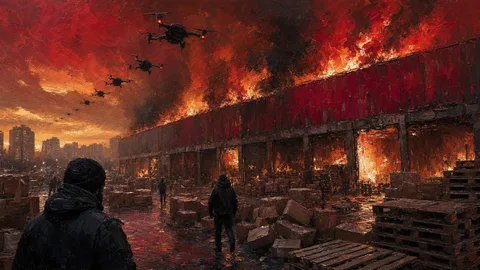
This is not a spectacular defeat with tanks rolling in and flags snapping in the wind. It is a slow, methodical, almost invisible erosion — Russian soldiers infiltrating basements, occupying abandoned houses, advancing a few meters each night. Then, in early June 2026, the 19th Army Corps had to admit what everyone feared: more than one hundred Russian soldiers were already inside the city.
The Donbas as the final chessboard
To understand the significance of Kostiantynivka, you have to understand the geography of the free Donbas. A single road connects the major cities: Sloviansk, Kramatorsk, Druzhkivka, Kostiantynivka. This corridor is the spine of Ukrainian defense in the east. Cut it and you cut supplies, rotations, evacuations. You cut life itself.
That is exactly what Moscow is trying to do. Not through dramatic breakthroughs — but through infiltrations, partial encirclements, and drone saturation. The Russian elite unit Rubicon, deployed in this sector since April 2025, has turned every Ukrainian vehicle into a target. Since winter, almost no truck can enter or leave Kostiantynivka without risking destruction.
The 156th Brigade and Ukraine's Achilles Heel
Fresh units thrown into a seasoned hell
At the heart of this setback lies a brutal military fact: the 156th Mechanized Brigade, a recently formed unit, was positioned in a sector that the Russians had precisely targeted for its relative lack of experience. Russian infiltration teams exploited the wide gaps between Ukrainian positions, slipping through vulnerabilities that more seasoned soldiers might have covered more effectively.
This is not a criticism of the 156th's soldiers. They were handed an impossible mission in impossible conditions. It is a criticism of the system: deploying fresh brigades into sectors where enemy pressure is at its maximum, in a city already logistically encircled before being militarily encircled. The 19th Army Corps, charged with defending the city, was forced to acknowledge in June that the situation had slipped beyond the control implied by official communiqués.
The gap between the official line and reality
This is one of the most disturbing truths of this war: what Ukrainian generals say and what soldiers report from the ground are two different things. Euromaidanpress documented this directly: the city was not encircled, officially. But soldiers described a situation significantly more complex than command would acknowledge. Vehicle rotations had become impossible. Evacuation of the wounded had become impossible. Even the heavy bombardment drones used to resupply frontline infantry were being increasingly intercepted by Rubicon teams.
Journalist Francis Farrell of the Kyiv Independent, in May 2026, made a ten-kilometer walk from Druzhkivka almost to the outskirts of Kostiantynivka. What he saw was unambiguous: the fortress had already been breached, long before the generals acknowledged it publicly.
Rubicon: The Unit That Killed the Logistics
Fiber-optic drones that change everything
The deployment of Russian elite unit Rubicon in the Kostiantynivka sector in April 2025 marked a turning point. That same month, the first fiber-optic-guided FPV drones began flying over the city. These drones cannot be jammed — they transmit no radio signal; they follow an invisible physical wire. Every Ukrainian truck, every SUV, every supply convoy became a potential target.
Within months, the effects were devastating. The OKKO gas station at the city entrance — a meeting point for soldiers, volunteers, and journalists — was destroyed. Supply convoys dwindled. Then uncrewed ground vehicles (UGVs) began to be intercepted too. The city was still held by Ukraine on the maps. In reality, it was already dying of logistical thirst.
Saturation as a war doctrine
What Rubicon represents is a Russian doctrine refined through two years of failure: stop seeking costly frontal breakthroughs, instead saturate the enemy's airspace until all logistics become impossible. It is attrition warfare applied to flows — fuel, ammunition, medicine, rotations. You don't take the city. You suffocate it. You wait until the defenders have nothing left to eat, no ammunition, no resupply drones. And then, almost without a fight, infiltrations become occupations.
Faced with this doctrine, Ukraine developed its own anti-drone drones, increasingly effective in open terrain. But in urban zones, where buildings provide cover and firing positions are multiple, the effectiveness of Ukrainian countermeasures is reduced. Kostiantynivka paid that price.
The Comparison With Pokrovsk: A Pattern Repeating
Fifty soldiers, then a hundred, then the city
The story of Pokrovsk is a predictive mirror of what is happening at Kostiantynivka. In summer 2025, about fifty Russian soldiers first infiltrated Pokrovsk. The breach could still have been plugged. It was not. When the infiltrators exceeded a hundred, the dynamic changed. The city was progressively overwhelmed, building by building, basement by basement, until Ukrainian withdrawal became inevitable.
At Kostiantynivka, in early June 2026, more than one hundred Russian soldiers were already inside the urban area according to the 19th Army Corps. The critical threshold — beyond which retaking the city would require a disproportionate effort — had been crossed. DeepState, the open-source mapping group, had documented large-scale infiltration of the eastern half of the city. The pattern is there, complete.
Withdrawals under saturated drone skies
The most likely scenario for Kostiantynivka is not a full classical encirclement. It is what the Kyiv Independent analysis describes as difficult and dangerous withdrawals across contested terrain under drone-saturated skies — exactly as happened at Pokrovsk and Myrnohrad six months earlier. The 7th Air Assault Corps and other Ukrainian elite units held the flank at Pokrovsk, but at considerable cost of exhaustion.
At Kostiantynivka, the same logic applies. Ukraine will have to choose between losing soldiers trying to hold a city already compromised, or making costly withdrawals that cede ground but preserve forces for the defense of Druzhkivka, Sloviansk, and Kramatorsk — the next fortresses on the road.
Lyman Holds: The Same Strategy Fails in the North
Flags planted, not positions held
If Kostiantynivka illustrates the failure of Ukrainian defenses in the south of the axis, Lyman — to the north, fifteen kilometers from Sloviansk — tells a different story. The Russians tried the same infiltration tactic. Small teams planted Russian flags in certain neighborhoods to create the impression of control. But according to cartographer Clément Molin, these "Potemkin flag" operations never corresponded to actual occupation.
AMK Mapping confirmed it: "Russia never consolidated these positions." Ukrainian counter-attacks north of Lyman continued to reduce the Russian salient. In June 2026, Lyman holds. And according to Euromaidanpress analysis, battlefield conditions have shifted in ways that come too late to save Kostiantynivka, but that might still save Lyman.
Ukrainian drones changing the equation
The difference between Lyman and Kostiantynivka is timing. Through spring 2026, Ukraine radically intensified its drone strikes across the entire Russian logistics zone up to 200 kilometers behind the front line. AI-assisted fixed-wing drones and long-range-wing FPV drones hammered Russian supply lines with increasing intensity. The rate of Russian territorial gains fell to just 30 square kilometers in June 2026 — approximately 10% of June 2025 gains.
This shift comes too late for Kostiantynivka, whose defenses had already been logistically bled by Rubicon well before Ukraine's drone counter-offensive ramped up. But for Lyman, for Druzhkivka, for the entire northern defense line, this new capability could change the game. The question is: can Ukraine scale up fast enough to stop the Russian steamroller before it reaches Sloviansk?
The Fortress Belt: Druzhkivka in the Crosshairs
A dangerous urban continuity
The region's topography is merciless for Ukrainian defense. Druzhkivka and Kostiantynivka are connected by a near-continuous residential zone. They share the same valley. They are flanked by the same strategic heights that overlook and command both cities. For Russian forces, once Kostiantynivka is sufficiently controlled, the slide toward Druzhkivka will not be a question of whether, but when.
Druzhkivka is a smaller city, but its value is symbolic as much as strategic: it is the last step before Kramatorsk. If Druzhkivka falls, the Russians find themselves pointing toward the heart of the free Ukrainian Donetsk held since 2014. The scenario of Sloviansk encircled from the south, with supply routes cut from both sides, suddenly becomes very concrete.
Long-prepared defenses
It would be inaccurate to present Sloviansk and Kramatorsk as cities without defenses. Ukraine has been preparing them for years. Fortifications have been built, defensive lines planned, stockpiles assembled. The Azov Brigade, an elite unit that had been redeployed westward to counter the Russian offensive on Dobropillia, may potentially need to be brought back east if pressure on the Kostiantynivka-Druzhkivka axis intensifies.
But preparation does not compensate for the lack of manpower. That is the brutal reality that any honest analysis must acknowledge: Ukraine faces an acute manpower crisis. The world's best fortifications serve no purpose without the soldiers to hold them. And every city lost in the Donbas brings the front line closer to the agglomerations that Kyiv considers absolute red lines.
The Manpower Crisis: The Invisible Enemy
On the same topic

ANALYSIS : Taiwan Puts NT$1,122.5 Billion Into Defence, Over…
Hold that number for a moment, because it marks the crossing…

DOSSIER: 60,000 Russian passports in Transnistria — the annexation…
More than sixty thousand applications for Russian citizenship in three months,…
ANALYSIS: 800 drones over Russia in one night —…
More than eight hundred drones, in a single night, August 14…
The real threat behind Russian breakthroughs
The Russian breakthrough at Kostiantynivka is not the product of overwhelming tactical superiority from Moscow. It is largely the product of a Ukrainian manpower crisis that left entire front sectors defended by understrength brigades. Russian infiltration teams did not force solidly held lines — they found empty spaces. Wide gaps between positions that more numerous brigades could have filled.
This reality is documented with cold precision in the Kyiv Independent analysis: Russian infiltration groups advanced through the 156th Mechanized Brigade's sector, exploiting insufficient troop density. In winter, they settled into basements of Ukrainian houses. Initially, Ukrainian drone teams spotted and neutralized them quickly. But the pressure accumulated across seasons until it exceeded the capacity to respond.
An impossible demographic equation
Ukraine is defending thousands of kilometers of front with a population that has already sustained considerable human losses and a massive exodus to Europe. Mobilization is difficult, politically and humanly. Zelensky's government is trying to balance the military imperative with the need to maintain a functioning economy and popular support. It is an equation with no good answer.
What the fall of Kostiantynivka illustrates is the limit of that equation. Even the technological ingenuity of Ukrainian drones, even the excellence of elite units like the Unmanned Systems Forces, cannot indefinitely compensate for a structural numerical disadvantage. Ukraine needs partners who understand this — and who act accordingly.
Russia's Infiltration Doctrine: A Lesson for NATO
The art of war without a defined front
What Russia has perfected at Kostiantynivka represents a major doctrinal evolution that NATO planners must study carefully. Abandon costly frontal assaults. Use small mobile teams to infiltrate urban areas. Cut logistics routes with saturation drones. Then let time do the rest. This doctrine — which might be called war by strangulation — is devastatingly effective against undermanned defenders in dense urban environments.
The redeployment of the Azov Brigade westward to counter the offensive on Dobropillia also illustrates another aspect of this doctrine: creating multiple simultaneous pressures on different axes to force the adversary to disperse. Moscow is not seeking to break through on a single axis. It seeks to stretch Ukrainian defenses to the breaking point across several axes simultaneously.
Implications for European defense
For NATO countries, particularly the Baltic states and Poland, observing the Battle of Kostiantynivka is not an academic exercise. It is a live demonstration of what modern hybrid warfare looks like. The lessons are clear: defender density matters, logistics is the primary target, and drone innovation must precede, not follow, the battle.
Alliance members who thought Ukraine's war afforded them a luxury of observation without direct implication are mistaken. Every kilometer of Ukrainian territory lost is a scenario test that NATO general staffs would have preferred never to see played out in real time, with cities and civilians as the stakes.
The Cost Russia Must Pay
Territorial gains decelerating
It would be unfair to present the situation as a generalized Ukrainian collapse. The overall figures tell a different story: in June 2026, Russia captured just 30 square kilometers of territory — approximately 10% of what it had taken in June 2025. Ukrainian drone saturation is working. Strikes on fuel depots, logistics bridges, supply convoys — all of this bleeds the Russian army before it even reaches the contact line.
The battle of Kostiantynivka is therefore an exception in a broader picture of Russian stagnation. That is precisely why it is so troubling — not because it announces a wave, but because it shows that even a weakened Russian army can capitalize on Ukraine's structural vulnerabilities when local conditions favor it.
Can Russia afford Sloviansk?
The Kyiv Independent analysis poses the central question: if Russia manages to take Druzhkivka, then attempts to go after Sloviansk and Kramatorsk, the cost in ammunition, equipment, and above all manpower will be considerable. These two cities are far larger than Kostiantynivka. Their defenses have been prepared for years. A major Russian offensive in that direction could turn into a bloodbath for Moscow.
That is where Ukraine's strategic hope lies: every costly city to take is another bleeding of the Russian army. Resistance is not just about territorial defense — it is an actuarial calculation. How long can Putin afford to pay the human and material price of advancing in the Donbas? The answer to that question will determine the war's outcome.
Zelensky and the Political Weight of Retreat
The red line that cannot be named
For the Zelensky government, every retreat in the Donbas is a delicate exercise in political communication. The Ukrainian population knows the war is hard — it lives it every day. But there is a psychological difference between "we are holding the line" and "we have abandoned another city." Kostiantynivka is not just any city. It is a symbol of resistance since 2014.
Ukrainian leadership must navigate two contradictory necessities: being honest about the military situation to maintain public trust, and avoiding creating a perception of rout that would weaken morale and national cohesion. So far, Zelensky has maintained this tension with remarkable skill. But every new setback makes it harder to hold.
The message sent to the West
The progressive fall of Kostiantynivka also sends a message to Washington, Berlin, and Brussels: delays in weapons deliveries, political hesitations, conditions placed on military aid have real consequences on the ground. Every time the West hesitates, a Ukrainian city pays the price. This is not rhetoric. It is a brutal arithmetic documented week after week on conflict maps.
Ukraine is not asking the West to fight in its place. It is asking for the tools to defend itself. Additional air defense systems, ammunition for artillery, support for mobilization and training. Requests that have been on the table for months, and that always arrive too slowly, too partially.
The Memory of 2014 as an Engine of Resistance
A city defending more than territory
Kostiantynivka is not just a position on a map. Since 2014, this city has symbolized a choice: remaining Ukrainian under pressure. The residents who did not flee carry twelve years of war within them. The soldiers who fought there and came back, or who did not come back, shaped the identity of this resistance. Losing Kostiantynivka means losing part of that collective memory.
That is why Ukrainian leadership, the military, and the population view ceding the rest of Donetsk Oblast in exchange for a peace promise from Moscow as strategically unacceptable. Not from stubbornness. From an understanding of what it means to leave Putin the ability to repeat this strangulation strategy ten years from now, from positions even further advanced.
Resistance as strategic investment
There is a cold logic behind Ukrainian resistance that Western cost-benefit calculations often miss. Every additional month of resistance costs Russia irreplaceable resources. Soldiers killed that Russian demographics cannot replace. Tanks destroyed that factories, under sanctions, struggle to rebuild. Artillery rounds fired that drain stockpiles. Billions of dollars burned in a war that Russia's economy — already under tension that Putin himself has admitted — bears with increasing difficulty.
The defense of Sloviansk and Kramatorsk is not just a matter of national sentiment. It is a strategy of exhausting the adversary. The slower Russia advances, the more it bleeds. And the question is not whether it can take these cities — given enough time and resources, perhaps it can. The question is: at what cost? And can Putin afford to pay it?
The Stakes for the Next Combat Season
Summer 2026 as a pivotal moment
The Kyiv Independent analysis is unambiguous: if Ukraine cannot rapidly plug the gap at Kostiantynivka, the city's fate is probably already decided — its collapse will play out through the rest of summer and perhaps into early fall. The window to reverse the situation is narrow. Reinforcements, if they come, must come now — not in two months.
Summer is traditionally a period of intense front activity. Weather conditions favor movement, supply lines are more fluid, and both sides seek to consolidate gains before the muddy autumn slows everything down. If Russia wants to push toward Druzhkivka before the rains arrive, now is when it will apply pressure.
The technological race against the clock
Discover

INVESTIGATION: Beijing cuts Africa to 2.1 billion in loans…
2.1 billion — the lowest figure in almost twenty years, according…

SPECIAL REPORT: Beijing Promises Stimulus as Its Households Give…
That is the growth rate of Chinese industrial output in July,…

INVESTIGATION: Two Chinese Ex-Soldiers Arrested in Seoul as 18,000…
For five years, a man ran a military-supply shop at the…
Paradoxically, summer 2026 is also the moment when Ukrainian drone capabilities are reaching their peak. Strikes on Russian refineries, fuel depots, logistics bridges are multiplying. If these strikes succeed in weakening Russian convoys enough before they reach the Kostiantynivka sector, they could slow the advance sufficiently for Ukraine to stabilize its defense elsewhere.
It is a race: Russia's strangulation doctrine versus Ukrainian drone innovation. Kostiantynivka may be a battle already lost. But Lyman holds. And if Ukraine manages to consolidate its deep-strike capabilities before Russia reaches Druzhkivka, the next fortress could be an entirely different story.
What Kostiantynivka Says About Us
The test of our commitment
The battle of Kostiantynivka is a test — not just for Ukraine, but for the West as a whole. Every time a Ukrainian city falls for want of resources, soldiers, logistical support, it poses an uncomfortable question to the democracies that proclaimed their solidarity: do our actions match our words?
Cold military analysis says that Kostiantynivka could have been defended longer with more troops, better logistics, more effective anti-drone systems deployed earlier. These elements were not lacking because Ukraine did not want them. They were lacking because international aid flows were insufficient, discontinuous, conditional. That cannot continue.
Solidarity as strategy
Supporting Ukraine is not charity. It is strategy. Every euro spent helping Ukraine hold is a euro that saves NATO from having to defend the Baltic states, Poland, Finland against a Russia emboldened by its Ukrainian successes. It is collective insurance logic — and like all insurance, it is far cheaper before the disaster than after.
The cities of the Donbas are falling one after another. Kostiantynivka follows Pokrovsk, as Pokrovsk followed Avdiivka. The pattern is there. The question is whether Western capitals will finally change their calculus — or wait until the next analysis report talks about Kramatorsk rather than Kostiantynivka.
Conclusion: The Price of Institutional Silence
An announced defeat that was not prevented
The Russian breakthrough at Kostiantynivka did not fall from the sky. It had been announced for months — by soldiers on the ground, by open-source cartographers, by journalists walking to the city's outskirts. The problem was not a lack of information. The problem was the gap between available information and the capacity to respond — in manpower, equipment, and decision speed.
Ukraine is paying today for a winter when its logistics lines were systematically destroyed by Rubicon, a spring when Russian infiltrations were underestimated in official communiqués, and a spring 2026 when drone innovations arrived too late for this particular battle. These are lessons that neither Ukraine nor its partners can afford not to retain going forward.
What is now at stake for Druzhkivka and beyond
The next step — Druzhkivka, Sloviansk, Kramatorsk — will be different. Defenses there are more prepared. The lessons of Kostiantynivka, if absorbed quickly, could change the dynamics. Ukraine has shown remarkable capacity for adaptation throughout this war. It has always found innovative solutions to each new Russian tactic. The battle of the Donbas is not over. It is entering its most critical — and most decisive — phase.
A Final Word: The Fortress Is Not Lost — It Is Moving
Kostiantynivka was not the final line
Fatalism must be rejected. Kostiantynivka falling does not mean the free Donbas is lost. It means the defensive line is shifting. That the fortress is being rebuilt elsewhere — at Druzhkivka, at Sloviansk, at Kramatorsk. Cities where defenses have been prepared with the lessons of each previous battle. Cities where Ukraine now knows exactly how Russia operates, and can anticipate rather than react.
Ukraine's war is a war of continuous learning. Every tactical defeat is converted into improved defensive doctrine. Every Russian innovation triggers a Ukrainian counter-innovation. The problem is not Ukraine's capacity for adaptation. It is the speed of that adaptation against a Russia that, despite its structural weaknesses, is still advancing. And speed depends on the resources the West chooses to provide.
History will judge
Zelensky has said it in different ways since the beginning: Ukraine is fighting for itself, but also for a principle — that borders cannot be changed by force, that sovereign states have the right to exist without being devoured by their neighbors. Kostiantynivka is one more city paying that price. It will not be the last. But history will judge — with precision and without complacency — who did what to stop this hemorrhage, and who looked away telling themselves it would work out fine.
The Donbas fortress has not fallen. It has shifted. And those who think this shift is without consequence have not looked at the maps long enough.
By Maxime Marquette, columnist
Columnist's transparency note
Editorial position and limitations
This essay is based exclusively on open journalistic and analytical sources — the Kyiv Independent, Euromaidanpress, and DeepState. I have no direct military contacts on the ground and claim no privileged information. All analysis of the tactical situation is based on published reports and open-source mapping. I am pro-Ukraine and anti-Russian aggression — this editorial position is assumed and transparent.
What I do not know
I do not know the exact plans of the Ukrainian command for the defense of Druzhkivka or Sloviansk. I do not know whether additional reinforcements have been deployed since these sources were written. The situation on the ground evolves rapidly — readers should consult the sources directly and continuously for an up-to-date picture. This essay reflects the documented state of the situation as of late June 2026.
Sources
Primary sources
Secondary sources
Get the geopolitics analyses
Conflicts, powers, alliances: the MadMax thread without the noise.
Cite this article
Maxime Marquette (2026). ESSAY: Kostiantynivka Falls — and With It, the Myth of the Impregnable Donbas Fortress. MadMax. https://mad-max.co/en/article/essai-kostiantynivka-tombe-et-avec-elle-le-mythe-de-la-forteresse-imprenable-du-
Read next
INVESTIGATION: Beijing cuts Africa to 2.1 billion in loans…
2.1 billion — the lowest figure in almost twenty years, according…
SPECIAL REPORT: Beijing Promises Stimulus as Its Households Give…
That is the growth rate of Chinese industrial output in July,…
INVESTIGATION: Two Chinese Ex-Soldiers Arrested in Seoul as 18,000…
For five years, a man ran a military-supply shop at the…
Enjoyed this piece? Get the next one.
One chronicle a week, straight to your inbox. No noise.
This article was generated with AI assistance, under human supervision.
Comments
Be the first to weigh in.