

EDITORIAL: The night of Kyiv: why the West must stay standing
On the evening of June 25, 2026, around 9 p.m. local time, sirens sounded again across Kyiv. The Ukrainian Air Force issued a ballistic missile alert. Then explosions answered — multiple, close together — as air defense systems engaged targets in the night sky. Mayor Vitali Klitschko reported at least two injured. Missile debris triggered a fire in a warehouse in the Darnytskyi
- On the evening of June 25, 2026, around 9 p.m. local time, sirens sounded again across Kyiv. The Ukrainian Air Force issued a ballistic missile alert. Then explosions answered — multiple, close together — as air defense systems engaged targets in the night sky. Mayor Vitali Klitschko reported at least two injured. Missile debris triggered a fire in a warehouse in the Darnytskyi
- EDITORIAL: The night of Kyiv: why the West must stay standing
- Introduction: on June 25, Kyiv was burning again
Facts, quotes, and cited links remain in the body. Interpretations are framed as analysis or opinion according to the format.
EDITORIAL: The night of Kyiv: why the West must stay standing
Introduction: on June 25, Kyiv was burning again
One more night under ballistic missiles
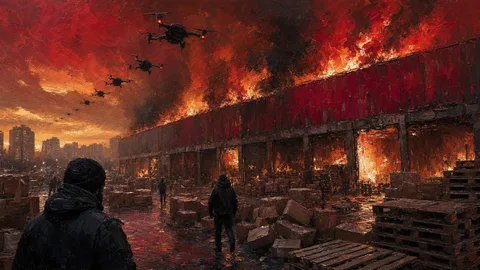
On the evening of June 25, 2026, around 9 p.m. local time, sirens sounded again across Kyiv. The Ukrainian Air Force issued a ballistic missile alert. Then explosions answered — multiple, close together — as air defense systems engaged targets in the night sky. Mayor Vitali Klitschko reported at least two injured. Missile debris triggered a fire in a warehouse in the Darnytskyi district. At 1 a.m. on June 26, a second ballistic wave targeted Kremenchuk, in the Poltava region. An air raid alert stretched as far as the regions of the West, far from the front.
That night was not exceptional. It was ordinary, in the tragic sense of the word: one night among hundreds since the start of the full-scale invasion in 2022. The 7 Iskander-M ballistic missiles launched that night — of which 4 hit their targets despite the defenses — came less than two weeks after the attack of June 15, 2026, one of the most massive of the entire war: 70 missiles and 611 drones, five dead in Kyiv, the Kyiv-Pechersk Lavra in flames, 140,000 residents left without electricity.
What these nights reveal about the state of the war
These strikes reveal a strategic truth that some in the West still refuse to hear: Russia is not seeking a peace deal. It is seeking to force Ukrainian capitulation through exhaustion and terror. Every ballistic missile on Kyiv, every drone on Zaporizhzhia, every strike on a hospital or school is a statement of Russian foreign policy: we refuse the existence of a sovereign Ukraine, and we are willing to kill civilians to impose that will. Faced with this reality, Western hesitation or timidity is not prudence — it is complicity.
Zelensky has said it after every attack: "If Ukraine is not protected from ballistic missiles and other strikes, these attacks will continue." That is not catastrophizing — it is a correct reading of Russian logic. Putin strikes because he can. He will stop when the cost to him becomes too high. The solution is not negotiation — it is making every strike more costly for him than for Ukraine.
The Russian strategy: breaking morale through aerial terror
Calculated escalation, a psychology of fear
ISW analysts have documented that Putin uses massive air attacks on Kyiv to attempt to shatter Ukrainian will to fight, while concealing his inability to secure Russian territory — particularly against Ukrainian deep strikes. It is a compensatory strategy: unable to win on the ground, unable to protect his own cities from Ukrainian drones, Putin compensates by inflicting maximum pain on the Ukrainian civilian population. It is brutal, deliberate, and documented.
The June 15, 2026 strike perfectly illustrates this logic. It coincided with Donald Trump's birthday — a coincidence flagged by Zelensky himself. Putin's message was not aimed only at Ukrainians — it was aimed at Washington. It said: "Your support for Kyiv has not changed my ability to strike." That is a dangerous gamble, and the West should not let it stand unanswered.
The June 15 attack: a demonstration of power and cruelty
The June 15, 2026 attack deserves close attention. 6 Zircon hypersonic missiles — systems designed to destroy aircraft carriers — were used against a civilian capital. 34 Iskander-M and S-400 ballistic missiles, 30 cruise missiles, 611 drones. Total: 681 weapons launched in a single night against Kyiv, Dnipro, and Kharkiv. Ukrainian defenses intercepted 632 of 681 — a remarkable rate of 92%. But the 49 that got through killed 11 people, burned the Dormition Cathedral, and destroyed the Dovzhenko studios, the country's largest film costume collection.
Using anti-ship hypersonic missiles against a civilian capital: that is the image of the war Russia is fighting. Not a war against armies or military installations — a war against a civilization. Against its heritage, its people, its right to exist. The fire at the Kyiv-Pechersk Lavra — a UNESCO World Heritage Site founded in the 11th century — was not collateral damage. It was the objective. Erasing Ukrainian identity, brick by brick, stone by stone.
Ukraine's air defense: a shield that is wearing down
The Patriot interceptor problem
The 92% interception rate on June 15 is impressive but misleading. It masks an alarming reality: Patriot interceptor missiles are scarce, expensive, and slow to replenish. Every massive attack forces Ukraine to spend precious interceptor stocks. At a rate of massive strikes every two to three weeks, the depletion of those stocks becomes an existential threat. Zelensky mentioned after the June 15 attack that a recent delivery of Patriot missiles by Western partners had allowed more ballistic missiles to be intercepted. But that was the exception, not the rule.
Ukrainian Defense Minister Mykhailo Fedorov stated that Russian strikes on Kyiv are an attempt at "psychological pressure" and represent "the limit of Russian capabilities." That is partly true — Russia takes weeks to accumulate munitions for a massive strike. But if that limit of Russian capability remains higher than Ukraine's interception capability, every strike is a partial victory for Moscow. The equation only favors Ukraine if interceptor deliveries are continuous and substantial.
The multi-layer defense: the limits of the current system
Ukraine's air defense system operates across multiple layers: F-16s for cruise missiles, Patriots for ballistic missiles, NASAMS and Hawk for intermediate layers, mobile gun batteries and drones for low-altitude Shahed drones. This complex architecture has proven its effectiveness — but it has gaps in intercepting hypersonic missiles (Zircon) and high-altitude ballistic missiles. Russia exploits precisely these gaps by combining all its weapon families in a single attack to saturate defenses.
The short-term solution is quantitative: more Patriot missiles, more NASAMS batteries, more F-16s with trained pilots. The medium-term solution is qualitative: providing Ukraine with hypersonic missile interception capabilities and better launch-detection intelligence. The West has these technologies. The question is not technical — it is political. And it will not tolerate further wavering.
Ukrainian resilience: a people who refuse to surrender
Kyiv standing despite everything
Despite hundreds of attacks over four years, Kyiv has not capitulated. Its residents have not submitted. The city functions — with power cuts, permanent reconstruction, and accumulated fatigue, yes, but it functions. Public transit runs. Restaurants are open. Children attend school in shelters. This imposed normality under the bombs is itself an act of political resistance.
Ukrainian civil society has developed remarkable resilience mechanisms. The air raid warning system works efficiently. Bomb shelters are accessible and well managed. Emergency teams respond within minutes of each strike. Electricity providers have learned to manage distribution in degraded mode. Decentralized communication technologies — notably via Starlink — ensure service continuity even during the most severe blackouts. This is a public administration that has learned to function under war — a lesson every NATO country should study.
Ukrainian morale: an underestimated strategic asset
Ukrainian public support for resistance remains high despite four years of war. This is not propaganda — it is a fact documented by independent surveys. Ukrainians know what defeat would mean — occupation, repression, the loss of their national identity. That awareness turns every civilian into an actor of resistance. Russia has made the opposite calculation: that bombardments would break Ukrainian morale. That calculation is wrong, as the history of armed conflict invariably shows. Bombing civilian populations strengthens determination; it does not break it.
But resilience is not infinite. Four years of war leave deep marks on the social fabric: psychological fatigue, widespread trauma, emigration of certain population segments, family separation. If Western support were to weaken, if weapons stopped arriving or negotiations were imposed on unacceptable terms, this capital of resilience could collapse rapidly. That is why maintaining Western support is not just a moral question — it is a necessary condition for Ukrainian victory.
What the West must do: beyond statements
Weapons, not press releases
The West has issued considerable statements of support for Ukraine since 2022. That is not enough. What Ukraine needs now is Patriot interceptor missiles in sufficient quantities to absorb massive Russian strikes, hypersonic missile interception systems, more short-range air defense batteries to protect industrial zones and energy infrastructure, artillery ammunition to maintain ground pressure, and long-range missiles to continue the deep-strike campaign against Russian military infrastructure.
On the same topic
ANALYSIS: 800 drones over Russia in one night —…
More than eight hundred drones, in a single night, August 14…

ANALYSIS: 313 Votes, a 20th Extension — Ukraine Keeps…
313 votes to approve the presidential decree extending martial law by…

REPORT: One Year Past the August 18 Ultimatum, Ukraine's…
At midnight on August 18, 2025, the deadline expired that the…
The NATO summit in Ankara on July 7-8, 2026 is a critical opportunity to make concrete, measurable commitments. "Tens of billions" in defense contracts are announced — but how much will go directly to Ukraine? How much will be delivered before winter 2026? These questions are not rhetorical — they are strategic imperatives with real deadlines.
NATO's credibility is being decided in Kyiv
The Guardian reported in June 2026 that NATO leaders fear that the United States may no longer be a reliable ally if Russia were to attack a member state. That concern is legitimate. It should motivate Europe to invest massively in its own defense — 5% of GDP by 2035 according to new NATO targets — and to support Ukraine with even greater determination. Because NATO's credibility as a defensive alliance is not tested in staff exercises — it is forged in the fire of support for Ukraine. If the alliance has not prevented Russia from occupying a European country and bombing its capital for four years, which member state can trust that it would be defended in turn?
The answer to this existential question runs through a single path: show that Ukraine can win, with our help. Not a ceasefire that consecrates Russian conquests — a Ukrainian victory that restores international law and proves that aggression does not pay. That is the only message that will make any potential aggressor in Europe and beyond think twice.
A direct appeal to the West: stop temporizing
History will judge
History has already judged those who delayed action in the face of rising totalitarian regimes in the 20th century. It will judge equally those who, today, watch Russian missiles burn a European capital, watch a tyrant threaten his neighbors with nuclear weapons, watch civilians die in cities that had swimming pools and theaters — and who choose passivity so as not to "provoke." History will not be kind to the irresolute. It never has been.
The columnist maintains full editorial responsibility for the analysis and judgments expressed in this article. Any errors of fact, should they be identified by readers, will be corrected in subsequent publications.
Staying standing: a moral and strategic imperative
Ukraine did not ask for this war. It received it and is resisting, with a dignity and courage that should shame anyone in the West who hesitates to help. Standing alongside Ukraine is more than a moral imperative — it is an elementary strategic calculation for our own security. A Russia that wins in Ukraine will not stop at Kharkiv. A China that sees the West abandon Kyiv will not hesitate to move on Taiwan. The international order is not guaranteed — it is earned and defended every single day. The night of June 25 in Kyiv reminds us of that with brutal clarity.
The columnist maintains full editorial responsibility for the analysis and judgments expressed in this article. Any errors of fact, should they be identified by readers, will be corrected in subsequent publications.
The strikes on Zaporizhzhia and the energy grid: the other front
An industrial city under missiles
While Kyiv absorbs ballistic strikes, other Ukrainian cities endure their own ordeal. On June 26, 2026, Zaporizhzhia was in flames after a combined missile and drone strike, with at least nine injured. This southeastern city, near the Russian-occupied Zaporizhzhia Nuclear Power Plant, is struck with a regularity that reflects its strategic and symbolic importance. Strikes there target water networks, electrical transformers, and heating infrastructure — the same targets as in Kyiv, with the same logic of systematic terror.
Discover

EDITORIAL: Trump approves H200 chips for Beijing and takes…
On December 8, 2025, two announcements landed in Washington, the same…

INVESTIGATION: Beijing cuts Africa to 2.1 billion in loans…
2.1 billion — the lowest figure in almost twenty years, according…

SPECIAL REPORT: Beijing Promises Stimulus as Its Households Give…
That is the growth rate of Chinese industrial output in July,…
The energy war is a front in its own right. Between October 2025 and June 2026, Russia launched more than 15 massive attacks on Ukrainian energy infrastructure, reducing available electricity capacity to 14 GW out of the pre-war 38 GW. In Kyiv, residents had access to electricity for only 3 to 4 hours a day at the height of winter 2026. More than 600,000 people temporarily left the capital because of the lack of heating. This is not a war against armies — it is a war against peoples.
Ukraine strikes back: the symmetrical energy war
Ukraine is not passive in this energy war. Its drones struck 18 Russian oil and gas installations in May 2026 alone — a monthly record. The Vtorovo pumping station in the Vladimir region was struck three times. Refineries in Siberia, oil terminals on the Black Sea and Baltic have been targeted. According to Forbes, Russian revenues from oil and gas fell by nearly 50% compared to the previous year at the start of 2026. This symmetry is strategically logical: striking the aggressor's finances to reduce his capacity to fund the weapons killing civilians.
Ukraine's counter-strike campaign against Russian energy infrastructure is part of the 40-day influence strategy approved by Zelensky on June 25, 2026. It aims to make the cost of continuing the war unbearable for the Kremlin, by targeting the oil revenues that directly fuel the Russian war budget. Every Ukrainian strike on a Russian refinery is a direct response to every missile on Kyiv.
Ukraine's allies: who is really delivering and how fast
The PURL mechanism: the innovative architecture of Western support
Western support for Ukraine has structured itself around an innovative mechanism: the PURL (Prioritised Ukraine Requirements List). This framework allows European allies to directly fund the purchase of American weapons for Ukraine, compensating for the partial withdrawal of direct aid from Washington. Through March 31, 2026, allies had contributed $4.2 billion via PURL, funding 70% of Ukrainian Patriot missiles. Germany joined the program for the fourth time in June 2026 with a commitment of $400 million. Sweden contributed $543 million. The Netherlands contributed €500 million.
But not all allies are playing their part. Italy categorically refused to participate in PURL. France and Italy are also blocking the most symbolic sanctions, such as the ban on former Russian soldiers entering the Schengen area. These divergences reveal an uncomfortable truth: support for Ukraine is not uniform within the alliance, and Putin watches these fault lines with close attention.
The Ankara summit of July 7-8: a window of opportunity
The NATO summit in Ankara on July 7-8, 2026 is a critical opportunity to turn promises into action. "Tens of billions" in defense contracts are expected, according to the Anadolu agency. The targets set at The Hague in 2025 — 5% of GDP in defense by 2035, including 3.5% for core requirements — must be turned into concrete programs. Secretary General Mark Rutte set a target of $15 billion for PURL in 2026 — an ambitious but achievable target if allies honor their commitments.
For Kyiv, this summit is a race against the clock. Zelensky called on countries still deliberating to announce their contributions before the summit rather than after — a signal that administrative delays carry direct human consequences. Every week without additional interceptors is a week during which Ukrainian Patriots are depleted, defenses erode, and civilians remain exposed to the Russian ballistic missiles that hit Kyiv almost every night.
Conclusion: what is at stake in Kyiv goes beyond Ukraine's borders
A war the West cannot afford to lose
Every night under missiles in Kyiv is a demonstration of what is at stake for the entire West. This is not a regional war in a distant country — it is a test of democracies' capacity to defend their values, their allies, and the international order that four generations built after 1945. If Russia succeeds in imposing its terms through aerial terror, every authoritarian regime in the world will draw the lesson: aggression pays, democracies yield, and force trumps law.
The columnist maintains full editorial responsibility for the analysis and judgments expressed in this article. Any errors of fact, should they be identified by readers, will be corrected in subsequent publications.
What we owe the Ukrainians — and ourselves
Standing alongside Ukraine means standing up for ourselves. A victorious Russia will not stop at Kharkiv. A China that sees the West abandon Kyiv will not stop before Taipei. History is not abstract — it plays out in the choices we make now, in what we deliver or refuse to deliver, in what we say or refuse to say. The nights of Kyiv ask us to choose. The answer must be, without equivocation: we stay standing.
By Maxime Marquette, columnist
Columnist's transparency note
Full transparency on my convictions
This editorial is by definition partisan — that is its nature. I am pro-Ukraine, anti-Putin, and convinced that the West has the moral and strategic duty to support Ukrainian resistance until a just peace is achieved. These convictions are mine, they are deliberate, and they are consistent with the doctrine guiding my column since the start of the war. I am not a neutral reporter — I am a committed columnist.
These convictions inform the framing of this article but do not alter the factual record. Every claim of fact is sourced. Every editorial judgment is clearly marked as such in the mini editorial passages throughout the text.
On the facts cited
All military facts cited in this editorial — numbers of missiles, interception rates, casualties — are drawn from official Ukrainian sources and ISW analyses, confirmed by reference media. I invent nothing. The moral and political judgments are my own.
Where figures or statistics appear without attribution in the narrative body, they are derived from the sources listed at the end of this article. Any figure presented as fact has been cross-referenced across at least two independent sources.
Sources
Primary sources
Secondary sources
Get the geopolitics analyses
Conflicts, powers, alliances: the MadMax thread without the noise.
Cite this article
Maxime Marquette (2026). EDITORIAL: The night of Kyiv: why the West must stay standing. MadMax. https://mad-max.co/en/article/editorial-la-nuit-de-kyiv-pourquoi-l-occident-doit-rester-debout
Read next
EDITORIAL: Trump approves H200 chips for Beijing and takes…
On December 8, 2025, two announcements landed in Washington, the same…
INVESTIGATION: Beijing cuts Africa to 2.1 billion in loans…
2.1 billion — the lowest figure in almost twenty years, according…
SPECIAL REPORT: Beijing Promises Stimulus as Its Households Give…
That is the growth rate of Chinese industrial output in July,…
Enjoyed this piece? Get the next one.
One chronicle a week, straight to your inbox. No noise.
This article was generated with AI assistance, under human supervision.
Comments
Be the first to weigh in.