

COMMENTARY: Zelensky Hero, Putin Tyrant: Moral Clarity as a Weapon
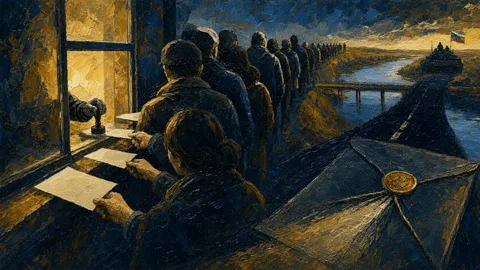
Zelensky's moral clarity is nowhere more intense than in his positions on peace negotiations. Faced with pressure from some Western interlocutors who want a "practical peace" — meaning an agreement that would consolidate Russian conquests in exchange for a ceasefire — Zelensky holds a line of fundamental consistency. Ukraine's conditions are straightforward: withdrawal of Russi
- Zelensky's moral clarity is nowhere more intense than in his positions on peace negotiations. Faced with pressure from some Western interlocutors who want a "practical peace" — meaning an agreement that would consolidate Russian conquests in exchange for a ceasefire — Zelensky holds a line of fundamental consistency. Ukraine's conditions are straightforward: withdrawal of Russi
- COMMENTARY: Zelensky Hero, Putin Tyrant: Moral Clarity as a Weapon
- Moral Clarity Tested by Impossible Negotiations
Facts, quotes, and cited links remain in the body. Interpretations are framed as analysis or opinion according to the format.
COMMENTARY: Zelensky Hero, Putin Tyrant: Moral Clarity as a Weapon
Moral Clarity Tested by Impossible Negotiations
Ukraine's Conditions for a Just Peace
Zelensky's moral clarity is nowhere more intense than in his positions on peace negotiations. Faced with pressure from some Western interlocutors who want a "practical peace" — meaning an agreement that would consolidate Russian conquests in exchange for a ceasefire — Zelensky holds a line of fundamental consistency. Ukraine's conditions are straightforward: withdrawal of Russian forces from all Ukrainian territories, including Crimea, annexed in 2014; credible security guarantees from allies prepared to intervene in the event of new aggression; a accountability mechanism for documented war crimes. These three conditions are not rhetorical maximalism. They are the minimum prerequisites for a peace agreement to be anything more than a deferred capitulation. Without Russian withdrawal, Ukraine remains dismembered. Without security guarantees, the next act of aggression is only a matter of time.
On June 26, 2026, Zelensky declared that Ukraine was "ready for meetings but Russia must take the first step." According to the Kyiv Independent, he confirmed that the window for serious negotiations was open until winter 2026 — after which military and political conditions could shift. That temporal precision is not an ultimatum. It is an invitation to Moscow to seize an opportunity that Ukraine's military trajectory is making progressively less advantageous for Russia. Zelensky approved a 40-day influence operation to push Moscow toward talks, according to RBC-Ukraine dated June 25, 2026. This combination of military pressure, diplomatic operations, and clarity on conditions is the most sophisticated negotiating strategy Kyiv has ever deployed.
Zelensky and Allied Support: The Art of Holding the Coalition
Speeches Before Parliaments: Rhetoric in the Service of a Just Cause
One of Zelensky's most remarkable capabilities as a wartime leader has been his mastery of international political communication. His speeches before the British Parliament, the U.S. Congress, the European Parliament, the Israeli Knesset, and dozens of other legislative chambers have been exercises in political rhetoric of remarkable effectiveness. Every time, the message was adapted to the audience — with the British, he evoked Churchill and resistance; with the Americans, Pearl Harbor; with the Israelis, existential threat. This ability to speak the emotional and historical language of each audience is political empathy in the service of a just cause. It maintained Ukraine's moral legitimacy with Western allies and had measurable concrete effects: positive votes on aid packages, public political commitments that governments could no longer walk back without political cost.
Zelensky's relationship with the Trump administration is one of the most delicate diplomatic challenges of his tenure. Trump oscillates between positions hostile to Ukraine aid and declarations of support depending on negotiation cycles. Zelensky has navigated this relationship with a pragmatism that never betrays his principles. He accepted meetings with Trump, adapted his language to American priorities — emphasizing the return on investment of American aid in terms of revenue from Ukrainian minerals — without ever surrendering his red lines on territorial sovereignty. This is not compromise. It is realist diplomacy in the service of moral objectives.
Zelensky's Legacy for Global Democracy
What Ukraine Brings to the International Debate
The war in Ukraine has not only been a humanitarian tragedy and a security challenge. It has also been an intellectual contribution to the global debate on democracy and resistance to authoritarianism. Ukrainians demonstrated that democracy can defend itself with weapons. They showed that a mobilized civil society can make up for the state's shortcomings in crisis conditions. They proved that technological innovation under existential pressure can produce meaningful military advances. These lessons have value well beyond Ukraine alone. For Taiwan, for the Baltic states, for Georgia, for every democracy facing the pressure of an authoritarian neighbor — the Ukrainian experience is a manual of resistance whose credibility comes from the fact that it was written in blood, not in academic circles.
Whatever the final outcome of the war, Zelensky will already have inscribed his name in history as the man who chose to stay and resist when every rational pressure counseled him to flee. That individual choice had global geopolitical consequences no one could have predicted on the night of February 24, 2022. It transformed an invasion meant to last 72 hours into a war of attrition that Russia cannot win quickly. The principle that moral clarity, maintained under extreme pressure, can have real strategic effects — that is Zelensky's most enduring contribution to the international debate on democratic leadership in times of crisis.
Introduction: When Moral Clarity Becomes Strategic
A Man Who Has Refused to Bend for Four Years
There is a photograph from this war's history that says everything. On February 24, 2022, Russian armies invade Ukraine. American intelligence offers Volodymyr Zelensky an emergency evacuation. His response has remained seared in collective memory: "I need ammunition, not a ride." That sentence — short, unambiguous, almost wry — is not merely personal courage. It is the definition of a moral posture that Zelensky has maintained without faltering through four years of total war, as Putin and his armies attempted to destroy his country, his city, and his life.
Today, June 27, 2026, that moral clarity is still there. It is expressed in direct peace offers, in the non-negotiable conditions on abducted children, in the refusal to endorse agreements that would amount to disguised surrender. It is also expressed in the drone strikes on Moscow that Zelensky calls "Ukrainian sanctions." This commentary is a defense of that moral clarity — not as naivety, but as a first-order strategic weapon.
Why Moral Clarity Is Not Naivety
Zelensky is sometimes accused of being "too moral" for diplomacy. Of not knowing how to "make compromises." That critique confuses moral clarity with tactical rigidity. Zelensky has shown remarkable tactical flexibility: he has shifted his positions on security guarantees, on negotiation formats, on ceasefire conditions. What he has never surrendered is the founding principle: Ukraine is a sovereign nation that was illegally attacked, and any peace must acknowledge that reality and prevent the next act of aggression.
This distinction — between tactical flexibility and integrity of principles — is at the core of what crisis analysts call "moral clarity." It is what the Harvard Gazette analyzed as early as March 2022, writing about "Putin's iron clarity versus Zelensky's moral clarity." Four years later, that moral clarity has proven to be an invaluable strategic resource — it allowed Ukraine to maintain the cohesion of international support, mobilize European populations, and present a face of dignity in the negotiations that followed.
The Tyrant and His Instruments
Putin: The Anatomy of a Tyranny
Vladimir Putin is a tyrant. I am not using that word as an insult. I am using it as a precise description of a mode of governance: a regime in which power is exercised by one person without real institutional constraint, through fear, corruption, and violence against opponents. In Russia, political opponents die in prison (Alexei Navalny, dead in February 2024), fall from windows, or go into exile. Independent journalists are killed or imprisoned. Military decisions are made by a single man and his inner circle, without debate or accountability.
That regime decided, in 2022, to invade a sovereign country to deny its national identity — Putin published essays claiming that Ukraine "does not exist" as a nation distinct from Russia. He ordered systematic strikes on civilian infrastructure knowing that civilians would die. He authorized the deportation of more than 20,000 Ukrainian children, a crime for which the International Criminal Court issued a warrant for his arrest. These facts are not in dispute. They are documented by independent bodies, including Russian institutions in exile.
Russian Propaganda and the Narrative of "Legitimacy"
The Russian propaganda machine works hard to rewrite these realities. It presents the war as a "special operation" of "denazification." It claims that Zelensky is an "illegitimate" leader whose mandate has "expired." It produces pseudo-legal arguments about the sovereignty of annexed regions. It cultivates in certain Western circles, particularly on the far right, the narrative that Ukraine and Russia bear equal responsibility for the conflict.
That narrative is false. Not "debatable" — false. Ukraine did not invade Russia. Ukraine did not annex Russian regions through rigged referendums. Ukraine did not bomb Russian cities to terrorize civilian populations. Those actions belong exclusively to Putin's regime. Zelensky's moral clarity consists of naming that asymmetry without shame and without false modesty: one country was attacked, and the other is the aggressor.
Zelensky: The Human Leader in an Inhuman War
Vulnerability as Strength
What sets Zelensky apart from most wartime leaders is his ability to show his vulnerability without appearing weak. In his speech on the fourth anniversary of the invasion, on February 24, 2026, he filmed from the bunker where he had managed the war's opening hours, recounting Biden's call offering an evacuation. He said: "Putin has not achieved his goals. He has not broken the Ukrainian people. He has not won this war." That is not triumphal rhetoric. It is a sober assessment, grounded in verifiable military facts.
That assumed vulnerability is also visible in his admissions of uncertainty — about negotiations, about the prospects for peace before winter, about the possible duration of the conflict. Zelensky does not pretend to know everything. He says what he knows, acknowledges what he does not, and maintains a clear direction. According to Kyiv International Institute of Sociology polling data, even after four years of war and corruption scandals in his inner circle, 61% of Ukrainians still express confidence in him. That is not the figure of a man broken by war. It is that of a leader who has maintained a relationship of trust with his people under the most difficult conditions imaginable.
Rhetoric as a Soft Power Weapon
Harvard Gazette analysts documented it as early as 2022: Zelensky's strength lies in his ability to "articulate a common Western identity rooted in shared moral qualities." By addressing parliaments, universities, and public opinion, adapting his message to every audience — democracy, freedom, resistance against tyranny — he transformed the Ukrainian cause into something broader than a territorial dispute between two neighboring countries. He inscribed it in the grand narrative of defending democracy against authoritarianism.
That rhetoric is not manipulation. It is precise. That is effectively what this war represents. And the precision of that framing has had concrete strategic consequences: it has sustained Western public support under conditions where war fatigue could have eroded the political and financial contributions. Moral clarity as a soft power weapon is perhaps Zelensky's most underestimated contribution to Ukraine's survival.
Moral Opposition as a Line of Defense
When Values Must Be Defended Through Action
Zelensky's moral clarity is only worth as much as the concrete actions backing it. On that score, the track record is real: Ukraine resisted militarily when every projection had Kyiv falling in 72 hours. It built a drone industry from practically nothing. It conducted deep-strike campaigns that surprised even the most skeptical military analysts. It maintained its democratic institutions — imperfect, scarred by scandals, but functioning — under conditions of total war.
But Zelensky has also drawn lines that the West must respect if it is to maintain its own moral consistency. He has stated clearly: no peace agreement will be "sold" to Ukrainians unless it includes credible security guarantees, recognition of territorial sovereignty, and an accountability mechanism for war crimes. Those three conditions refuse any "peace" that would in reality be a capitulation dressed up as compromise.
The Deported Children: An Absolute Line
One of the most revealing positions expressing Zelensky's moral clarity is his categorical refusal to "exchange" deported Ukrainian children for prisoners of war. Russia proposed that exchange — treating children as bargaining chips. Zelensky responded: "Can you imagine how we can exchange our children? Yes, it is important to bring back our soldier-prisoners, but we cannot exchange them for children." More than 20,000 Ukrainian children have been deported to Russia — a documented crime, ICC arrest warrant issued. That absolute line — children are not diplomatic currency — defines the difference between a leader who maintains his humanity in wartime and a system that has lost its own.
That position has costs. It complicates negotiations. It makes certain "practical" arrangements impossible. But it is right. And over the long term, justice is also a strategy: a Ukraine that had "negotiated" its deported children for tactical gains would no longer carry the moral legitimacy to represent the values it is defending.
Putin as a Distorting Mirror of Reality
"Denazification" as a Founding Lie
Discover

INVESTIGATION: Beijing cuts Africa to 2.1 billion in loans…
2.1 billion — the lowest figure in almost twenty years, according…

SPECIAL REPORT: Beijing Promises Stimulus as Its Households Give…
That is the growth rate of Chinese industrial output in July,…

INVESTIGATION: Two Chinese Ex-Soldiers Arrested in Seoul as 18,000…
For five years, a man ran a military-supply shop at the…
The central justification for the Russian invasion — the "denazification" of a country governed by a Jewish president whose family lost members in the Holocaust — is so grotesquely false that it says more about the regime producing it than about its target. This narrative fabrication is the symptom of a system in which reality is entirely malleable and truth has become a governance tool.
This has practical consequences for negotiations: it is very difficult to negotiate with a partner whose narrative architecture is fundamentally disconnected from reality. When Putin says Russia is "protecting Russian-speaking populations in the Donbas" while massively bombing predominantly Russian-speaking cities, the gap between discourse and action is total. This means that any agreement concluded with that regime is only worth what its guarantors can enforce by force — not by trust.
Tyranny as a Structurally Inefficient Mode of Governance
Authoritarian regimes have one fatal structural flaw: they cannot use truth as management information. In a regime where anyone who brings bad news risks suffering consequences, decisions are made on the basis of information filtered upward. That is what explains Putin's colossal strategic miscalculation in February 2022: he received reports telling him Ukraine would collapse in 72 hours, because his advisers told him what he wanted to hear. The reality — a people ready to resist to the death — was never conveyed.
This structural weakness of tyranny is one of the most powerful arguments in favor of Ukraine's ultimate victory — not necessarily quick, not necessarily without immense costs, but fundamentally more probable than a dictatorship whose primary management tool is fear and lies.
Conclusion: Moral Clarity Does Not Fight the War — It Makes the War Worth Fighting
What Victory Really Means
Ukraine's victory will not be measured solely in recovered square kilometers or held positions. It will be measured by the clarity with which democratic values — sovereignty, freedom, accountability — have been defended and preserved. Zelensky understood from day one that this war is not only geographical. It is a war of ideas, of legitimacy, of law. That is why his moral clarity is not an idealist luxury. It is the foundation of any durable strategy.
That much, at least, is not in dispute. The record is written in actions, not in intentions. History will judge the choices made here — not the speeches delivered, but the decisions taken, the weapons sent or withheld, the alliances honored or abandoned. That is the standard that applies.
The West's Responsibility in the Face of That Clarity
If Zelensky maintains his moral clarity, the West has the responsibility to maintain its own in return. That means not accepting peace formulas that would sacrifice Ukrainian sovereignty for short-term gains. That means not normalizing Putin's presence in international forums as long as he remains under an ICC arrest warrant. That means funding support for Ukraine not out of charity, but out of understanding that defending democratic values is also defending our own interests.
On the same topic
DOSSIER: 60,000 Russian passports in Transnistria — the annexation…
More than sixty thousand applications for Russian citizenship in three months,…

SPECIAL REPORT: Beijing buys 40 cargoes of sanctioned Russian…
On August 28, 2025, a tanker named Arctic Mulan moored at…

ANALYSIS : Taiwan Puts NT$1,122.5 Billion Into Defence, Over…
Hold that number for a moment, because it marks the crossing…
By Maxime Marquette, columnist
Columnist's transparency note
A committed commentary
This commentary is deliberately partisan — in the etymological sense: it takes the side of democracy against authoritarianism, of sovereignty against aggression, of truth against propaganda. That is a conscious editorial choice. I make no claim to neutrality on these foundational questions. I believe it is more honest to own that position than to conceal it behind a facade of "balanced journalism."
Readers are entitled to weigh that context when assessing this piece. Transparency about where a columnist stands is not a disclaimer — it is a condition of intellectual honesty. I hold these positions publicly and consistently, and I do not expect every reader to share them.
What I do not know
I have no access to Zelensky's inner life or to the private deliberations of his government. The corruption scandals in his circle are real and deserve to be documented — which I do not do in detail in this commentary, for lack of sufficiently developed recent sources. The moral clarity I attribute to Zelensky is based on his public acts and documented statements. It makes no claim to being a complete biography.
These limits do not invalidate the analysis. They define its perimeter. Every judgment I make here is grounded in verifiable public sources, cited in the section below. Where I speculate or infer, I say so. Where I assert, the evidence is in the record.
Sources
Primary sources
Secondary sources
Get the geopolitics analyses
Conflicts, powers, alliances: the MadMax thread without the noise.
Cite this article
Maxime Marquette (2026). COMMENTARY: Zelensky Hero, Putin Tyrant: Moral Clarity as a Weapon. MadMax. https://mad-max.co/en/article/commentaire-zelensky-heros-poutine-tyran-la-clarte-morale-comme-arme
Read next
INVESTIGATION: Beijing cuts Africa to 2.1 billion in loans…
2.1 billion — the lowest figure in almost twenty years, according…
SPECIAL REPORT: Beijing Promises Stimulus as Its Households Give…
That is the growth rate of Chinese industrial output in July,…
INVESTIGATION: Two Chinese Ex-Soldiers Arrested in Seoul as 18,000…
For five years, a man ran a military-supply shop at the…
Enjoyed this piece? Get the next one.
One chronicle a week, straight to your inbox. No noise.
This article was generated with AI assistance, under human supervision.
Comments
Be the first to weigh in.