

COMMENTARY: Why Russia Cannot Stop Ukrainian Drones
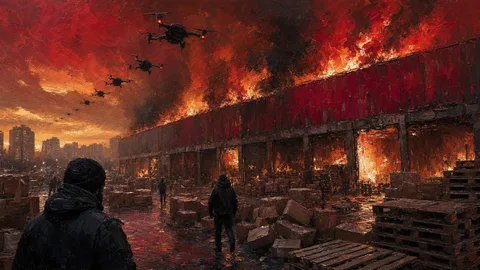
Every week since the start of 2026, the same images repeat: columns of smoke over Russian cities, refineries on fire, air-raid sirens in the suburbs of Moscow. Russian authorities announce hundreds of drones shot down. And yet, drones still get through, reach their targets, cause real damage. How is that possible? How can a military power that boasts of having the world's most
- Every week since the start of 2026, the same images repeat: columns of smoke over Russian cities, refineries on fire, air-raid sirens in the suburbs of Moscow. Russian authorities announce hundreds of drones shot down. And yet, drones still get through, reach their targets, cause real damage. How is that possible? How can a military power that boasts of having the world's most
- COMMENTARY: Why Russia Cannot Stop Ukrainian Drones
- Introduction: A question that deserves a real answer
Facts, quotes, and cited links remain in the body. Interpretations are framed as analysis or opinion according to the format.
COMMENTARY: Why Russia Cannot Stop Ukrainian Drones
Introduction: A question that deserves a real answer
The question everyone is asking
Every week since the start of 2026, the same images repeat: columns of smoke over Russian cities, refineries on fire, air-raid sirens in the suburbs of Moscow. Russian authorities announce hundreds of drones shot down. And yet, drones still get through, reach their targets, cause real damage. How is that possible? How can a military power that boasts of having the world's most sophisticated air-defense systems — including the S-400 and S-500 — not intercept propeller-driven drones manufactured in Ukraine?
The short answer: because the problem is fundamentally unsolvable with current means and existing doctrine. The longer answer — the one I will try to develop here — involves geographical, technological, economic, and doctrinal considerations that combine to create a structural vulnerability Russia cannot fix in a matter of months. Here, from my perspective as a columnist specializing in geopolitics, is why Russia cannot stop Ukrainian drones.
The premise: figures that seem to contradict reality
Russia claims to intercept thousands of drones every month. In May 2026, the Russian Ministry of Defence claimed 8,973 drones intercepted — a monthly record. And yet, according to Militarnyi, those massive interceptions did not prevent Ukrainian drones from causing devastating damage to Russian oil infrastructure. The Kapotnya refinery in Moscow burned on May 17, 2026 anyway, despite 130 anti-aircraft positions within a 50-kilometre radius. This apparent paradox — many interceptions, targets still hit — is the core of the problem I am trying to analyze.
The truth is that Russia's interception figures are probably partly accurate, but they measure the wrong thing. What matters is not the number of drones shot down — it is the percentage of armed drones that reach their target despite the defense. And on that measure, according to the Wall Street Journal as cited by RBC-Ukraine on June 27, 2026, Ukraine has disabled approximately 20% of Russia's petroleum refining capacity. That is not a Ukrainian failure — it is a success for its campaign.
Reason number 1: The problem of immensity
17 million km²: the unstoppable geographic enemy
Russia is the largest country in the world: 17 million square kilometres. Defending that territory against low-altitude drones is physically impossible for any army, regardless of its wealth or technological sophistication. The simple calculation: a Pantsir-S1 system can cover a zone of roughly 30 km in radius. To provide continuous coverage of the entire European part of Russia (~4 million km²), roughly 1,400 Pantsir systems deployed adjacently would be needed. Russia may possess a few hundred of those systems in total — and many are deployed at the front in Ukraine.
In practice, the actual coverage is not continuous but discontinuous: engagement zones around priority sites — air bases, command centers, major refineries — separated by uncovered corridors. Ukrainian drones, programmed to fly at low altitude along terrain contours, exploit precisely those corridors. Russian geography, once perceived as protection — the strategic depth that exhausted invaders — has become a vulnerability in a long-range drone war.
Peter Dickinson is right: immensity as weakness
Peter Dickinson of the Atlantic Council framed this reality with remarkable precision: Ukraine's deep-strike campaign aims to "exploit Russia's vastness and turn it from a strength into a weakness." That is exactly what is happening. Where Russian strategic depth had protected the country against Napoleon in 1812 and against Hitler in 1941–42 — allowing retreat and force reconstitution — it becomes a dead weight in a drone war: too much territory to protect, too few systems available, too many possible entry points for Ukrainian drones. Russia's immensity is its Achilles heel in 2026.
Russia cannot concentrate its defenses on a single critical point. It must simultaneously protect refineries in the Urals, air bases at Pskov, military installations at Voronezh, command centers in Moscow, and hundreds of other targets scattered across a continent-sized territory. With a limited stock of air-defense systems — part of which is deployed at the front in Ukraine — that task is structurally impossible. Russia is condemned to leave uncovered zones, and Ukrainian drones find those zones.
Reason number 2: The technological mismatch
Systems designed for a different enemy
The S-300, S-400 and even the more recent S-500 were designed to intercept fast, high-altitude targets: combat aircraft flying at Mach 2, intercontinental ballistic missiles, supersonic cruise missiles. These are exceptional systems against that type of threat. But a propeller-driven Ukrainian drone like the Liutyi flies at approximately 150–200 km/h and at an altitude of 50 to 100 metres above the treetops. Those characteristics create what CNN experts described in June 2026 as a fundamental technical problem: Russia's defense is "simply not adapted" to this threat — "not equipped to detect, track and engage" swarms of small, slow drones.
The problem is physical: the radars of S-300/S-400 systems are optimized for high-altitude, supersonic-speed targets. A drone at 150 km/h hugging a forest at 50 metres altitude falls within a radar blind spot created by the combination of its very low altitude and terrain clutter. Low-altitude radars can detect it, but at much shorter ranges — leaving very little reaction time. And reaction time is critical: a drone at 150 km/h moving through a radar gap will have reached its target before the human command chain has authorized an engagement.
The Pantsir caught in the swarm trap
The Pantsir-S1, supposed to be the answer to small drones, has a fundamental limitation in the Ukrainian context: it can only engage four targets simultaneously. When a formation of 20, 30 or 50 drones approaches from different directions and at varying altitudes, the Pantsir is mathematically overwhelmed. The first wave of drones is engaged and may be shot down. The subsequent drones get through in the confusion created by that engagement, exploiting the radar reorientation and reloading of new interceptor missiles.
Moreover, Ukraine systematically integrates decoy drones into its formations — designed to mimic the radar signature of missiles or heavier drones, forcing the Pantsir to spend its interceptor missiles on decoys. When the missile loader is exhausted — 12 missiles in a standard Pantsir loader — reloading takes several minutes during which the position is defenseless. The actual armed drones aim precisely at that vulnerability window. It is a surgical exploitation of the defensive system's cycle limits.
Reason number 3: The irreversible economic asymmetry
A $55,000 drone versus a million-dollar missile
This may be the most fundamental reason Russia cannot win the drone war: the economics do not allow it. A Ukrainian drone from the FP-1 family costs approximately $55,000. The Liutyi drone — more advanced — costs approximately $200,000. A Russian Tor interceptor missile costs approximately $200,000 to $300,000. A Pantsir (57E6) missile starts at $100,000. An S-400 interceptor costs several million dollars. In other words: every time Russia uses a missile to shoot down a Ukrainian drone, it spends as much as or far more than the cost of the drone destroyed.
At campaign scale — thousands of drones launched every month — the economic asymmetry becomes catastrophic for Russia. Ukraine can produce and launch drones at a tempo that drives up Russian defense costs in an unsustainable way, while at the same time producing a real damage effect on the targets hit. CBS News, citing Western officials in 2026, reported that Ukraine can produce long-range strike drones faster than Russia can manufacture air-defense missiles — "depleting Russian stocks at a potentially unsustainable rate."
Ukrainian production soars, Russian stocks deplete
Ukraine's production figures are telling: the Ukrainian Ministry of Defence stated in mid-2026 that production of medium-range strike drones had increased by approximately 312% in the first four months of 2026 compared to all of 2025. The target is to reach 300 long-range drones per day. In March 2026, Ukraine launched approximately 7,000 drones toward Russian territory — more than Russia sent toward Ukraine that month. That is a spectacular strategic reversal: the invaded nation striking farther and harder than the invader.
Faced with this scale-up, Russian interceptor missile stocks are depleting. In 2025, Western estimates put Russia's remaining S-300 launcher stocks at approximately 400 units — after losses accumulated since 2022, some of them due to the controversial use of these defensive missiles in offensive mode against Ukrainian targets. The replacement cycle takes 7 to 8 months per missile, in an industry disrupted by sanctions. The mathematical logic of that depletion is inexorable.
Reason number 4: Intelligence and trajectory planning
Mapping defenses to find the gaps
The growing successes of Ukrainian drones deep in Russian territory are explained not only by the number and cost of drones — they are also explained by increasingly excellent targeted intelligence. Ukrainian trajectory-planning teams continuously map the known positions of Pantsir and Tor systems, surveillance radars, and electronic-warfare units. These maps, built over years of OSINT observations, human intelligence, and electronic sensors, allow designers to draw infiltration routes that thread between engagement zones.
The Kyiv Post and other specialized media have described the method: drones fly at low altitude along pre-programmed trajectories that follow terrain contours, use forest cover, and engage in corridors degraded by electronic warfare. Hybrid navigation systems — combining GPS, inertial navigation, and AI-based terrain visual recognition — allow drones to maintain those precise trajectories even in heavy-jamming environments. That is hostile-environment navigation at a level of sophistication that would have seemed beyond Ukraine's reach two years ago.
The first wave as an intelligence tool
The tactical organization of Ukrainian attacks intelligently combines reconnaissance and exploitation. Drones in the first wave — sometimes cheaper drones or sophisticated decoys — "test" the defenses, forcing activation of radars and engagement systems. Those activations reveal the positions and characteristics of active defensive systems — information immediately transmitted to planning units to adjust the trajectories of armed drones in the following wave. Intelligence is generated in real time, during the attack itself.
This real-time reconnaissance-exploitation tactic represents a significant doctrinal advance. It transforms every attack into an intelligence operation, whose findings immediately serve the ongoing attack and feed planning for future attacks. Every Pantsir position revealed during an attack is now mapped, targeted for future neutralization, or routed around in subsequent missions. The Russian defense, by activating itself, involuntarily contributes to its own progressive degradation.
Reason number 5: Electronic warfare — a double-edged sword
GPS jamming that turns against Moscow
Russia invests massively in electronic warfare to disrupt the GPS navigation systems of Ukrainian drones. That strategy has had partial successes — many Ukrainian drones have deviated from their course, some accidentally ending up over Baltic countries or Finland. But Ukraine's response has been technological: development of hybrid navigation systems that reduce GPS dependency and maintain precise trajectories even in heavily jammed environments.
More problematically for Russia, its own GPS jamming has negative collateral effects. It disrupts the communications and navigation of its own forces. It degrades the performance of its own guidance systems, which also rely on satellite positioning. And it cannot be targeted only at Ukrainian drones — it affects every GPS-equipped device in the jamming zone, including civilian aircraft and Russian military equipment. Electronic warfare is a double-edged weapon that Russia deploys abundantly but also pays the cost of.
Radar gaps: a permanent map of vulnerabilities
Russia does not have a continuous radar field across its territory. Its coverage is, according to available analysis, concentrated around Moscow, a few strategic installations, and military bases — covering perhaps 10 to 15% of the total territory. Vast areas — hundreds of kilometres — have minimal or no radar coverage, particularly at very low altitude. These gaps are a permanent map of available corridors for Ukrainian drones.
Russia can, and tries to, close these gaps by adding mobile radars. But deploying and maintaining radars across the Russian expanse is logistically costly. And every new radar deployed is a potential target for Ukrainian drones — which deliberately target radars and guidance systems to create new blind spots. It is a cat-and-mouse game where the attacker holds the initiative advantage: it can choose when, where, and how to strike, while the defender must be everywhere at once.
Reason number 6: Sanctions break the supply chains
Semiconductors: the shortage that paralyzes everything
Modern air-defense systems are sophisticated computers that process thousands of radar data points in real time to identify, track, and engage targets. Those calculations require advanced semiconductors — signal-processing chips, high-density memory, radio-frequency components — that Russia cannot produce domestically at the required quality and that have been subject to strict export controls from the West and Japan since 2022. Before 2022, these components arrived legally. Since 2022, they have been under embargo.
Russia is seeking alternatives through China and gray channels — Turkey, Kazakhstan, the UAE. Those alternatives make it possible to obtain certain components but with lead times extended to 18 to 24 months and often lower performance. The 21st EU sanctions package of June 2026 continued to close these workaround channels. The Kremniy EL plant in Bryansk — producing electronics for Pantsir systems — was struck by Ukrainian drones, further reducing the capacity to maintain and produce air-defense systems.
On the same topic
ANALYSIS: 800 drones over Russia in one night —…
More than eight hundred drones, in a single night, August 14…

INVESTIGATION : Russia's FSB Erases 4 Ukrainian Regions' Border…
Not an assault, not an ultimatum, not a televised proclamation from…

REPORT: One Year Past the August 18 Ultimatum, Ukraine's…
At midnight on August 18, 2025, the deadline expired that the…
A production cycle in a downward spiral
The combination of sanctions and Ukrainian strikes on weapons factories creates a vicious circle for Russian defense production. Sanctions reduce access to electronic components. Strikes damage the factories that use those components. Damaged factories produce less. The stock of available systems shrinks. Remaining systems are worked harder and wear out faster. The lack of spare parts makes maintenance difficult. And the cycle repeats, each turn tighter than the last.
This vicious circle has been documented by the ISW in its June 2026 assessments and in various defence analyses. Russia is trying to break out of it through alternative imports, substitute production, and partnerships with Iran and North Korea. But those substitutes are partial and do not reverse the underlying trend. The trajectory of Russian production capacity in air-defense systems is, at this stage, pointing downward.
Reason number 7: Doctrine cannot keep pace with the threat
An army built for the Cold War
Russian air-defense doctrine was designed for a very specific strategic context: the Cold War, with its high-altitude American strategic bombers and intercontinental ballistic missiles. The S-300 and S-400 systems are responses to those threats — excellent systems against fast, high-altitude targets with a strong radar signature. Nothing in that doctrine anticipated hundreds of small, slow drones flying at very low altitude, on trajectories programmed to avoid radars, in saturation formations designed to overwhelm interceptors.
Doctrinal adaptation is long and difficult. It requires rethinking not only the weapons systems but also engagement procedures, rules of fire authorization, command and authorization chains, detection and alert modes. These institutional changes take years in any military. Russia is trying to accomplish them in a matter of months, under the pressure of an active war, with resources constrained by sanctions. It is a formidable institutional challenge that traditional military bureaucracies are ill-equipped to meet rapidly.
Anti-drone towers: a makeshift answer to a structural problem
The erection of 43 specialized anti-drone towers around Moscow between May and September 2025, to raise Pantsir systems above urban terrain obstacles, perfectly illustrates the doctrinal problem. It is a creative solution, but a makeshift one — an improvised adaptation to a threat that existing doctrine and equipment cannot address properly. These towers are fixed, known, and mapped by Ukrainian OSINT. They improve local coverage of Moscow but do not solve the systemic problem of defending the entire territory.
The real doctrinal answer would involve directed-energy weapons systems — lasers, high-power microwaves — whose marginal interception cost is near zero (the cost of an energy pulse) and that do not deplete with the number of shots fired. These technologies exist, but are not yet deployed at scale in Russia. Developing, testing, and deploying such systems would take years — time that Russian air defense probably does not have under current wartime conditions.
Reason number 8: Resource dispersal across multiple fronts
Kaliningrad, the Arctic, and Ukraine all at once
Russia must simultaneously defend borders and interests across multiple theatres: the Ukrainian front, the Kaliningrad enclave surrounded by NATO states, the northern flank near Finland now an Alliance member, the vast Arctic coastlines, the Sino-Russian border (formally friendly but strategically sensitive over the long term), and now the interior territory exposed to drones. These multiple demands disperse available air-defense systems across a spectrum of missions that current resources cannot cover adequately.
Analyses cited by LB.ua in April 2026 documented that more than 30% of air-defense systems from the Russian Far East had been withdrawn for redeployment westward — leaving entire regions with dramatically reduced coverage. That redistribution movement perfectly illustrates the dilemma: reinforcing the defense of one point creates a vulnerability elsewhere. Russia is in a situation where it cannot protect everything simultaneously with its current means.
The front as a resource drain
The Ukrainian front is itself an insatiable consumer of air-defense resources. Russian forces deployed in occupied zones need protection against HIMARS missiles, short-range combat drones, rockets, and artillery shells. Tor-M2 and Pantsir systems deployed at the front are unavailable for interior territory defense. And systems are regularly destroyed at the front — the ISW documented on June 26, 2026 the destruction of two S-300 launchers near Volnovakha. Every front-line loss reduces the pool available for all other missions.
It is a multi-directional exhaustion circle: the front consumes systems, interior defense consumes others, factories under sanctions and strikes produce fewer replacements, and Ukrainian drone formations continue to intensify. The trajectory of Russia's entire air-defense system points toward a progressive degradation that, if it continues, could become an open crisis within 12 to 18 months.
What this means for the war
A growing vulnerability window
The convergence of all these factors — impossible geography, technological mismatch, economic asymmetry, excellent Ukrainian planning, double-edged electronic warfare, component sanctions, outdated doctrine, and resource dispersal — creates a growing vulnerability window in Russian air defense. This window did not open all at once: it has widened progressively since 2022, accelerating in 2025 and still more in 2026 with the scale-up of Ukrainian drone production.
For Ukraine, this window is a strategic opportunity to exploit with urgency. The 40-day campaign endorsed by Zelensky on June 25, 2026, with its 660 drones launched in a single week according to available reports, is precisely the deliberate exploitation of that window. The more Ukraine strikes while Russian defense is at its weakest, the more damage accumulates irreversibly on Russia's war infrastructure. Time is a factor: if Russia finds technological or economic solutions to its air-defense problems, the window could close.
What this does not mean
I must be honest about the limits of my analysis. The degradation of Russian air defense does not mean Russia will collapse tomorrow, or even in six months. It still possesses considerable offensive capabilities — Iskander ballistic missiles, guided glide bombs, Iranian Shahed drones. It can still inflict massive destruction on Ukraine. Ukraine's deep-strike campaign creates pressure, not immediate victory. And that pressure can generate unpredictable behavior from a regime with its back against the wall — including an escalation that no one wants.
What I can state with more confidence: the current trajectory is unfavorable for Russia in the specific dimension of the drone war. It cannot stop Ukrainian drones with its current means, within the geographical, technological, and economic context it finds itself in. To reverse that trend, it would need to simultaneously solve several structural problems — which, under sanctions and in the middle of a war, is practically impossible within a two-to-three-year horizon.
Lessons for democracies
Our own vulnerabilities
Russia's air-defense debacle against drones is not an exclusively Russian problem. The same structural vulnerabilities — systems designed for the Cold War, discontinuous radar coverage, economic asymmetry unfavorable to costly interceptors, dependence on foreign semiconductors — exist in the defense architectures of many countries, including NATO members. The difference is that Western democracies, if they draw lessons from Ukraine, still have the time and resources to adapt their defense architectures.
Investments in directed-energy weapons systems (lasers, microwaves), in killer-drones (intercepting drones with drones), in decentralized distributed defense, and in low-altitude AI surveillance sensors are priorities that Ukrainian lessons make urgent. NATO, through exercises like BALTOPS 2026 and structures like the FLF Finland, is progressively integrating those lessons. But the pace of adaptation must accelerate.
The drone arms race
We have entered a new era of the arms race — an era dominated by unmanned systems. On one side, drone producers are accelerating their scale-up — Ukraine as model, China as dominant actor, the United States, Europe, and South Korea as rapid followers. On the other, countermeasure developers are trying to find economical and technological answers to drone proliferation. That race will define a significant part of military doctrine for the coming decades.
What Ukraine demonstrates in 2026 is that drones have already changed warfare. They allow an economically and militarily inferior nation to exert strategic pressure on a much larger power. They transform the geography of a defense whose depth was its principal virtue. And they create an economic asymmetry that fundamentally favors the attacker. Armies that do not integrate these lessons will find themselves in Russia's position — defending a sky full of holes, with ill-suited systems, at an unsustainable cost.
The possible response: what Russia could theoretically do
Long-term solutions unlikely in the short term
To be fair in my analysis, I must explore what Russia could theoretically do to improve its situation. On the technological side, it would need to invest massively in directed-energy weapons systems — lasers and high-power microwaves — that resolve the economic asymmetry by offering near-free interceptions. Russian prototypes in this domain already exist (Peresvet), but their large-scale deployment would take years and considerable resources that the current war does not leave available.
On the doctrinal side, it would need to develop short-range mobile defenses deployed in depth, with faster engagement procedures less dependent on centralized human authorization. On the industrial side, it would need to solve its semiconductor supply problems — which means either circumventing sanctions more effectively, or building a domestic advanced-chip industry in a matter of years. These solutions exist theoretically. None is achievable in the short term under Russia's current conditions of war, sanctions, and an already exhausted budget.
The inevitable conclusion
Russia cannot stop Ukrainian drones because it faces a multidimensional structural problem that cannot be solved in a few months with available resources. The geography is unfavorable. The technology is ill-suited. The economics are unfavorable. The intelligence is inferior. Sanctions are biting. Doctrine is outdated. Resources are dispersed. And meanwhile, Ukraine produces more and more drones, better and better, reaching farther and farther.
This is not a prophecy of inevitable Ukrainian victory — wars are too complex for one-way prophecies. But it is an honest analysis of why the Russian sky keeps developing holes, and why it will continue to do so in the months ahead. Russia launched a war it cannot win in the air. And in modern warfare, the side that loses the sky loses a great deal.
Flamingo missiles: striking the very factories that manufacture the interceptors
Discover

INVESTIGATION: Beijing cuts Africa to 2.1 billion in loans…
2.1 billion — the lowest figure in almost twenty years, according…

SPECIAL REPORT: Beijing Promises Stimulus as Its Households Give…
That is the growth rate of Chinese industrial output in July,…

INVESTIGATION: Two Chinese Ex-Soldiers Arrested in Seoul as 18,000…
For five years, a man ran a military-supply shop at the…
Striking the source rather than the vector
The most formidable innovation of Ukraine's campaign is not just sending drones — it is targeting the factories that manufacture the air-defense systems themselves. In June 2026, Ukrainian Flamingo missiles struck a plant in Volgograd producing launch systems for Yars, Topol-M, and Iskander systems. That is a strategy of implacable logic: if Russia cannot produce enough new defense systems, the degradation of its anti-aircraft coverage becomes inevitable and irreversible. Western sanctions limit the components. Ukrainian strikes destroy the assembly lines. The combined result is a production deficit that Moscow cannot fill under current conditions.
The Kyiv Independent reported in June 2026 that Ukraine struck the Vtorovo pumping station for the second consecutive time — demonstrating a capacity to re-strike deep Russian industrial targets that the Russian defense cannot prevent. That strategy of repeated strikes on the same installations is deliberate: it aims to prevent repairs and make production resumption impossible in the short term. Every missile factory rendered inoperable is a future interceptor that will never be delivered to Russian air defense — a permanent subtraction from Putin's defensive capacity.
The multiplier effect on the defense chain
The destruction of a launcher-producing factory is not a simple localized industrial setback — it is a negative multiplier on the entire Russian air-defense chain. One S-400 launcher not produced is one defense system not delivered, a gap in coverage over Moscow or Saint Petersburg, an industrial site or military base left unprotected. Ukraine's deep-strike campaign has understood this value-chain logic and exploits it methodically — targeting not only refineries and fuel depots, but also production facilities for weapons and essential military components.
The ISW documented in its June 22, 2026 assessment that Ukraine had conducted 210 intermediate strikes in May and 145 in June, including 28 strikes on oil infrastructure in June alone. That sustained tempo, combined with the strategy of re-striking the same industrial targets, creates cumulative attrition that Russia cannot absorb indefinitely. The war is no longer only a battle at the front — it is a contest between Ukrainian production capacity and Russian industrial resilience.
North Korea and Iran: the authoritarian axis as an industrial crutch
Alternatives that do not fill the deficit
Faced with the stranglehold of Western sanctions on its advanced electronic component supplies, Russia has turned to its authoritarian allies — primarily Iran and North Korea — to compensate for production deficits. Iran supplies Shahed drones in large quantities, allowing Moscow to maintain a low-cost attack capability against Ukraine. North Korea delivers artillery shells and, according to several defence analyses, soldiers directly into the combat zone — with a confirmed death toll of approximately 2,300 according to the BBC as cited in June 2026. These contributions ease pressure on certain Russian production lines, but do not solve the fundamental air-defense problem.
The technological deficit is too deep to be filled by authoritarian alternatives. Neither Iran nor North Korea manufactures the advanced semiconductors needed for modern interceptor guidance systems. China could theoretically supply those components, but Beijing maintains a policy of calculated caution — it does not want to jeopardize its trade relations with the West to rescue Russia's defense industry. The result is that Russia obtains mass ammunition, cheap drones, and North Korean labor — but not the high-technology components that would allow it to rebuild a credible air defense.
An authoritarian axis that reveals Russia's limits
Moscow's growing dependence on Tehran and Pyongyang is itself an admission of industrial weakness. A great military power that must import artillery shells from North Korea and attack drones from Iran is a great power whose defense industry is in crisis. These palliative imports keep the Russian war machine moving, but they do not allow air defense to be rebuilt — which requires technologies that neither Pyongyang nor Tehran possesses. The authoritarian axis is a crutch, not a solution.
For Ukraine and its Western allies, that dependence is a valuable piece of strategic intelligence. It confirms that economic sanctions are having a real effect on Russian industrial capacity — not enough to trigger an immediate collapse, but enough to force Moscow into demeaning partnerships with the most unpredictable regimes on the planet. Every tightening of sanctions — like the 21st EU package of June 2026 — squeezes that vice a little tighter and makes the alternatives less viable. Russia chases substitute solutions in a world that is increasingly closing its doors.
Conclusion: The sky as a mirror of the war
Air defense as a strategic barometer
The state of a country's air defense is a faithful barometer of its overall military condition. When the systems work, industries are supplied, doctrines are adapted, stocks are maintained. When they malfunction, the entire military edifice creaks. Russia's air defense in 2026 is that barometer: it signals a military edifice under mounting strain, whose resources are depleting faster than they are being replenished, and whose doctrinal adaptations are arriving too slowly against a threat that evolves faster than the defenses.
Russian refineries are burning. Russian milbloggers are complaining. Muscovites are hearing the sirens. And Ukrainian drones keep arriving — more numerous, reaching farther, more precise. Not because Russia is stupid or incompetent. But because it faces a structurally unsolvable problem with the means available to it. That is why Russia cannot stop Ukrainian drones.
What we must do with this reality
For the democracies supporting Ukraine, this reality is an additional argument for sustaining and intensifying that support. The weapons and technologies provided to Kyiv — particularly drone technologies — are producing measurable strategic effects. They reduce Russia's capacity to finance and wage war. They create growing pressure on the Kremlin. They demonstrate that Western support works. The lesson from Russia's sky riddled with holes is also a lesson about the effectiveness of supporting Ukraine: keep going, accelerate, do not waver.
By Maxime Marquette, columnist
Columnist's transparency note
My biases and method
This commentary reflects my reading of available public sources, combined with my own analysis and convictions. I am supportive of Ukraine and critical of Putin's regime. I believe Western support for Ukraine is justified and necessary. These positions inform my commentary but do not prevent it from being factual — all figures and data cited are sourced. I strive to clearly identify personal opinions (signaled by the commentary format) and factual data.
I am not a defense engineer. My analysis of technical capabilities relies on specialized sources — MiGFlug, ISW, LB.ua, Militarnyi — whose technical details I cannot independently verify. Defence experts might nuance certain points of my analysis. I accept and welcome that.
What I do not know
I do not know the precise real state of Russian interceptor missile stocks. I do not know to what extent Chinese or Iranian alternative solutions could change the dynamic I describe. I do not know the exact capabilities of the latest Ukrainian drones or their actual attrition rates. On all these points, my conclusions remain probabilistic analyses, not certainties.
Sources
Primary sources
Secondary sources
Get the geopolitics analyses
Conflicts, powers, alliances: the MadMax thread without the noise.
Cite this article
Maxime Marquette (2026). COMMENTARY: Why Russia Cannot Stop Ukrainian Drones. MadMax. https://mad-max.co/en/article/commentaire-pourquoi-la-russie-ne-peut-pas-arreter-les-drones-ukrainiens
Read next
INVESTIGATION: Beijing cuts Africa to 2.1 billion in loans…
2.1 billion — the lowest figure in almost twenty years, according…
SPECIAL REPORT: Beijing Promises Stimulus as Its Households Give…
That is the growth rate of Chinese industrial output in July,…
INVESTIGATION: Two Chinese Ex-Soldiers Arrested in Seoul as 18,000…
For five years, a man ran a military-supply shop at the…
Enjoyed this piece? Get the next one.
One chronicle a week, straight to your inbox. No noise.
This article was generated with AI assistance, under human supervision.
Comments
Be the first to weigh in.