

Kyiv torches two Russian refineries, Moscow already rationing gasoline
Introduction: the fuel war changes face
- Introduction: the fuel war changes face
- On the night of Saturday into Sunday , Ukraine 's long-range drones once again struck deep inside Russian territory.
- Two oil refineries were targeted: the one in Slaviansk-na-Kubani , in the Krasnodar region, roughly 300 kilometers from the front line, and another in the Yaroslavl region, nearly 700 kilometers from the Ukrainian border.
Facts, quotes, and cited links remain in the body. Interpretations are framed as analysis or opinion according to the format.
Introduction: the fuel war changes face
Two strikes, one message
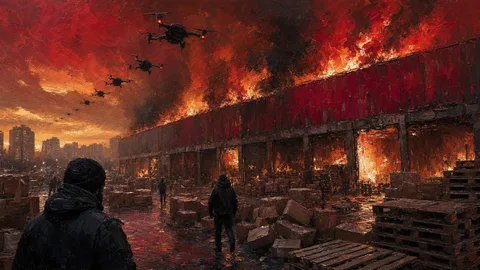
On the night of Saturday into Sunday, Ukraine's long-range drones once again struck deep inside Russian territory. Two oil refineries were targeted: the one in Slaviansk-na-Kubani, in the Krasnodar region, roughly 300 kilometers from the front line, and another in the Yaroslavl region, nearly 700 kilometers from the Ukrainian border. President Volodymyr Zelensky confirmed the strikes on Telegram, calling them "long-range sanctions" that, in his words, further reduce the resources feeding the Russian war machine, according to Reuters.
This is not an isolated episode. It's the methodical continuation of a campaign begun months ago, aimed directly at the war's central nerve: the Kremlin's oil revenues. And as a columnist who has followed this conflict since day one, I must admit a certain cold fascination at the surgical precision with which Kyiv has come to identify Vladimir Putin's true Achilles' heel: not tanks, not trenches, but kerosene tanks.
One dead, damage inflicted, a tragic routine
According to Krasnodar governor Veniamin Kondratyev, debris from downed drones caused a fire at the Slaviansk-na-Kubani refinery, killing one person and injuring another in a nearby village, according to Al Jazeera. Several homes were also damaged. In the Yaroslavl region, governor Mikhail Evraev reported a drone attack that led to the temporary closure of roads leading to Moscow, while the local airport briefly suspended operations.
I never celebrate a death, even one on the aggressor's side. But things must be named plainly: this victim fell in a war that Russia chose to launch, and that its own government refuses to end despite four years of destruction. The moral responsibility for every consequence of this war continues to fall, ultimately, on Moscow.
What the Slaviansk-na-Kubani refinery represents
A strategic installation for occupied Crimea
The Slaviansk-na-Kubani refinery, operated by the Slaviansk EKO group, processes nearly 4 million tons of crude per year and has a capacity of roughly 100,000 barrels per day, according to Bloomberg. It serves as a key fuel source for annexed Crimea as well as for Russian Black Sea ports, particularly for exporting fuel oil, naphtha, and marine fuel. Striking this installation therefore amounts to directly cutting one of the logistical arteries feeding Russian forces deployed on the occupied peninsula.
This site is not new to the list of Ukrainian targets. It has already been hit several times since the start of the conflict, including a January 26 strike that damaged components of its main crude-processing unit, according to Bloomberg. The repetition of strikes on this specific site illustrates a clear Kyiv doctrine: keep hitting the same targets until they stop functioning.
A choice that owes nothing to chance
The choice of this refinery fits an unrelenting logic of economic pressure. By targeting infrastructure that fuels both the Russian army and the exports financing the war effort, Ukraine strikes exactly where it hurts: Putin's regime's wallet.
This is a strategy I watch with undisguised admiration. While some Western commentators still worry about possible escalation, Ukraine understood long ago that a modern war is also won, if not first won, on the battlefield of the enemy's war economy.
The second target: Yaroslavl, 700 kilometers from the front
The impressive range of Ukrainian drones
The fact that Kyiv can strike a target 700 kilometers from its border demonstrates the scale of technological progress made by Ukraine's defense industry in long-range drones. This range means that no Russian oil installation, even one deeply buried in the interior, is now fully safe.
Russian authorities had not, at the time of writing, publicly confirmed the extent of the damage at the Yaroslavl site, according to Al Jazeera. This partial silence from Moscow in the face of strikes documented by Ukrainian sources and partly confirmed by local authorities has become a habit for the regime, which prefers to publicly downplay the scale of the damage rather than admit its vulnerability.
A symbol for Russian public opinion
Every strike that reaches a region as far from the front as Yaroslavl sends a powerful signal to the Russian population: the war is no longer a distant abstraction confined to evening news bulletins, it now directly touches daily life, with road closures, air travel disruptions, and fuel shortages.
This is exactly the intended effect, and I see no reason to apologize for it in the name of some false journalistic neutrality. As long as Russian society continues to tolerate, out of indifference or fear, the war waged in its name, it is legitimate that it feels the cost of it directly.
A systematic campaign, not an isolated stunt
Near-daily strikes for months
This double strike fits into a continuous escalation. According to Bloomberg, Ukraine carried out at least 14 drone attacks against Russian refineries in November alone, a pace that has only intensified since. On June 25, drones had already targeted two refineries belonging to Rosneft in the city of Ufa, sparking fires in their main processing units, according to the same source.
On June 18, a record attack had targeted Moscow itself, with nearly 194 drones shot down according to mayor Sergei Sobyanin, some of which reached the capital's oil refinery, disrupting airport operations and forcing the closure of several major roads.
The International Energy Agency confirms the impact
This isn't just a Ukrainian perception: according to a report from the International Energy Agency cited by Bloomberg, drone strikes are expected to continue weighing on Russian refinery processing rates at least through mid-2026. Since the start of the year, the frequency of attacks on Russian refineries has doubled, causing full or partial refining shutdowns and a reduction in the production of gasoline, diesel, and jet fuel, according to data compiled by Reuters.
What strikes me is the strategic discipline behind this campaign. This isn't improvised revenge: it's an architecture of strikes designed to maximize the cumulative effect on an industry the Russian regime believed was untouchable behind thousands of kilometers of territorial depth.
Putin acknowledges a "certain deficit" of fuel
The Kremlin's unusual admission
Vladimir Putin himself eventually admitted publicly, during a televised interview, that Russia is experiencing a "certain deficit" of fuel, while promising to strengthen the security of oil installations and increase production, according to remarks reported by the Chicago Tribune. This is a rare admission for a leader accustomed to systematically downplaying his country's internal difficulties.
Discover

INVESTIGATION: Beijing cuts Africa to 2.1 billion in loans…
2.1 billion — the lowest figure in almost twenty years, according…

SPECIAL REPORT: Beijing Promises Stimulus as Its Households Give…
That is the growth rate of Chinese industrial output in July,…

INVESTIGATION: Two Chinese Ex-Soldiers Arrested in Seoul as 18,000…
For five years, a man ran a military-supply shop at the…
Putin also accused Kyiv of seeking to "create divisions within Russian society" and to "force Russia to interrupt, even momentarily, the advance of its troops along the line of contact," vowing that "we will not give them that opportunity." These words betray, despite the bravado, a genuine concern about the effectiveness of the Ukrainian campaign.
Rationing and lines at the pump
On the ground, the consequences are already visible: long lines are forming at gas stations in several Russian regions, and many local authorities have introduced fuel rationing measures, according to Fortune. In occupied Crimea, the free public sale of gasoline has even been entirely suspended, with fuel now reserved for emergency services or distributed via strictly controlled state vouchers, according to Al Jazeera.
Watching Putin admit, even grudgingly, a fuel shortage in the world's largest oil-producing country is an almost darkly comic moment if the stakes weren't so tragic. It is living proof that the war he launched against Ukraine is methodically turning back against his own people.
The broader economic impact on the regime
Falling oil revenues
According to an analysis by the Centre for Research on Energy and Clean Air cited by the Guardian, Russia's revenue from fossil fuel exports was 13% below pre-war levels in 2025, under the combined effect of stricter sanctions, Ukrainian drone strikes on energy infrastructure, difficulty finding new gas markets, and falling global oil prices.
These figures confirm that the Ukrainian strike campaign is not merely a symbol of resistance: it produces a measurable, cumulative economic effect, adding to Western sanctions to progressively erode the Kremlin's financial capacity to fund its war.
Added tax pressure completes the picture
The Russian government also raised its VAT from 20% to 22% earlier this year, a rate now higher than those applied in the United States, the United Kingdom, France, or Germany, according to the Guardian. This tax hike, decided in the middle of a war, illustrates just how tight the Russian budget has become, forced to compensate through domestic taxation for what sanctions and strikes are costing it abroad.
It must be repeated relentlessly: every dollar of oil revenue Moscow loses is one dollar less to fund the missiles falling on Ukrainian cities. This simple equation alone justifies the entire campaign of long-range sanctions carried out by Kyiv.
Russia's military response and the price paid by Ukrainian civilians
Immediate retaliation on Ukrainian territory
As is often the case, these deep Ukrainian strikes were accompanied by Russian retaliation against civilians. The same day, a Russian aerial bomb killed two people in Zaporizhzhia, in southern Ukraine, injuring several others, including children, according to regional administration head Ivan Fedorov, cited by the Chicago Tribune. In the Belgorod region, on the Russian side, a Ukrainian drone also caused one death and one injury, according to acting governor Alexander Shuvaev.
This apparent symmetry in human losses should fool no one: on one side, an invading army that deliberately strikes civilians in a sovereign country; on the other, an army defending its territory by targeting the aggressor's military-economic infrastructure, with collateral damage it never deliberately seeks.
A night of massive bombardment across Ukraine
According to the Ukrainian air force, Russia launched 142 drones and eight missiles during its overnight offensive, of which 125 drones and seven missiles were intercepted by Ukrainian air defenses. These figures, repeated night after night for years, are a reminder of the scale of the defensive effort Kyiv must sustain while simultaneously carrying out its offensive campaign against Russian oil infrastructure.
This is the moral asymmetry I refuse to see erased by some supposed journalistic balance. There are not two equivalent sides in this war: there is an aggressor bombing civilians, and a nation fighting for survival by striking the economic levers of its tormentor.
The role of Western sanctions in this equation
Twenty sanctions packages and visible cracks
After twenty successive rounds of sanctions, the European Union is finally beginning to see tangible cracks in the Russian economy, according to Euronews. European officials hope that a full ban on certain imports, combined with a crackdown on the "shadow fleet" of Russian tankers evading sanctions and Ukrainian strikes on oil export infrastructure, will quickly tighten the financial vise around the Kremlin.
The International Monetary Fund estimates that the Russian economy will grow by only 1.1% in 2026, a figure barely above the 1% recorded in 2025, confirming a prolonged stagnation far from the growth rates trumpeted by official Kremlin propaganda at the start of the conflict.
Transatlantic coordination still has room to improve
Despite this progress, coordination between Western sanctions and the Ukrainian military campaign remains imperfect. Experts agree that stronger enforcement of the price cap on Russian oil, combined with tighter controls on Chinese suppliers of military components, would be necessary to further amplify the effect of Ukrainian strikes on the Russian war economy.
This is where the West must rise to match Ukrainian audacity. Kyiv strikes with drones built in record time; our governments, meanwhile, sometimes take months to close the smallest loophole in a sanctions regime. That bureaucratic slowness costs lives.
The awkward silence of certain Western allies
Caution bordering on complacency
Some Western governments continue to watch this deep-strike campaign with excessive caution, fearing uncontrolled escalation. This wariness, present since the start of the conflict, has often slowed the delivery to Ukraine of longer-range weapons, forcing Kyiv to urgently develop its own strike capabilities, precisely the ones that made this weekend's attacks possible.
It is telling that it was drones produced by Ukraine's own defense industry, not Western weapons, that made it possible to reach targets 700 kilometers from the border. Ukrainian ingenuity has ultimately compensated, at least partially, for the hesitation of certain partners.
Trump, a variable-geometry supporter
The Trump administration continues to oscillate between military support for Ukraine and a stated desire to quickly negotiate an end to the war with Moscow. This ambivalence, documented by numerous American media outlets, illustrates the paradox of a president who remains, in my view, a necessary but unpredictable ally for the Ukrainian cause.
I continue to believe that Trump remains a necessary evil for the West against the authoritarian axis formed by Russia, China, Iran, and North Korea. But his tendency to want to end this conflict at any cost worries everyone who, like me, refuses a peace that would reward Russian aggression.
What this means for the rest of the conflict
A war of attrition slowly tipping
This campaign of strikes against oil infrastructure fits into a war of attrition where time no longer clearly favors Moscow. While the ground front has remained largely frozen for months, it is now on the economic front that a decisive part of the conflict is being played out, with consequences that will take months, if not years, to fully materialize.
Every refinery taken offline, even temporarily, reduces Russia's capacity to finance its military operations and maintain its population's standard of living, a factor that could eventually weigh on the regime's internal political stability.
Ukraine's bet on Western patience
The long-term success of this strategy depends largely on Ukraine's ability to sustain the pace of its strikes while continuing to receive sufficient military and financial support from its Western allies, in a context where public fatigue in certain European and American countries remains a real risk.
This is where everything is decided: Ukraine has proven it knows how to strike its adversary intelligently. What remains to be seen is whether the West will have the staying power to support it to the end, without being distracted by media fatigue over a war that has now lasted more than four years.
The broader threat Russia represents
A regime that remains dangerous despite its fragilities
It would be a mistake to conclude from these economic difficulties that Putin's Russia is on the verge of collapse. An economically weakened regime can remain extremely dangerous, particularly because it could be tempted toward more desperate, even more unpredictable, actions as its resources dwindle.
Moscow's growing dependence on Beijing, documented by the Kiel Institute, also illustrates a worrying strategic shift: China now accounts for roughly 35% of Russia's total foreign trade and supplies the vast majority of dual-use goods entering the country, reinforcing an authoritarian axis the West must collectively be wary of.
The axis of hostile regimes tightens
This shift toward Beijing confirms what I have been repeating for months: Russia, Iran, North Korea, and China form an increasingly interdependent arc of authoritarian regimes, where each link benefits from the others' difficulties. Weakening one of these regimes, as Ukraine is doing with its oil strikes, sends a deterrent message to the entire axis.
This is why this Ukrainian campaign extends far beyond the Russo-Ukrainian conflict alone. It sends a signal to Tehran, Pyongyang, and Beijing: Western democracies, through their Ukrainian ally, have the technical means and the necessary resolve to make any prolonged aggression pay dearly.
The limits of what we truly know
Figures that cannot be independently verified
We must remain honest about the limits of our knowledge of the actual situation inside the targeted refineries. Images circulating on Russian social media cannot always be independently verified, and the exact extent of damage at sites like Yaroslavl remains, at this stage, partly uncertain for lack of complete official confirmation from Moscow.
Similarly, it is difficult to precisely assess how quickly Russia manages to repair these installations. Putin claimed that "all damaged sites are being restored fairly quickly," but no independent source fully confirms this claim.
Uncertainty that doesn't invalidate the underlying trend
These gray areas, however, do not change the underlying trend confirmed by multiple consistent sources: Ukrainian strikes are intensifying, fuel shortages are very real in Russia, and the Kremlin's war economy shows tangible signs of exhaustion.
I would rather admit these gray areas than give in to the temptation of easy triumphalism. Intellectual rigor requires acknowledging what we don't know, even when the general trend supports the editorial line I have defended since the start of this war.
Why the West must intensify its support now
The moment is strategic, not merely symbolic
This phase of the conflict represents a pivotal moment where stronger Western support, particularly in satellite intelligence and drone production capacity, could considerably accelerate the erosion of Russia's war-fighting capacity. Every month of delay in delivering additional equipment needlessly prolongs the suffering of Ukrainian civilians under Russian bombs.
European governments, in particular, should accelerate funding for the production of Ukrainian drones on Ukrainian soil itself, a solution that bypasses logistical delivery delays while strengthening Kyiv's strategic autonomy against Washington's occasional hesitations.
A window that will not stay open forever
Nothing guarantees that this window of Russian economic vulnerability will remain open indefinitely. Should the Kremlin's oil revenues stabilize, particularly due to a global rise in oil prices linked to other geopolitical crises, the current pressure could ease, offering relief to a regime that has done nothing to deserve it.
It is now, not in six months, that the West must raise both its tone and its deliveries. History will judge harshly the Western leaders who let this strategic window pass out of excessive caution or short-term electoral calculation.
The Moscow precedent and the normalization of deep strikes
June 18, a symbolic turning point
On the same topic
ANALYSIS: 800 drones over Russia in one night —…
More than eight hundred drones, in a single night, August 14…
INVESTIGATION: Two Chinese Ex-Soldiers Arrested in Seoul as 18,000…
For five years, a man ran a military-supply shop at the…

SPECIAL REPORT: Beijing buys 40 cargoes of sanctioned Russian…
On August 28, 2025, a tanker named Arctic Mulan moored at…
It's worth revisiting the June 18 attack to measure how far the Ukrainian campaign has come. That night, Moscow suffered its heaviest aerial assault of the entire war, with nearly 194 drones shot down over the Russian capital, according to Bloomberg. Some of the devices reached Moscow's oil refinery, operated by Gazprom Neft, disrupting air traffic and forcing the closure of several major city roads.
This precedent marked a shift in perception in both the West and Russia: the capital itself, long considered untouchable, is no longer safe from Ukrainian drones. This weekend's strikes on Slaviansk-na-Kubani and Yaroslavl confirm that precedent was not an isolated accident, but the announcement of a new strategic normal.
A dangerous habituation for the Kremlin
The risk for Vladimir Putin is that the repetition of these deep strikes will eventually erode his own population's confidence in the state's ability to protect its critical infrastructure. Habituation to energy insecurity, combined with persistent inflation, could durably weaken the social contract underpinning Kremlin power.
I have said it with the same conviction for months: a regime that can no longer guarantee gasoline to its own citizens sooner or later loses part of its domestic legitimacy. Putin knows this, and that is precisely why he continues to deny the true scale of the crisis in front of the cameras.
Conclusion: the fuel war is only beginning
A provisional but significant tally
The weekend strikes against the Slaviansk-na-Kubani and Yaroslavl refineries confirm a now well-established trend: Ukraine has made economic warfare a central component of its defense strategy, with measurable results on Russian oil revenues, the Kremlin's fiscal stability, and the daily life of the Russian population itself, faced with growing fuel shortages.
This tactical and strategic success must not, however, obscure the persistent brutality of this war, which continues to claim victims on both sides of the front, and which demands renewed, relentless Western support to allow Kyiv to maintain pressure until Moscow accepts a just peace, not a peace imposed by the exhaustion of a single side.
Staying clear-eyed about the road still ahead
The road to that outcome remains long and uncertain. But every refinery that goes up in flames under Ukrainian drones brings, as Zelensky himself puts it, Russia a little closer to the moment when continuing this war of aggression will cost it more than ending it.
I close this file the same way I open it every time: with the conviction that Ukraine's victory is not only desirable, it is necessary for the balance of the free world. Every burning Russian refinery is one more step toward that victory, and I will keep saying so plainly, without false diplomatic modesty.
By Maxime Marquette, columnist
Columnist's transparency note
Who I am and my acknowledged biases
I sign my pieces under the name Maxime Marquette, columnist-analyst for mad-m.ca. I hold a pro-Western, firmly pro-Ukrainian editorial line, and I am critical of the authoritarian regimes represented by Russia, China, Iran, and North Korea. I consider Volodymyr Zelensky a heroic leader and Vladimir Putin the chief architect of this war of aggression.
My method consists of systematically cross-referencing several reputable journalistic sources before stating a fact, and clearly separating my opinions, always marked by italicized passages, from established, sourced facts. I do not claim to know the exact extent of the damage caused by each strike, nor the precise timeline for repairing the affected Russian installations.
What I don't know
I don't know whether the fuel shortages observed in Russia will worsen in the coming weeks or whether the regime will manage to resolve them quickly. Nor do I know what the next target of the Ukrainian deep-strike campaign will be. I invent no testimony, no anonymous source, no scene to which I would not have had direct access through public, verifiable documents.
Sources
Primary sources
Secondary sources
Get the geopolitics analyses
Conflicts, powers, alliances: the MadMax thread without the noise.
Cite this article
Maxime Marquette (2026). Kyiv torches two Russian refineries, Moscow already rationing gasoline. MadMax. https://mad-max.co/en/article/commentaire-kyiv-incendie-deux-raffineries-russes-moscou-rationne-deja-lessence
Read next
INVESTIGATION: Beijing cuts Africa to 2.1 billion in loans…
2.1 billion — the lowest figure in almost twenty years, according…
SPECIAL REPORT: Beijing Promises Stimulus as Its Households Give…
That is the growth rate of Chinese industrial output in July,…
INVESTIGATION: Two Chinese Ex-Soldiers Arrested in Seoul as 18,000…
For five years, a man ran a military-supply shop at the…
Enjoyed this piece? Get the next one.
One chronicle a week, straight to your inbox. No noise.
This article was generated with AI assistance, under human supervision.
Comments
Be the first to weigh in.