

COLUMN: Resisting in Kherson under occupation — and spending twenty years in prison for it
On June 18, 2026, the Southern District Military Court in Rostov-on-Don heard the indictment in the case of three men from Kherson: Oleksandr Kruchynenko, born July 1, 1982, a lawyer by profession; Mykola Semeniuk, born August 6, 1988, a farmer; and his brother Serhiy Semeniuk, born September 18, 1996. These three men have been held in Russian captivity since June 2022 — arrest
- On June 18, 2026, the Southern District Military Court in Rostov-on-Don heard the indictment in the case of three men from Kherson: Oleksandr Kruchynenko, born July 1, 1982, a lawyer by profession; Mykola Semeniuk, born August 6, 1988, a farmer; and his brother Serhiy Semeniuk, born September 18, 1996. These three men have been held in Russian captivity since June 2022 — arrest
- COLUMN: Resisting in Kherson under occupation — and spending twenty years in prison for it
- Introduction: Three men standing before the Russian judicial machine
Facts, quotes, and cited links remain in the body. Interpretations are framed as analysis or opinion according to the format.
COLUMN: Resisting in Kherson under occupation — and spending twenty years in prison for it
Introduction: Three men standing before the Russian judicial machine
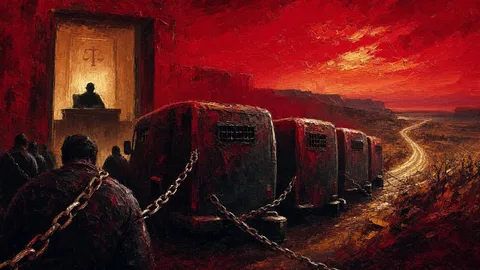
The Rostov court and its Kafkaesque logic
On June 18, 2026, the Southern District Military Court in Rostov-on-Don heard the indictment in the case of three men from Kherson: Oleksandr Kruchynenko, born July 1, 1982, a lawyer by profession; Mykola Semeniuk, born August 6, 1988, a farmer; and his brother Serhiy Semeniuk, born September 18, 1996. These three men have been held in Russian captivity since June 2022 — arrested, or more precisely abducted, a few days after the death of pro-Russian collaborator Dmytro Savluchenko on June 23, 2022.
The main charge? "International terrorism." Under Article 361 § 3 of the Russian criminal code, which defines an "international terrorist act" as any explosion, fire, or other action committed outside Russia that threatens Russian citizens "with the intent to violate the peaceful coexistence of states and peoples, or aimed at Russia's interests." Translation: resisting an illegal military occupation on your own soil is now classified as "international terrorism" by the state occupying you. It is the right to resist criminalized by the law of the occupier.
Four years of detention before the trial even begins
Kruchynenko and the Semeniuk brothers have been in Russian detention for four years. The case was not forwarded to the court until early April 2026. Four years of uncertainty, far from their families, subjected to a military judicial system that international law explicitly forbids an occupying power from applying in the territory it occupies. That four-year delay — without trial, without guaranteed access to lawyers of their choice, in the conditions one can imagine for Ukrainian prisoners of war in Russia — is itself a form of legal torture.
The international defense organization Defend Lawyers, which closely monitors this case, described the trial as a "cynical farce" and a "show trial." That language is not excessive: applying Russian criminal law to Ukrainian citizens for acts committed on Ukrainian soil, during a Russian military occupation, is a clear violation of international humanitarian law — specifically Article 64 of Geneva Convention IV, which forbids an occupying power from applying its own legislation in occupied territory.
Who are Oleksandr Kruchynenko and the Semeniuk brothers?
A lawyer, a farmer, a young man — three shattered lives
Oleksandr Kruchynenko was 40 years old at the time of his arrest in June 2022. A trained lawyer, he had allegedly been approached — according to the Russian version of events — by an SBU officer named Yevhen Loboda to form a resistance network in occupied Kherson. Loboda allegedly asked him to find people "willing to carry out terrorist activities" and to coordinate a clandestine group. The fact that it is the Russian prosecution itself that describes recruitment in those terms illustrates the nature of the indictment: in the Russian reading, any act of Ukrainian resistance is by definition "terrorist."
Mykola Semeniuk and his brother Serhiy were, according to revelations from independent Russian newspaper Mediazona at the June 18 hearing, members of the 73rd Naval Special Operations Center of Ochakiv, the intelligence branch of the Ukrainian Navy. They were not ordinary civilians who had spontaneously taken up arms — they were trained members of Ukraine's defense forces, operating under occupation. Under international law, they hold the status of lawful combatants.
The targets of their resistance: collaborators, not civilians
The Russian prosecution charges them with three specific acts. First, the death of Valery Kuleshov on April 20, 2022 — a Ukrainian police investigator who had betrayed his compatriots to become the designated future "chief of Kherson's occupation police" for the Russians. Second, an alleged attempt on the life of Volodymyr Saldo on June 7, 2022 — the same Saldo who today serves as the puppet "governor" installed by Moscow in occupied Kherson oblast. Third, the death of Dmytro Savluchenko on June 23, 2022 — appointed by the Russians as "head of the department of youth, family, and sports" of the occupation administration.
What strikes the eye is that all these targets were Ukrainian collaborators actively working for the Russian occupier. Kuleshov was to be installed as chief of the occupation police. Saldo still heads the puppet administration today. Savluchenko was a functionary of the occupation administration. Under international law, armed collaborators of the enemy are legitimate targets in an armed conflict. Resistance to occupation is protected by international law, not criminalized by it.
Article 361: a Russian law with an impossible geography
"International" terrorism in your own city
Article 361 § 3 of the Russian criminal code is particularly revealing of the legal absurdity at the heart of this case. It defines "international terrorism" as acts committed "outside Russia." Yet Kherson is not, and never will be, a Russian city — even though Moscow claimed to annex it via a sham "referendum" in September 2022. At the time the alleged acts took place (March–June 2022), Kherson was a Ukrainian city temporarily under Russian military occupation.
Applying Article 361 — pertaining to acts committed "outside Russia" — to events that occurred in a Ukrainian city reveals the fundamental contradiction in Russia's reasoning: either Kherson is Russian (in which case the article does not apply, because the acts would have been committed on Russian soil), or Kherson is Ukrainian (in which case Russia has no right to apply its criminal law on that territory). In both cases, the charge is legally untenable. But legal logic does not concern Russian military courts.
The potential sentences: twenty years or more
The three defendants face 20 years in prison or more under the combination of charges: participation in a terrorist organization (Article 205.4 § 2), acts of international terrorism (Article 361 § 3), attempted international terrorism, and several counts related to explosives (Articles 222 § 2, 222.1 § 4, 223.1 § 3). For Mykola and Serhiy Semeniuk, weapons smuggling charges are added.
These sentences are not idle threats in the Russian judicial system — they are regularly handed down. Russian military courts have sentenced dozens of captured Ukrainians to long terms on similar charges since 2022. What distinguishes this case from previous trials is that Kruchynenko and the Semeniuk brothers are being prosecuted for acts committed before Kherson's capture — that is, for resisting the invasion in its first weeks, when their city was still partly under Ukrainian control.
International law versus Russian "justice"
The Geneva Convention as an ignored shield
Geneva Convention IV of 1949, which Russia has signed, is explicit: an occupying power may not apply its own criminal law in occupied territory for acts committed before the occupation or in the context of legitimate resistance. Article 64 stipulates that the criminal law of the occupied territory remains in force, except to the extent necessary to ensure the security of the occupying power and its personnel.
The application of Article 361 of the Russian criminal code — which did not exist in the Ukrainian legislation applicable in Kherson — to acts of resistance committed on Ukrainian soil by Ukrainian citizens is a direct violation of these principles. This is not a debatable interpretation: it is the position defended by human rights organizations, international law jurists, and UN observers monitoring Russian judicial proceedings against Ukrainians.
The Special Tribunal for the Crime of Aggression: the context
This case fits within a broader international justice context. In May 2026, 36 states and the European Union formally created the Special Tribunal for the Crime of Aggression against Ukraine (STCA), which entered its "skeleton phase" on June 8, 2026 according to JusticeInfo.net. For the first time since the Nuremberg and Tokyo trials, an international tribunal is created specifically to try the crime of aggression. This tribunal will have jurisdiction to try the decision to launch the war — not individual war crimes, which fall under the International Criminal Court.
The painful irony is this: while the international community painstakingly builds the institutions meant to hold Russia accountable for its aggression, that same Russia organizes "terrorism" trials against those who dared resist that aggression. Two parallel judicial processes, with radically opposite conclusions about who is the criminal in this war.
Why this trial now? Four years after the facts
The mystery of the timeline
A question demands an answer: why this trial now, four years after the arrest of these three men? Defend Lawyers explicitly notes that there appears to be "no good reason" for having delayed the proceedings so long. The case was forwarded to the court only in April 2026, though the arrests date to June 2022.
Several hypotheses might explain the delay. First, Russian judicial procedures are notoriously slow in complex cases. Second, the Russian authorities may have used those four years of preliminary investigation to attempt to extract additional information about Ukrainian resistance networks. Third, the trial may serve a political communication purpose at a specific moment — demonstrating to the Russian public that the state is fighting against "Ukrainian terrorism" even in occupied territories.
A trial of deterrence
The deterrent dimension of this trial must not be underestimated. By publicly sentencing resisters to long prison terms, Russia sends a message to the Ukrainian population in the territories it occupies: resistance will not be tolerated and will be punished with the full force of the Russian criminal code, whether international conventions forbid it or not. This strategy of deterrence through the courts is part of the overall occupation apparatus: military control, administrative control, and now criminal control.
For Ukrainians still living in occupied territories — in the oblasts of Donetsk, Luhansk, Zaporizhzhia, Kherson, and in Crimea — the message is clear: any act of resistance, however justified under international law, exposes you to charges of "terrorism" and decades in the Russian prison system. This is systematic legal terror.
Discover

COLUMN : Europe Moved 8.5 Billion Euros in a…
That is what the European Commission says it has disbursed for…

INVESTIGATION: Beijing cuts Africa to 2.1 billion in loans…
2.1 billion — the lowest figure in almost twenty years, according…

SPECIAL REPORT: Beijing Promises Stimulus as Its Households Give…
That is the growth rate of Chinese industrial output in July,…
Consular access and the fate of prisoners
The invisibility of Ukrainian civilian prisoners
Unlike military prisoners of war, whose exchanges are regularly documented and publicized, Ukrainian civilian prisoners held in Russian jails — like Kruchynenko and the Semeniuk brothers — receive far less international coverage. They are not part of the formal exchange lists that primarily concern combatants. Their families struggle to obtain information about their detention conditions. Consular access is limited or nonexistent.
On June 27, 2026, Ukraine exchanged 160 prisoners of war, including defenders of Azovstal held since 2022 — the 76th exchange since the start of the invasion. These exchanges concern military combatants. The situation of civilian prisoners like the three Kherson men is different and far more precarious: they are subject to Russian judicial proceedings that, once completed, will officially transform them into "ordinary convicted criminals" in the eyes of the Russian prison system, with even fewer protections.
The 67 collaborators sanctioned by Zelensky
As a mirror image of the Kherson trial, President Zelensky signed decrees 501/2026 and 502/2026 on June 26, 2026, imposing sanctions against 67 collaborators and organizations active in occupied territories. These sanctions target kindergarten directors involved in the abduction of Ukrainian children, heads of occupation administrative structures, and companies supporting the Russian military-industrial complex. The symmetry is significant: while Russia tries Ukrainian resisters, Ukraine sanctions those who chose to cooperate with the occupier.
This Ukrainian policy of sanctioning collaborators responds to a deterrence logic similar to Russia's, but fundamentally different in its legal nature: Ukraine is sanctioning its own citizens who betrayed their country — which is legally legitimate for any sovereign state — not citizens who resisted an illegal occupation.
The legitimacy of resistance: an international law perspective
Article 51 of the UN Charter and resistance to occupation
International law is clear on the right to resist illegal occupation. Article 51 of the United Nations Charter recognizes the inherent right to individual or collective self-defense. International humanitarian law (Hague and Geneva law) distinguishes lawful combatants from civilians, but also recognizes the status of "levée en masse" — the spontaneous resistance of the civilian population to an invasion — as legitimate under the laws of war.
The Semeniuk brothers, members of the 73rd Naval Special Operations Center, are clearly lawful combatants under these criteria. Kruchynenko, if his activities were part of a structured organization with recognized command, would also fall under this category. The designation of "terrorist" implies, by definition, acts deliberately targeting civilians to spread terror — something the Russian prosecution cannot demonstrate, its own documents showing that the targets were armed collaborators of the occupier.
The Ukrainian Ombudsman and monitoring of the case
The Ukrainian Human Rights Ombudsman and international human rights organizations are closely following this case. It fits within a broader catalog of Russian judicial proceedings against Ukrainians, whose number has considerably grown since 2022. The International Claims Commission for Ukraine, whose full implementation Ukraine and the United Kingdom are seeking to ensure according to the joint leadership declaration of June 23, 2026, is one of the mechanisms through which victims of these proceedings might eventually obtain redress.
But future redress does not console men who are spending their years in Russian prisons today. For Kruchynenko and the Semeniuk brothers, international justice, when it comes, will come too late for the years of their lives already lost.
The context of repression in occupied territories
A systematic occupation judicial system
The case of the three Kherson men is not isolated. It fits within a structured system of judicial repression that Russia deploys across all the Ukrainian territories it occupies. The International Criminal Court has documented hundreds of cases of abusive judicial proceedings against Ukrainian citizens in occupied territories. The UN has recorded thousands of cases of enforced disappearances, arbitrary arrests, and illegal detentions.
The Special Tribunal for the Crime of Aggression (STCA) will eventually have jurisdiction to try the political and military decision-makers who ordered the war. But the individuals responsible for "terrorism" trials — the prosecutors, judges, and FSB officials who handled these cases — fall under other justice mechanisms, notably the ICC for war crimes and crimes against humanity. The file is building, slowly but surely.
The sanctioned collaborators: the other face of occupation
The 67 collaborators sanctioned by Zelensky on June 26 represent the other side of the same phenomenon: Russian occupation could not function without the active participation of Ukrainians who chose to serve the invader. These kindergarten directors involved in child abductions, these heads of occupation administrative offices, these engineers at companies manufacturing drones for the Russian army — they are the human cogs of an occupation machine that could not run without them.
Between the resistance of Kruchynenko and the Semeniuk brothers on one side, and the collaboration of the 67 on the other, lies the entire spectrum of human choices under occupation. This spectrum has always existed in every occupation in history — from the Second World War to contemporary conflicts. And in all those stories, resisters end up being recognized for what they were, and collaborators for what they were too.
The international reach of the case
This trial in the reports of human rights organizations
This case is documented by Defend Lawyers, an international organization defending lawyers and jurists under pressure. It feeds into the reports of the UN High Commissioner for Human Rights on the situation in occupied Ukrainian territories. It will contribute to the work of the future Special Tribunal for the Crime of Aggression and the ICC's investigations into violations of international humanitarian law in Ukraine.
On June 24, 2026, the United Kingdom presented a statement to the OSCE on Russia's "extensive and well-documented violations" of international humanitarian law in Ukraine. Those violations include precisely the type of abusive judicial proceedings that Kruchynenko and the Semeniuk brothers face. The international community observes, documents, and charges. The judicial process, at the international level, is underway — even if its slowness is painful.
The role of international media
International coverage of this case is limited. Major Western media do not cover the trials held in Russian military courts in Rostov against Ukrainian resisters. That is a gap that specialized organizations like Defend Lawyers, Euromaidanpress, and Ukrainian monitoring teams are trying to fill. Without this systematic documentation, these trials proceed in invisibility — which is exactly what the Russian authorities want.
Because international visibility is a form of protection. When the world knows that a man is being tried for resisting the illegal occupation of his city, pressure increases for that trial to be conducted according to minimum standards — and for those men to be eventually included in future prisoner exchanges. Invisibility, by contrast, facilitates abuse. That is why this kind of reporting — modest as it may be, and belated — has genuine utility.
Kherson's resistance: a heroic chapter under-documented
The first months of occupation: men and women standing firm
Kherson fell on March 1, 2022, only five days after the invasion began. The city found itself virtually without military defense against the Russian advance, and the resistance that organized in the first months was primarily civilian and clandestine. Public demonstrations took place in Kherson's streets, Ukrainian flags were hung, underground resistance networks were formed to gather intelligence, sabotage Russian operations, and target the most active collaborators.
In that context, the activities charged against Kruchynenko and the Semeniuk brothers — organizing a clandestine network, targeting occupation collaborators — corresponded exactly to what any organized resistance does in any occupation conflict. The fact that their targets were people who had actively chosen to betray their country and serve the occupier does not diminish their legitimacy — it reinforces it.
The liberation of November 2022 and its aftermath
On November 11, 2022, Kherson was liberated by Ukrainian forces. It was one of the most symbolically important victories of the war. But that liberation came too late for Kruchynenko and the Semeniuk brothers, arrested in June 2022, five months before their city regained freedom. They had helped maintain resistance through the darkest months of the occupation, and they are paying the price in Russian prisons while their fellow citizens live — despite the relentless shelling on the right bank of the Dnipro — in an officially Ukrainian city.
Kherson's liberation transformed these men from shadow resisters into forgotten prisoners of war. Their cause deserves to be recalled — not only for them, but for all those in still-occupied territories who make the same choices of resistance and deserve the same international support.
The expected verdict and its implications
In Russian military courts, the verdict is rarely surprising
The foreseeable outcome of this trial is conviction. Russian military courts have a conviction rate approaching 99 percent according to available data — a statistic that speaks volumes about their nature. This is not a judicial body in the Western sense — it is an instrument for legitimizing decisions already made by Russian security services.
The accused do not deny, according to available information, their participation in the events charged against them — they simply reject the characterization as "terrorism." That is a fundamental distinction, both legally and morally: one can accept responsibility for one's acts while contesting their criminal characterization. Kruchynenko and the Semeniuk brothers will in all likelihood be sentenced to long terms. But their conviction by a Russian military court carries no more legitimacy than any other act of an illegal occupying power in a territory it has no right to occupy.
The future: inclusion in prisoner exchanges?
The question that arises for the future is whether these men will be included in prisoner exchanges. Once convicted by Russian justice, they will officially be "ordinary convicts" in Russia's eyes — a designation that complicates their inclusion in formal prisoner-of-war exchanges. But Ukraine has already managed to include arbitrarily detained civilians in certain exchanges, including the 7 civilians repatriated on June 27, 2026 according to Ukrainian Pravda.
The fate of Kruchynenko and the Semeniuk brothers will depend partly on the international pressure exerted on Russia to include them in future exchanges, and partly on Ukrainian negotiations with Moscow — negotiations that often unfold far from cameras. It is a silent struggle, with no guarantee of success, that their families and human rights organizations will continue to wage.
The moral question: can those who resisted be judged?
Resistance to occupation: a universal right
At its core, this case raises a fundamental moral question: can one, morally, condemn men who resisted the illegal occupation of their country? The answer is no — and not only on moral grounds. Under international law, resistance to an illegal occupation is explicitly protected, not criminalized. The distinction between legitimate resister and terrorist rests on the nature of the targets and the methods used, not on the mere fact of resisting.
The targets of Kruchynenko and the Semeniuk brothers were armed collaborators of the occupier — people who had actively chosen to work toward establishing the Russian occupation administration. This is not indiscriminate terrorism against innocent civilians. It is organized resistance against the human instruments of occupation. The distinction is clear in international law, even if the Russian judicial system chooses to ignore it.
On the same topic

SPECIAL REPORT: Beijing buys 40 cargoes of sanctioned Russian…
On August 28, 2025, a tanker named Arctic Mulan moored at…
INVESTIGATION: 316 political cases in Crimea — the occupation…
Three hundred and sixteen people are being prosecuted on political grounds…
INVESTIGATION: Beijing cuts Africa to 2.1 billion in loans…
2.1 billion — the lowest figure in almost twenty years, according…
What this case says about Russia
In the end, this trial says more about Russia than about the accused. A state that criminalizes resistance to its own illegal occupation, that applies its criminal law to citizens of another country on the soil of that other country, that sentences men to twenty years in prison for having defended their city — that state reveals its true nature. This is not a democracy applying the law based on universal principles. It is a power state that uses law as a tool of domination.
And that nature, documented in every hearing of the Rostov military court, is precisely what the Special Tribunal for the Crime of Aggression against Ukraine and the International Criminal Court are assembling in their files. Justice takes time. But it has a long memory.
International justice and its limits in an active conflict
The challenges of documenting evidence in occupied zones
The Rostov trial illustrates a painful reality of wartime justice: evidence is difficult to collect in territories under military occupation. Witnesses are intimidated or displaced. Documents are destroyed or falsified. Crime scenes are inaccessible to independent investigators. This reality limits the scope of judicial proceedings that can be conducted during the conflict itself.
But it does not make them impossible. Organizations such as the International, Impartial and Independent Mechanism (IIIM) for war crimes in Ukraine, the International Criminal Court (ICC), and specialized NGOs like Human Rights Watch and Amnesty International document international law violations in real time, as far as possible. These files will serve as the basis for future judicial proceedings, whether before national or international jurisdictions.
The role of international organizations in judicial monitoring
The Kherson trial — conducted in Russia against Ukrainian resisters — is itself a case documented by these organizations. The fact that these men are tried for "terrorism" because of their resistance to an illegal military occupation constitutes a documented violation of international humanitarian law. That documentation is valuable for future accountability proceedings.
International justice builds slowly. The ad hoc tribunals for the former Yugoslavia and Rwanda took years to deliver their first verdicts. The ICC has already issued an arrest warrant against Vladimir Putin himself for the deportation of Ukrainian children. These processes are imperfect and slow — but they exist, and the evidence accumulates to sustain them.
The right to resist in the Ukrainian context
The legal framework of resistance to occupation
International law explicitly recognizes the right of peoples to resist foreign military occupation. Article 1(4) of Additional Protocol I to the 1977 Geneva Conventions extends the protection afforded to combatants to wars of national liberation against foreign occupation. Within that legal framework, Ukrainian resisters who fought the Russian occupation in Kherson are exercising a right recognized by international law — not committing a terrorist crime.
The characterization of "terrorism" used by Russia in this trial is an instrumentalization of legal terminology for political ends. This instrumentalization is documented in many contexts — authoritarian regimes using anti-terrorism laws to criminalize political opposition and resistance to occupation. The fact that Russia applies this logic to Ukrainian resisters does not alter their status under international law.
Historical precedents and their applicability
Historical precedents illuminate this situation. French partisans tried by German military courts during the Nazi occupation were rehabilitated after the war. Vietnamese resisters tried by colonial courts were recognized as national heroes. History has systematically rehabilitated those who resisted illegal occupations, even when the occupier's courts had convicted them.
For the men tried in Rostov, that historical perspective is distant and abstract. They face prison sentences in a judicial system controlled by the state accusing them. But for their families, for the Ukrainians following this trial, and for the history recording it — their resistance will be assessed by the standards of international law, not Russian anti-terrorism legislation.
Conclusion: injustice named is already half-defeated
What we owe Kruchynenko and the Semeniuk brothers
We — journalists, observers, citizens of free countries — have an obligation toward Oleksandr Kruchynenko, Mykola, and Serhiy Semeniuk: not to let them disappear into the silence of Russian prisons. To name their case, document their story, recall the principles of international law that render their conviction illegitimate. That is not much compared to what they are living. But it is what is possible from here.
These men resisted an illegal occupation on their own soil. They did not abandon their country when it needed them most. They paid and continue to pay the price of that choice in the prisons of Rostov-on-Don. The least we can do is ensure that the world remembers their story — not as that of terrorists convicted by a puppet court, but as that of Ukrainian resisters whose cause is just, and whose freedom is a debt the international community should endeavor to repay.
A documented injustice does not disappear
The history of occupations and resistances has shown one constant: well-documented injustices eventually come to be recognized. The French resisters sentenced by German military courts between 1940 and 1944 did not remain "terrorists" in history — they became national heroes. Polish, Greek, and Dutch resisters sentenced by the Nazi occupier were rehabilitated, honored, commemorated. There is no reason for history to treat Kruchynenko and the Semeniuk brothers any differently — and every reason to expect that those judging them today will be held accountable before tomorrow's courts.
By Maxime Marquette, columnist
Columnist's transparency note
Position and ethical commitment
I am pro-Ukrainian and I consider resistance to Russian occupation to be legitimate. My analysis of this legal case is necessarily colored by that conviction. I have tried to clearly distinguish what is documented (the charges, the dates, the names of the accused) from what belongs to my editorial interpretation (the characterization of the acts as legitimate resistance). I acknowledge that the legal characterization of certain of these acts may be subject to debate in specific contexts, and I invite the reader to consult the international law analyses of qualified specialists.
Sources and method
The factual account of this case rests primarily on the documentation produced by Defend Lawyers (June 22, 2026), an organization that closely monitors Russian judicial proceedings against Ukrainians. I supplemented this information with sources on the context of the Kherson occupation and international law developments relating to Ukraine. I do not have access to the Russian judicial files themselves, nor to direct testimony from the accused or their relatives.
Sources
Primary sources
Secondary sources
Get the geopolitics analyses
Conflicts, powers, alliances: the MadMax thread without the noise.
Cite this article
Maxime Marquette (2026). COLUMN: Resisting in Kherson under occupation — and spending twenty years in prison for it. MadMax. https://mad-max.co/en/article/chronique-resister-a-kherson-sous-occupation-et-passer-vingt-ans-en-prison-pour-
Read next
COLUMN : Europe Moved 8.5 Billion Euros in a…
That is what the European Commission says it has disbursed for…
INVESTIGATION: Beijing cuts Africa to 2.1 billion in loans…
2.1 billion — the lowest figure in almost twenty years, according…
SPECIAL REPORT: Beijing Promises Stimulus as Its Households Give…
That is the growth rate of Chinese industrial output in July,…
Enjoyed this piece? Get the next one.
One chronicle a week, straight to your inbox. No noise.
This article was generated with AI assistance, under human supervision.
Comments
Be the first to weigh in.