

COLUMN: Art and War — When Eurosatory 2026 Looks Like a Dystopian Future Gallery Opening
From 15 to 19 June 2026, the Paris-Nord Villepinte Exhibition Centre was transformed into something unique in the world — something that press releases cautiously called a "show", but which felt, to anyone walking its halls, like a museum of the world as it actually is. Eurosatory 2026 — 2,100 exhibitors, 68 countries, 50,000 visitors, 185,000 square metres of exhibition space
- From 15 to 19 June 2026, the Paris-Nord Villepinte Exhibition Centre was transformed into something unique in the world — something that press releases cautiously called a "show", but which felt, to anyone walking its halls, like a museum of the world as it actually is. Eurosatory 2026 — 2,100 exhibitors, 68 countries, 50,000 visitors, 185,000 square metres of exhibition space
- COLUMN: Art and War — When Eurosatory 2026 Looks Like a Dystopian Future Gallery Opening
- Introduction: A Museum That Does Not Say Its Name
Facts, quotes, and cited links remain in the body. Interpretations are framed as analysis or opinion according to the format.
COLUMN: Art and War — When Eurosatory 2026 Looks Like a Dystopian Future Gallery Opening
Introduction: A Museum That Does Not Say Its Name
185,000 square metres of possible and impossible futures
From 15 to 19 June 2026, the Paris-Nord Villepinte Exhibition Centre was transformed into something unique in the world — something that press releases cautiously called a "show", but which felt, to anyone walking its halls, like a museum of the world as it actually is. Eurosatory 2026 — 2,100 exhibitors, 68 countries, 50,000 visitors, 185,000 square metres of exhibition space — was officially "the world's largest land and air-land defence event". Unofficially, it was the place where ongoing wars and wars yet to come made their appointment, under fluorescent lights, with buffets and business cards.
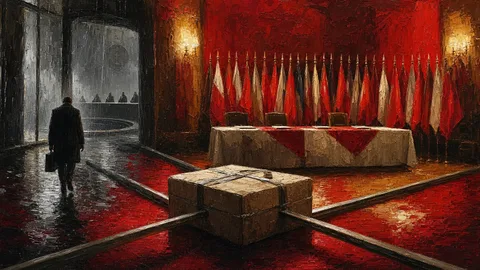
I walked through it with a columnist's eyes, not a buyer's. And what I saw fascinated and unsettled me in equal measure. Autonomous combat robots displayed on pedestals like contemporary sculptures. Ten-tonne submarine drones exhibited like industrial artwork. Long-range missiles arranged in air-conditioned halls, under lighting that would have done credit to a gallery in the Marais. Death neatly packaged in four-colour brochures. The future of humanity staged with the care of a luxury storefront. I am not sure whether that is fascinating or terrifying — perhaps both, simultaneously and inextricably.
"The most ambitious in the event's history" — and it shows
The organisers of Eurosatory 2026 had promised the most ambitious edition in the history of this show that has existed since the 1960s. The promise was kept. The extension into Hall 4 made it possible to accommodate all the exhibitors that the previous edition had only been able to fit in Hall 5B. The demonstration area was completely redesigned to "reflect the reality of modern operations" — which in concrete terms means: reconstructions of trench warfare, demonstrations of 3D drone manoeuvres, simulations of urban combat. The vitrification of the battlefield as a tourist attraction.
The official speakers included European Defence Commissioner Andrius Kubilius, French Minister of the Armed Forces Catherine Vautrin, French Army Chief of Staff General Pierre Schill, British Army Commander Lieutenant General Zac Stenning, and representatives from Poland, Lithuania, Belgium and European Frontex. An assembly of military and political leaders that perfectly illustrates what the world has become in 2026: a place where generals give speeches in exhibition halls and ministers pose in front of combat drones for photographers.
Robots — From Science Fiction to the Supply Chain
Autonomy as the new paradigm
If a single concept dominated the aisles of Eurosatory 2026, it was autonomy. No longer remote-controlled systems operated by a human — but systems capable of perceiving their environment, making decisions, executing missions with reduced or zero human intervention. Autonomous ground reconnaissance robots that patrol independently. Drone swarms coordinated by artificial intelligence. Pilotless logistics vehicles that follow military columns. Air defence systems that identify and neutralise threats in milliseconds — far faster than any human operator could manage.
The Sea Trident from Ukrainian company Global Mark, presented at Eurosatory, perfectly illustrates this trend. An underwater drone weighing 10,000 kg, with a range of 2,000 nautical miles, capable of navigating to a depth of 60 metres with "full autonomy and adaptive navigation". Its missions: strategic strikes, logistics deliveries, interception of other underwater drones. Its dimensions: 10 x 2 x 1.5 metres. Its top speed: 10 knots. Its maximum payload: 1,000 kg. I stood a long time looking at that autonomous submarine the size of a truck, and thought about the thousands of kilometres of Ukrainian, Russian and global coastline it could traverse without any human noticing.
The ethical limits of lethal autonomy
The autonomy of weapons systems raises ethical and legal questions that Eurosatory's catalogues do not address — and that is precisely what makes the show unsettling for a non-military observer. Who is responsible when an autonomous robot kills a civilian? How is proportionality determined for an attack decided by an algorithm? Does international humanitarian law, developed for conflicts between humans, apply without modification to systems that make lethal decisions without direct human intervention?
These questions are not rhetorical — they are being debated in forums like the UN Committee on Lethal Autonomous Weapons Systems (LAWS), without a binding regulatory consensus emerging to date. Meanwhile, the technologies advance and are deployed. The gap between technological reality and ethical regulation widens every year. Eurosatory 2026 was a living demonstration: the technology is ready, exhibited, commercialised — while international lawyers are still searching for how to regulate it.
Drones — The Art of Miniaturised Warfare
From model to battlefield in real time
The paradox of defence shows has always been this: what is presented in exhibition halls has often already been tested in real conditions. Eurosatory 2026 pushed this irony to its extreme. The drones displayed on Ukrainian stands were not prototypes — they were improved versions of systems striking Russia the night before. The brochures presented technical specifications that Ukrainian operators already knew by heart, from the depths of their trenches or bunkers. The defence show as a near-real-time summary of an ongoing war: this is a historical novelty.
Among the systems presented, the Vyrivniuvach ("Equaliser") from DG Industries, now in serial production, draws attention: a guided glide bomb with a claimed range of 130 km — well beyond sector norms. Military analysts estimate the practical range at 60 to 90 km under real Ukrainian conditions, but even that bracket represents significant capability. The FP-2 from Fire Point — with its 105 kg payload over 200 km, and a long-range version in development based on the FP-1 capable of striking at 1,400 km — illustrates the diversity of solutions available. The range has grown so broad that a potential buyer has an embarrassment of choices.
Ukraine as an involuntary showroom
There was something uncomfortable — and absolutely fascinating — about the fact that the 80 Ukrainian companies present at Eurosatory were showcasing technologies tested in real wartime conditions, simultaneously. During the five days of the Paris show, Ukrainian drones were striking targets in Russia every night. Those same drones, or their equivalents, were on display in Villepinte. The battlefield as a commercial argument: "this technology works — proof in real time". This is a form of marketing that has no equivalent in any other industrial sector.
The rise of Ukrainian companies — from 10 to 80 exhibitors between the last two editions — transformed their role within the show. They were no longer recipients of international aid looking for suppliers — they were exporters of battle-proven military technology, signing co-production agreements with European partners. The agreement signed at Eurosatory between Ukrainian Armor and AviaNera Technologies (Czech Republic) for drone and missile engines is the most concrete example. Ukraine has become a global hub for defence innovation — and Eurosatory made this reality tangible for those who still doubted it.
Missiles — Long-Range Power in Chrome-Plated Boxes
On the same topic
INVESTIGATION: 36 States Sign in Chișinău — and the…
Thirty-four members of the Council of Europe, plus Australia, plus Costa…

ANALYSIS : Taiwan Puts NT$1,122.5 Billion Into Defence, Over…
Hold that number for a moment, because it marks the crossing…

INVESTIGATION : Russia's FSB Erases 4 Ukrainian Regions' Border…
Not an assault, not an ultimatum, not a televised proclamation from…
The range race — and what it reveals
If drones dominate conversations at Eurosatory 2026, missiles remain the instrument of strategic power — and their presence in exhibition halls is, equally, striking in its apparent banality. Systems capable of striking at hundreds or thousands of kilometres, displayed between a fleet management software stand and a body armour manufacturer. The absolute decontextualisation — tearing these instruments from their context of use to place them under fluorescent lights — creates an almost surrealist aesthetic effect.
The range race reflects a doctrine that has asserted itself in recent conflicts: whoever strikes from further away gains an asymmetric advantage. French SCALP missiles, American ATACMS systems, Ukrainian long-range missiles in development — all illustrate this logic. At Eurosatory, defence companies present their ranges with impressive technical precision — ranges in kilometres, payloads in kilograms, accuracy in metres — as one might present the specifications of a luxury car. The aestheticisation of firepower as an object of industrial desire: that is the permanent subtext of defence shows.
The questions that brochures do not ask
Eurosatory's brochures do not ask who will end up under the missiles displayed on their glossy pages. They do not ask about civilian populations, infrastructure, the dead. That is not their role — they sell military capabilities to armed forces that have their own doctrines and legal frameworks. But the civilian observer that I am cannot help holding both realities in mind simultaneously: the technical sophistication presented in these halls, and what it produces when applied to real cities, real hospitals, real homes.
This is not a criticism of the defence industry as such — in a world where Putin bombs Ukrainian cities, where China presses on Taiwan, where Iran develops its ballistic missile capabilities, having credible military capabilities is a necessity for the survival of democracies. But it seems important to maintain this awareness — that behind every system on display at Eurosatory, there are real uses, real lives, real political and military decisions. The show should never become as comfortable as a luxury window display without that consciousness.
The Theme of "Multi-Domain Superiority" — and What It Conceals
When military terminology meets management jargon
The strategic themes highlighted by Eurosatory 2026 deserve an analysis of their vocabulary: "multi-domain superiority", "remote engagement", "land manoeuvre and air mobility", "comprehensive security", "crisis management and industrial resilience". These formulations are those of a sector that has learned to speak the language of strategic management as much as military doctrine. "Multi-domain superiority" — which roughly means the ability to act simultaneously and in a coordinated fashion across land, air, naval, space and cyber domains — is the central concept of modern warfare.
This concept is not new — it emerged from American experience in the Gulf wars and in Afghanistan. But it has taken on new meaning with the war in Ukraine, where the combination of FPV drones, long-range missiles, electronic warfare, cyber attacks and propaganda has created an operational environment of unprecedented complexity. Eurosatory 2026 presented the industrial responses to this complexity — and they are impressive in their diversity and sophistication.
The demonstration area — war as spectacle
The redesigned demonstration area of Eurosatory 2026 — with its reconstructions of trench warfare, 3D drone manoeuvres and urban combat simulations — embodies the central paradox of these major shows: to sell instruments of war, they must be shown in operation. And showing them in operation means turning them into spectacle. Visitors watching demonstrations of armoured vehicles or tactical drones in a manicured demonstration zone are experiencing something fundamentally different from those who see the same systems used in actual combat in Donetsk or Kherson.
This staging is not a flaw of Eurosatory — it is inherent to the nature of professional trade shows. But it creates an aesthetic distance that can be misleading. War is dirty, chaotic, traumatising for everyone who lives it. Trade show demonstrations are clean, orderly, impressive. The gap between the two should remain conscious for anyone attending these events — and notably for the political and military decision-makers who make purchasing decisions there that will have consequences far beyond Villepinte.
What Eurosatory Says About Our Time
A world that accepts war as a permanent reality
Thirty years ago, the idea of staging the world's largest defence show in Europe would have seemed anachronistic — on a continent convinced it had turned the page on armed conflict with the end of the Cold War. Eurosatory 2026, with its record ambitions, its 50,000 visitors and its considerable media presence, says something clear about the era: we have accepted — perhaps resigned to it, perhaps lucidly — that war has once again become a permanent and proximate reality, not a distant parenthesis or an anomaly of history.
This acceptance is not in itself pessimistic — it can be read as a return to realism after decades of post-historical illusions. But it raises a deep cultural question: how does a society that "normalises" war to the point of turning it into a leading commercial event in Paris simultaneously maintain an aspiration to peace? How to reconcile the need to arm democracies and the refusal to let war become banal? That is a tension that Eurosatory's organisers do not resolve — it is not their role. It is ours, as citizens and observers.
Ukraine as a phantom presence at every stand
What was present everywhere at Eurosatory 2026, even at stands that did not explicitly mention Ukraine, was the reality of the Russo-Ukrainian war as a universal reference. Every system is evaluated against its potential effectiveness in that conflict. Every doctrine is tested against what Ukrainian soldiers have learned in their trenches. Ukraine is not merely a client or an exhibitor — it is the verification standard for everything presented in Paris. The most documented war in modern history — with drones filming every strike, open-source data analysed in real time — has become the benchmark of contemporary defence.
And in that phantom presence, there is something important to grasp: Ukraine is not a special case, a geographical or historical anomaly. It is the demonstration of what can happen to any democracy that finds itself facing an authoritarian neighbour determined to crush it. The buyers of defensive systems in Eurosatory's aisles — whether Polish, Lithuanian, Finnish or Taiwanese — know this. Zelensky knows it. And the industrialists signing contracts in Paris know it too. This shared clarity is, paradoxically, the only genuinely reassuring thing in this fascinating and chilling show.
Discover

COLUMN : Europe Moved 8.5 Billion Euros in a…
That is what the European Commission says it has disbursed for…

INVESTIGATION: Beijing cuts Africa to 2.1 billion in loans…
2.1 billion — the lowest figure in almost twenty years, according…

SPECIAL REPORT: Beijing Promises Stimulus as Its Households Give…
That is the growth rate of Chinese industrial output in July,…
Women at Eurosatory: Representations and Realities of a Still-Male Sector
The defence sector facing its cultural revolution
Walking Eurosatory's aisles, one cannot help noticing a visible tension: at the stands showcasing the most advanced technologies — autonomous drones, electronic warfare systems, digital command platforms — the presentation teams are predominantly composed of male engineers and military personnel. The defence sector is one of the least female-represented among advanced technology industries. According to European Union data, women make up less than 25% of employment in Europe's defence industries.
This reality is changing — slowly. Targeted recruitment programmes at major companies — Thales, BAE Systems, Leonardo — aim to bring more women into defence engineering careers. The European Defence Agency published in 2025 a report on "Diversity and Inclusion in European Armed Forces" that highlights the link between team diversity and operational performance. Military studies show that more diverse units achieve better results in complex operations requiring rapid decision-making under pressure. This is a pragmatic argument — not merely an ideological one — for a more inclusive defence industry.
Eurosatory's technologies and their impact on civilian populations
One angle poorly represented in Eurosatory's official communications is that of the humanitarian impact of the technologies on display. Precision-guided munitions reduce collateral damage compared to unguided weapons — this is a real, documented argument. But even the most precise weapons kill civilians in modern urban warfare. The conflict in Ukraine — where cities like Kharkiv, Mariupol and others have been reduced to fields of rubble — demonstrates this with relentless clarity.
Humanitarian organisations — Human Rights Watch, Amnesty International, the ICRC — have teams that track the use of weapons displayed at shows like Eurosatory on real theatres of war. Their reports document the reality of the civilian impact of modern weapons, including those that benefit from the best available guidance technology. These reports are not displayed at Eurosatory's stands — but they are part of the reality of the world in which these technologies are deployed. Ignoring them would be a form of intellectual dishonesty.
Electronic Warfare: The Invisible Front That Eurosatory Brought to Light
Jamming, decoys and countermeasures: the battle for the electromagnetic spectrum
Among the visually least spectacular but most strategically important halls at Eurosatory, electronic warfare systems occupied a growing place. The Ukrainian conflict demonstrated that mastering the electromagnetic spectrum — the ability to jam enemy communications, neutralise adversary GPS systems, decoy air defence radars — is as decisive as raw firepower. Companies like Rohde and Schwarz, L3Harris, Hensoldt and Thales presented portable tactical jamming systems, electronic emission detection and classification tools, and digital communications protection systems against adversary interception.
Ukraine was forced to develop its own electronic warfare capabilities to counter Russian systems — and it has produced innovative low-cost solutions that experts studied with keen interest at Eurosatory. Ukrainian teams presented notably portable drone jamming systems, developed in just a few months, that have shown real operational effectiveness in the field. This is another example of the Ukrainian innovation revolution that fascinates the entire global defence industry.
Military cybersecurity: when weapons systems become digital targets
Modern weapons systems are computer networks that fire, fly and navigate. Their connectivity — which is their operational strength — is also their fundamental vulnerability. At Eurosatory, several companies specialising in military cybersecurity — Airbus CyberSecurity, MBDA with its digital division, Thales Cybersecurity — presented solutions to protect connected weapons platforms against cyberattacks, software intrusions and remote takeover attempts. This threat is not theoretical — cybersecurity incidents involving military equipment have been documented by independent researchers.
The convergence of physical warfare and digital warfare is redefining the design standards for weapons systems. A tank or a missile that can be hacked is a threat to its own operator as much as to the enemy. Cybersecurity certifications for military equipment are becoming as important as ballistic performance or mechanical reliability certifications. NATO has established minimum cybersecurity standards for allied forces' equipment — but their application remains uneven across alliance members, creating weak links in the chain of collective defence.
Conclusion: The Dystopian Future Is Already Here — Let Us Face It
Neither condemnation nor celebration — a demand for consciousness
Eurosatory 2026 is neither an event to condemn nor to celebrate without nuance. It is a mirror. A mirror of what the world has become — a world where democracies have understood that they must defend themselves to survive, and where this necessity has generated an arms industry operating with all the logic of the market: innovation, competition, marketing, costs, margins. This is not beautiful in the aesthetic sense. It is real, it is necessary, and it is our collective responsibility to understand all its dimensions.
What I take away from Eurosatory 2026 is less the systems themselves than what they collectively represent: an era that looked the reality of the Russian, Chinese and Iranian threat squarely in the face, and decided to stop pretending it could be immunised by the sole force of its pacifist convictions. This is a maturity hard won. The dystopian future gallery opening takes place every day in Ukraine — Eurosatory was simply its illustrated catalogue.
Art and war — an ancient relationship, never resolved
Art and war have always maintained a complex relationship. From Goya painting the atrocities of the Napoleonic war to Picasso creating Guernica to denounce the bombings of the Spanish Civil War, artists have often been the first to name what soldiers and politicians preferred to leave unsaid. In an inverted sense, the halls of Eurosatory are also an aesthetic space — the aesthetic of industrial power, of technological precision, of form in the service of lethal function. This is not art in the critical sense of the term. But it is a form of material culture that says much about what we are and what we value.
The next edition of Eurosatory will take place in two years. It will be even more ambitious, even more technologically advanced, even more populated with Ukrainian companies if the war continues — or with a new kind of players if something has changed in the geopolitical space by then. What I know is that I will look at that next show with the same mixed eyes: those of a columnist who sees the necessity and who cannot quite resolve his unease in front of the strange beauty of killing machines under fluorescent lights.
Columnist's Transparency Note
Positioning and bias
Maxime Marquette did not attend Eurosatory 2026 in person — this column is based on journalistic sources covering the event, the show's official communications, and reporting from specialist media outlets. The use of "I" and first-person descriptions is a stylistic choice of the column as a genre, not an assertion of physical presence. The author supports the defence of democracies and the strengthening of Ukrainian and European military capabilities. He simultaneously harbours ethical reservations about certain aspects of the autonomy of weapons systems.
The author has no ties to defence industry companies, national armed forces or governmental defence organisations. Technical data on the cited systems comes from open sources — manufacturer communications, specialist press reporting, analyses from Euromaidan Press, Militarnyi and EU Perspectives. This column was written on 27 June 2026.
What this article does not cover
This column does not constitute an exhaustive technical review of the systems presented at Eurosatory 2026 — that is not its purpose. Nor does it cover the commercial and contractual aspects of transactions concluded during the show. The perspective of non-Western countries on Eurosatory — particularly nations that are neither NATO members nor allies of Western democracies — is absent from this analysis. A more complete geopolitical analysis of the show would need to incorporate those perspectives.
The author acknowledges that his posture as a "troubled observer" of the defence industry may seem uncomfortable — or even hypocritical — to those doing the difficult work of developing and deploying these systems to defend values the author shares. He embraces this as a tension inherent to his role as a columnist.
By Maxime Marquette, columnist
Sources
Primary sources
Secondary sources
Get the geopolitics analyses
Conflicts, powers, alliances: the MadMax thread without the noise.
Cite this article
Maxime Marquette (2026). COLUMN: Art and War — When Eurosatory 2026 Looks Like a Dystopian Future Gallery Opening. MadMax. https://mad-max.co/en/article/chronique-l-art-et-la-guerre-quand-eurosatory-2026-ressemble-a-un-vernissage-du
Read next
COLUMN : Europe Moved 8.5 Billion Euros in a…
That is what the European Commission says it has disbursed for…
INVESTIGATION: Beijing cuts Africa to 2.1 billion in loans…
2.1 billion — the lowest figure in almost twenty years, according…
SPECIAL REPORT: Beijing Promises Stimulus as Its Households Give…
That is the growth rate of Chinese industrial output in July,…
Enjoyed this piece? Get the next one.
One chronicle a week, straight to your inbox. No noise.
This article was generated with AI assistance, under human supervision.
Comments
Be the first to weigh in.