

OPINION: Ukraine Strikes Russian Refineries — 25% of Capacity Goes Up in Smoke
There is something deeply symbolic in this act of war: Ukraine, fighting for its survival for more than four years with often inadequate means, has managed to strike directly at the heart of the oil machine that finances this war. Long-range Ukrainian drones have hit the refineries of Slaviansk-na-Kubani in the Krasnodar region, the oil installations at Yaroslavl, the fuel depo
- There is something deeply symbolic in this act of war: Ukraine, fighting for its survival for more than four years with often inadequate means, has managed to strike directly at the heart of the oil machine that finances this war. Long-range Ukrainian drones have hit the refineries of Slaviansk-na-Kubani in the Krasnodar region, the oil installations at Yaroslavl, the fuel depo
- OPINION: Ukraine Strikes Russian Refineries — 25% of Capacity Goes Up in Smoke
- Introduction: When the war reaches Putin's oil
Facts, quotes, and cited links remain in the body. Interpretations are framed as analysis or opinion according to the format.
OPINION: Ukraine Strikes Russian Refineries — 25% of Capacity Goes Up in Smoke
Introduction: When the war reaches Putin's oil
Ukrainian drones at the heart of Russia's war economy
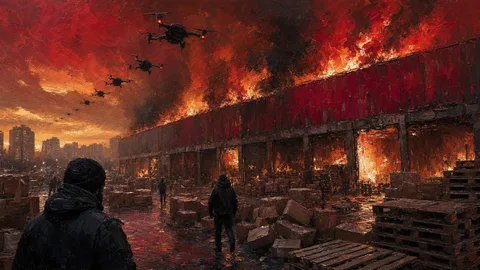
There is something deeply symbolic in this act of war: Ukraine, fighting for its survival for more than four years with often inadequate means, has managed to strike directly at the heart of the oil machine that finances this war. Long-range Ukrainian drones have hit the refineries of Slaviansk-na-Kubani in the Krasnodar region, the oil installations at Yaroslavl, the fuel depots at Kerch in Crimea, and the terminal at Port Kavkaz. In total, according to available assessments, these strikes have put roughly 25% of the Russian refining capacity accessible from Ukrainian territory out of commission.
That figure — a quarter of refining capacity affected — is not merely military. It is economic, strategic, and symbolic. Russia draws its war revenues from oil. Its military vehicles run on fuel refined in those facilities. Its missiles are built with petrodollars. When Ukraine hits a refinery, it is not just destroying an industrial installation — it is firing a bullet directly into Putin's wallet. And Putin was rattled enough by it to publicly acknowledge the need to reinforce his air defenses.
A Putin admission worth its weight in gold
In his public statements at the end of June 2026, Vladimir Putin acknowledged that Ukrainian strikes on refineries justified strengthening Russia's air defense systems. That is an extraordinary admission — not only that these strikes are having a real effect, but that Russia was not adequately prepared to counter them. Russian air defense, presented as impenetrable in Kremlin rhetoric, clearly has gaps that Ukrainian drone engineers know how to exploit with growing precision.
In Crimea, the consequences were immediately visible to the local population: fuel sales were temporarily suspended at several gas stations following the strikes on the Kerch depots. Ordinary residents with no say in wartime decisions found themselves queuing at dry pumps — a direct consequence of a Ukrainian military strategy targeting the economic infrastructure of the illegal occupation of the peninsula.
The anatomy of the strikes — Slaviansk, Yaroslavl, Kerch, Port Kavkaz
The Slaviansk-na-Kubani strike in Krasnodar
The Slaviansk-na-Kubani refinery, in the Krasnodar region in southwestern Russia, is one of the most important refining installations on the Russian southern flank. Its processing capacity fuels a large share of fuel distribution across the North Caucasus and plays a crucial logistical role for Russian military operations in the southern theater. Striking it means attacking a direct logistical artery of the Russian war machine in the most active sector of the conflict.
Satellite imagery available after the strike shows significant damage to several distillation units and storage tanks. The fires that followed burned for several hours, attesting to the quantity of fuel destroyed. Rebuilding such installations requires specialized industrial equipment — precisely the kind of equipment that sanctions make difficult for Russia to obtain. Repairs will be slow, costly, and geopolitically complicated.
Yaroslavl — striking Russia's economic heartland
The strike on the Yaroslavl oil installations is geopolitically even more significant. Yaroslavl is a major industrial city located 250 kilometers northeast of Moscow — deep in European Russia, far from any frontline. Reaching Yaroslavl with long-range drones demonstrates two critical things: first, that Ukraine now possesses long-range strike capabilities threatening infrastructure previously considered out of reach. Second, that Russia's strategic depth is no longer the impenetrable guarantee it once was.
The Yaroslavl strike provoked a particularly sharp reaction in Moscow — cities that close to the capital coming under attack sends a powerful signal to the Russian population that the war is no longer something happening "over there," in Ukraine or in border regions, but something that now touches Russia's own interior. That reality, which the Russian government is desperately trying to downplay, creates additional domestic pressure that is increasingly difficult to manage.
Crimea — striking the illegal occupation at its source
Kerch and Port Kavkaz — the logistical nodes of occupation
The strikes on the Kerch fuel depots and the Port Kavkaz terminal carry a particular strategic dimension: these installations are at the heart of the logistics sustaining Russia's occupation of Crimea. Kerch, at the eastern tip of the peninsula, and Port Kavkaz, facing it on the opposite shore of the strait, form the main artery through which Russia supplies Crimea — especially since the construction of the Kerch Bridge in 2018 and its partial repair after previous strikes.
Disrupting these logistical installations raises the cost of occupying Crimea — already massive for Russian finances — and complicates military operations using the peninsula as a rear base. The suspension of fuel sales at Crimean gas stations after these strikes illustrates the concrete effect on the daily lives of residents under occupation. This disruption also carries a political dimension: it reminds Crimea's residents that occupation has a cost they are paying too.
The logistical degradation strategy — what Ukraine is trying to accomplish
Ukraine's strategy of striking Russian refineries and fuel depots is not new — it has developed and intensified over months. The strategic objective is multi-dimensional. First, reduce fuel availability for Russian military operations — every ton of naval fuel or military diesel burned in a refinery is a ton that never reaches armored vehicles or warships. Second, force Russia to deploy air defense assets to protect civilian and industrial installations — resources that cannot simultaneously be used at the front. Third, demonstrate to the Russian population and global markets that the "Russian fortress" is vulnerable.
Each of these objectives has been partially achieved. Russia has indeed had to redeploy S-300 and Pantsir systems to protect its oil installations in interior regions. That redeployment obligation creates tensions in the Russian air defense architecture, which must simultaneously protect cities, the front, and industrial installations — with air defense resources that are not unlimited.
25% capacity affected — what that number really means
The economic value of these strikes
The estimate of 25% of Russian refining capacity affected by Ukrainian strikes requires context. It does not mean that 25% of total Russian refining capacity across the entire country has been taken offline — Russia is a vast country with refineries spread from Siberia to the Baltic Sea. It means that 25% of the capacity in zones accessible to long-range Ukrainian drones has been significantly hit. That nuance matters — but it does not diminish the real impact.
In economic terms, available estimates suggest the strikes have destroyed hundreds of millions of dollars' worth of Russian industrial infrastructure. More importantly, the associated production outages carry compounding costs in terms of lost revenues, logistical reallocation, and additional pressure on a budget already described as deficit-ridden by the Kiel Institute. Every damaged installation is a fixed cost producing zero revenue during repairs — a hole in public finances that can no longer afford more holes.
The impact on Russian oil exports
Russia exports a significant share of its oil as refined products — fuels, heavy fuel oil, naphtha — rather than crude alone. Refineries are therefore a critical link in the export chain, and their damage directly affects exportable volumes. Fewer refined products exported means less foreign currency revenue — precisely the kind of pressure the Kiel Institute identifies as critical in depleting Russia's financial buffers.
Russian oil exporters, already under pressure from the G7's $60-per-barrel price cap and competition from Iranian oil back on the market, now face reduced refining capacity that limits their flexibility in composing their export offering. This simultaneous compression by price and volume is exactly the combination that creates the conditions for economic distress identified by Kiel Institute economists.
The Russian response — escalating strikes on Ukraine
The logic of retaliation — and its limits
Russia's response to the refinery strikes has been predictable: retaliation in the form of massive strikes on Ukrainian energy infrastructure. This dynamic of symmetrical escalation is one of the defining features of the conflict's current phase — every deep Ukrainian strike is followed by a Russian strike on Ukrainian cities or energy networks. That retaliation logic has important limits on the Russian side.
Russia has already exhausted a significant portion of its precision missile stockpile in previous strike waves. Kinzhal, Kh-101, and Iskander missiles are expensive to produce, and production rates are constrained by sanctions and component shortages. Each massive retaliation depletes resources that Russia cannot reconstitute as fast as it consumes them — an attrition equation that, over time, favors Ukraine if it continues to receive effective air defense systems.
Ukrainian air defense under maximum pressure
Discover

INVESTIGATION: Beijing cuts Africa to 2.1 billion in loans…
2.1 billion — the lowest figure in almost twenty years, according…

SPECIAL REPORT: Beijing Promises Stimulus as Its Households Give…
That is the growth rate of Chinese industrial output in July,…

INVESTIGATION: Two Chinese Ex-Soldiers Arrested in Seoul as 18,000…
For five years, a man ran a military-supply shop at the…
Russian retaliation creates real pressure on Ukrainian air defense. The Patriot, SAMP/T, and NASAMS systems supplied by Western allies are effective but limited in number. Each Russian missile wave consumes interceptors that must be resupplied — a logistical challenge that Western allies struggle to meet at the required pace. Continuously funding the supply of air defense interceptors for Ukraine is a priority that support conferences repeat but that actual deliveries do not always sufficiently cover.
The asymmetry is brutal: a Ukrainian drone costing a few tens of thousands of dollars can force Russia to use an interceptor or defense system worth millions. But in the other direction, a Russian Kh-101 missile costing one million dollars forces Ukraine to use a Patriot interceptor costing two million. That economic asymmetry runs in both directions — which is why continuous air defense supply for Ukraine is as important as offensive strikes.
The deep-strike doctrine — Ukraine's strategic evolution
From defense to asymmetric offense
Ukraine's capacity to strike deep into Russian territory represents one of the most significant strategic evolutions of this conflict. At the beginning of the full-scale war, Ukraine was primarily in defensive mode, responding to Russian strikes rather than initiating. The gradual development of long-range drones — some capable of reaching targets more than 1,000 kilometers away — has fundamentally changed that equation.
This deep-strike doctrine is both a strategic necessity and a paradigm shift. Strategically, hitting Russian refineries and fuel depots directly degrades Russian military capacity by severing fuel supply lines. But it is also a political message: Ukraine can inflict real costs on Russia on its own soil, transforming a war that Putin wanted to be asymmetrically costly for Ukraine into one where costs are shared more equitably between the belligerents.
The crucial role of allies in this capability
Ukraine's deep-strike doctrine would not have been possible without the evolution of Western allies' position on authorizing the use of their weapons against Russian territory. For a long time, the United States, the United Kingdom, and France imposed explicit restrictions on using ATACMS, Storm Shadow, and SCALP missiles against targets inside Russia. Those restrictions were progressively lifted — first for military targets in border zones, then for deeper infrastructure.
Ukraine's domestically designed long-range drones — manufactured in Ukraine with components often produced locally or obtained through sanction-bypassing channels — are not directly subject to those restrictions. Ukraine builds them, uses them, and improves them outside the framework of restrictions on ally-supplied weapons. This is an example of Ukrainian industrial and technological creativity in wartime — a capability that deserves to be recognized and supported financially with far greater intensity.
The broader economic effects — the commodity war
The impact on global oil markets
Ukrainian strikes on Russian refineries have repercussions that extend far beyond the bilateral conflict. Global oil markets are sensitive to any significant disruption in production or refining in a major producer country. Strikes affecting 25% of accessible Russian refining capacity create a geopolitical risk premium on crude prices that ripples through pump prices in countries entirely unrelated to the war.
This global economic dimension carries an important political implication: governments in Asia, Africa, and Latin America that have chosen neutrality in the Russia-Ukraine conflict are indirectly bearing the consequences of the war through their energy prices. That is an additional argument for those governments to actively pressure Russia diplomatically to end a conflict whose economic cost they are partly paying — even without being belligerents.
Fertilizers and global food security
Russian oil installations produce not only fuel but also inputs for the manufacture of nitrogen fertilizers, of which Russia is a major global exporter. Strikes on these installations therefore have potential ripple effects on the availability and price of fertilizers on global markets. Fewer available fertilizers, or at higher prices, means lower crop yields in countries that depend on Russian fertilizers — notably in sub-Saharan Africa and parts of South Asia.
This indirect impact on global food security is a reality that analysis of this conflict must honestly integrate. Ukraine has the right to strike Russian economic infrastructure financing the war — it is extended self-defense, legally and morally defensible. But the humanitarian consequences of those strikes on third-party populations deserve to be documented and addressed, not ignored. This is why international food aid programs for the most vulnerable countries must be maintained and strengthened, independently of the war's fluctuations.
Strategic communication — what Zelensky says with these strikes
The internal message — that Ukraine can win
Volodymyr Zelensky has understood from the start that strategic communication is a war tool as important as weapons. Every deep Ukrainian strike on Russian territory is accompanied by carefully orchestrated messaging: images of the fires, official target confirmation, a message to the Ukrainian population that its army can carry the war to the enemy. This internal message is crucial for maintaining the morale of a population enduring daily strikes, one that needs to see its forces are not purely defensive.
Zelensky's decision to write an open letter to Putin in early June 2026, proposing mutual limits on long-range strikes, fits the same logic of strategic communication. Putin's refusal — documented in his public statements at the end of June — gave Ukraine additional justification to continue its deep strikes. Zelensky proposed de-escalation. Putin refused. Moral responsibility for escalation is clearly assigned.
The message to allies — that military support produces results
The refinery strikes also serve a crucial diplomatic objective: demonstrating to allies that their military support for Ukraine is producing measurable and strategically significant results. In a context of ally fatigue and debate in several Western capitals about whether to keep funding the war, tangible evidence that Ukraine can effectively strike Russia's war economy provides first-order political arguments.
Decision-makers in Washington, Berlin, and Paris hesitating over the next aid package need to see that their investments are producing effects — that weapons and funds are not disappearing into a bottomless pit but translating into concrete economic and military damage for Russia. The refinery strikes provide that proof. They also make the case for lifting the remaining restrictions on using Western weapons against deep Russian targets.
Russian air defense — capable but overwhelmed
The gaps in Russia's shield
The success of Ukrainian strikes across such varied targets — from Krasnodar to Yaroslavl to Crimea — reveals significant gaps in Russian air defense. These gaps are not new, but their geographic scope is remarkable. Russia has sophisticated air defense systems — S-400, S-500, A-135 around Moscow — but these systems are primarily designed to intercept ballistic missiles at high altitude and military aircraft, not swarms of small, slow-flying drones at low altitude.
Ukrainian drones exploit precisely this gap in Russian air defense architecture. By flying at low altitude, often at night, on routes that bypass identified radars, they pass through the mesh of an air defense net that S-400 systems cannot lower far enough to intercept them effectively. Russia has responded by deploying Pantsir systems and electronic warfare units, but coverage remains incomplete across a territory of this size.
The drone technology race — one Russia is losing
The technology race between Ukrainian drones and Russian air defenses is accelerating, and for now it favors Ukraine. Ukrainian engineers are integrating AI-powered navigation technologies that allow drones to bypass Russian GPS jamming. Longer-range drone variants reach targets at ever-greater distances. Stealth models reduce radar signatures. Each new generation of Ukrainian drones responds to the countermeasures Russia deployed against the previous generation.
This technological innovation dynamic is one of Ukraine's most precious strategic assets in this conflict. The Ukrainian technology sector, supported by state funding, international private partners, and an engaged diaspora community, is producing military innovation at a pace that embarrasses far larger countries. Russia, hamstrung by restrictions on semiconductor imports and a technology industry gutted by the exodus of its engineers, struggles to keep pace with this asymmetric innovation tempo.
Implications for negotiations — striking to negotiate better
Economic pressure as diplomatic leverage
Refinery strikes are not merely military acts — they are also a diplomatic strategy. By degrading Russian economic capacity, Ukraine raises the cost Putin pays to continue the war, which could, in theory, bring him to consider diplomatic compromises he rejected when his finances were more solid. That is the classic logic of economic pressure as a precondition for negotiation.
The ongoing diplomatic process — with American envoys Witkoff and Kushner reportedly en route to Moscow as of late June 2026 — unfolds in a context where Russian economic pressure is at its maximum. If serious negotiations were to open, they would do so with an economically pressured Russia — exactly the most favorable context for Ukraine to obtain acceptable terms.
Zelensky's position — negotiating without surrendering
Zelensky stated it clearly in his open letter to Putin and in his public communications throughout June 2026: Ukraine is willing to talk, but not to surrender. Peace talks that would involve ceding occupied territories without credible security guarantees are not acceptable — that is the position documented by polls (62% of Ukrainians refuse any territorial concession) and by the Ukrainian government's official stance. The refinery strikes serve this logic: they demonstrate that Ukraine has the capacity to maintain pressure, and that any negotiation takes place with an active, capable Ukrainian belligerent — not a defeated party raising its hands.
The distinction between "ceasefire" and "durable peace" is at the heart of the current diplomatic debate. Ukraine refuses a ceasefire that would freeze current front lines without robust security guarantees — fearing that Moscow would use it to reconstitute its forces and resume combat in two or three years, as it did after Minsk. The refinery strikes participate in demonstrating that Russian reconstitution under a ceasefire is not as simple as Moscow might hope.
The international reaction — support, concerns, silence
Allies between encouragement and caution
Western allies' reaction to Ukrainian strikes on Russian refineries blends tacit encouragement with official caution. No Western government explicitly condemns these strikes — framing them as self-defense against the economic infrastructure of an aggressor is legally defensible and politically acceptable. But some capitals, notably those most anxious about escalation risk with Russia, send caution signals in private — fearing that strikes pushed too deep might trigger a disproportionate Russian reaction.
This internal debate within Western alliances between "supporting Ukrainian offensive capabilities" and "managing escalation risk" is one of the moment's most productive tensions. It reflects legitimately different assessments of Russia's escalation threshold — and uncertainty about that threshold is real, even for the best analysts. What the refinery strikes have demonstrated so far is that Moscow responds with retaliation against Ukraine, not escalation outside the Ukrainian theater. That behavior is a useful indicator — but it does not guarantee future behavior will be identical.
The telling silences — Beijing and Tehran are watching
China and Iran, Russia's partners in this war, are watching Ukraine's deep-strike capability with close attention. Beijing is drawing its own lessons about deep-strike strategies — for its own calculations about Taiwan and the vulnerability of economic infrastructure to low-cost drone attacks. Tehran, which supplies the Shahed drones that Russia uses against Ukraine, now sees its own drone technologies being used as an inverse model by Ukraine — a cruel irony of military technology diffusion.
The silence of Beijing and Tehran in the face of Ukrainian strikes is revealing. Neither officially condemns these strikes — which would be difficult to justify publicly — but both are monitoring the implications for their own regional strategies. The transformation of the war in Ukraine into a global laboratory of asymmetric military innovation is perhaps its most enduring strategic legacy for the decades to come.
What Zelensky asked of Putin — the open letter and its rejection
The mutual limitation proposal — and its dismissal
In early June 2026, Zelensky published an open letter to Putin proposing mutual limits on long-range strikes. The proposal was simple in its logic: if both parties agree not to strike each other's civilian and energy infrastructure with long-range missiles and drones, the populations of both countries suffer less. It was a humanitarian de-escalation proposal that placed Putin in an uncomfortable position: refusing means assuming responsibility for the continuation of the destruction.
Putin refused. His public justification — that Ukraine made the proposal because Russian "deep counter-strikes into Ukrainian territory are far more powerful" — is a telling admission. It acknowledges that both sides are striking each other in depth, and that Russia believes it holds the advantage in that exchange. This reasoning ignores one essential fact: the cost-effectiveness ratio of Ukrainian strikes on Russian refineries is incomparably better than that of Russian strikes on already-battered Ukrainian cities.
The implications of refusal — the open-door strategy
Putin's refusal had an important diplomatic consequence: it freed Ukraine of any moral constraint on continuing its strikes. Having proposed de-escalation and been refused, Kyiv can strike refineries, fuel depots, and deep Russian military installations with its moral justification entirely intact. "We proposed to stop. You said no. The consequences are yours." That narrative is simple, clear, and resistant to Russian attempts to present themselves as victims of Ukrainian escalation.
The Trump-Putin meeting in Alaska produced no agreement on limiting long-range strikes — one of many unresolved questions illustrating the gap between the parties' positions. With envoys Witkoff and Kushner heading to Moscow, it remains to be seen whether de-escalation mechanisms can be negotiated bilaterally between Washington and Moscow — without Kyiv having a say, which would be a fundamental diplomatic error that allies must avoid.
The drone economy — how Ukraine funds its strikes
Ukraine's drone industrial ecosystem
Ukraine's deep-strike capability rests on an industrial ecosystem that deserves as much recognition as its results. Dozens of small and medium Ukrainian companies — some founded during the war, others repurposed — produce components, navigation systems, and drone airframes in scattered workshops designed to withstand strikes. This industrial decentralization is itself a tactical response to Russian attacks: there is no single large factory to destroy, only hundreds of small workshops that keep producing even if some are hit.
Funding this ecosystem combines state budgets, voluntary contributions from the Ukrainian population — crowdfunding campaigns have financed entire drone swarms — and targeted international donations. Organizations like the Ukraine Defense Fund and Ukrainian diaspora initiatives worldwide have raised tens of millions of dollars specifically for drones. It is a participatory, distributed, resilient war economy — reflecting the country that runs it.
The next generation — toward even more capable drones
Ukrainian engineers are working on next-generation drones with improved range and precision. Artificial intelligence-guided systems that can recognize and target specific structures without depending on GPS. Composite materials that reduce radar signatures. Payload architectures that increase destructive power against industrial targets. This continuous innovation ensures that Ukraine's deep-strike capability is not a performance peak but an improving trajectory that will keep evolving.
International support for this Ukrainian drone industrial ecosystem is a strategic investment that deserves to be massively scaled up. Co-production contracts with British, French, and Baltic companies will increase production capacity while transferring technologies. Engineer exchange programs between Ukraine and its European partners enrich both sides. This is the military-industrial dimension of Ukraine's European integration — and it too is being built under bombs.
The impact on Russian soldiers at the front — the fuel that runs dry
Fuel shortages affecting operations
Refinery strikes have a direct effect on Russian military operations at the front. Military analysts' reports indicate supply tensions for certain Russian units in sectors furthest from alternative supply sources. Armored vehicles immobilized for lack of diesel. Slowed logistical operations. Combat helicopters with reduced flight time. These disruptions are not generalized — Russia has logistical alternatives — but they represent additional friction in a war machine already under pressure.
The most direct impact is in Crimea and the North Caucasus regions, supplied primarily by the refineries and depots that were struck. Russian military units deployed in Crimea and adjacent oblasts have supply chains directly disrupted by the strikes on Kerch and Slaviansk. The suspension of civilian fuel sales in Crimea is an indirect indicator that military supply priorities took precedence over civilian needs — a political decision that amplifies the frustration of the peninsula's civilian population.
Logistics as Russia's Achilles' heel
On the same topic

DOSSIER: 60,000 Russian passports in Transnistria — the annexation…
More than sixty thousand applications for Russian citizenship in three months,…
ANALYSIS: 800 drones over Russia in one night —…
More than eight hundred drones, in a single night, August 14…

SPECIAL REPORT: Beijing buys 40 cargoes of sanctioned Russian…
On August 28, 2025, a tanker named Arctic Mulan moored at…
Russian logistics in Ukraine have always been an identified weak point since the start of the full-scale war. The initial difficulties of the motorized column attempting to advance on Kyiv in February 2022 were partly logistical. The Russian army has structural problems in managing its supply chains over long distances — corruption in maintenance contracts, warehouse theft, organizational dysfunctions that mean fuel intended for the front sometimes ends up sold on gray markets.
Ukrainian strikes on refineries aggravate these existing structural weaknesses. They do not create the problem — they amplify problems that exist independently. And that amplification has a multiplier effect on Russian operational effectiveness that military balance sheets do not always capture precisely, because it involves degraded capabilities rather than destroyed forces.
Conclusion: Hitting Putin's wallet — the right strategy
Refinery strikes are shifting the war's balance
Ukrainian strikes on Russian refineries — Slaviansk, Yaroslavl, Kerch, Port Kavkaz — represent a major strategic evolution in this conflict. By directly targeting the economic infrastructure financing and fueling Putin's war machine, Ukraine demonstrates that it has found a viable asymmetric strategy for inflicting disproportionate costs on a militarily superior adversary. The results — 25% of refining capacity affected, fuel sales suspended in Crimea, Putin requesting more air defenses — confirm the strategy works.
This strategy must be supported, funded, and amplified by Western allies. Lift the remaining restrictions on weapons used against Russian military and economic infrastructure. Massively fund the Ukrainian long-range drone industrial ecosystem. Maintain and intensify the economic pressure documented by the Kiel Institute. These three actions combined create synergistic pressure — military, economic, and diplomatic — that places Ukraine in the best possible position for what comes next.
Ukraine deserves to win — and the means to do it
To close this opinion piece, one simple conviction: Ukraine deserves to win this war. Not merely because it is the victim of illegal aggression. But because it has demonstrated, week after week, that it has the competence, the creativity, and the resilience to do so. Drones reaching Yaroslavl. Refineries burning in Krasnodar. A Russian war economy approaching its limits, partly because of Ukrainian resistance. These victories deserve to be consolidated — not compromised by rushed negotiations, misplaced ally fatigue, or short-sighted geopolitical calculations.
By Maxime Marquette, columnist
Columnist's transparency note
Sources and limitations
This opinion piece is based on information available as of June 29, 2026 concerning Ukrainian strikes on Russian refineries, notably Vladimir Putin's statements on the need to reinforce air defenses (cited by Al Jazeera), reports on the suspension of fuel sales in Crimea, and data from the Kiel Institute Report No. 9 on Russian oil revenues. The estimate of 25% of refining capacity affected is based on assessments available from open sources — this figure is an approximation subject to revision as new information emerges. I do not have access to classified intelligence data on the precise extent of the damage.
Analyses of the economic and logistical effects of the strikes are interpretations based on publicly accessible data and the Kiel Report No. 9. Projections regarding future Ukrainian drone strategies are speculative, based on documented trends rather than certainties.
Declared biases
I support Ukraine's strategy of deep strikes on Russian military and economic infrastructure as falling within the scope of extended self-defense. I consider these strikes morally justified within the context of a war of aggression. I acknowledge that legitimate experts hold different assessments of the escalation risks associated with these strikes — those assessments deserve to be taken seriously even if they do not change my fundamental position.
Sources
Primary sources
Secondary sources
Get the geopolitics analyses
Conflicts, powers, alliances: the MadMax thread without the noise.
Cite this article
Maxime Marquette (2026). OPINION: Ukraine Strikes Russian Refineries — 25% of Capacity Goes Up in Smoke. MadMax. https://mad-max.co/en/article/billet-l-ukraine-frappe-les-raffineries-russes-25-de-la-capacite-en-fumee
Read next
INVESTIGATION: Beijing cuts Africa to 2.1 billion in loans…
2.1 billion — the lowest figure in almost twenty years, according…
SPECIAL REPORT: Beijing Promises Stimulus as Its Households Give…
That is the growth rate of Chinese industrial output in July,…
INVESTIGATION: Two Chinese Ex-Soldiers Arrested in Seoul as 18,000…
For five years, a man ran a military-supply shop at the…
Enjoyed this piece? Get the next one.
One chronicle a week, straight to your inbox. No noise.
This article was generated with AI assistance, under human supervision.
Comments
Be the first to weigh in.