

FACT CHECK: The Graham law is 10 days old, and Trump’s Treasury has listed no Russian name yet
At the UN on September 22, Donald Trump brandished “enormous new tariff authorities” against Moscow’s war. The law that gives them to him has been signed since September 18. That is a good move.
- At the UN on September 22, Donald Trump brandished “enormous new tariff authorities” against Moscow’s war. The law that gives them to him has been signed since September 18. That is a good move.
- A missile during the meeting
- At the UN on September 22 , Donald Trump brandished “enormous new tariff authorities” against Moscow’s war.
Facts, quotes, and cited links remain in the body. Interpretations are framed as analysis or opinion according to the format.
A missile during the meeting
Ten days of law
At the UN on September 22, Donald Trump brandished “enormous new tariff authorities” against Moscow’s war. The law that gives them to him has been signed since September 18. That is a good move.
Provisional verdict. Signed: true. Enforced: not yet.
Ten days, zero Russian names on the list.
We will measure the gap in days. That is the unit the law chose for itself. We are on day 10. The text allows 30.
Kyiv, the night of September 23
During those ten days, the sky over Kyiv did not count the way Washington does. On the night of September 23 to 24, a Russian ballistic missile hit the capital. Two dead. Six wounded. That is the toll reported by Ukrainska Pravda.
Volodymyr Zelensky was meeting six members of Congress at the time. Brian Fitzpatrick. Mike Quigley. Marcy Kaptur. Jared Golden. Joe Wilson. Gregory Meeks.
The topic: the Graham law. Zelensky pointed out that the strike had landed while they were discussing it. He asked for pressure on the aggressor to become total.
A pen makes almost no sound. A ballistic missile whistles. That whistle grants no one a grace period.
No legal deadline protects a window.
The words from the podium
New York, September 22
Here is the claim to check, in context.
Trump was talking about the war between Russia and Ukraine. He brought up the law signed the week before. In honor of Senator Lindsey Graham, he specified. A powerful law, passed by Congress.
Then this line, according to the transcript: “if necessary, I will have to use them.” It is time, he added, for the dying to stop.
He also put forward a figure. Twenty-five thousand young people die every month, mostly soldiers, he said. No source came with that figure.
Earlier, he had been asked for his message to Vladimir Putin. His answer, as reported by the Kyiv Post: “Settle the war.”
The number missing from the passage
In the passage on Ukraine, Trump never said “100%.” The figure is in the law. It was not in the sentence.
The Kyiv Post summed up the threat this way: tariffs of up to 100% on buyers of Russian energy, if necessary.
Everything rests on that “if.” Necessary according to whom? Measured how?
And yet the most confident sentence in the passage was not about Moscow. It was about peace. It will happen, he said, faster than people think.
A threat in the conditional keeps the tool in its holster.
What the signature is worth
Two votes, two parties
Let’s start with what is true. And what is good.
The Senate passed the law 86 to 11, in August. The House followed on September 16: 262 to 159.
In the House, 58 Democrats voted yes. Seven Republicans voted no, according to Baker McKenzie. Two parties, one text.
Two days later, the White House announced the signing. H.R. 5334. The Lindsey O. Graham Sanctioning Russia and Iran Act. The text authorizes and expands, the announcement says, sanctions, tariffs and prohibitions targeting Russia.
A president who signs a sanctions law against the Kremlin, passed by both parties, strengthens the West. That is a good move. It gets named as such, without scare quotes.
One reservation, only one. According to RFE/RL, former diplomat Daniel Fried regretted the lack of any public message around the signing. A good move, played in a whisper.
Iran until 2031
The law does something else. Headlines forget it. It extends the 1996 Iran Sanctions Act until 2031. Without it, that act would have expired on December 31, 2026.
Moscow and Tehran in the same text. Two of the powers that threaten the West. One signature.
That is not nothing. It is not just one more sanction against Moscow.
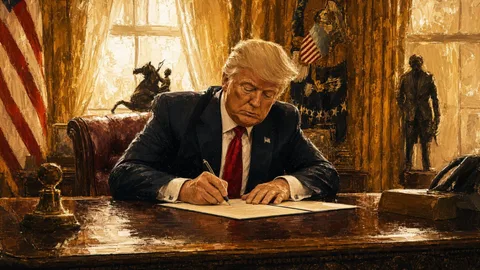
Signing arms the hand. Striking takes a second move.
Thirty days, says the law
The verb that binds
On the essentials, the law does not say “may.” It says “shall.”
The text published by Congress sets the deadline. No later than 30 days after enactment, the president must act.
The law says Sberbank. The law says VTB. The law says Gazprombank. The law says the Bank of Russia, with at least two sanctions. The law says any other state-owned Russian bank.
Then comes the tariff. On all goods from the targeted countries, a duty of up to 100%. A tax paid by the American importer. Then by the buyer.
October 18 at the latest
Thirty days after September 18 lands on October 18. Baker McKenzie does the same math.
For Russian goods themselves, the ceiling rises to 500%. Shadow fleet vessels must also be sanctioned within thirty days.
The law spares humanitarian aid, farm products, food and medicine. Everything else is supposed to fall.
Day 10 of 30. Twenty days for “shall” to become a name.
The law set the hour. Nobody rang the bell.
On the same topic

COLUMN: At 54 Volodymyrska Street, Moscow burns the address…
A Russian jet-powered drone struck the presidium building of the National…

SPECIAL REPORT: Trump’s 100% tariff on patented drugs spares…
Since 12:01 a.m. this Tuesday, September 29, a 100% duty has…
COMMENTARY: Trump’s Iowa steel mill is good news due…
On September 28, in the Oval Office, Donald Trump announced a…
The Treasury’s ledger
From September 18 to 28
There is a public place to check. The Office of Foreign Assets Control. OFAC. The Treasury posts every sanctions action there.
As of September 28, its list of recent actions shows a last entry dated the 23rd. It concerns the Democratic Republic of the Congo. Removals.
Between the 18th and the 28th, no entry announces a Russia-related designation.
None.
A license for Lukoil
On signing day, OFAC did publish a Russia document. An amended general license. Number 131J.
It authorizes certain transactions. The purpose: negotiating and entering into contingent contracts for the sale of Lukoil International GmbH. The related maintenance is covered too.
It is not a retreat. It is not a strike either. It is a permission that frames a sale.
Two days before the signing, on the 16th, OFAC removed two Russia-related listings. A Swiss national living in Spain. A Turkish cutting-tools company.
One license, two removals. That, on the ledger, is the Treasury’s Russia week.
On the ledger, the Graham law is still waiting for ink.
Section 115
A certification, a report
The law that binds contains its own exit. It is numbered 115.
The president may waive a sanction on a foreign person. The president may waive a restriction. The president may waive a duty set out in the title.
One condition. Before the waiver, he sends Congress a written certification: it is in the national interest. He attaches a report explaining the basis.
In other words, the law’s “shall” can become a “no.” Signed. Justified. Filed.
The door Beyer saw
For all the Democratic fear of tariff power without guardrails, this section is what will tell us what the law weighs. Not the podium.
On September 16, Democratic Representative Don Beyer of Virginia feared the opposite of inaction, according to NPR. The law, he said, would let the president label almost any country an evasion facilitator. Then tax it at up to 100%, with no guardrails and no end date.
Two opposite fears for one text. One sees a tariff thrown at anyone. The other sees a tariff thrown at no one.
Section 115 can prove both right. Depending on the day.
To bind or to excuse: the same pen will do.
October, Kyiv asks
Three days, three appeals
Zelensky read Section 115 before many others did. He is not asking for a law. He is asking for a date.
On September 25, according to Ukrainska Pravda, he raised enforcement of the Graham law in a conversation with Trump.
On the 26th, after a night of strikes, he asked that the tariff power be used against Russia. And against everyone who funds its war, the Kyiv Post reports. Fourteen wounded in one night, two dead in Zaporizhzhia, according to him.
On the 27th, he hardened his tone. Moscow, he said, knows how to send the encouraging diplomatic signals the world wants to hear. To buy time.
Honoring Lindsey Graham
He wants the new sanctions to take effect in October. He wants the law enforced in full. He wants no Russian oligarch taken off any list.
As early as September 19, according to ArmyInform, he had put down the truest sentence in the file. The best way to honor Lindsey Graham, he said, is not passing the law. It is enforcing it in full.
A wartime president making his case with American law. That is a man who read the text all the way to the deadline.
Kyiv is not asking for a pen. It is asking for a calendar.
Five countries, no more
China, India, Turkey
The 100% tariff does not target Russia. It targets those who pay Russia.
The law reserves it for the five largest importers of Russian energy. And for the five countries that do the most to help evade sanctions, according to Baker McKenzie.
For crude oil, Senate staff named China, India, Slovakia, Hungary and Azerbaijan, according to the law firm Squire Patton Boggs. For gas: China, France, Japan, Hungary and Belgium.
A think tank cited by the Kyiv Post puts China at the top of the buyers of Russian oil. Then India. Then Turkey.
Paris and Tokyo on the gas list
Read the gas list again. France. Japan. Belgium.
Allies.
More analysis

EXPLAINER: Putin denies any mobilization, then signs his fourth…
Vladimir Putin signed a decree on September 28 that sets the…

ANALYSIS: With decree 686, Putin hides who buys Russian…
Decree 686, signed by Vladimir Putin on September 28, does not…

ANALYSIS: Trump says he offered Iran nothing. His own…
On September 28, Axios reported, citing American officials, that Donald Trump…
The law provides a way out. A country that accounts for less than 15% of Russian natural gas exports, and that cuts its purchases, can escape the tariff.
The European Union has committed to ending its purchases of Russian oil and gas by the end of 2027, Daniel Fried of the Atlantic Council recalls. End of 2027. Not this fall.
And yet that way out admits a risk. Applied without discernment, the tariff would first hit the camp that helps Kyiv.
Hitting Beijing would be a policy. Hitting Paris, a blunder.
The deadline has not passed
Day 10 is not day 31
Now I have to write what cuts against this reading.
Nothing is late. The law allows thirty days. On day 10, a Treasury that has listed nothing is still within the letter of the text.
Baker McKenzie says it bluntly: most measures are due by October 18. Not by September 28.
On September 19, analyst Luke Coffey, quoted by RFE/RL, was already warning against expecting immediate new sanctions. Kerri Bitsoff, quoted in the same piece, added that hitting a large buyer like China would take sustained presidential will.
Part of the “shall” even exists already. Gazprombank has been under Treasury sanctions since November 21, 2024, according to the statement at the time.
A tariff takes more than a week
Hitting China or India takes work. Naming the countries. Measuring each one’s purchases. Notifying Congress before adjusting a rate.
That work, if it is moving, leaves no public trace before publication.
That is true. And it does not change this: since the signing, the Treasury’s only Russia document on the ledger is a license.
Legal patience and proof of action are two different things.
Names coming off
Fridman and Usmanov
While Washington counts its days, Europe has taken names off.
The European Union delisted the oligarchs Mikhail Fridman and Alisher Usmanov, the Kyiv Post reported on September 26. Estonia and the United Kingdom will keep their own sanctions on them. Two capitals said no.
Zelensky asked European leaders not to take any Russian oligarch off the existing lists.
Kyiv, the same week
On the 16th, two names left the American ledger. On the 18th, a law was signed. On the night of the 23rd to the 24th, a ballistic missile came into Kyiv.
Names go out. A missile comes in.
Somewhere in a Kyiv stairwell, someone heads for the shelter with a half-asleep child against one shoulder. The weight. The warmth. The pajamas slipping.
The window pane rattles. Then the engine. Then the silence, worse than the engine.
Who, at that hour, reads a ledger?
Over there, day 10 means nothing. There is only the night, and the next one.
A name taken off makes no sound. A missile does.
The lock already in place
Thirty days to lift
And yet the law is already working. Not on the ledger. On the future.
It locks.
Under the text, lifting any sanction, restriction or duty set by the law goes through a report to Congress. For 30 days after that report, the lifting cannot take effect. Congress can block it with a joint resolution of disapproval.
Sanctions imposed by executive order before the law stay in force, the law firm Bird & Bird specifies.
270 days to leave
Second real effect: the clock for companies. Those that must leave Russia have 270 days. The count started on September 18. It runs out around June 15, 2027.
Third effect: early termination comes at a price. According to Baker McKenzie, the president can end it sooner only by certifying a peace agreement signed by Russia with Ukraine.
This is the most underrated effect of September 18. A president can no longer quietly erase this file.
What already applies: a clock and a lock.
Discover
EXPLAINER: Putin denies any mobilization, then signs his fourth…
Vladimir Putin signed a decree on September 28 that sets the…
ANALYSIS: With decree 686, Putin hides who buys Russian…
Decree 686, signed by Vladimir Putin on September 28, does not…
ANALYSIS: Trump says he offered Iran nothing. His own…
On September 28, Axios reported, citing American officials, that Donald Trump…
The pen and the if
The 18th, a measurable effect
Let’s judge Trump’s two moves separately. On their effects.
On September 18, he signed. Measurable effect: written obligations, a deadline, a lock, Iran covered until 2031. A good move, no reservations.
On September 22, he presented those powers as a weapon to be used if necessary. Measurable effect on the ledger, six days later: none.
In the same speech, he said he was working very closely with the leaders of Russia and Ukraine.
The 22nd, a tool on display
The conditional is supposed to keep Moscow at the table. It also, without a doubt, keeps the tool in its holster.
And yet a tool shown and never used would end up being read in the Kremlin as stage scenery.
Energy, discussed with Zelensky in New York, is another file, and it does not replace this one.
A good move on the 18th. A conditional promise on the 22nd.
Three lines to read on October 19
The ledger, the tariff, the report
This verdict will change on October 19. Reading will be enough.
Either we will read Sberbank, VTB and Gazprombank on OFAC’s ledger, with the law cited.
Or we will read a tariff decision against one or more of the five countries.
Or we will read, in Congress, a waiver certification. With its report.
All three are answers. The fourth possibility would not be one. Nothing at all.
Day 31
Daniel Fried of the Atlantic Council was calling for swift enforcement as early as September 16. And for a Congress ready to hold the administration to account if it did not follow through.
A justified waiver would be a choice. It could be fought. A silence would be…
I confess a weariness with these deadlines. So many dates promised to Ukraine have slipped. I no longer read a calendar without first looking for the empty box.
Three lines will do. The blank will speak too.
A law waiting for its names
Twenty days left
Ten days have passed since the signing. Twenty remain.
The law is real. The good move of the 18th is real. Enforcement does not yet exist on the Treasury’s ledger.
For those twenty days, Kyiv will count in its own unit. In nights. In alerts. In window panes replaced.
The morning of October 19
On October 19, in Congress as here at home, will anyone open the ledger to check?
It is public. It only asks to be read.
After day 30, every day without a name will have a signatory.
Thirty days of law, and a ledger that will say if it exists.
Sources:
Primary Sources:
- U.S. Congress — text of H.R. 5334, sections 113 and 115, September 18, 2026
- U.S. Treasury, OFAC — general license 131J on Lukoil International, September 18, 2026
- The White House — H.R. 5334 signed into law, September 18, 2026
Secondary Sources:
Get the geopolitics analyses
Conflicts, powers, alliances: the MadMax thread without the noise.
Cite this article
Maxime Marquette (2026). FACT CHECK: The Graham law is 10 days old, and Trump’s Treasury has listed no Russian name yet. MadMax. https://mad-max.co/en/article/the-graham-law-is-10-days-old-and-trumps-treasury-has-listed-no-russian-name-yet
Read next
EXPLAINER: Putin denies any mobilization, then signs his fourth…
Vladimir Putin signed a decree on September 28 that sets the…
ANALYSIS: With decree 686, Putin hides who buys Russian…
Decree 686, signed by Vladimir Putin on September 28, does not…
ANALYSIS: Trump says he offered Iran nothing. His own…
On September 28, Axios reported, citing American officials, that Donald Trump…
Enjoyed this piece? Get the next one.
One chronicle a week, straight to your inbox. No noise.
This article was generated with AI assistance, under human supervision.
Comments
Be the first to weigh in.