

TESTIMONY: In occupied Crimea, prisoners stranded — Russia paralyzed
For more than a week, not a single political prisoner has left occupied Crimea. Not one Crimean Tatar sentenced by the occupation courts. Not one Ukrainian citizen transferred for a judicial hearing on the mainland. Stranded. Held at the Simferopol detention center, in a wait they have been told is indefinite. This is not an act of Russian will — it is the direct consequence of
- For more than a week, not a single political prisoner has left occupied Crimea. Not one Crimean Tatar sentenced by the occupation courts. Not one Ukrainian citizen transferred for a judicial hearing on the mainland. Stranded. Held at the Simferopol detention center, in a wait they have been told is indefinite. This is not an act of Russian will — it is the direct consequence of
- TESTIMONY: In occupied Crimea, prisoners stranded — Russia paralyzed
- Introduction: when the occupier is paralyzed by its own crimes
Facts, quotes, and cited links remain in the body. Interpretations are framed as analysis or opinion according to the format.
TESTIMONY: In occupied Crimea, prisoners stranded — Russia paralyzed
Introduction: when the occupier is paralyzed by its own crimes
A week without transfers — the admission of a logistical failure
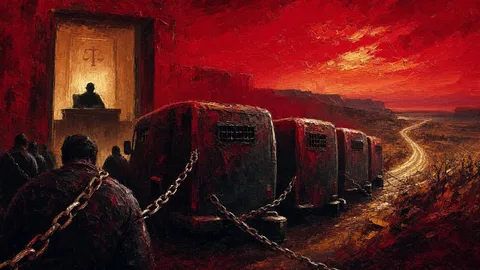
For more than a week, not a single political prisoner has left occupied Crimea. Not one Crimean Tatar sentenced by the occupation courts. Not one Ukrainian citizen transferred for a judicial hearing on the mainland. Stranded. Held at the Simferopol detention center, in a wait they have been told is indefinite. This is not an act of Russian will — it is the direct consequence of the fuel shortage gripping the peninsula since Ukrainian strikes on access bridges and petroleum depots.
Eskender Bariiev, a member of the Mejlis of the Crimean Tatars, made this situation public on June 25, 2026. His account is precise, factual, free of exaggeration: Russian prison vans have stopped running because there is no fuel. This detail — seemingly trivial — is in reality the exposure of a deep infrastructure crisis in Crimea, and of an occupier no longer capable of managing the territories it has illegally annexed.
The victims of an occupation justice with no way out
Who are these stranded detainees? Two distinct categories, according to Bariiev. First, Crimeans convicted by occupation courts — Crimean Tatars and Ukrainians held on grounds that Ukraine and human rights organizations describe as politically motivated. Second, Ukrainian citizens from recently occupied territories, brought to Crimea for judicial hearings and now unable to return.
These men and women are not mere abstractions. They are fathers, mothers, sons, brothers. Their families wait for news that never comes. Their prolonged detention — beyond what even the occupation courts ordered — is yet another illustration of Russia's contempt for any form of law, including the law Russia itself claims to apply in the territories it controls.
Ukrainian strikes on bridges — a strategy destabilizing the occupation
Cut the lines, paralyze the system
Ukrainian strikes on bridges connecting Crimea to the mainland carry far more than direct military value. They have a systemic value: by cutting or threatening supply routes, they progressively asphyxiate the occupation economy. Fuel has vanished from retail sale in Crimea. Trams have been halted in Yevpatoria. Prison transfers are paralyzed. These are the direct, measurable consequences of a Ukrainian strategy of logistical denial, applied with growing precision.
The Ukrainian Navy declared, in remarks reported on June 28, 2026, that it had been "pulling down the walls" of the Crimean fortress for years. This phrase sums up a doctrine: attack not the fortified peninsula head-on, but systematically degrade the infrastructure that keeps it functioning. Bridges, fuel depots, power stations — each strike is a piece in a larger puzzle.
Crimea is no longer an impregnable fortress
In 2014, when Russia illegally annexed Crimea, the peninsula appeared to many as an irreversible fait accompli. The Kremlin transformed it into a military base and a showcase of recovered power. In 2022, with the full-scale invasion, Crimea served as a launch platform for strikes on southern Ukraine. Today, in 2026, the situation has been radically transformed.
Ukrainian strikes have put the Kerch Bridge out of service or severely damaged it. They have disrupted fuel depots and military installations. Electricity is rationed. Fuel is rationed. And prison vans have stopped. What this says about the long-term sustainability of the Russian occupation is troublingly clear.
The repression of Crimean Tatars since 2014
A people under occupation for twelve years
The history of the Crimean Tatars under Russian occupation is a history of systematic persecution. Since 2014, their Mejlis — the community's representative body — has been banned by the occupation authorities. Dozens of their leaders have been detained and convicted on charges of "extremism" or "terrorism" that every international human rights organization condemns as politically motivated.
This people, which had already endured the Stalinist deportation of 1944 — when Stalin ordered the expulsion of the entire Crimean Tatar community — is once again facing targeted repression. Putin's Russia has inherited the worst Soviet reflexes and applies them to a people that has never accepted the occupation of its ancestral land.
200,000 war crimes recorded
Charlotte Surun, British chargée d'affaires in Ukraine, stated at the memorial ceremony for Victoria Amelina in Lviv that the office of the Ukrainian Prosecutor General had recorded more than 200,000 crimes since the start of the full-scale invasion. Each crime corresponds to a human being. The Crimean Tatar political prisoners, held for years in conditions their families describe as degrading, are part of these numbers.
These 200,000 crimes are not abstract statistics. They are case files, evidence, testimonies gathered by Ukrainian prosecutors working under bombardment to ensure that international justice will one day have the arsenal it needs to hold those responsible to account. This work, little known, is crucial — for memory and for the future.
The fuel crisis in Crimea — symptom of a collapse
A revealing shortage
The fuel shortage in occupied Crimea is not a momentary accident. It is the predictable result of a Ukrainian strategy applied with consistency. Strikes on fuel depots, refineries, and supply routes have progressively reduced Russia's capacity to maintain normal logistics on the peninsula. Fuel has disappeared from retail sale. That is not a rhetorical formula — the residents of Crimea live it every day.
For the local population — whether Tatar, Ukrainian, or Russian — this shortage is a concrete economic reality. Cars cannot run. Businesses cannot function normally. Public services are disrupted. The occupation machine, which promised to bring prosperity, is proving incapable of providing the basic functions of a regional economy.
Trams halted in Yevpatoria
A symptomatic detail: the trams of Yevpatoria have stopped running. This coastal city, known for its beaches and Soviet-era resorts, symbolized in Russian rhetoric a Crimea reclaimed and revitalized as a tourist destination. Today, its trams are at a standstill. It was not the war that stopped these trams — it was the logistical failure of the Russian occupation administration, incapable of maintaining the energy supply the peninsula requires.
Every tram halted, every prison van immobilized, every empty fuel depot is a fragment of the same story: that of an occupation project that is fracturing under Ukrainian pressure. Russia can still maintain its troops in Crimea. But its capacity to administer normally the territory it stole is deteriorating at a pace that can only accelerate.
The humanitarian implications — an invisible emergency
Detainees forgotten by international law
The political prisoners stranded at the Simferopol detention center find themselves in a doubly absurd legal void. Russia holds them under Russian law applied in a territory whose annexation the international community does not recognize. They cannot benefit from the normal protections accorded to prisoners of war — because officially they are civilian detainees. Nor can they benefit from the guarantees of Ukrainian civil law — because they are kept beyond the reach of Ukrainian authorities.
The International Committee of the Red Cross has had extremely limited access to detainees in occupied Crimea. International monitoring missions are virtually nonexistent. These men and women are, in practice, invisible to the mechanisms of international protection. Their prolonged confinement in a prison where conditions are already documented as degrading compounds a situation that was already intolerable.
The duty of memory and international pressure
The publication of this information by Eskender Bariiev and Euromaidan Press is itself an act of resistance. Documenting, naming, making visible — that is the work that allows the international community to maintain even minimal pressure on the occupier's behavior. Every report, every article, every testimony is a piece of the dossier that will one day serve before the courts.
Ukraine and its allies have the responsibility not to let these prisoners disappear into silence. Prisoner exchanges that have taken place since the start of the conflict show that releases are possible — but they require political will, laborious negotiations, and sustained international attention. That attention we must maintain.
Families as tools of psychological pressure
The impossibility of informing relatives in Ukraine
Beyond the direct suffering of political prisoners held in occupied Crimea, their situation creates cascading suffering for their families remaining in free Ukraine. Under the Russian occupation regime, communications between detainees and their relatives are limited, filtered, and often severed entirely. Families in Odesa, Kherson, or Kyiv may go weeks without news of a son, husband, or father held in Crimea — unable to know whether he is alive, in good health, or in immediate danger.
This prolonged uncertainty is a form of systematic psychological torture — documented by human rights organizations including Human Rights Watch, Amnesty International, and groups defending the rights of Crimean Tatars. It is deliberate: by keeping families in ignorance, the Russian occupation authorities amplify suffering beyond prison walls and extend their psychological control over thousands of people in free Ukrainian territory.
Advocacy organizations facing institutional obstacles
On the same topic
INVESTIGATION: 316 political cases in Crimea — the occupation…
Three hundred and sixteen people are being prosecuted on political grounds…

DOSSIER: 60,000 Russian passports in Transnistria — the annexation…
More than sixty thousand applications for Russian citizenship in three months,…

ANALYSIS: 800 drones over Russia in one night —…
More than eight hundred drones, in a single night, August 14…
Organizations such as the Crimean Human Rights Monitoring Group, Crimea SOS, and the Crimean Tatar Rights Coordination Team have been documenting the cases of political detainees since the 2014 occupation. Their work is made extraordinarily difficult by the absence of physical access to Crimea, the closure of normal communication channels, and the risks faced by their on-the-ground sources. Every piece of information about a detainee must be verified through indirect channels — sometimes months after the events themselves.
Yet these organizations play a crucial role in maintaining the institutional memory of detentions. Their painstaking documentation constitutes a database that prosecutors at the ICC, international lawyers, and prisoner exchange negotiation teams will be able to draw on the day Crimea recovers Ukrainian legal authority. This work of memory, done in the shadows and with insufficient resources, is one of the most important forms of resistance to the occupation.
The diplomacy of exchanges: what the Crimean case reveals
Prisoner exchanges as a complex diplomatic lever
Prisoner exchanges between Ukraine and Russia have constituted one of the few channels of direct contact between the two belligerents since 2022. These exchanges, often facilitated by intermediaries such as the United Arab Emirates, Qatar, or Turkey, have enabled the return of several thousand Ukrainian military personnel and civilians. But political prisoners held in Crimea since 2014 — many of them Crimean Tatars — fall into a different category.
Russia treats them as ordinary criminals or terrorists under its legal framework — designations it refuses to negotiate within the standard prisoner-of-war exchange process. This creates a deliberate legal asymmetry: prisoners of war can be exchanged under the Geneva Conventions, but political prisoners convicted under Russian law find themselves in a legal void where Russia can refuse any negotiation by invoking its judicial sovereignty.
What the logistical paralysis reveals about the state of Russia
The inability of Russian authorities to transfer political prisoners from Crimea to mainland penitentiary facilities — revealed through sources close to documented cases — says something important about the state of Russia in 2026. A prison system that can no longer manage its own detainees, even in a territory it has controlled for twelve years, is a system under severe structural strain.
That strain is the combined result of economic sanctions, massive human losses in the Ukrainian conflict, and the gradual degradation of Russian administrative infrastructure. This is not a one-off failure — it is the symptom of a system deteriorating under the weight of its own contradictions. And for the political prisoners of Crimea, this systemic deterioration translates into additional uncertainty about their daily fate.
How the situation has evolved since 2022: a continuous deterioration
Twelve years of occupation, a worsening crisis
Since the illegal annexation of Crimea in 2014 and the imposition of a Russian prison system on the territory, the situation of political prisoners has only continued to deteriorate progressively. Each year brings new arrests, new trials conducted under Russian law imposed on a population that has never accepted it, new convictions accumulating in the registers of human rights organizations. By 2026, the number of confirmed political prisoners in Crimea far exceeds the figure recorded in 2022.
This continuous deterioration is the result of a deliberate policy of systematic repression of any opposition to the occupation. Crimean Tatars, the most heavily targeted group, have seen their organizations banned, their places of worship closed, their media censored. Ukrainian human rights defenders who remain in Crimea and document violations face arrest with every operation. The space for peaceful civil resistance has narrowed to the point of near nonexistence.
International pressure: real but insufficient
The mechanisms of international pressure on Russia regarding its political prisoners in Crimea are multiple but of limited effectiveness. UN General Assembly resolutions, reports from the Office of the High Commissioner for Human Rights, bilateral diplomatic approaches by allied governments — none of this has produced significant releases. Russia systematically treats such pressure as interference in its internal affairs and does not change its policy.
That does not make these pressures useless. They keep the issue on the international diplomatic agenda, prevent it from being forgotten, document the facts for future proceedings, and create symbolic pressure on Russian officials who may one day face international courts. In the dossier of Crimea's political prisoners, the patience and consistency of the international community are themselves a form of resistance.
Conclusion: Crimea, mirror of Russian failure
What these immobilized vans tell us about the war
Prison vans that can no longer run for want of fuel. Political prisoners held indefinitely. Trams at a standstill. This picture of a paralyzed peninsula is a striking metaphor for the general state of the Russian imperial project in Ukraine. Vladimir Putin promised the restoration of Russian greatness. He has produced an occupation administration incapable of managing its own detainees.
Crimea in 2026 is no longer the symbol of Russian strength it was supposed to be in 2014. It is a territory asphyxiated by Ukrainian strikes, managed in chaos by overwhelmed occupation authorities, where the rights of residents — especially Crimean Tatars and Ukrainians — are violated daily. And at the Simferopol detention center, men and women wait, not knowing when — or whether — they will walk out.
The imperative of justice
This testimony demands a response from the international community. Not one more declaration, not one more resolution that Russia will disregard — but concrete pressure, monitoring mechanisms, demands for release embedded in ongoing diplomatic processes. These prisoners have names. They have families. They have stories the occupation sought to erase. To name them, to count them, to demand their release — that is the minimum the free world owes them.
Crimea will be Ukrainian. And when that day comes, these archives of occupation crimes will be the foundation of a justice that will not expire.
Discover

INVESTIGATION: Beijing cuts Africa to 2.1 billion in loans…
2.1 billion — the lowest figure in almost twenty years, according…

SPECIAL REPORT: Beijing Promises Stimulus as Its Households Give…
That is the growth rate of Chinese industrial output in July,…

INVESTIGATION: Two Chinese Ex-Soldiers Arrested in Seoul as 18,000…
For five years, a man ran a military-supply shop at the…
By Maxime Marquette, columnist
Columnist's transparency note
Acknowledged position and sources
This article is based on statements by Eskender Bariiev, a member of the Mejlis of the Crimean Tatars, as reported by Euromaidan Press on June 25, 2026. I am pro-Ukraine and regard the annexation of Crimea as illegal under international law — a position held unanimously by the United Nations and the vast majority of the international community. I did not have access to the detainees themselves and cannot confirm their conditions of detention firsthand.
I acknowledge that I was unable to independently verify all figures cited on the repression of Crimean Tatars. These data come from human rights organizations and Ukrainian authorities, which I trust but which have an interest in the narrative. This limitation is inherent in covering a territory under Russian occupation, inaccessible to independent journalists.
What I do not know
I do not know the exact number of prisoners currently stranded in Simferopol. I do not know precisely which specific strikes caused the current fuel shortage. I do not know whether the situation has changed since this article's source was published on June 25, 2026. The war evolves rapidly and some information may be outdated by the time of reading.
My analysis of the strategic implications of Ukrainian strikes reflects my own reading of events, based on available sources but not on certified military expertise. It should be read as an analytical perspective, not as a staff briefing.
Sources
Primary sources
Secondary sources
Get the geopolitics analyses
Conflicts, powers, alliances: the MadMax thread without the noise.
Cite this article
Maxime Marquette (2026). TESTIMONY: In occupied Crimea, prisoners stranded — Russia paralyzed. MadMax. https://mad-max.co/en/article/temoignage-en-crimee-occupee-les-prisonniers-bloques-la-russie-paralysee
Read next
INVESTIGATION: Beijing cuts Africa to 2.1 billion in loans…
2.1 billion — the lowest figure in almost twenty years, according…
SPECIAL REPORT: Beijing Promises Stimulus as Its Households Give…
That is the growth rate of Chinese industrial output in July,…
INVESTIGATION: Two Chinese Ex-Soldiers Arrested in Seoul as 18,000…
For five years, a man ran a military-supply shop at the…
Enjoyed this piece? Get the next one.
One chronicle a week, straight to your inbox. No noise.
This article was generated with AI assistance, under human supervision.
Comments
Be the first to weigh in.