

REPORT: Yaroslavl in flames, when the war reaches deep into Russia
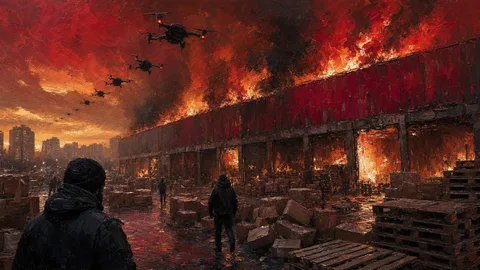
In late March 2026, a refinery in the city of Yaroslavl, more than 250 kilometers northeast of Moscow, took a direct hit followed by a fire, according to a CNN report dated March 28.
- In late March 2026, a refinery in the city of Yaroslavl, more than 250 kilometers northeast of Moscow, took a direct hit followed by a fire, according to a CNN report dated March 28.
- In late March 2026 , a refinery in the city of Yaroslavl , more than 250 kilometers northeast of Moscow, took a direct hit followed by a fire , according to a CNN report dated March 28.
- This is not Kharkiv, nor Donetsk, nor even a border town: Yaroslavl sits far, very far, from any conventional front line, in what was until recently still called the Russian heartland, that territory supposedly sheltered from combat.
Facts, quotes, and cited links remain in the body. Interpretations are framed as analysis or opinion according to the format.
Introduction
In late March 2026, a refinery in the city of Yaroslavl, more than 250 kilometers northeast of Moscow, took a direct hit followed by a fire, according to a CNN report dated March 28. This is not Kharkiv, nor Donetsk, nor even a border town: Yaroslavl sits far, very far, from any conventional front line, in what was until recently still called the Russian heartland, that territory supposedly sheltered from combat. There is something deeply unsettling, for any population, about watching war suddenly cross a distance once thought impassable.
According to the same source, the regional governor confirmed damage to residential structures near the site hit, meaning this strike did not target an isolated industrial facility alone: it had direct repercussions on the surrounding urban fabric, in a city whose civilian population had, until then, known the war only through screens and newspapers.
This piece offers a reconstructed report based on data from CNN and other established journalistic sources, without claiming a presence on the ground or direct access to witnesses of this event. The goal is to document rigorously what is known about this strike on Yaroslavl, its immediate consequences, and what it reveals about this war's broader shift deep into Russian territory.
The night Yaroslavl discovered the war
A direct hit followed by a fire
According to the CNN report, the Yaroslavl refinery took a direct hit, followed by a fire that broke out shortly after impact, in late March 2026. Precise details on the exact scale of the flames and the duration of the emergency response are not covered in the sources available for this analysis, but mention of a fire following the impact suggests damage significant enough to affect, at least temporarily, the site's operational capacity.
A refinery fire never dies out in a few minutes; it takes hours, sometimes days, before the columns of smoke stop reminding an entire city of what just happened a few streets away.
Damage that extends beyond the industrial site
The regional governor, cited by CNN, confirmed damage to residential structures located in the immediate vicinity of the site hit. This official confirmation, coming from a Russian regional authority itself, carries particular weight: it is not an unverified Ukrainian claim, but an admission, even a partial one, from the local authorities concerned.
This kind of official acknowledgment remains relatively rare in typical Russian communication about the consequences of Ukrainian strikes, suggesting that the extent of the residential damage was visible enough to make total silence difficult to maintain in front of a local population that directly witnessed the events.
More than thirty drones intercepted, a figure worth weighing carefully
An air defense mobilized but not airtight
Still according to CNN, more than 30 drones were intercepted by Russian air defense during this same wave of attacks. This figure points to real defensive mobilization, but it also underscores, by contrast, that intercepting thirty drones was not enough to prevent at least one successful hit on the refinery itself. Intercepting thirty drones out of thirty-one is not an air-defense failure; it is simply proof that no defense, however capable, ever achieves an absolute success rate.
This nuance is essential to properly assess the relative effectiveness of Russian air defense: a high interception rate never guarantees total protection, and it is precisely that non-intercepted fraction, however small, that keeps producing material damage and, potentially, casualties.
What this figure does not say about the swarm's composition
Available sources do not specify the exact breakdown between reconnaissance drones, decoy drones, and munitions actually meant to hit a precise target within this wave of attack on Yaroslavl. This distinction, crucial for assessing the operation's tactical sophistication, remains beyond the reach of an analysis based solely on the aggregated figures reported by CNN.
It is nonetheless reasonable to assume, given the outcome, that at least part of this drone swarm specifically targeted the refinery rather than diffuse targets, given the apparent precision of the impact reported by regional authorities themselves.
Saratov, the strike that preceded Yaroslavl
Rosneft hit the previous weekend
According to CNN, the Saratov refinery, owned by Rosneft, had been hit the weekend before the strike on Yaroslavl, indicating a tight sequence of two separate attacks on Russian oil installations located in different regions of the country, within a span of just a few days.
Two refineries struck within days, hundreds of kilometers apart, do not tell a story of coincidence; they tell a story of a deliberate campaign that multiplies its targets to stretch thin a defense that cannot be everywhere at once.
Rosneft, a recurring target of this campaign
The fact that Saratov belongs to Rosneft, Russia's largest oil company and a central pillar of Russian state financing, adds a further strategic dimension to this sequence of strikes. Targeting installations belonging to this particular company could reflect a deliberate intent to strike the most economically significant infrastructure, rather than striking at random among all available oil sites on Russian territory.
No source consulted for this analysis explicitly confirms this hypothesis of priority targeting of Rosneft assets, but the recurrence of this company's name in successive strike reports is, at the very least, a pattern worth tracking over time.
The Russian heartland, a sanctuary that no longer exists
A geographic transformation of the conflict
The case of Yaroslavl, like that of Saratov a few days earlier, illustrates a major geographic transformation of this conflict: cities located far from any border, in what once made up Russia's deep heartland, are now exposed to drone strikes capable of covering hundreds of kilometers to reach their target. There is no longer, for the ordinary Russian population, any geographic guarantee of safety based on distance from the front alone.
This transformation goes beyond the isolated case of Yaroslavl; it fits within a broader trend documented by several Western media, which record increasingly frequent Ukrainian strikes on installations at distances once considered beyond the reach of any realistic Ukrainian military capability.
Psychological consequences for the local population
On the same topic
ANALYSIS: 800 drones over Russia in one night —…
More than eight hundred drones, in a single night, August 14…

ANALYSIS : Taiwan Puts NT$1,122.5 Billion Into Defence, Over…
Hold that number for a moment, because it marks the crossing…

SPECIAL REPORT: Beijing buys 40 cargoes of sanctioned Russian…
On August 28, 2025, a tanker named Arctic Mulan moored at…
Beyond the immediate material damage, this kind of strike on a city previously spared by the war likely carries significant psychological consequences for the local population of Yaroslavl, which suddenly discovers a vulnerability it did not think it shared with cities closer to the front. No opinion survey or detailed testimony on this psychological dimension appears in the sources available for this analysis.
This absence of qualitative data on how the local population feels illustrates a recurring limitation of journalistic accounts focused on material figures: the fear, uncertainty, and shift in perception that such a strike produces among ordinary residents remain, for now, largely invisible in the available coverage.
The response of Russian regional authorities
Partial but real communication
The regional governor's confirmation of damage to residential structures is a relatively rare example of partial official communication about the concrete consequences of a Ukrainian strike deep inside Russian territory. This communication, though incomplete in many respects, contrasts with the more total silence observed for certain other sites struck during the same period.
When a local authority confirms damage it could have kept quiet, that is never a coincidence; it is a sign that, on that day, silence had become politically more costly than admission.
What this partial transparency reveals about information control
Information control in Russia around the consequences of the war remains broadly strict, but events visible enough locally, like a refinery fire touching residential areas, can hardly be fully concealed from a population that witnesses them directly. This tension between narrative control and locally observable reality runs through most of the available information on deep strikes across Russian territory.
This tension likely explains why certain details leak through anyway, in a minimal and controlled form, while other aspects of these events remain largely in the shadows for outside observers.
The industrial dimension: Yaroslavl in the Russian oil network
The refinery's role in regional supply
The Yaroslavl refinery holds a significant place in supplying petroleum products to central Russia, a densely populated area that includes several major cities beyond Moscow itself. A reduction in this site's capacity, even temporary, could ripple into fuel distribution across this part of the country, echoing the broader shortages documented elsewhere in Russia during the summer of 2026.
No precise data on the production capacity actually affected by this late-March strike appears in the sources consulted, preventing an exact quantitative assessment of this event's regional impact on local fuel supply.
One site among several in a broader campaign
Yaroslavl and Saratov are only two examples among more than fifty Russian oil installations targeted by Ukrainian strikes since March 2026, according to estimates reported by several Western media for the same period. Every new city added to this list is a reminder that this campaign follows no implicit geographic limit; it follows a logic of targets, not a logic of symbolic borders.
This cumulative scale transforms what might look like a series of isolated incidents into a systematic strategy aimed at weakening Russian refining capacity across the entire national territory, far beyond border zones alone.
The wider context of Ukraine's energy campaign
A strategy aimed at cutting Russian war revenue
This campaign of strikes against Russian refineries, of which Yaroslavl is a documented example, fits within a broader strategy aimed at reducing Russia's ability to finance its war effort through oil revenue, while also complicating the country's domestic fuel supply. This dual intent, economic and logistical, is regularly cited by Western analysts quoted in specialized press.
Nothing in the sources consulted allows for the claim that the specific strike on Yaroslavl followed a distinct economic objective separate from this campaign's broader goal; it fits, by all indications, within this overall logic rather than a calculation isolated to this single site.
Links with the fuel crisis observed later in the year
The late-March strike on Yaroslavl precedes by several months the broader fuel crisis documented in Russia during the summer of 2026, with rationing reported across the vast majority of the country's regions. This time lag suggests a cumulative effect: each individual strike, taken alone, produces a limited impact, but their accumulation over several months eventually produces a nationwide crisis.
A refinery on fire in March does not make headlines during the summer that follows; but it quietly becomes part of the sum of damage that explains why that summer became the summer of rationing.
Limits of independent verification
What is known with certainty, what is assumed
This analysis relies primarily on a single established journalistic report, that of CNN dated March 28, 2026, which demands particular methodological caution: the finer details of the event, notably the exact scale of residential damage or the precise number of people affected, are not necessarily covered with the same thoroughness as an event backed by multiple corroborating sources.
This limitation does not undermine the general reliability of the reported information, but it calls for clearly distinguishing what is confirmed by this single source from what would amount to unfounded extrapolation, given additional data not currently available.
The absence of a precise human toll for this specific event
The sources consulted for this analysis provide no precise casualty or injury count directly linked to the strike on Yaroslavl itself, unlike other events of this war where detailed human tolls have been established by multiple news agencies. The absence of a figure is not the absence of human consequence; it is, most often, the absence of coverage thorough enough to document it.
This absence of precise human data is a significant limitation of this analysis, one that must be explicitly flagged rather than filled in with assumptions not grounded in verifiable facts.
The climate of tension in non-border Russian regions
New vigilance in cities previously spared
Events like the one in Yaroslavl likely contribute to a heightened climate of vigilance in Russian cities that, until recently, saw themselves as largely removed from the direct risks of this war. This shift in local security perception, though difficult to measure precisely without a dedicated opinion survey, follows logically from the repetition of similar strikes on industrial targets in comparable areas.
Local authorities, in this context, likely face growing pressure to strengthen defensive measures around sensitive infrastructure on their territory, though available sources do not detail the exact nature of measures actually adopted in Yaroslavl since this event.
Implications for trust in central authorities
Every strike hitting territory previously considered safe can also weigh on public trust in central authorities' ability to provide effective protection, a political dynamic that extends well beyond the strictly material scope of this strike. Defense of a territory is not measured only in intercepted drones; it is also measured in the eyes of citizens who, one morning, discover that the war has followed them home.
This political dimension, though largely speculative given the absence of reliable public-opinion data on contemporary Russia, is a potentially significant factor in how the Kremlin manages its communication around this type of event.
What this case reveals about the conflict's evolution in 2026
Discover

INVESTIGATION: Beijing cuts Africa to 2.1 billion in loans…
2.1 billion — the lowest figure in almost twenty years, according…

SPECIAL REPORT: Beijing Promises Stimulus as Its Households Give…
That is the growth rate of Chinese industrial output in July,…

INVESTIGATION: Two Chinese Ex-Soldiers Arrested in Seoul as 18,000…
For five years, a man ran a military-supply shop at the…
A war redrawing its own geographic boundaries
The case of Yaroslavl, alongside that of Saratov a few days earlier, confirms a trend already observed elsewhere on Russian territory: by 2026, the war between Russia and Ukraine is no longer confined to a conventional front line, but now extends to dispersed targets across all of Russian national territory, regardless of the distance traditionally considered protective.
This war has long been measured in kilometers of front gained or lost; perhaps it should now also be measured in kilometers of depth lost from Russia's illusion of security.
Questions that remain open after this event
Several questions remain unanswered in the available sources: the exact extent of residential damage confirmed by the regional governor, the timeline for repairing the refinery itself, and whether similar strikes on this same site might recur in the following months. These uncertainties, rather than being filled with unfounded assumptions, must be explicitly acknowledged as current limits of available information.
Acknowledging these informational limits is, in itself, an essential part of rigorous journalistic treatment of this type of event, which occurred far from any direct journalistic presence on the ground.
Fuel logistics in central Russia
One link among many in a strained chain
The Yaroslavl region fits within a broader logistics network supplying fuel to several oblasts in central Russia, an area that does not always benefit from the same supply priorities as Moscow itself. A disruption, even temporary, to one link in this chain can ripple through several neighboring oblasts before logistics authorities can rebalance supply.
A refinery damaged far from the front does not just bear the cost of one night of strikes; it makes its consequences felt, in cascade, hundreds of kilometers away, for weeks.
The absence of precise data on the disruption's duration
No source consulted for this analysis specifies exactly how long the Yaroslavl refinery remained offline after this late-March strike, nor the timeline for returning to full operational capacity. This lack of precise information prevents a rigorous quantitative assessment of the event's real impact on regional fuel supply in the following weeks.
This informational limit, recurring for most sites struck on Russian territory, reflects the tight control authorities exercise over the release of precise operational data concerning their own damaged infrastructure.
Comparable precedents elsewhere in central Russia
A geography of strikes that keeps expanding
Beyond Yaroslavl and Saratov, several other installations in central and western Russia have been reported as targets of similar strikes during the first half of 2026, according to various Western news sources. This expanded geography confirms that the case of Yaroslavl is not an isolated exception, but fits within a broader regional pattern of deep strikes.
Every new city hit expands, a little further, the mental map Russian populations must now draw to assess their own exposure to this war.
What this geographic dispersal implies for Russian defense
This growing dispersal of targets across Russian territory necessarily complicates the task of national air defense, which must spread limited resources across a growing number of potentially vulnerable sites, from the Black Sea coast to central cities like Yaroslavl.
No source consulted allows for a precise assessment of whether this dispersal results from a deliberate strategic choice on the Ukrainian side or simply from the natural expansion of long-range drone capabilities available over the course of the conflict.
Long-term stakes for the civilian population
Living with the uncertainty of a new vulnerability
For the residents of Yaroslavl and comparable cities, the uncertainty created by this event does not simply fade once the fire is finally put out. It settles in, potentially, as a new permanent feature of daily life, alongside the fuel lines documented elsewhere in Russia during the summer of 2026.
A population that has seen a refinery burn near their homes never fully regains the carefree feeling it had before that night.
What this case reveals about the conflict's likely duration
The persistence of strikes like the one in Yaroslavl, month after month, suggests that this conflict shows no sign of a quick resolution at mid-2026, neither on the conventional military side, nor on the side of this parallel energy war that now extends across all of Russian territory.
This absence of any sign of rapid de-escalation is, in itself, significant information for assessing this war's medium-term outlook, well beyond the particular case of this central Russian refinery.
Conclusion
Yaroslavl, in late March 2026, will remain a documented example of this broader shift: a war that has stopped respecting the distances that historically shielded Russia's heartland from combat. A direct hit on a refinery, damaged residential structures, more than thirty intercepted drones but at least one that reached its target: this record, partial as it is, is enough to measure the scale of the strategic change underway.
Nothing available allows for the claim that Yaroslavl is an exceptional case rather than one example among others of a broader trend. What the reported facts do allow, with the caution this type of source demands, is the assertion that the depth of Russian territory has, since spring 2026, stopped offering a reliable guarantee against the direct consequences of this war. A city that discovers a refinery burning at its gates does not forget it come the following spring; it simply learns to live with a fear it did not know before.
Signature
Signed Maxime Marquette, columnist
Columnist's Transparency Box
Editorial positioning
This reconstructed report is written from a declared angle preference, pro-Western, which guides the choice of subject and the attention paid to the documented consequences of Ukraine's campaign against Russian oil infrastructure. This positioning is a declared editorial choice, not a claim to absolute neutrality, but it implies no fixed categorization of the Russian authorities cited: every named actor is presented through their reported statements, not through a moral judgment presented as settled truth.
Methodology and sources
This text relies primarily on the CNN report dated March 28, 2026, used as the single reference source for the factual details of the strike on Yaroslavl and the regional governor's official confirmation of residential damage. This data was placed in context using Reuters and the Moscow Times for the broader trajectory of Ukraine's energy campaign. Reliance on a single journalistic source for the central event has been explicitly flagged as a methodological limit.
Nature of the analysis
This text distinguishes reported facts from CNN, confirmed by a Russian regional authority, contextual elements established by other sources on the broader energy campaign, and the columnist's personal analysis of this event's symbolic and strategic scope, clearly identified by tone and phrasing, without ever passing definitive moral judgment on a named person.
Sources
Primary sources
Secondary sources
Get the geopolitics analyses
Conflicts, powers, alliances: the MadMax thread without the noise.
Cite this article
Maxime Marquette (2026). REPORT: Yaroslavl in flames, when the war reaches deep into Russia. MadMax. https://mad-max.co/en/article/report-yaroslavl-in-flames-when-the-war-reaches-deep-into-russia
Read next
INVESTIGATION: Beijing cuts Africa to 2.1 billion in loans…
2.1 billion — the lowest figure in almost twenty years, according…
SPECIAL REPORT: Beijing Promises Stimulus as Its Households Give…
That is the growth rate of Chinese industrial output in July,…
INVESTIGATION: Two Chinese Ex-Soldiers Arrested in Seoul as 18,000…
For five years, a man ran a military-supply shop at the…
Enjoyed this piece? Get the next one.
One chronicle a week, straight to your inbox. No noise.
This article was generated with AI assistance, under human supervision.
Comments
Be the first to weigh in.