

COLUMN: Lavrov and His "Massive Strikes" — Russian Diplomacy as a Continuation of War
During the night of June 17 to 18, 2026, Ukraine launched its most significant drone attack since the beginning of the war. Nearly 200 drones targeted Moscow, penetrating the Russian multi-layered air defence. The Kapotnya oil refinery, in the southeastern part of the city, was s
- During the night of June 17 to 18, 2026, Ukraine launched its most significant drone attack since the beginning of the war. Nearly 200 drones targeted Moscow, penetrating the Russian multi-layered air defence. The Kapotnya oil refinery, in the southeastern part of the city, was s
- Introduction: when a foreign minister speaks like a general
- June 18, 2026: Lavrov takes the floor after the night of drones
Facts, quotes, and cited links remain in the body. Interpretations are framed as analysis or opinion according to the format.
Introduction: when a foreign minister speaks like a general
June 18, 2026: Lavrov takes the floor after the night of drones
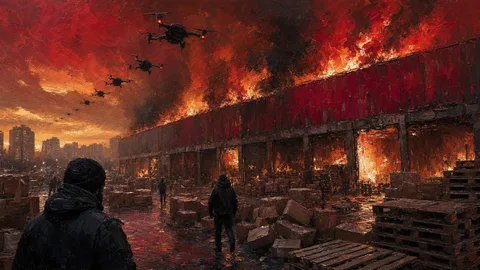
During the night of June 17 to 18, 2026, Ukraine launched its most significant drone attack since the beginning of the war. Nearly 200 drones targeted Moscow, penetrating the Russian multi-layered air defence. The Kapotnya oil refinery, in the southeastern part of the city, was struck, igniting major fires and black smoke clouds visible across the capital. 17 people were injured. Airports were temporarily closed. More than 500 flights were delayed or cancelled. Russia claimed to have intercepted "nearly 1,000 drones and four cruise missiles in 24 hours" nationwide.
The next day, Sergei Lavrov, Russia's foreign minister since 2004, did not convene a UN Security Council meeting, did not send a formal diplomatic note, did not propose mediation. He responded with threats. According to Ukrainska Pravda, Lavrov declared that "words alone are no longer sufficient" and that Russian forces would continue to regularly carry out "combined massive strikes" against targets they consider to affect the combat capabilities of Ukrainian forces. That is the language of a war minister, not a diplomat.
The Ukrainian response: Zelensky says aloud what Moscow refuses to hear
Ukrainian President Volodymyr Zelensky presented the attack on Moscow as an "absolutely justified response" to Russian strikes on Ukraine — notably the strike on a Kyiv cathedral and on an eleven-century-old UNESCO-listed monastery. This justification aligns with international law: an armed attack justifies a proportional response. Moscow strikes Ukrainian cathedrals, Kyiv strikes a Russian refinery. This is not terrorism — it is the symmetrical warfare that Russia believed it could conduct with impunity exclusively on others' soil.
And it is precisely this reciprocity that provoked Lavrov's sharp reaction. Russia had for over four years been waging a war in which it freely bombed Ukrainian territory, its cities, its hospitals, its civilian infrastructure — without expecting to receive blows on its own soil. The June 17-18 attack broke that asymmetry. And Lavrov's furious rhetoric is the response of a system that is not prepared to receive what it inflicts.
Lavrov: portrait of a diplomat transformed into a mouthpiece for war
The man who has survived every Russian crisis since 2004
Sergei Lavrov is a unique case in contemporary world diplomacy: a foreign minister in post for 22 years, surviving every crisis, every change of government, every round of international sanctions. Born in 1950, trained at MGIMO — the Soviet institute for international relations that shapes Russian diplomats in a tradition of hard rhetoric — Lavrov represented Russia at the UN for ten years before becoming foreign minister under Putin.
He is known for his sardonic humor, his barely concealed contempt for his Western counterparts, and his capacity to defend indefensible positions with apparent serenity. Since 2022, he has become one of the most recognizable faces of Russian war propaganda — not because he makes war directly, but because he is tasked with justifying the unjustifiable to the international audience and intimidating Ukraine's potential allies.
The transformation of Russian diplomacy under war
What the June 18, 2026 declaration by Lavrov illustrates is the complete transformation of Russian diplomacy since the start of the full-scale invasion in February 2022. It is no longer diplomacy in the classical sense — an instrument of negotiation, conflict resolution, and management of inter-state relations. It has become an instrument of war: intimidation of adversaries, demoralization of Ukraine's allies, attempts to divide the coalitions of support.
Every public statement by Lavrov must be read within this framework. His threats of "regular massive strikes" are not diplomatic proposals: they are deterrence messages addressed simultaneously to Ukrainians planning new attacks, to Westerners considering increasing their aid to Ukraine, and to the Russian domestic audience that must perceive Moscow's response as strong and decisive.
The Russian escalation rhetoric: a manual decoded
The citation of Putin as supreme reference
The June 18, 2026 declaration by Lavrov is revealing of a well-practiced Russian communication mechanism: refer everything back to a prior declaration by Vladimir Putin. He said: "It is no coincidence that the president announced some time ago, after another act by the Kyiv terrorist, that we would henceforth regularly conduct massive combined strikes against targets whose condition directly affects the combat capability of the Armed Forces of Ukraine."
This quote reveals a communication structure in which Lavrov announces nothing new — he recalls a decision that Putin had already made. He positions himself as the executor of a policy defined by the supreme leader, not as the decision-maker. This is a way of maintaining narrative consistency, showing that Russia had anticipated and planned its response, and presenting violence as a rational and premeditated decision rather than an emotional reaction.
The word "terrorist" applied to Zelensky: the rhetoric of dehumanization
The systematic use of the term "terrorist" to characterize Zelensky and Ukrainian leaders is one of the most consistent communication techniques of Russian propaganda since 2022. This designation serves several objectives. First, legitimizing strikes against Ukrainian targets by presenting them as counter-terrorism operations rather than aggression. Second, deterring Ukraine's Western allies by suggesting that by supporting it, they support "terrorists." Third, feeding the Russian domestic narrative that the war is a necessary defensive operation.
This designation is factually absurd: Zelensky is a democratically elected president of a sovereign state defending its territory against an invasion. But the factual absurdity does not diminish the rhetorical effectiveness of the designation — it is repeated frequently enough to settle into the discourse of certain audiences, particularly outside the West.
Massive strikes as an instrument of civilian terror
The cycle of Russian strikes: a deliberate strategy
The "combined massive strikes" that Lavrov references do not exclusively target military objectives. This is one of the most documented realities of the war: Russian missiles and drones regularly strike civilian infrastructure — power grids, heating installations, hospitals, housing. These strikes serve a dual function: weakening Ukrainian military capabilities by disrupting supply and production lines, and terrorizing the civilian population to break its will to resist.
This is a strategy that violates international humanitarian law and that many legal experts qualify as war crimes. The fact that Lavrov announces it publicly — "we will regularly conduct combined massive strikes" — is itself a form of admission. Publicly announcing a campaign of strikes against targets that include civilian infrastructure is announcing an intention that contravenes the international law obligations that Russia formally accepted.
The Kapotnya refinery: a military target, not a civilian one
It must be noted that the Kapotnya refinery, the primary target of the June 17-18 attack, is not a civilian objective in the strict sense. It produces fuel that powers Russian military operations. Ukrainian strikes on Russian refineries are part of a strategy of degrading Russian military logistical capacity — a militarily coherent and defensible strategy under international humanitarian law.
This is the fundamental difference between Ukrainian and Russian strikes: the former target primarily infrastructure that supports the Russian war effort; the latter deliberately and documentably target civilian infrastructure — power grids, heating installations, hospitals, residential buildings — to terrorize the population. This asymmetry is moral, legal, and factual. It must be named clearly.
The history of Russian escalation threats: a credibility balance sheet
Four years of threats — what real escalation?
Since the start of the full-scale invasion in February 2022, Russia has multiplied its escalation threats: use of tactical nuclear weapons if the West intervened directly, strikes on Western arms convoys if military aid continued, massive strikes if Ukraine struck Russian territory. These threats have, to some extent, succeeded in constraining Western decisions — for a long time, NATO countries refused to deliver certain weapons systems precisely to avoid "provoking" Russia.
But let us look at the follow-through record. Ukraine received Western tanks — Leopards and Abrams. It received long-range missiles capable of striking Russian territory. It now regularly strikes Moscow with drones. And each time, Russia threatened, sometimes intensified its strikes on Ukraine, but did not cross the threshold of nuclear escalation or direct confrontation with NATO. Its threats were partially effective, but their limits are now documented.
The paradox of eroded credibility
There is a paradox in Lavrov's June 18, 2026 communication: his threats of "regular massive strikes" do not constitute an escalation — they describe what Russia is already doing. Russia has been striking Ukraine massively since the beginning of the war. Announcing that it will continue to do so is not an escalation: it is the declaration of an intent to maintain the status quo of violence.
This paradox reveals the difficulty in which Russian escalation rhetoric finds itself: by repeatedly threatening and partially following through without ever crossing the most serious thresholds, Russia has partly exhausted its deterrence capacity. Ukraine and its allies have learned to calibrate more precisely the actual red lines of Moscow, which has allowed gradually increasing support to Kyiv despite the threats.
The attack on Moscow: strategic significance beyond the symbol
Two hundred drones over the Russian capital: a paradigm shift
The June 17-18, 2026 attack goes beyond symbolism. Nearly 200 drones reaching Moscow represents a significant operational capability. It means that Ukraine has developed, or received, long-range drones in sufficient numbers to saturate the multi-layered air defence of the Russian capital. Russia claims to have intercepted "nearly 1,000 drones and four cruise missiles in 24 hours" — but the images of the refinery ablaze prove that some still reached their target.
This penetration capability has direct military implications: it forces Russia to deploy additional anti-missile defence systems around Moscow and other interior targets, pulling these systems away from front-line defences. This is precisely the strategic logic of deep strikes: forcing the adversary to divide and stretch its defensive resources across a larger number of targets. Zelensky stated it explicitly: the strike on Moscow is a proportional response to the attack on Kyiv.
The shifts in psychological frontier
Beyond the military dimension, there is a crucial psychological one. Moscow has been, since the beginning of the war, the symbol of Russian impunity — the capital that sends the bombings but does not receive them. The black smoke of Kapotnya visible across the city changes that perception. For the Russian population, fed for years by propaganda presenting the war as distant and victorious, the images of the burning refinery send a different message: the war is in Moscow too.
Discover

INVESTIGATION: Beijing cuts Africa to 2.1 billion in loans…
2.1 billion — the lowest figure in almost twenty years, according…

SPECIAL REPORT: Beijing Promises Stimulus as Its Households Give…
That is the growth rate of Chinese industrial output in July,…

INVESTIGATION: Two Chinese Ex-Soldiers Arrested in Seoul as 18,000…
For five years, a man ran a military-supply shop at the…
This psychological disruption is difficult to quantify but politically significant. The 500+ flights delayed or cancelled, airports closed, residents watching smoke from their windows — these are experiences that create cracks in the narrative of a "distant and winning war" that the Kremlin carefully maintains. Lavrov's reaction — of unusual virulence even by his standards — may also be the response of a regime that perceives those cracks.
Europe and unified defence: the response to the Russian tempo
Berlin, June 25: European leaders at the defence table
While Lavrov was threatening, European leaders were meeting in Berlin to reaffirm their commitment to deeper defence cooperation, ahead of the NATO Ankara summit of July 7 and 8. This meeting, reported by European Relations on June 25, 2026, illustrates the dynamic in which Europe finds itself: Russian threats have paradoxically accelerated European defence integration rather than discouraging it.
This is a strategic irony that Putin had probably not anticipated when he launched his invasion in 2022: he produced exactly the opposite of his intended objective. Instead of weakening NATO and dividing Europe, he reunified and strengthened it. Sweden and Finland joined the Alliance. Defence budgets are surging. Industrial cooperation is accelerating. And every Lavrov threat convinces a few more hesitant governments that they must invest more in their collective security.
What Lavrov's threat says about Russian weakness
There is an empirical rule in geopolitics: when an actor threatens loudly, it is often because it feels weakened. The furious rhetoric from Lavrov after the Moscow attack may be the sign of a regime that does not have the means to match its ambitions. Russia is losing men in massive numbers on the Ukrainian front. Its war economy is absorbing considerable resources, at the expense of the population and other sectors. Its allies — North Korea, Iran, to some extent China — cannot compensate for the losses in conventional military capabilities.
The threat of "regular massive strikes" may be a response to an inability to achieve decisive military victories in the field. When one cannot win battles, one can attempt to threaten the adversary with unacceptable costs so that it abandons the fight. This is a low-cost deterrence strategy — verbal and symbolic — substituting for a victorious military strategy. And this substitution is precisely what Ukraine seeks to expose by striking Moscow.
Russian diplomacy in multilateral arenas
The UN as a tribune for manipulation
Russian diplomacy at the United Nations is a perfect example of the instrumental use of multilateral institutions. Russia uses its Security Council veto to block any resolution condemning its aggression, then presents to the General Assembly counter-resolutions presenting Ukraine as the aggressor. This strategy saturates UN mechanisms with inconclusive deliberations, making them less effective and feeding a discourse of moral relativism — "both sides are equally guilty" — that benefits the aggressor.
Lavrov himself is a master of this technique. He has presented the invasion of Ukraine as a defensive "special military operation," the expansion of NATO as an "aggression" against Russia, and Ukrainian resistance as "terrorism." These formulations are factually false, but they are repeated with implacable consistency that creates, in certain global audiences — particularly in the Global South — enough ambiguity to complicate the construction of an international coalition against Russian aggression.
Peace negotiations: Moscow plays for time
Russia has regularly used peace negotiation proposals as propaganda instruments: offers vague enough to be unacceptable, but public enough to put Ukraine in the position of apparent refusal and lead some observers to think that Ukraine is the obstacle to peace. This tactic — peace conditional on concessions unacceptable to Ukraine — has a long history in Russian diplomacy.
In this context, Lavrov's June 18 threats serve a dual role. On one side, they signal to Ukraine and the West that Moscow is prepared to continue the war indefinitely. On the other, they serve the Russian domestic narrative: look how strong we are, look how we respond to provocations. It is simultaneous communication toward multiple audiences, each receiving a slightly different but convergent message on the same conclusion: Russia does not yield.
Ukraine resists: Kyiv's response to Lavrov's rhetoric
Drone strikes as strategic language
Ukraine has developed since 2023 a doctrine of deep drone strikes on Russian territory that constitutes its concrete response to Lavrov's threats and Russia's terror strategy. These strikes target energy infrastructure, oil depots, arms factories, and military installations on Russian soil. They serve several objectives: degrading Russian logistical capabilities, depriving the Russian war economy of its resources, and — like the attack on Moscow — creating psychological and political pressure on the Russian population.
Ukrainian Minister Fedorov declared that Ukrainian unmanned systems units had struck more than 800,000 verified enemy targets since the start of the year, and that drone strikes had caused more than 167,000 Russian casualties in 2026. These figures are difficult to independently verify, but the scope of Ukraine's drone campaign is documented by multiple sources and implicitly acknowledged — by the violence of the Russian reaction.
Ukrainian resistance as a model
What is remarkable about the trajectory of the war since 2022 is Ukraine's capacity to transform what was initially a desperate resistance into an active threat to Russian territory. Kyiv is no longer merely defending its territory: it is carrying the conflict to Moscow, to St. Petersburg, to the Russian border regions. This is a strategic transformation that few analysts had anticipated, and it invalidates the Russian premise that the war could be won at limited cost on a peripheral territory.
Lavrov's threats will not stop this dynamic. They will not reverse Ukraine's capacity to produce and deploy drones in mass. They will not restore the territorial impunity that Russia believed it had. And this is perhaps the most important lesson the West should retain: supporting Ukraine is not merely an act of moral solidarity — it is a contribution to the demonstration that armed aggression is not a viable strategy in the 21st century.
What Europe must do now in the face of Lavrov's rhetoric
Not yielding to intimidation: the response to the threat
The appropriate response of European democracies to Lavrov's threats is the one they have gradually adopted since 2022: not yielding to intimidation, continuing to support Ukraine with weapons, ammunition, and financial resources, and maintaining the economic sanctions that weaken the Russian war machine. This approach has produced results: Russia has not achieved its military objectives, and Ukraine survives and resists four years after an invasion that was supposed to subdue it within days.
But Europe must go further. It must accelerate its own arms production to reduce its dependency on limited stocks and on potentially unpredictable American decisions under the Trump administration. It must maintain political consistency in its support for Ukraine, even under the economic pressure that Russian threats create. And it must name clearly — as I strive to do in this column — the reality of what Russian diplomacy says and does.
The European political discourse as resistance
There is one final dimension to underscore: the narrative struggle. Lavrov's rhetoric aims to normalize Russian violence, to relativize the aggression, to create enough ambiguity to undermine Western support. The appropriate response is unequivocal narrative clarity: naming the aggression, naming the aggressor, regularly recalling why Ukraine is fighting and why this fight is just. This clarity is not propaganda — it is the defence of truth in a war where truth is one of the first targets of the Russian strategy.
The leaders gathered in Berlin on June 25, 2026 to reinforce European defence cooperation are part of this response. NATO Secretary General Rutte telling Putin "we will defend ourselves" is part of this response. And columns that refuse to treat Lavrov's threats as legitimate diplomatic declarations are also part of this response. It is a battle on multiple fronts simultaneously. Ukraine wages it with drones. We can wage it with words.
The operational context: what the Ukrainian attack on Moscow reveals
Ukraine's long-range strike capability as a strategic fait accompli
The Ukrainian attack on Moscow that triggered Lavrov's threats was not an accident — it is the expression of a Ukrainian military doctrine that has evolved since the conflict began. Kyiv has progressively developed its deep-strike capability on Russian territory, initially cautiously, then with growing boldness as its Western allies lifted restrictions on the use of provided weapons. Modified FPV drones, autonomous systems, long-range missiles — the Ukrainian deep-strike arsenal is today an operational reality that Moscow can no longer ignore.
This capability fundamentally changes the nature of the conflict. Russia has always presented the war in Ukraine as a "special military operation" conducted by its forces on foreign territory — a framing that allowed the Russian population to live relatively normally, shielded from the conflict's realities. Strikes on Moscow — symbolically, politically — fracture this frame. Putin and Lavrov can no longer shield their citizens from the reality of the war they triggered. This is an internal political vulnerability for which the threat of "massive strikes" is, in part, an attempt at concealment.
What the Russian response says about the fragility of its defence apparatus
The fact that Ukrainian drones can reach Moscow also reveals gaps in Russia's air defence apparatus around its capital. Air defence systems like the S-400, the Pantsir-S1 and the Buk have demonstrated limitations against low-radar-signature drones flying at low altitude. This vulnerability surprised many analysts who had overestimated the density and effectiveness of the Russian anti-aircraft shield around its major urban centres.
For Ukraine, every strike on Russian territory has strategic value that goes beyond the physical damage caused. It demonstrates the resilience and creativity of the Ukrainian defence industry, forces Russia to redeploy air defence systems from the front to the rear, and — perhaps most importantly — imposes a psychological and political cost on the Russian population that, until now, had largely been spared the direct consequences of the war.
Escalation rhetoric as substitute for military effectiveness
When verbal threats compensate for operational failures
The correlation between Russian operational failures in the field and the intensification of Moscow's escalation rhetoric is not coincidental. When Russian military advances stall, when Ukrainian counter-offensives gain ground, when Russian weapons systems are destroyed in large numbers — it is often in these periods that nuclear rhetoric and threats of "massive strikes" reach their peak. This is a form of symbolic compensation: what cannot be won in the field, one attempts to compensate for through rhetorical terror.
This mechanism is not specific to Russia — other militarily troubled actors have resorted to the same tactics. But the Russian singularity is the scale and systematicity of the practice. Lavrov, Medvedev, Putin himself have created a catalog of threats so dense and repeated that outside observers have increasing difficulty distinguishing credible threats from routine bluster. This may be deliberate: creating a background noise of escalation so constant that it loses its specific deterrent effect — but maintains a form of diffuse anxiety in Western societies.
The boomerang effect of the too-often-brandished nuclear threat
There is a paradox in Russia's repeated nuclear threat strategy: by brandishing it so often, Moscow has eroded its deterrent effectiveness. In 2022, the first Russian nuclear threats generated real concern in Western capitals and contributed to slowing weapons deliveries to Ukraine. In 2026, after four years of near-permanent nuclear rhetoric and no effective use of nuclear weapons, the initial panic effect has dissipated. Ukraine's allies have learned to calibrate their responses to Moscow's actions rather than its threats.
This phenomenon of "threat habituation" is documented in the literature on nuclear deterrence. Deterrence functions through the fear of an unpredictable and catastrophic response. When threats become predictable and their repeated non-execution reduces the credibility of future execution, deterrence erodes. Moscow has found itself in a trap of its own making: to maintain deterrence, it would either have to execute its threats (with the catastrophic consequences that entails), or reduce them (implicitly acknowledging their hollowness).
Western allies facing Russian threats: anatomy of a collective response
Maintaining support for Ukraine despite psychological pressure
Facing four years of Russian escalation threats, Western allies have maintained — and even increased — their support for Ukraine. This maintenance has not been self-evident: at several junctures, notably during the first deliveries of heavy tanks, long-range missiles, and F-16 systems, voices in Western capitals argued for restraint in the name of non-provocation. These voices were progressively marginalized as Russian escalation claims did not materialize and Ukrainian military needs became more evident.
The resilience of Western support owes to several factors. First, the growing understanding that Ukraine was fighting for the security of all of Europe — a perception that transformed the war from a "faraway conflict" to a direct stake in everyone's security. Second, the solidification of positions as the crisis continued: once Leopard tanks, HIMARS missiles, and F-16s had been delivered without the predicted Russian nuclear apocalypse occurring, fear of subsequent threats was mechanically reduced.
The question of support durability in the face of democratic fatigue
The real risk for Ukraine is not a spectacular break in Western support — it is gradual erosion linked to public fatigue and growing budgetary constraints. Democracies have electoral cycles, shifting internal priorities, and populations that, after four years, are beginning to feel the economic effects of rearmament and sanctions. This democratic fatigue is precisely what Moscow is betting on over the long term: not defeating Ukraine militarily, but waiting for its allies to tire.
This is why the Ankara summit and long-term financial commitments to Ukraine are strategically important: they create institutional mechanisms that better resist democratic fatigue than informal support reaffirmed at every new summit. When a country has signed a formal weapons delivery agreement over five years or annual financial support, it is politically more costly to backtrack — even under domestic pressure — than if the commitment was purely declaratory.
On the same topic

COLUMN : Europe Moved 8.5 Billion Euros in a…
That is what the European Commission says it has disbursed for…
ANALYSIS: 800 drones over Russia in one night —…
More than eight hundred drones, in a single night, August 14…

ANALYSIS: 313 Votes, a 20th Extension — Ukraine Keeps…
313 votes to approve the presidential decree extending martial law by…
What Russian rhetoric reveals about Moscow's internal fragilities
Threats as a signal from a leadership under pressure
The violence of Russian rhetoric after the Moscow attack is also — and perhaps above all — an internally directed signal. Putin is running a state that initially presented this war as a rapid, clean, and victorious operation. Four years later, the human and economic costs are considerable, and questions are circulating in Russian public opinion — quietly, but genuinely. Lavrov's rhetoric about "retaliatory massive strikes" is not only aimed at Western capitals: it is also aimed at the Russian population, to signal that the government still controls the situation and that victory is within reach.
The signals of internal pressure on the Russian leadership are multiplying. Military losses, difficult to conceal in their home regions, create dissonance between official propaganda and lived reality. The Russian war economy is showing signs of inflationary overheating. And the economic elites close to the Kremlin, who had initially supported the war out of calculation, are beginning, according to some analyses, to measure the long-term cost of international isolation.
Can Putin afford a de-escalation without losing face?
The question preoccupying many analysts is that of the exit: can Putin negotiate a de-escalation, even a ceasefire, without it being perceived domestically as a capitulation? The answer depends largely on how the end of fighting can be narratively presented to the Russian population. If Moscow can maintain the narrative of an accomplished mission — even partially — a negotiated exit is politically viable. If the ceasefire is perceived as a military defeat, the regime faces a significant internal risk.
This is why analysts who advocate for a rapid negotiated solution must take into account this narrative constraint on the Russian side. An agreement that allows Putin to present a form of victory — even minimalist — is more durable than an agreement that pushes him into a position of public humiliation. This is not a moral concession to the aggressor: it is a realistic assessment of the conditions necessary for any eventual peace to hold over time.
Conclusion: Lavrov will keep threatening, Ukraine will keep resisting
A long-duration war whose rhetoric will not change
The June 18, 2026 declaration by Lavrov is not a turning point in the war: it is the continuation of rhetoric that Moscow has maintained for over four years. It will continue as long as Putin's regime is in place and as long as the war continues. This constancy is its own weakness: rhetoric that never changes eventually loses its power of intimidation, becomes perceived as a predictable background noise rather than a threat to be precisely calibrated.
What Zelensky's reaction says
Zelensky's response — qualifying the attack as an "absolutely justified response" and promising to intensify retaliation if Russia continues striking Ukrainian cities — says something fundamentally true about the nature of this war: it is not between morally equivalent forces, but it imposes a de facto symmetry that Russia could not foresee. The smoke of Kapotnya visible from Moscow is proof that Ukrainian resistance has transformed the rules of the game. And Lavrov can threaten as much as he wants — this transformation is irreversible.
Signed Maxime Marquette, columnist
Columnist's transparency box
Who I am and my declared biases
I am resolutely pro-Ukraine in my analysis of this conflict. I consider the Russian invasion of Ukraine an unprovoked aggression against a sovereign state, and I believe that Ukrainian resistance is morally and legally justified. I do not claim a neutrality I do not possess. These biases are consistent with my editorial doctrine — assumed and transparent. I commit, however, to not inventing facts and to citing my sources for anything factual.
What I do not know and my method
I do not have access to intelligence about the actual military capabilities of Ukraine or Russia. Casualty and strike figures are difficult to independently verify. The sources I use include Ukrainska Pravda, The Guardian, Al Jazeera, European Relations, and RTÉ. These sources have been cross-referenced and I have flagged uncertainties where they exist.
Sources
Primary sources
Secondary sources
Get the geopolitics analyses
Conflicts, powers, alliances: the MadMax thread without the noise.
Cite this article
Maxime Marquette (2026). COLUMN: Lavrov and His "Massive Strikes" — Russian Diplomacy as a Continuation of War. MadMax. https://mad-max.co/en/article/lavrov-et-ses-frappes-massives-la-diplomatie-russe-comme-continuation-de-la-guer
Read next
INVESTIGATION: Beijing cuts Africa to 2.1 billion in loans…
2.1 billion — the lowest figure in almost twenty years, according…
SPECIAL REPORT: Beijing Promises Stimulus as Its Households Give…
That is the growth rate of Chinese industrial output in July,…
INVESTIGATION: Two Chinese Ex-Soldiers Arrested in Seoul as 18,000…
For five years, a man ran a military-supply shop at the…
Enjoyed this piece? Get the next one.
One chronicle a week, straight to your inbox. No noise.
This article was generated with AI assistance, under human supervision.
Comments
Be the first to weigh in.