

Kyiv Under Ballistic Missiles on the Eve of the NATO Summit
On the night of July 5 to 6, 2026, Russia launched ballistic missiles, cruise missiles, and drones at Kyiv, according to the
- On the night of July 5 to 6, 2026, Russia launched ballistic missiles, cruise missiles, and drones at Kyiv, according to the
- Introduction: a night of explosions before diplomacy
- On the night of July 5 to 6, 2026 , Russia launched ballistic missiles , cruise missiles , and drones at Kyiv , according to the Ukrainian air force .
Facts, quotes, and cited links remain in the body. Interpretations are framed as analysis or opinion according to the format.
Introduction: a night of explosions before diplomacy
A capital struck at dawn
On the night of July 5 to 6, 2026, Russia launched ballistic missiles, cruise missiles, and drones at Kyiv, according to the Ukrainian air force. Explosions echoed across downtown as the coordinated attack continued for several hours, forcing thousands of residents to take shelter in subway stations turned into makeshift bunkers.
According to city officials cited by Le Monde, at least seven people were killed in Kyiv and another in the Bucha district, northwest of the capital, bringing the toll to at least eight dead, while at least 34 people were wounded in the capital and its region. Mayor Vitali Klitschko reported fires and damage in several districts, with residents trapped in a damaged building in the Podilskyi district.
A warning that came true within hours
This strike comes just hours after a warning from President Volodymyr Zelensky, who said on Sunday that Ukrainian intelligence indicated Russia "was preparing a new massive strike." The speed with which this warning materialized shows how Moscow continues to demonstrate its ability to hit the Ukrainian capital almost at will, despite four years of war.
The attack also comes on the eve of the NATO summit in Ankara, a timing that is no coincidence according to several Western analysts: Vladimir Putin is visibly seeking to remind everyone of his capacity for harm at the exact moment Western leaders gather to discuss future support for Kyiv.
The backdrop of a dark week for Kyiv
The July 2 strike, the deadliest of the year
This July 6 attack adds to an already tragic week for the Ukrainian capital. The preceding Thursday, July 2, Russia carried out one of its deadliest attacks of the year against Kyiv, killing at least 27 to 30 people and wounding more than 100 others, according to the city's military administration and matching sources. Ukrainian national police counted 113 wounded in total.
During the July 2 strike, Moscow used more than 70 missiles, nearly half of them ballistic missiles, along with nearly 500 drones, according to President Zelensky. The European Union responded by preparing new sanctions against Russian military producers, according to EU foreign policy chief Kaja Kallas.
A capital in mourning, a resilience wearing thin
Ukraine observed a day of national mourning after the July 2 attack, a rare gesture reflecting the scale of shock felt by the population. This succession of major strikes within just a few days illustrates a clear intensification of the Russian campaign against major Ukrainian cities, precisely as international attention turns to diplomacy.
This repetition of massive strikes raises a fundamental question: how long can a civilian population keep enduring this pace of attacks without the international community significantly speeding up its deliveries of air defense systems?
The Podilskyi district, symbol of this night of horror
Residents trapped under the rubble
Mayor Vitali Klitschko confirmed that residents remained trapped in a multi-unit apartment building that suffered heavy damage in the Podilskyi district, one of the Ukrainian capital's historic neighborhoods. Rescue teams worked for hours in the dark trying to pull people out from under the rubble, an effort made perilous by the risk of further strikes.
According to city officials cited by Le Monde, the attack caused four fires, all in residential buildings, once again illustrating that these Russian strikes primarily hit areas inhabited by civilians rather than strictly military targets.
Two districts hit by debris
Beyond Podilskyi, a second district also reported fires or damage linked to falling debris from intercepted missiles or drones shot down by Ukrainian air defense. This spread of damage across several neighborhoods demonstrates the scale of the attack, which combined several types of munitions in a single coordinated wave.
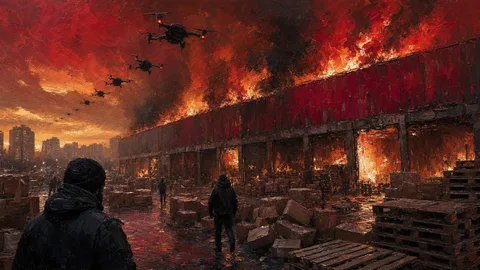
These images of gutted residential buildings, broadcast by Western media within the first hours of the morning, once again remind the entire world of the daily reality experienced by Ukrainian civilians, far from the air-conditioned conference rooms where their fate is negotiated.
Ukraine's response, striking at the heart of Russian territory
Russian refineries in Kyiv's crosshairs
In response to this escalation, Ukraine has intensified its own long-range strikes against oil and military infrastructure deep inside Russian territory. According to the Kyiv Independent, Ukrainian forces struck a major refinery in Nizhny Novgorod, as well as other targets in occupied territories, according to the Ukrainian General Staff.
This deep-strike strategy aims to reduce Russia's ability to fund and supply its war machine, by directly targeting the oil revenues that sustain the Kremlin's military effort. These strikes also hit facilities near Saint Petersburg, according to Al Jazeera, demonstrating an increasingly extended Ukrainian operational reach.
A war now touching both capitals
This dynamic of reciprocal strikes, hitting both Kyiv and deep targets in Russian territory, illustrates a phase of the war where neither side appears able to land a decisive blow, but where each seeks to maximize pressure on the other ahead of a possible renewed diplomatic cycle.
For Ukraine, these strikes on Russian refineries also send a clear political message to its Western partners: Kyiv is not a passive victim, but an actor capable of carrying the war onto its aggressor's own territory when circumstances demand it.
The NATO summit in Ankara, a credibility test
A different mood, according to observers
According to an analysis by the Carnegie Endowment for International Peace, the atmosphere ahead of the NATO summit in Ankara has clearly shifted compared to previous Alliance meetings, with palpable tensions among European allies and an American administration whose posture remains unpredictable on certain files.
This strike, coming on the very eve of the summit, places Western leaders before an immediate choice: concretely accelerate deliveries of the air-defense systems promised to Ukraine, or continue settling for statements of support that change nothing about the reality experienced by the people of Kyiv.
Zelensky and Trump, a meeting under high tension
President Zelensky is set to meet Donald Trump on the sidelines of the summit, a meeting whose importance is amplified by this new attack. This strike, coming literally on the eve of their talks, could increase pressure on Washington to accelerate its own military commitments to Kyiv, particularly regarding missile defense.
This sequence is yet another reminder of how Western diplomacy remains hostage to the military calendar imposed by Moscow, which deliberately chooses the timing of its attacks to maximize their political and symbolic impact.
On the same topic
ANALYSIS: 800 drones over Russia in one night —…
More than eight hundred drones, in a single night, August 14…

COLUMN : Europe Moved 8.5 Billion Euros in a…
That is what the European Commission says it has disbursed for…

INVESTIGATION: Beijing cuts Africa to 2.1 billion in loans…
2.1 billion — the lowest figure in almost twenty years, according…
Air defense systems, the absolute emergency
A deliberate saturation of Ukrainian defenses
The combination of ballistic missiles, cruise missiles, and drones used by Russia in this attack is explicitly designed to saturate Ukrainian air-defense systems, which must simultaneously manage several types of threats with radically different trajectories and speeds. This saturation tactic remains one of the hardest to counter, even for the most advanced Western systems.
Military experts stress that only a massive reinforcement of Patriot batteries and other similar systems could allow Ukraine to intercept a significantly higher share of these combined attacks, a goal that depends on the political will of Western capitals to deliver this equipment faster.
Europe's role in this race against the clock
Several European countries have pledged to speed up their own deliveries of air-defense systems, but production and transfer timelines remain a major obstacle. This bureaucratic and industrial slowness continues to cost lives with every new wave of Russian attacks against Ukrainian urban centers.
The Ankara summit offers European leaders another opportunity to prove, through concrete, numbered commitments, that their support for Ukraine goes beyond mere diplomatic rhetoric.
The role of Western intelligence in this anticipated attack
A precise warning that wasn't enough to prevent everything
The fact that President Zelensky was able to warn as early as Sunday of an imminent massive strike demonstrates the quality of intelligence now available to Ukraine, largely bolstered by information sharing with its Western allies. But that precise warning was not enough to prevent the human and material losses of this new attack.
This situation illustrates a fundamental limit of defensive warfare: even knowing the enemy's intentions in advance, a nation cannot fully protect itself without sufficient material means to intercept every projectile launched against it.
Cooperation that must deepen
This anticipatory capacity, while valuable, also underscores the urgency of turning this intelligence into real protection, through accelerated deliveries of interception systems rather than settling for early warnings that don't necessarily save lives on the ground.
Western intelligence services, notably American and British, continue to play a discreet but decisive role in this Ukrainian capacity to anticipate Russian movements, a partnership that deserves public recognition despite its usually confidential nature.
The immediate diplomatic repercussions
New European sanctions in preparation
Following the deadly July 2 strike, the European Union announced it was preparing new sanctions specifically targeting entities supporting the Russian military-industrial complex, according to EU foreign policy chief Kaja Kallas. This new July 6 attack should reinforce European determination to speed up adoption of these measures.
These sanctions would notably target suppliers of electronic components used in manufacturing Russian ballistic missiles and drones, a sector Moscow has managed to keep active despite years of successive Western restrictions.
Increased pressure on Russia's allies
Beyond direct sanctions against Moscow, several Western voices are also calling for intensified pressure on countries that continue to supply components or technical assistance to Russia, notably certain Asian suppliers whose ties to the Russian defense industry remain poorly documented publicly.
This broader approach, targeting the entire Russian military supply chain rather than only its direct actors, could prove more effective in the long run than sanctions aimed solely at isolated Russian individuals or companies.
The silent testimony of Kyiv's residents
A tragic routine taking hold
For many residents of Kyiv, this new night of explosions fits into a now-familiar tragic routine: rushing down into subway stations, waiting out the alert, then coming back up to discover the extent of overnight damage. This normalization of nighttime terror represents, in itself, a partial psychological victory for Moscow.
Despite this constant pressure, life continues to organize itself in Kyiv with remarkable resilience: shops reopen, schools function as best they can, and the population stubbornly refuses to give in to panic despite years of repeated bombing.
A generation marked forever
The children of Kyiv are now growing up with the sound of sirens and explosions as the backdrop of their childhood, a collective trauma whose long-term psychological consequences remain difficult to fully measure at this stage of the conflict.
This human reality, often overshadowed by missile counts and geopolitical analyses, deserves to be recalled every time a new international summit examines the future of this war.
The military lessons of this new escalation
The constant evolution of the Russian arsenal
This attack once again confirms the constant evolution of the Russian arsenal, which now combines different types of munitions in increasingly sophisticated ways to maximize effectiveness against Ukrainian defenses. This ongoing Russian adaptation forces Ukraine and its Western allies into a constant technological race to maintain their defensive edge.
Western military analysts closely monitor every new attack to identify possible tactical or technological developments that could be exploited by other potential adversaries of NATO in future conflicts, turning this war into a tragic but instructive laboratory for Western defense.
What the West must take away for its own defense
Beyond direct support for Ukraine, this war offers crucial lessons for missile defense across all NATO member countries, which must now factor the reality of combined, saturating attacks into their own territorial defense doctrines.
This dimension of collective learning justifies, beyond mere moral solidarity with Kyiv, sustained Western investment in strengthening Ukrainian air-defense capabilities.
Ukraine's position under diplomatic pressure
Kyiv refuses to negotiate under duress
Despite this new wave of attacks, Ukrainian officials reaffirmed their refusal to negotiate under military duress, insisting that any peace discussion must take place on the basis of a balanced position of strength rather than under the pressure of strikes meant to break Kyiv's will.
This position, constantly repeated by President Zelensky and his government, aims to show Western allies that giving in to Russian military pressure would send a disastrous signal, not only for Ukraine, but for the entire international order built on respect for state sovereignty.
A clear message aimed at Ankara
By enduring this attack on the very eve of the summit, Kyiv also hopes to strengthen the resolve of Western leaders gathered in Turkey, concretely reminding them, through images of the rubble in the Podilskyi district, of what is truly at stake in their diplomatic discussions.
This message, however tragic its form, could prove decisive in shaping the decisions made at this summit, crucial for the future of Western support for Ukraine.
Implications for the rest of the conflict
An escalation that could worsen before the summit
Several analysts fear this July 6 attack will not be the last before the official opening of the NATO summit, Moscow having shown in the past its ability to multiply symbolic strikes around major diplomatic events to maximize their psychological and political impact.
This worrying prospect demands heightened vigilance from Western and Ukrainian intelligence services in the coming days, as world leaders converge on Ankara to discuss the future of a war that has, so far, shown no sign of slowing on the Russian side.
The ultimate test for Western solidarity
This sequence of deadly strikes, occurring just days apart, represents an ultimate test for Western solidarity: will the leaders gathered in Ankara finally choose to massively accelerate their defense deliveries, or will they continue to settle for verbal condemnations that stop no missile?
The answer to this question will largely determine the trajectory of the coming months of this war, and by extension, the credibility of the entire Western alliance in the eyes of adversaries watching closely for every sign of weakness or division.
What this night reveals about the nature of the war in 2026
A war of attrition that refuses to run out of steam
More than four years after the start of Russia's full-scale invasion, this July 6 attack shows that Russia still retains both the capability and the will to strike hard at the very heart of the Ukrainian capital, despite the apparent exhaustion of its military and economic resources regularly highlighted by Western analysts.
This persistence of the Russian threat is a reminder that any Western strategy based on waiting for a natural collapse of Moscow's military capacity remains risky, and that only steady, growing material support for Ukraine can truly change the course of this conflict.
The urgency of a Western response equal to the moment
Faced with this reality, the West can no longer afford to treat each new Russian strike as an isolated event requiring a simple diplomatic condemnation. A structural, lasting response, including massive and regular deliveries of air-defense systems, remains the only credible option to durably protect Ukrainian civilian populations.
It is this urgency, embodied by the images of the damaged building in Podilskyi and the tragic count of victims, that Western leaders will need to keep in mind throughout the discussions at the NATO summit in Ankara.
International solidarity in the face of this new attack
Swift condemnations but awaited action
Several Western leaders quickly condemned this new Russian attack on Kyiv, reiterating their support for Ukraine just hours before the opening of the NATO summit in Ankara. These swift reactions, while appreciated by Kyiv, remain largely symbolic as long as they don't translate into concrete, numbered military commitments.
Western embassies in Ukraine also multiplied messages of solidarity on social media, a now-routine practice after every major strike, but one that struggles to mask the growing impatience of the Ukrainian population with the slow pace of equipment deliveries promised for months.
The weight of Western public opinion
These images of Kyiv in flames, widely broadcast by Western media, continue to influence public opinion in allied countries, maintaining constant political pressure on governments to publicly justify every delay in their commitments to Ukraine.
This citizen pressure, combined with repeated appeals from Ukrainian authorities, could prove decisive in convincing some hesitant governments to accelerate their own contributions at the Ankara summit.
A final warning before the summit
This July 6 attack could be interpreted as a final warning from Moscow before the official opening of the NATO summit, a way for the Kremlin to remind everyone that it retains military initiative, even as Western delegations prefer to focus on diplomatic discussions in Ankara.
The coming hours and days will tell whether this strike was an isolated episode or the prelude to a new escalation coordinated with the international diplomatic calendar, a question now preoccupying Western intelligence services as a whole.
Discover
INVESTIGATION: Beijing cuts Africa to 2.1 billion in loans…
2.1 billion — the lowest figure in almost twenty years, according…

SPECIAL REPORT: Beijing Promises Stimulus as Its Households Give…
That is the growth rate of Chinese industrial output in July,…

INVESTIGATION: Two Chinese Ex-Soldiers Arrested in Seoul as 18,000…
For five years, a man ran a military-supply shop at the…
Conclusion: the Ukrainian capital, a symbol of resistance that does not weaken
One more night in a war that refuses to end
This July 6, 2026 attack on Kyiv will join the long list of Russian strikes that, each in its own way, try to break Ukrainian resolve without ever fully succeeding. The eight victims recorded in Kyiv and Bucha, along with the 34 wounded, add to an already immense human toll since the start of this Russian war of aggression.
As Western leaders prepare to discuss the future of support for Ukraine at the NATO summit in Ankara, this night of explosions in Kyiv is an unequivocally brutal reminder of the absolute urgency of turning diplomatic words into concrete acts of defense.
A call to action that can no longer wait
The resilience shown by the people of Kyiv, who keep rebuilding, working, and living despite repeated attacks, deserves Western support equal to their courage. The Ankara summit represents a crucial opportunity, perhaps one of the last before a possible resumption of negotiations, for the West to finally prove that its commitments to Kyiv go beyond mere statements of intent.
History will remember how Western democracies responded at this pivotal moment: with a decisive acceleration of their military support, or with another missed opportunity in the face of Vladimir Putin's ongoing aggression.
By Maxime Marquette, columnist
Columnist's transparency note
On the sources and figures used
This article relies on reporting by CNN, Le Monde, and the Associated Press regarding the July 6, 2026 attack on Kyiv, as well as earlier reporting by ABC News and Bloomberg on the separate, deadlier July 2, 2026 attack. The casualty figures cited come from Ukrainian municipal and military authorities at the time of publication and may change as rescue operations continue.
What I cannot state with certainty
I cannot independently confirm the exact number of missiles intercepted by Ukrainian air defense during this specific July 6 attack, nor the precise operational details of Ukrainian strikes against Russian oil infrastructure. My role as a columnist is to faithfully report facts confirmed by reliable sources, never inventing additional details.
Sources
Primary sources
CNN — Deadly Russian strikes hammer Kyiv on eve of Trump trip, July 6, 2026
Le Monde — Russia launches deadly barrage on Kyiv region on eve of NATO summit, July 6, 2026
Associated Press — Russian missile and drone attack on Ukraine's capital, July 6, 2026
Kyiv Independent — Ukraine strikes major Russian oil refinery in Nizhny Novgorod
Secondary sources
ABC News — 27 dead, more than 100 injured in Kyiv, July 2, 2026
Bloomberg — Russia, Ukraine Exchange Missile Strikes Ahead of NATO Summit, July 2, 2026
Al Jazeera — Ukraine hits oil and military facilities near Russia's St. Petersburg, July 4, 2026
Carnegie Endowment — Ahead of the Ankara Summit, NATO's Mood Has Changed, July 1, 2026
Get the geopolitics analyses
Conflicts, powers, alliances: the MadMax thread without the noise.
Cite this article
Maxime Marquette (2026). Kyiv Under Ballistic Missiles on the Eve of the NATO Summit. MadMax. https://mad-max.co/en/article/kyiv-sous-les-missiles-balistiques-a-la-veille-du-sommet-de-l-otan
Read next
INVESTIGATION: Beijing cuts Africa to 2.1 billion in loans…
2.1 billion — the lowest figure in almost twenty years, according…
SPECIAL REPORT: Beijing Promises Stimulus as Its Households Give…
That is the growth rate of Chinese industrial output in July,…
INVESTIGATION: Two Chinese Ex-Soldiers Arrested in Seoul as 18,000…
For five years, a man ran a military-supply shop at the…
Enjoyed this piece? Get the next one.
One chronicle a week, straight to your inbox. No noise.
This article was generated with AI assistance, under human supervision.
Comments
Be the first to weigh in.