

Kostiantynivka, the Drone Hell Where Ukraine Still Holds
While the spotlight turns to the NATO summit in Ankara and the grand diplomatic maneuvers between Washington, Kyiv, and Moscow, a report
- While the spotlight turns to the NATO summit in Ankara and the grand diplomatic maneuvers between Washington, Kyiv, and Moscow, a report
- Introduction: a war of attrition far from the cameras
- A front no longer making headlines, but still bleeding
Facts, quotes, and cited links remain in the body. Interpretations are framed as analysis or opinion according to the format.
Introduction: a war of attrition far from the cameras
A front no longer making headlines, but still bleeding
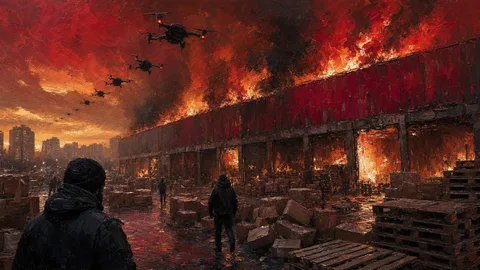
While the spotlight turns to the NATO summit in Ankara and the grand diplomatic maneuvers between Washington, Kyiv, and Moscow, a report from The New York Times published on July 5, 2026 recalls a harsher truth: in the ruins of Kostiantynivka, in the Donetsk region, Ukrainian soldiers keep fighting building by building, under a constant rain of Russian drones. This war never pauses to wait for a summit or an official statement.
The industrial city of Kostiantynivka has been contested for months between Russian and Ukrainian forces. A Ukrainian military spokesperson denied on Saturday a Kremlin claim that Russian troops had taken the city, asserting that Ukraine still holds it, despite considerable and continuous military pressure.
Kostiantynivka's strategic symbolism
This city is regarded by Moscow as the gateway to Kramatorsk, the last major stronghold in the Donetsk province still controlled by Ukraine and coveted for years by Vladimir Putin. Its fall would open the way to a broader Russian advance into this key region of eastern Ukraine.
The battle, building by building
Eleven Russian assaults repelled in a single day
According to Major Andriy Kovalov, spokesperson for the Ukrainian General Staff, Ukrainian troops repelled eleven separate Russian assaults on Friday while holding their designated lines. "The situation remains difficult, but it is under the control of Ukraine's defense forces," he said Saturday, a message of firmness that contrasts with Russian propaganda claiming a complete capture of the city.
Brigadier General Oleksandr Bakulin, commander of the 19th Army Corps tasked with defending Kostiantynivka, confirmed that Russian soldiers had been spotted in parts of the city, including its downtown, though no specific zone is under the enemy's full control.
A methodical but costly Russian infiltration
According to Bakulin, more than a hundred Russian soldiers are believed to have entered the city, a figure some Ukrainian journalists instead put at around 250 men. Notably, unlike in previous battles, Russian soldiers are no longer infiltrating in units or even in pairs, but one by one, a tactic dictated by the omnipresence of drones that make any grouped movement lethally risky.
The drone war that changed everything
Moving becomes an act of survival
The massive use of surveillance and attack drones by both sides has turned every movement around Kostiantynivka into a deadly gamble. Ukrainian soldiers describe a reality where crossing a street, changing position, or simply stepping out of a building exposes them to constant observation followed by a precision strike, often within minutes.
This dynamic echoes accounts gathered in the nearby city of Druzhkivka, where residents described how a simple trip to buy cigarettes ended in the amputation of a leg because of a Russian drone. This level of daily terror, imposed on civilians and combatants alike, illustrates the scale of this conflict's technological shift.
The glaring shortage of troops and ammunition
Despite Ukraine's recent successes with medium-range drone strikes against Russian supply lines in the south of the country, Ukrainian soldiers stationed in Donetsk continue to complain of a shortage of troops, ammunition, and drones to hold their positions against the constant pressure of the Russian army.
Guided bombs, a threat Ukraine cannot stop
A belt of martyred cities
A string of cities forming a belt in eastern Ukraine, including Sloviansk, Kramatorsk, Druzhkivka, and Kostiantynivka, have been severely damaged by Russian aerial bombardment in recent months, driving thousands of civilians to flee. These strikes use guided aerial bombs, which Ukraine remains unable to intercept effectively despite improved air defenses elsewhere on its territory.
On Friday, Russian aircraft dropped six guided bombs on the city of Sumy, in northeastern Ukraine, killing four people in the city center, including a five-year-old girl and her mother. These strikes are a reminder that the war is not confined to the Donetsk front — it also hits civilians with no direct link to the fighting.
Ukrainian farms also under drone fire
In southern Ukraine, Russian forces have also targeted thousands of hectares of farmland with drone swarms in recent days. A local farmer, Viktor Hordiienko, described enduring up to a hundred Russian drones a day over his fields, making any defense practically impossible and threatening a wheat harvest on the verge of being collected.
The broader context of the 2026 war
A war that has lasted more than four years
This fight for Kostiantynivka is part of a war that has now exceeded four years, becoming the deadliest conflict in Europe since World War II. The battle patterns seen at Kostiantynivka echo those of Bakhmut and Pokrovsk, two cities where Russian bombardment methodically destroyed buildings and positions before eventually forcing a tactical Ukrainian withdrawal rather than a pointless sacrifice of human lives.
Brigadier General Bakulin was explicit about this defensive doctrine: "We have not tried to hold every position at any cost by sacrificing large numbers of people," he explained, an approach that prioritizes preserving Ukrainian forces over the symbolism of lost ground.
Simultaneous pressure on major cities
While fighting rages in Donetsk, Russia has also intensified its strikes on major Ukrainian cities, notably Kyiv, in the days leading up to the NATO summit in Ankara. This dual pressure, military on the ground and psychological on civilians in major cities, illustrates the Russian strategy of total war against the whole of Ukrainian territory.
Courage documented by Ukrainian soldiers themselves
Video messages from the ruins
The Ukrainian army released a series of video messages on Saturday from soldiers filmed amid damaged buildings, asserting that they were still defending the city. These messages, while not immediately independently verifiable, offer a direct, poignant testimony of troop determination on the ground, far from sanitized official statements.
This direct military communication, broadcast in the middle of battle, also serves a strategic goal: countering Russian propaganda that already claims to control the city, by showing the entire world that Ukrainian resistance remains active on every contested street.
A double-edged wartime communication
On the same topic
ANALYSIS: 800 drones over Russia in one night —…
More than eight hundred drones, in a single night, August 14…

REPORT: One Year Past the August 18 Ultimatum, Ukraine's…
At midnight on August 18, 2025, the deadline expired that the…

SPECIAL REPORT: Beijing buys 40 cargoes of sanctioned Russian…
On August 28, 2025, a tanker named Arctic Mulan moored at…
I note, however, the necessary caution around this type of military content: these videos, while moving, are also part of a communications war where each side seeks to shape the narrative to its advantage. This takes nothing away from the real courage of the filmed soldiers, but it does demand a critical reading of how they are distributed.
What this reveals about the state of Russian forces
An army advancing, but bleeding
The fact that the Russian army must now infiltrate Kostiantynivka man by man, rather than in organized formations, reveals a considerable human cost for every meter of ground gained. This slow pace of advance, despite an apparent numerical and material superiority, illustrates the real limits of the Russian war machine after more than four years of prolonged conflict.
Western military analysts note that this pace of advance, measured in hundreds of meters rather than kilometers, carries an exorbitant cost in human losses for Moscow, a factor that could eventually weigh on Russia's capacity to sustain this war of attrition over the long term.
Ukrainian determination as a key factor
This methodical resistance, city by city, building by building, confirms that Ukrainian determination remains a major strategic factor that Moscow continues to underestimate, despite four years of war and colossal losses on both sides of the front.
The urgent needs of the Ukrainian army
Drones and ammunition, still the same request
Testimony gathered on the Donetsk front confirms a recurring need since the war began: more drones, more ammunition, and more fresh troops. This request, tirelessly repeated by Ukrainian soldiers on the ground, sometimes contrasts with the slow pace of Western deliveries promised at successive diplomatic summits.
The NATO summit in Ankara represents a crucial opportunity to turn words of support into concrete deliveries, as the soldiers in Kostiantynivka do not have the luxury of waiting for diplomacy to catch up with their urgent needs on the ground.
The gap between promises and the reality of the front
This gap between the commitments made in Western capitals and the reality lived by soldiers in the trenches of Kostiantynivka illustrates a permanent tension of this war: the declared generosity of allies often collides with bureaucratic delays and each donor country's internal political calculations.
The human dimension behind the military numbers
Civilians caught in the crossfire
Beyond the military fighting, tens of thousands of civilians have had to flee the cities of the Donetsk belt, leaving behind their homes, their businesses, and sometimes family members unable or unwilling to leave. This silent humanitarian crisis accompanies every advance or military retreat along this stretch of the front.
The remaining residents, often elderly or without the means to leave, live without electricity, without running water, and under the constant threat of drones, an existence few Western observers can truly imagine from the comfort of their respective capitals.
The human price of a war of position
This slow, methodical war of position imposes a considerable human toll that far exceeds official military statistics. Every building retaken or lost represents upended lives, displaced families, and an entire generation marked by this prolonged conflict.
The role of technology in this phase of the war
FPV drones, a democratized and deadly weapon
First-person-view drones, or FPVs, have become the most feared weapon on this front, capable of precisely targeting isolated individuals, vehicles, or fortified positions at a much lower cost than traditional weaponry. This technological democratization of warfare has fundamentally changed how both sides operate on the ground.
Anti-drone nets, resembling huge spiderwebs, are now installed along roads in Ukrainian cities of the Donbas to protect vehicles, including those evacuating civilians, from these near-daily precision attacks.
A permanent tech race between both sides
This drone war illustrates a constant technological race between Kyiv and Moscow, each side seeking to develop new countermeasures against the other's innovations, in an escalation cycle showing no sign of slowing after more than four years of conflict.
The relative silence of the international community
A forgotten front in the headlines
Discover

INVESTIGATION: Beijing cuts Africa to 2.1 billion in loans…
2.1 billion — the lowest figure in almost twenty years, according…

SPECIAL REPORT: Beijing Promises Stimulus as Its Households Give…
That is the growth rate of Chinese industrial output in July,…

INVESTIGATION: Two Chinese Ex-Soldiers Arrested in Seoul as 18,000…
For five years, a man ran a military-supply shop at the…
Despite the intensity of the fighting in Kostiantynivka, this front gets far less media attention than the major strikes on Kyiv or the international diplomatic summits. This asymmetry of attention risks minimizing, in the eyes of the Western public, the daily and prolonged reality of this war of attrition far from the capitals.
This media imbalance is not trivial: it can shape public perception of the support Ukraine needs, giving the mistaken impression that the war is only being fought in major cities and at summits, rather than in these methodical wars of attrition that actually determine the territorial outcome of the conflict.
The importance of continuing to tell these stories
It is precisely for this reason that reports like The New York Times' on Kostiantynivka remain essential: they remind the Western world that the war never stops, even when the spotlight turns elsewhere to high-level diplomacy.
The implications for future military support
A credibility test for Western allies
The situation in Kostiantynivka poses a direct question to the Western allies gathered in Ankara: will the support promised to Ukraine finally translate into sufficient deliveries of drones and ammunition to shift the balance of power on this specific front, or will it keep arriving too slowly to make a decisive difference?
This question goes beyond mere summit diplomacy: it touches directly on the West's ability to demonstrate, through concrete actions and not mere statements, its willingness to support Ukraine through to a just peace rather than a forced capitulation.
The role of Western defense production
The capacity of the Western defense industry to rapidly ramp up its production of drones and ammunition remains a decisive factor in meeting the needs voiced by soldiers on fronts like Kostiantynivka, where every day of delay translates directly into lost ground or lost lives.
What the Western world must take from Kostiantynivka
A lesson in resilience under extreme pressure
The fight for Kostiantynivka offers a lesson in resilience that reaches far beyond this one city: it shows that even facing constant military pressure and omnipresent drone technology, human determination remains a decisive factor that firepower alone cannot always defeat.
This Ukrainian resilience, documented directly by independent journalists like those of The New York Times, deserves to be recognized and concretely supported by all NATO member countries, beyond the mere speeches of solidarity delivered at international summits.
An urgent reminder ahead of the Ankara summit
On the eve of the NATO summit in Ankara, this report on Kostiantynivka should serve as a blunt reminder to every Western leader gathered there: the war continues, it is brutal, it is methodical, and it demands concrete support rather than promises repeated year after year.
Comparisons with other fronts of the war
Pokrovsk and Bakhmut, scenarios that repeat
The pattern seen at Kostiantynivka faithfully mirrors that of Bakhmut and Pokrovsk, two emblematic cities where Russian forces advanced very slowly, at the cost of considerable human losses, before finally seizing ruins largely devoid of immediate strategic value. This repetitive pattern of attrition warfare illustrates a Russian military doctrine that prioritizes symbolic conquest over operational efficiency.
Western strategists studying these repeated patterns note that each city taken by Russia costs proportionally more in men and equipment than the last, a possible sign of the gradual exhaustion of Russian offensive capacity despite four years of continuous mobilization.
Tactical lessons for NATO
These prolonged urban battles offer valuable lessons for WesternNATO armies, notably on the crucial importance of drone warfare, anti-drone protection for civilian and military infrastructure, and the need to maintain robust supply chains even under constant bombardment.
Conclusion: a war that never stops for diplomats
The contrast between plush lounges and trenches
While Western leaders negotiate in the comfort of conference rooms in Ankara, Ukrainian soldiers keep fighting in the rubble of Kostiantynivka, dodging drones that can strike at any moment. This stark contrast between hushed diplomacy and the reality of the front must stay present in the mind of every Western decision-maker during this critical summit.
The duty to remember and to keep supporting
This battle, like so many others before it in this prolonged war, deserves to be told, understood, and supported by a West that must stay true to its commitments to Ukraine, not only out of moral solidarity, but because Ukrainian resistance is a direct line of defense against the Russian expansionism that would eventually threaten the security of all of Europe.
By Maxime Marquette, columnist
Columnist's transparency note
Who I am and my acknowledged biases
I write this commentary as an openly pro-Ukraine, engaged columnist. I consider Ukrainian resistance to be a fight for the survival of a free nation against Russian imperialist aggression, and I believe the West must maintain concrete military support, especially for less publicized fronts like Donetsk.
What I don't know, and my method
I cannot independently verify the exact content of Ukrainian military videos released from the front, nor confirm the precise casualty figures on either side. This commentary relies exclusively on verifiable journalistic reporting and cited, dated official statements, without invention or fabricated testimony.
Sources
Primary sources
The New York Times — Far from Kyiv and Moscow, soldiers hunt through ruins and dodge drones, July 5, 2026
Associated Press — Russian missile and drone attack on the Ukrainian capital, July 6, 2026
Secondary sources
Institute for the Study of War — Russian offensive campaign assessment, July 3, 2026
Radio Free Europe/Radio Liberty — The Donbas war at Kostiantynivka
Ukrainska Pravda — War news, July 2, 2026
CNN — Russia attacks Kyiv with ballistic missiles on the eve of the NATO summit, July 6, 2026
The Times — The destruction of Donbas, the city wiped off the map, May 2026
Get the geopolitics analyses
Conflicts, powers, alliances: the MadMax thread without the noise.
Cite this article
Maxime Marquette (2026). Kostiantynivka, the Drone Hell Where Ukraine Still Holds. MadMax. https://mad-max.co/en/article/kostiantynivka-l-enfer-des-drones-ou-l-ukraine-tient-encore
Read next
INVESTIGATION: Beijing cuts Africa to 2.1 billion in loans…
2.1 billion — the lowest figure in almost twenty years, according…
SPECIAL REPORT: Beijing Promises Stimulus as Its Households Give…
That is the growth rate of Chinese industrial output in July,…
INVESTIGATION: Two Chinese Ex-Soldiers Arrested in Seoul as 18,000…
For five years, a man ran a military-supply shop at the…
Enjoyed this piece? Get the next one.
One chronicle a week, straight to your inbox. No noise.
This article was generated with AI assistance, under human supervision.
Comments
Be the first to weigh in.