

COLUMN: Helsinki and Stockholm share runways, and Russian aircraft meet two flags
The Gulf of Finland, late September. A low sea the color of slate. Granite islets. Ferries shuttling between Helsinki and Tallinn. On shore, people haul their rowboats out of the water, hands already red from the autumn sea.
- The Gulf of Finland, late September. A low sea the color of slate. Granite islets. Ferries shuttling between Helsinki and Tallinn. On shore, people haul their rowboats out of the water, hands already red from the autumn sea.
- The gulf before the alert
- The Gulf of Finland, late September.
Facts, quotes, and cited links remain in the body. Interpretations are framed as analysis or opinion according to the format.
A gray sea on a Thursday
The gulf before the alert
The Gulf of Finland, late September.
A low sea the color of slate. Granite islets. Ferries shuttling between Helsinki and Tallinn. On shore, people haul their rowboats out of the water, hands already red from the autumn sea.
A low sky. Wind. Gulls.
Nothing in this scene looks like a front line.
September 24
And yet on Thursday, September 24, with stray drones from a neighboring war having already pushed Helsinki to tighten the watch over its skies, quick-reaction fighters leave their runways, somewhere in Finland and somewhere in Sweden.
A runway is a ribbon of concrete. You forget it until a plane rolls down it. Remember this one: in this story, it is the thing that changes.
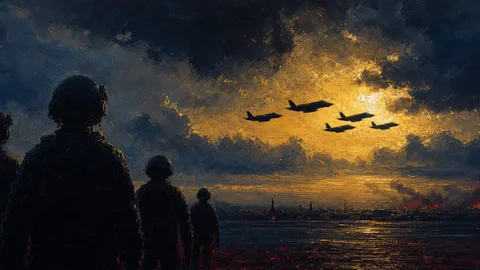
Over the gulf, in international airspace, a Russian air force detachment is on its way. Finnish F/A-18 Hornets and Swedish JAS 39 Gripens climb to meet it. Together. For the first time.
A calm sea, and two flags in the same sky.
Three Russian silhouettes
A Tu-134 and its escort
The next day, September 25, at 9:30 a.m. Helsinki time, the Finnish Air Force publishes the statement. The Swedish Armed Forces put out the same text.
The identified detachment includes a Tu-134 transport aircraft, which NATO calls Crusty. MiG-31 fighters, the Foxhounds. Su-30 fighters, the Flanker-Hs.
The statement gives no exact number of Russian fighters. The statement gives no time for the interception.
International airspace
A detail that matters: the Russian aircraft were flying in international airspace. The statement mentions no violation.
So the Kremlin crossed nothing that Thursday. Its air force did what it often does over the Baltic: fly close to other people’s coasts, in a group, a transport escorted by fighters.
To identify is to go and look. Pull up alongside. Read the registration, count the missiles under the wings, take pictures. Then see them off with your eyes.
No shot. No shout. A look.
The mission was directed by the Finnish Air Force’s air operations center.
The gesture is old. The hands doing it are new.
A first, not a routine
Years of training
The Nordic countries have been intercepting Russian aircraft for a long time. That is not the news.
For several years, the two air forces write, their pilots have flown across each other’s border almost every week in training. Exercises. Rehearsals.
Each air force remains responsible for its own airspace, Colonel Vesa Mäntylä points out. That does not change.
September 24 was not an exercise. It was, according to the statement, the first joint operational identification mission by the two air forces.
The first real flight
A first. Not a routine. A date.
The colonel, deputy chief of staff at Finnish Air Force Command, sums it up: the deeper cooperation that “began this autumn” makes these joint missions possible. It also lets quick-reaction fighters operate from the other country’s air bases.
Major General Jonas Wikman, who commands the Swedish Air Force, speaks of trust built over years. “This is what close cooperation looks like in practice,” he says.
This column reads it this way: the September 24 flight is first of all a revelation. The defense of the North is being built beneath NATO’s floor, between two neighbors who lend each other their runways.
Years of rehearsals for one real flight.
The other country’s runway
August 28
On August 28, the Finnish Ministry of Defence and the Defence Forces announce the agreement.
Sweden will take part in the surveillance and protection of Finland’s territorial integrity. With its Gripen fighters. With a Visby-class corvette from its navy, in the Baltic Sea.
The Swedish assets mainly strengthen air surveillance. They free up Finnish forces to repel violations and incidents, if needed.
Until the end of 2026
The agreement runs at least until the end of 2026, the Finnish Defence Forces write.
And it contains a quiet sentence that changes everything: quick-reaction fighters are based mainly at home, but they can operate from the other country’s bases if necessary.
So a Swedish Gripen can land in Finland, refuel, take off again. A Finnish Hornet can do the same in Sweden.
The alliance starts on a borrowed runway.
Not on a treaty. On concrete.
A border ends where the neighbor’s runway begins.
Beneath NATO’s floor
Four air forces, one sky
The flight on the 24th was not a NATO mission. It fell under cooperation between two states, under Finnish direction.
In practice, SVT explains, Swedish fighters are guided by the Finnish Air Force’s command center. One country talks. The other flies.
It still fits into a wider fabric. Both statements recall the cooperation known as Nordic Air Power: the air forces of Finland, Sweden, Norway and Denmark, four air forces working on their interoperability within collective defense.
Over the Baltic, the Finns and the Swedes also coordinate with the detachments of NATO’s Baltic Air Policing mission.
Capacity on call
That same month, according to the Barents Observer, the Finnish Air Force announced another agreement, called Capacity on Call, with Denmark, the Netherlands, Belgium and Norway: sharing F-35s, personnel and weapons systems.
Five countries. 262 F-35s between them by 2030, the same paper says.
And on the ground, NATO created its Forward Land Forces in Finland in June 2026, under Swedish lead: a battle group in Boden, Sweden, and a multinational headquarters in Rovaniemi.
Two countries. Then four. Then five. Then the whole Alliance.
NATO is the roof. Borrowed runways are the walls.
September 18, in Rovaniemi
Two jets delivered, 64 ordered
Six days before the joint flight, another event had touched down in Lapland.
On September 18, at 5:45 p.m. local time, Finland’s first two F-35s land at the Lapland Air Wing base in Rovaniemi, on the Arctic Circle. They had left Fort Worth, Texas, on September 15, with a stopover in the Azores.
During the ferry flight, flown by American aviators, the Finnish roundels were covered, the Finnish Air Force notes. That is the rule for these flights. The tail numbers, though, were readable: JF-510 and JF-512.
Finland has ordered 64. The last is due to arrive in 2030, the Barents Observer reports.
The Hornet on its way out
These F-35s will replace the current fleet: 55 F/A-18C and 7 F/A-18D Hornets, based in Rovaniemi and Kuopio-Rissala.
On September 18, the F-35s arrived escorted by Hornets, according to the Finnish Air Force.
On September 24, it is Hornets again that climb toward the Russian aircraft, alongside the Gripens.
A jet welcoming its replacement. Then going back to work as if nothing had happened.
Two jets delivered. Sixty-four promised. Six days apart.
The old Hornet still flies. It no longer flies alone.
An interception without a violation
No retaliation, no escalation
It is worth saying what this flight is not.
It is not retaliation. It is not a violation repelled. It is not a diplomatic crisis. It is not an escalation. It is not a feat.
The Russian aircraft were in international airspace. Nordic fighters scramble regularly for this kind of identification, Euronews notes.
Each from home, that day
Another limit, more awkward for my reading. That Thursday, according to SVT, the Swedish jets took off from Sweden and the Finnish ones from Finland, then they joined up.
The borrowed runway was not used on the 24th. It exists on paper and in the right to operate. Not yet in the logbook.
What is a borrowed runway worth if nobody has used it yet?
And the agreement has an expiry: at least until the end of 2026. Beyond that, nothing is written.
And yet the procedure held. A Finnish center guided Swedish Gripens toward a Russian detachment, and nobody got in anyone’s way in the same sky.
A first is not a habit. Not yet.
Discover

COLUMN: At 54 Volodymyrska Street, Moscow burns the address…
A Russian jet-powered drone struck the presidium building of the National…

SPECIAL REPORT: Brussels sanctions a camp called Peace and…
Romashka, Sputnik, Raduga, Mir, Leto, Vita: the Official Journal of the…

OPEN LETTER: Leo XIV, you quote Benedict XV, so…
Holy Father, on September 28 in Metz, you asked Europe to…
The drones that stray
No direct threat
Why this agreement, and why now? The official answer makes everyone a little uncomfortable.
On August 28, the Finnish Defence Forces wrote: “No direct military threat is directed against Finland.” Then they explained. Ukraine, in its “justified defensive operations” against Russia, is carrying out large-scale drone attacks on Russian territory, and some drones have strayed into Finnish airspace and territory.
It is uncomfortable. It is in writing.
I note it because it costs my side. Ukrainian drones ended their flight in Finland. An ally had to reinforce its skies partly because of them.
Fallout from a neighboring war
But read the Finnish government’s sentence, published the same day: these incursions are a consequence of Russia’s war of aggression against Ukraine.
Helsinki does not get the address wrong. The stray drone is Ukrainian. The war that launched it is Russian.
The Defence Forces add that the attacks on Russia will probably not stop anytime soon. Hence the agreement: sustain heightened vigilance for a long time without wearing down Finland’s forces alone.
The drone comes from Ukraine. The war comes from the Kremlin.
The same day, in Copenhagen
A low risk that is growing
On the day of the joint flight, Euronews reports, Denmark’s Defence Intelligence Service presented an updated assessment of the Russian threat.
Its head, Thomas Ahrenkiel, spoke of a “low but growing risk” that Russia launches a limited military attack against one or more NATO countries bordering Russia.
Finland borders Russia.
Limited. Bordering. Growing. Three words from an allied intelligence service.
An invasion of a NATO country is still judged very unlikely by that service. It does not rule it out.
Sabotaging the aid
Above all, the Danish service expects more so-called hybrid attacks. Until now, it says, they aimed to sow fear and weaken public support for aid to Ukraine.
They are starting to aim at something else: stopping the aid from arriving. Sabotage against defense companies. Against rail convoys carrying military equipment.
Euronews also recalls that after a violation of Polish airspace, NATO launched Eastern Sentry to deter further Russian incursions.
The Kremlin, the same outlet notes, dismisses as unfounded the accusations over some incursions in Europe.
The same Thursday, a warning and an answer.
Exposed and protected
The most fragile sea
Sweden’s outgoing prime minister, Ulf Kristersson, commented on the flight on X.
The Baltic, he wrote, has never been as exposed as it is today. Nor has it ever been better protected. He added that in a tense situation, we are stronger together.
Exposed. Protected. Both.
The two sentences are true at the same time. That is what keeps the gray sea of the opening from ever being calm.
Refueled by a neighbor
Back to the runway. It has changed since this column began.
The Barents Observer reports what a former F-16 pilot, Per Erik Solli, of the Norwegian Institute of International Affairs, describes: Norwegian F-35s can now patrol over the Barents Sea, then land in Rovaniemi. There, Finnish technicians refuel them, inspect them and send them back up.
A borrowed runway is thick gloves on a fuel hose. A borrowed runway is the hiss of an engine cooling in the Arctic night. A borrowed runway is a mechanic signing the logbook of a plane that is not his.
No treaty replaces that gesture. No summit films it.
A neighbor’s refueling is worth a signature.
What Norway keeps closed
East of the 28th meridian
Integration from the ground up also has its closed doors.
According to the Barents Observer, Norway keeps an old Cold War practice: self-imposed restrictions on allied fighter flights east of the 28th degree of longitude, over eastern Finnmark. That is the stretch of its sky closest to the Russian border.
The restrictions stem from a concern not to provoke Moscow, whose main nuclear naval forces are based on the coast of the Kola Peninsula.
Caution from another era
Per Erik Solli, quoted by the same paper, thinks this buffer zone will disappear in the long run. Allied fighters, he says, already fly close to the Russian border over the Baltic states and Finland.
Only Norway keeps its buffer.
And yet earlier in September, two Norwegian F-35s landed in Rovaniemi, the same paper reports. Up north, the buffer is already being bypassed by concrete.
The concrete moves forward. The rule, not yet.
I understand the caution. I also find it dated. Restraint designed for another century sometimes outlives the reason it was born.
Even among allies, some runways stay closed.
A defense built from the ground up
A Finnish center, Swedish Gripens
On the same topic

ANALYSIS: With decree 686, Putin hides who buys Russian…
Decree 686, signed by Vladimir Putin on September 28, does not…
OPINION: Why Warsaw is right to shoot down what…
A Russian military helicopter spent 42 seconds in Polish skies on…

EDITORIAL: American taxpayers pay for a 2024 ad the…
Between two football games, on September 26 and 27, a president…
Here is my verdict. The September 24 flight reveals where the West’s defense in the North is actually being built.
Not in grand declarations. In agreements between two countries. You see it in a Finnish operations center guiding Swedish fighters. You see it in a Swedish corvette lent out to watch the Baltic on Finland’s behalf. You see it in a Finnish technician refueling a Norwegian F-35.
NATO provides the frame: collective defense, Baltic air policing, forward forces. The neighbors pour the concrete.
No speeches. Fuel. Schedules. Runways.
Runway by runway
And that is good news, the most solid this file contains.
A bilateral agreement gets signed fast. It does not wait for consensus across the whole Alliance. It gets tested at the first takeoff.
What northern Europe can still build, it builds this way: runway by runway, refuel by refuel, flight by flight.
The summit promises. The borrowed runway delivers.
October 1, in Rovaniemi
A ceremony and a president
What comes next already has dates.
On October 1, the Finnish Air Force will present its first F-35s to the press and to guests in Rovaniemi. President Alexander Stubb, commander in chief of the Defence Forces, has been invited, according to the Air Force.
The same day, a new commander takes over the Lapland Air Wing: Colonel Tuukka Elonheimo, until now head of the Finnish liaison office in Washington, according to the Air Force.
Mechanic training begins in Rovaniemi at the end of 2026. Pilot training follows, in January 2027.
2028, then 2030
Initial operational capability is planned for early 2028. Full capability, for the end of 2030. Until then, Hornets and F-35s will fly side by side.
And the agreement with Sweden runs at least until the end of 2026.
Two dates. A gap.
And in 2027?
The aircraft timetable outruns the agreement’s…
The jets have a date. So does the trust, for now.
A runway you lend
Two flags, one sky
In the first paragraph, the runway was just a ribbon of concrete.
By the end, it is a promise. The promise that a neighbor will refuel your plane at three in the morning without asking which country’s roundel it wears.
On September 24, the Russian air force met two flags instead of one. Two roundels. One command center.
Our own runways
Would Canada accept an allied fighter taking off from its own runways to defend its skies?
The answer says what kind of ally we are.
The sea turns gray and calm again. Until the next alert.
Two flags over the gulf. A borrowed runway below.
Sources:
Primary Sources:
- Finnish Air Force — first joint identification mission with Sweden, September 25, 2026
- Finnish Defence Forces — closer cooperation with Sweden, August 28, 2026
- NATO — Arctic security and Forward Land Forces in Finland, updated July 24, 2026
Secondary Sources:
Get the geopolitics analyses
Conflicts, powers, alliances: the MadMax thread without the noise.
Cite this article
Maxime Marquette (2026). COLUMN: Helsinki and Stockholm share runways, and Russian aircraft meet two flags. MadMax. https://mad-max.co/en/article/helsinki-and-stockholm-share-runways-and-russian-aircraft-meet-two-flags
Read next
COLUMN: At 54 Volodymyrska Street, Moscow burns the address…
A Russian jet-powered drone struck the presidium building of the National…
SPECIAL REPORT: Brussels sanctions a camp called Peace and…
Romashka, Sputnik, Raduga, Mir, Leto, Vita: the Official Journal of the…
OPEN LETTER: Leo XIV, you quote Benedict XV, so…
Holy Father, on September 28 in Metz, you asked Europe to…
Enjoyed this piece? Get the next one.
One chronicle a week, straight to your inbox. No noise.
This article was generated with AI assistance, under human supervision.
Comments
Be the first to weigh in.