

EDITORIAL: For the first time, the EU extends its sanctions against Russia for a full year
On June 18, 2026, at the heart of a European Council summit in Brussels, the twenty-seven heads of state and government of
- On June 18, 2026, at the heart of a European Council summit in Brussels, the twenty-seven heads of state and government of
- Introduction: On June 18, 2026, Europe took a historic step in Brussels
- A decision that breaks with ten years of procrastination
Facts, quotes, and cited links remain in the body. Interpretations are framed as analysis or opinion according to the format.
Introduction: On June 18, 2026, Europe took a historic step in Brussels
A decision that breaks with ten years of procrastination
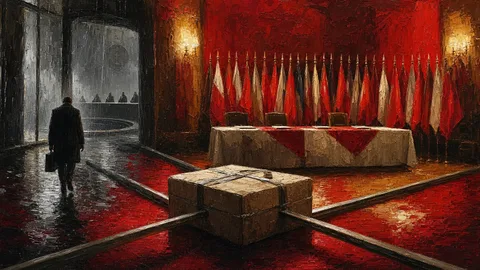
On June 18, 2026, at the heart of a European Council summit in Brussels, the twenty-seven heads of state and government of the European Union did something they had never done since these sanctions against Russia first existed: they extended them for a duration of twelve months, instead of the usual six. This is not a technical detail. It is a political signal of considerable magnitude, a clear break with a decade of semi-annual renewals made systematically perilous by the repeated vetoes of Viktor Orbán's Hungary.
The European Council spokesperson, Maria Tomasik, confirmed the decision to journalists gathered in Brussels in the hours following the summit: "European Union leaders have approved the conclusions on Ukraine and have agreed to extend sanctions against Russia for another year." A sober wording for a gesture that marks, according to the same source, an absolute first in the history of the European sanctions mechanism. The President of the European Commission, Ursula von der Leyen, was more lyrical: "The tide is truly turning."
Zelensky in Brussels, or the symbolic power of presence
The meeting began in the presence of Ukrainian President Volodymyr Zelensky, invited to the summit before European leaders continued their deliberations among themselves. The discussions lasted in total about three and a half hours, ending shortly before midnight, Kyiv time. This is not insignificant: Zelensky's presence at the table of the Twenty-Seven is never symbolically neutral. It reminds every leader that the decisions made in this cold marble room have consequences of flesh and blood a few thousand kilometers to the east.
According to Ukrainska Pravda, whose Brussels correspondents followed the summit closely, the discussions on Ukraine finally resulted in a unanimous adoption of the European Council conclusions — the first time the twenty-seven had agreed on such a document since December 2024. Two strong symbols, then, for a single night of negotiations: the annual extension of sanctions and the return to unanimity for the conclusions. Europe has found its collective voice.
The mechanics of the veto: how Orbán turned a routine vote into a geopolitical weapon
Six months as a lever for perpetual pressure
Since 2014, when the EU imposed its first sectoral sanctions against Russia in response to the illegal annexation of Crimea, the renewal mechanism has always functioned on a semi-annual rhythm. The rule is simple and ruthless: unanimity required, every six months. A single recalcitrant member state is enough to block the process. For years, this unanimity clause constituted the loophole methodically exploited by Viktor Orbán, Prime Minister of Hungary until April 2026.
Orbán knew perfectly well that each renewal represented an opportunity to negotiate — frozen European funds, concessions on energy policy, exemptions on Russian oil imports. The logic was cynical but effective: turning a routine vote into a bargaining chip. Robert Fico's Slovakia had, at certain moments, joined Budapest in this veto dance, further aggravating intra-European tensions. The result? An EU that moved backward, perpetually held hostage by its unanimity rule and a Hungarian leader whose agenda served Moscow far more than Brussels.
The human cost of institutional paralysis
What technocratic analyses of voting mechanisms sometimes forget is that every blocked or delayed renewal had a real cost for Ukraine. In February 2026, on the eve of the fourth anniversary of the full-scale invasion, Hungary had again vetoed a new sanctions package — the twentieth — and a loan of 90 billion euros for Kyiv. The head of European diplomacy, Kaja Kallas, had called this failure a "setback," while ensuring that work continued. In March 2026, Hungary and Slovakia had jointly blocked the renewal of individual sanctions hitting more than 2,700 people and entities, just days before their expiration date.
These repeated blockades were not simple diplomatic posturing. They meant that every session of the Council of the EU on sanctions became a moment of intolerable suspense — a suspense that Moscow watched with satisfaction, seeing in it proof that Western unity was a fiction of varying geometry. Every European hesitation was an encouragement for the Kremlin to hold on, to continue, to wait for the bloc to crack from within.
April 12, 2026: Hungary flips, Europe breathes
Péter Magyar and the historic defeat of Orbán
On April 12, 2026, in proportions that stunned the most optimistic analysts, Hungarian voters put an end to sixteen years of Orbán's reign. The Tisza party, led by Péter Magyar, a former Orbán associate turned fierce opponent, won about 53.6% of the vote, compared to 37.8% for Fidesz. With 138 of the 199 seats in parliament, Magyar had a two-thirds supermajority — enough to amend the constitution. The turnout reached a record since the return to democracy. Hungarians had voted, and they had voted for Europe.
Orbán conceded defeat within hours. "The results, although not yet final, are clear and understandable; for us, they are painful but unambiguous." In the streets of Budapest, thousands celebrated, as if the air were suddenly purer. In Brussels, where the head of diplomacy Kaja Kallas had immediately spoken of a "new dynamic" and hope for the blocked decisions, the reaction was hardly less enthusiastic. In just a few hours, the European Union's geopolitical calculus had changed fundamentally.
Magyar, a pro-European pragmatist who changes the game
From the day after his victory, Magyar had clearly indicated that he would not block the 90 billion euro loan for Ukraine and that he would not oppose the renewal of sanctions against Russia. "If unanimity exists within the European Union, we will of course support the sanctions," he declared. In June 2026, during a meeting at the Elysée with President Macron, the two leaders discussed "key European issues," notably support for Ukraine and the continuation of sanctions against Russia. The new Hungarian Prime Minister kept his promises. The Hungary of Péter Magyar is a Hungary that votes with Europe, and not against it.
Fico's Slovakia had also — according to sources cited by Meduza — chosen not to raise objections during the June summit. DW had, in fact, directly linked this absence of blockage to Orbán's departure from Hungarian power. The balance of power had changed. Without Budapest's political cover to mask its own pro-Russian posturing, Bratislava found itself isolated, unable to form a front of refusal on its own.
The June 18 decision: a first since the creation of sanctions in 2014
A unanimous vote of the Twenty-Seven
According to the European Council spokesperson and the correspondents of Ukrinform present in Brussels, the 27 EU leaders unanimously approved the European Council conclusions and decided to extend sectoral sanctions against Russia for twelve months instead of the usual six. The spokesperson specified that this was an "agreement at the political level," with the formal decision to be adopted by the Council of the EU in the following weeks — a formality, according to diplomatic sources. It was therefore not just a routine renewal: it was a fundamental decision, an institutional paradigm shift.
Interfax-Ukraine cited the Center for Countering Disinformation of the National Security and Defense Council of Ukraine, which noted that "the change in the duration of sanctions happened for the first time since 2015." The nuance is important: while sectoral sanctions have existed since 2014, their renewal has been invariably semi-annual since then. Doubling this duration means breaking a procedural rigidity that ultimately served the EU's enemies more than the EU itself. The annual extension simplifies the process, makes economic pressure on Moscow more stable, and deprives the Kremlin of the hope of a crack in the European position every six months.
Sectoral sanctions that weigh on the Russian economy
To properly measure what's at stake, let’s recall what these sectoral sanctions cover: restrictions on trade, finance, energy, transport, and luxury goods. They include the ban on importing Russian oil by sea and the disconnection of several Russian banks from the SWIFT system. These twenty successive sanctions packages since 2022 have helped deprive Russia of tens of billions of dollars in oil revenues. Von der Leyen had indicated in June 2026 that Russian energy revenues had fallen by about 40% early in the year. The Russian ghost fleet, those oil tankers that circumvent sanctions, has been progressively targeted — more than 632 ships sanctioned at this stage.
And the mechanics don't stop there. The 21st sanctions package, announced by von der Leyen in early June, aims even further: restrictions on 31 additional Russian banks, targeting cryptocurrencies, new restrictions on the energy sector, first sanctions against Russian fishing, and, a highly symbolic measure, a ban on entry into the EU for any Russian national who served in the army after February 24, 2022. The arsenal is strengthening, and the annual extension gives it a continuity that semi-annual blockages perpetually threatened.
Von der Leyen and Costa: the architects of a Europe finding its voice
The speech of regained confidence
At the joint press conference following the summit, on June 19, 2026, European Commission President Ursula von der Leyen delivered a speech that stood out for its offensive tone. "The tide is truly turning. We have also agreed on the renewal of Russian sanctions — and this time for 12 months, not 6. This sends a strong signal." Two simple sentences, but heavy with meaning. Von der Leyen did not seek to minimize the scope of the change: she claimed it as a political victory and a marker of European determination in the face of Vladimir Putin.
The President of the European Council, António Costa, had also welcomed the adoption of common conclusions on Ukraine — the first time since December 2024 that the twenty-seven had agreed on such a document. This detail, which might seem secondary, actually says something essential about the state of the EU over the last eighteen months: the inability to adopt common conclusions was not a drafting problem. It was the symptom of a paralysis of collective will, maintained by Hungarian and Slovak vetoes. On June 18, the paralysis ended.
A signal to Kyiv, a warning to Moscow
According to Euronews, the twelve-month extension is specifically intended to provide increased predictability to Ukraine at a moment when Kyiv is seeing a "renewed momentum on the battlefield" and when Washington is signaling a new determination to strengthen restrictions against Moscow. This synchronization between the EU and the United States on the sanctions issue is not negligible: for a large part of the Trump era, American signals had been ambiguous, offering Moscow the hope that Western pressure would fragment. The EU-Washington coordination, if confirmed, changes the balance of power.
Von der Leyen had also indicated that the bloc aimed to open new negotiation clusters for accession with Ukraine before the summer — a first cluster having already been opened in June. It is another bombshell declaration in this diplomatic landscape: sanctions on one side, accession on the other. The EU says to Kyiv: we are punishing those who attack you less well, and we are integrating you more resolutely. This is the double Brussels promise of June 18.
The 21st sanctions package: pressure that doesn't let up
Unprecedented measures on fishing, combatants, and cryptocurrencies
A few weeks before the June summit, on June 9, 2026, von der Leyen presented the main lines of the 21st sanctions package. The list is long and significant. For the first time, the EU is targeting the Russian fishing sector: substantial restrictions on imports of certain fish products and a total ban on others, including cod. For the first time as well, the EU is proposing a ban on entry into European territory for anyone who has served in the Russian armed forces since the beginning of the war — a symbolically powerful measure that makes Europe a forbidden territory for the soldiers of the invasion.
On the financial and digital front, the package proposes expanding transaction bans to 31 additional Russian banks, as well as 20 banks, cryptocurrency companies, platforms, and oil traders in third countries. For the first time, a total ban from third countries on crypto-asset services is considered — a measure aimed at closing the circumvention doors through which Russia seeks to escape Western financial restrictions. The architecture of economic pressure is progressively closing in on Moscow.
The ghost fleet as an economic front line
Targeting the Russian ghost fleet remains one of the most concrete dynamics of the sanctions war. At this stage, more than 632 ships have been sanctioned. The 21st package proposes adding 30 more, but also — and this is a novelty — targeting the ships that assist the ghost fleet: bunkering operations, provisioning services, logistical intermediaries. According to Kaja Kallas, the sanctions on the ghost fleet had tangible effects: "After our last sanctions package, the 17th, Russian oil exports via the Black Sea and the Baltic Sea decreased by 30% in one week," she stated in 2025.
The analysis is cold and clinical: every sanctioned vessel is a dried-up revenue stream. Every disconnected bank is a severed financial capacity. Every technology banned for export is a missing component in the Russian military production chain. Sanctions do not win the war alone. But they wear down the Russian war economy, raise its cost, and reduce its room for maneuver. The annual extension guarantees that this grinding will not be interrupted at each semi-annual renewal.
The December 2025 anti-veto mechanism: how the EU anticipated the problem
The emergency jurisprudence that changed the game
While June 18, 2026, represents a turning point, it did not happen in an institutional vacuum. In December 2025, the European Union had already adopted, by a clear majority, an emergency legal mechanism that de facto deprived Hungary of its right to veto the extension of sanctions against Russia. Under these new rules, the European Commission was empowered to maintain the freeze on Russian state assets — about 210 billion euros held largely by Euroclear in Belgium — until Moscow ends the war and pays reparations.
This mechanism represented a pragmatic and legally bold response to Budapest's chronic obstruction. It did not eliminate the right of veto in all areas, but it created an immunity zone for frozen assets, immunizing the most critical decisions against Hungarian blackmail. It was fine, delicate, but necessary institutional surgery. With Orbán's defeat in April 2026, this emergency mechanism became less necessary for the immediate future — but it remains in the European legal arsenal as insurance against future temptations of destructive vetoes.
The end of the era of the Hungarian hostage
The combination of two factors — the December 2025 anti-veto mechanism and Magyar’s April 2026 victory — created the conditions for a June summit finally free from the constraints that had paralyzed previous ones. For the first time since 2014, no member state raised a formal objection to an annual extension. Hungary, far from being the grit in the gears, simply became one voice among twenty-seven. Slovakia, isolated, did not attempt to play the pro-Russian hero alone.
One must measure what the end of what we might call the era of the Hungarian hostage represents symbolically. For years, every sanctions renewal was a closed-door negotiation between Brussels and Budapest. Every extension bought meant something given up, something conceded. This psychology of the balance of power, intrinsically unfavorable to the EU, is over. On June 18, for the first time in years, the vote was not a precarious release of a recalcitrant hostage. It was a normal political decision of an organization that functions normally.
Ukraine, Zelensky, and the war: the context of a diplomatic victory
The battlefield and the negotiation table
The Brussels summit was held in a context of slight but real Ukrainian momentum. Von der Leyen had stated that "Ukraine is holding the line" before the summit. Discussions on possible peace negotiations were continuing in parallel, with the EU reaffirming that there could be no just peace without the agreement of Ukraine and Europe. The conclusions of the European Council also called on Russia to "show a sincere will for peace" and to "accept a complete, unconditional, and immediate ceasefire." A strong wording, but one that no one expected to see followed by immediate effect on the Moscow side.
Discover

EDITORIAL: Trump approves H200 chips for Beijing and takes…
On December 8, 2025, two announcements landed in Washington, the same…

INVESTIGATION: Beijing cuts Africa to 2.1 billion in loans…
2.1 billion — the lowest figure in almost twenty years, according…

SPECIAL REPORT: Beijing Promises Stimulus as Its Households Give…
That is the growth rate of Chinese industrial output in July,…
Zelensky, for his part, attended the beginning of the summit before leaving the European leaders to deliberate among themselves. His presence in Brussels has become a form of diplomatic ritual, a way for Ukraine to physically remind everyone of its status as a central strategic partner. The decision to open the first EU accession negotiations with Kyiv — the first cluster opened in June 2026 — further reinforced the message: Europeans are not just supporting Ukraine militarily and financially. They are integrating it, progressively, into their common project.
A signal to Washington and the skeptics
The annual extension of sanctions also fits into a particular American context. According to RBC Ukraine, the United States itself was discussing the possible re-imposition of sanctions against Russia under certain conditions, and President Donald Trump had himself made statements to this effect. The image of a firm Europe, capable of making structural decisions without waiting for a signal from Washington, matters in this environment. It sends a message to America that its transatlantic ally is not a fragile bureaucratic construction, but a power capable of managing its own levers of pressure on Moscow.
It also sends a message to proponents of Western withdrawal, whether they are American Republicans or European populists: war fatigue has not translated into political surrender. Twelve months of sanctions, without the possibility of semi-annual blackmail, is the signal that the West will not abandon Ukraine at the next voting deadline. This is foreign policy conducted with continuity. It’s not spectacular. But it’s what works.
Kaja Kallas and the diplomacy of sanctions: a clear line in a blurred context
The firm voice of the High Representative
Since taking office as the head of European diplomacy, Kaja Kallas has embodied a line of uncompromising firmness in the face of Russia. Estonian, and therefore geographically and historically exposed to the Russian threat, she has never indulged in the diplomacy of equidistance. Her statements have been consistently clear: "The pressure must weigh on the aggressor, not on the victim," "there can be no just peace without accountability for Russia," "every sanction weakens Russia's ability to fight." In a diplomatic universe often prone to infinite nuances, Kallas has maintained a legible course.
Her management of the individual sanctions file during the March 2026 renewal — when Budapest and Bratislava had blocked the vote just days before expiration — had been emblematic of this tenacity. She did not yield to requests to remove certain names from the list. She maintained the pressure until an agreement was reached. This philosophy of non-surrender in the face of internal blackmail is exactly what the EU needed to remain credible vis-à-vis Kyiv and Moscow.
The EEAS and the institutional architecture of pressure
Behind Kallas's statements, it is the entire architecture of the European External Action Service (EEAS) that works on the design, monitoring, and strengthening of sanctions. The sanctions division of the EEAS coordinates impact assessments, identifies circumvention circuits, and proposes new targets. It is technical, invisible work, but fundamental. The Consolidated FAQ published by the European Commission in June 2026 reflects the complexity of this legal edifice: thousands of pages of regulation to frame tens of thousands of individual and sectoral designations.
This collective work has allowed the EU to go from zero sectoral sanctions in 2021 to 21 successive packages in four years. Each package adds new layers, closes new doors, targets new actors. The whole forms a network of restrictions that, even if imperfect, even if partially circumventable, constitutes the largest economic pressure operation that Europe has ever conducted against an aggressor state. The annual extension does not just prolong this network: it gives it a structural stability it never had.
Individual sanctions: the other front, still semi-annual
An important distinction often forgotten
We must be precise on a technical point that many articles confuse: the twelve-month extension decided on June 18, 2026, concerns sectoral sanctions — those that hit economic sectors like energy, finance, trade, and transport. Individual sanctions — those targeting specific people and entities, more than 2,700 names on the list — remain subject to semi-annual renewal, according to Euronews. This semi-annual rhythm for individual sanctions is not accidental: it allows for adjusting the list, adding names, and removing others whose legal status is contested or who have deceased.
It is precisely on individual sanctions that Hungary and Slovakia had exercised their most direct blackmail in recent years. In March 2026, the two countries had demanded the removal of certain names from the list before accepting the renewal. These petty squabbles, conducted just hours before the measures expired, perfectly illustrated the perverse dynamic that the annual extension of sectoral sanctions seeks to avoid for this subset. The question of the annual extension of individual sanctions remains open, but it was not on the agenda for June 18.
The case of Kirill and Bulgarian resistance
Even with Orbán's departure, unanimity is not a permanent natural state. Work on the 21st sanctions package met with unexpected resistance from Bulgaria, which opposed the inclusion of Russian Orthodox Patriarch Kirill on the list of sanctioned individuals. The historical and religious links between Bulgaria and the Russian Orthodox Church explain this sensitivity. This is an example of how unanimity, even in a post-Orbán EU, will always remain a goal to be achieved rather than an automatic given.
These residual frictions do not call into question the general trajectory. They simply remind us that Europe is a pluralistic democracy, composed of 27 nations with different histories, different sensitivities, and different economic vulnerabilities. Building a common foreign policy in this context remains a permanent feat. That the EU has managed to maintain twenty sanctions packages, prepare a twenty-first, and decide on an annual extension — all this together — is in itself a remarkable political victory.
The Russian reaction: between denial and implicit recognition
Moscow facing a unity it did not anticipate
The Kremlin's reaction to the June 18 decision was, as often, a combination of official denial and implicit nervousness. After Orbán's defeat in April 2026, Kremlin spokesperson Dmitri Peskov stated that Moscow "respected the choice of the Hungarians" and expected "pragmatic contacts" with the new leadership in Budapest. Pro-Kremlin figures, for their part, predicted that the result "would only accelerate the collapse of the EU." These catastrophic predictions for Europe are a sign that the Kremlin was aware of what it was losing with Orbán: its institutional relay within the Union itself.
For that is exactly what Orbán represented for Moscow: not just a simple political ally, but an integrated mechanism of institutional sabotage. A man who, from within the EU, could delay, block, and dilute collective decisions. This presence at the heart of the European apparatus was infinitely more precious than any pro-Russian speech delivered from the outside. His loss is a strategic amputation for the Kremlin, even if Putin will never admit it publicly.
The Russian economy under increasing pressure
The numbers are there, even if Russian sources do everything to hide them. Von der Leyen had recalled in June 2026 that sanctions had effectively cut Russia off from global capital markets, that Russian economic growth was "at best weak," and that energy revenues had fallen by about 40% early in the year. The Russian National Wealth Fund had decreased by 6 billion dollars in the single month of May 2026 — from 42 to 36 billion — and could, according to some projections, be exhausted the following year. Economic attrition is not a Western propaganda myth: it is a documented reality, even if its speed is slower than many had hoped.
The annual extension of sectoral sanctions fits into this logic of long-term attrition. This is not a decision that will change the state of the battlefield tomorrow morning. But it is a decision that says to Moscow: economic pressure is now structural, not cyclical. It will not disappear at the next voting deadline. It will not be bartered for a Hungarian compromise. It is there, solid, predictable, permanent — until Russia chooses peace.
Fico's Slovakia: the persistent but isolated obstacle
Fico without Orbán: an orphaned veto
While Orbán's defeat was the main trigger for the paradigm shift, it would be inaccurate to claim that Slovakia no longer exists as a friction factor. Robert Fico, the Slovak Prime Minister, has maintained pro-Russian rhetoric and obstructive positions on several European files. But without Orbán to form a coherent tandem, his influence has been considerably reduced. As The Semafor pointed out after Orbán's defeat, the Slovak leader had "promised to continue his anti-EU approach even without his close partner." A promise that the facts of June 18 contradicted.
Slovak political dynamics are, moreover, more complex than they appear. Fico must navigate between his nationalist rhetoric and the economic realities of a country deeply integrated into the European single market. Veto threats are less credible when they risk isolating Slovakia within a Union that can, if necessary, activate its institutional emergency mechanisms. And then there is the domestic political context: Slovak polls indicate that the population remains, in its majority, favorable to relations with the EU and concerned by the Russian threat.
The arc of European solidarity tightens
Beyond the Hungarian and Slovak cases, we must look at the underlying trend. Since 2022, every election in an EU member state that has seen a pro-Russian or sanctions-skeptical party come to power or threaten to do so has ultimately resulted in a continuity of the sanctions policy. Public pressure, the reality of the war, the images of a bombarded Kyiv — all of this has maintained a fundamental cohesion in European public opinion. Populist leaders can use anti-Brussels rhetoric, but they cannot totally ignore that their voters do not want a Europe that capitulates to Putin.
On the same topic
INVESTIGATION: 36 States Sign in Chișinău — and the…
Thirty-four members of the Council of Europe, plus Australia, plus Costa…

ANALYSIS : Taiwan Puts NT$1,122.5 Billion Into Defence, Over…
Hold that number for a moment, because it marks the crossing…

COLUMN : Europe Moved 8.5 Billion Euros in a…
That is what the European Commission says it has disbursed for…
This underlying political reality is perhaps the most important factor in the durability of European sanctions policy. Institutions matter. Voting mechanisms matter. But the collective will of the European peoples not to let an imperialist Russia dictate the continent's borders — this will is the bedrock on which everything rests. And it seems, for now, to be holding.
The future of sanctions: toward a more robust architecture
The June 18 precedent and its long-term implications
The June 18 decision is not just a one-time event. It establishes an institutional precedent that could durably modify how the EU manages its economic pressure mechanisms. If an annual extension is possible this time, it could remain so during the next renewals — provided the collective political will is maintained. It also opens the way for a broader reflection on the reform of the sanctions mechanism itself: should strict unanimity be maintained on all aspects? Should qualified majority mechanisms be considered for certain foreign policy decisions?
These questions, which would have seemed theoretical two years ago, are now on the table. The experience of systematic blockages by a single member state has shown the vulnerability of unanimity as a universal principle. The institutional reform of the EU in foreign policy is a complex undertaking, which requires a revision of the treaties — and therefore the agreement of all. But the idea is making headway, supported notably by France and Germany, who have regularly expressed their frustration at Hungarian blockades.
Sanctions as a component of a global strategy
The annual extension of sectoral sanctions is part of a three-pillar European strategy: military and financial support for Ukraine, economic pressure on Russia via sanctions, and the process of progressive integration of Ukraine into the EU. These three pillars reinforce each other. Sanctions weaken the Russian war economy and show Kyiv that Europe is serious. Military support allows Ukraine to hold on the battlefield. The accession process gives Kyiv a clear political horizon that strengthens its resilience.
The June 18 summit advanced simultaneously on all three fronts: extension of sanctions for twelve months, adoption of common conclusions on Ukraine, and confirmation of the opening of new accession clusters. This convergence is no accident. It reflects a coherent strategic vision that the EU had not always managed to embody in its concrete decisions. On June 18, the vision and the decision joined together. This is perhaps the true novelty of the Brussels evening.
Conclusion: Europe maturing, one sanction at a time
The end of an era of institutional fragility
June 18, 2026 will go down in history as the date on which the European Union decided, for the first time in more than a decade, that its policy of sanctions against Russia deserved structural continuity rather than a perpetually threatened renewal. Twelve months instead of six: a decision that seems modest but that closes an era where every summit was a bet on the survival of European cohesion. The Europe of permanent crisis management is giving way, perhaps, to a Europe of long-term politics. This is not yet a given. But the conditions are met as they have not been since the beginning of the full-scale war.
The conjunction of Orbán's defeat, the rise of pro-European leaders, the activation of anti-veto institutional mechanisms, and the determination of Von der Leyen, Kallas, and Costa has produced something rare: a European decision that clearly says what it does and does what it says. Putin wanted a divided Europe. He had an active agent of that division in Budapest. He no longer has him. This is not the final victory. But it is a real, tangible, historic victory.
What this means for Ukraine and for us
For Ukraine, the annual extension of sanctions is a message of lasting solidarity. It means that economic pressure on Russia will not ease at the next voting deadline, that the resources Moscow devotes to the war will be continually constrained, and that Kyiv can plan for the long term knowing that its European partners are not backing down at every semi-annual renewal. It is a moral guarantee as much as an economic measure.
For us, Europeans, this decision is a reminder that our institutions can work. That they can learn, adapt, and resist the pressure of recalcitrant states and narrow interests. That European unity is not a well-meaning fiction but a constructed, defended, and sometimes dearly bought political reality. The road remains long. The challenges are many. But on June 18, 2026, Europe proved that it was capable, when History demands it, of rising to the occasion.
Signed Maxime Marquette, columnist
Sources
Primary sources
Secondary sources
Get the geopolitics analyses
Conflicts, powers, alliances: the MadMax thread without the noise.
Cite this article
Maxime Marquette (2026). EDITORIAL: For the first time, the EU extends its sanctions against Russia for a full year. MadMax. https://mad-max.co/en/article/editorial-pour-la-premiere-fois-l-ue-prolonge-ses-sanctions-contre-la-russie-d-u-2
Read next
EDITORIAL: Trump approves H200 chips for Beijing and takes…
On December 8, 2025, two announcements landed in Washington, the same…
INVESTIGATION: Beijing cuts Africa to 2.1 billion in loans…
2.1 billion — the lowest figure in almost twenty years, according…
SPECIAL REPORT: Beijing Promises Stimulus as Its Households Give…
That is the growth rate of Chinese industrial output in July,…
Enjoyed this piece? Get the next one.
One chronicle a week, straight to your inbox. No noise.
This article was generated with AI assistance, under human supervision.
Comments
Be the first to weigh in.