

EDITORIAL: The Kyiv Lavra struck by a Russian drone — the crime the West must name
At 01:19 on June 15, 2026, a Geran-2 drone launched from Russian territory struck the Kyiv-Pechersk Lavra — one of the oldest
- At 01:19 on June 15, 2026, a Geran-2 drone launched from Russian territory struck the Kyiv-Pechersk Lavra — one of the oldest
- Introduction: June 15, 2026 at 01:19 — when Russia targets the soul of Ukraine
- A strike in the dead of night on a thousand-year-old sanctuary
Facts, quotes, and cited links remain in the body. Interpretations are framed as analysis or opinion according to the format.
Introduction: June 15, 2026 at 01:19 — when Russia targets the soul of Ukraine
A strike in the dead of night on a thousand-year-old sanctuary
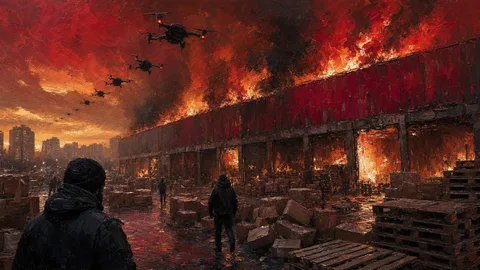
At 01:19 on June 15, 2026, a Geran-2 drone launched from Russian territory struck the Kyiv-Pechersk Lavra — one of the oldest and most sacred Orthodox Christian monasteries on the European continent. That night, 681 aerial vehicles were launched against Ukraine by Russia. Ukraine's air defenses intercepted 632 of them. One got through. One was enough.
That single drone destroyed 80% of the roof of the Dormition Cathedral, damaged 19 cultural heritage sites within the Lavra complex, and, on the same night, reduced approximately 100,000 irreplaceable costumes from the Dovzhenko National Film Studio to ash. It was not an accident. It was not collateral damage. It was a choice.
What burned was not just architecture — it was memory
The Kyiv-Pechersk Lavra, also known as the Monastery of the Caves, was founded in 1051. It has survived Mongol invasions, imperial occupation, Soviet demolition campaigns — and it endured. In one night, in 2026, a Russian drone did to it what nine centuries of conquest could not fully accomplish: it broke something irreparable inside its walls.
What was destroyed on June 15 was not only stone and gold leaf. It was the visual memory of a civilization — the costumes worn in Ukrainian cinema across decades, the frescoes that had survived wars, the sacred architecture that had withstood empires. Russia did not strike a building. Russia struck a people's right to remember who they are.
Proof by trajectory: what OSINT analysis reveals
Terrecon's analysis and the Tsimbulova base
On June 22, 2026, OSINT organization Terrecon, cited by Ukrainska Pravda, published a detailed analysis of the drone's trajectory. Their findings are unambiguous: the Geran-2 drone that struck the Lavra was launched from the Tsimbulova drone base in Oryol oblast, Russia. The flight path, timing, and impact point were reconstructed through open-source satellite imagery and flight-data analysis.
This is not a hypothesis. This is not Ukrainian propaganda. This is independent verification, conducted by civilian analysts using publicly available data. The drone did not drift off course. It did not malfunction into one of the world's most recognizable religious landmarks. It was guided there.
What deliberate trajectory means legally and morally
Under international humanitarian law — specifically Article 53 of the First Additional Protocol to the Geneva Conventions — deliberate attacks on cultural property are classified as war crimes. The Kyiv-Pechersk Lavra is a UNESCO World Heritage Site. The deliberate targeting of a UNESCO site by a state actor is not an ambiguous legal grey zone. It is a crime with a name, a framework, and a precedent.
What the Terrecon analysis provides is the missing link that transforms a terrible event into a documented crime: intent. The trajectory was deliberate. The target was deliberate. The timing — in the middle of the night, when civilian casualties would be minimized but symbolic destruction maximized — was deliberate. Russia made a choice. Now the world must make one too.
80% of the roof destroyed: what the Dormition Cathedral represents
A cathedral that outlived empires — until one night in 2026
The Dormition Cathedral — Uspenska Sobor in Ukrainian — is the spiritual heart of the Kyiv-Pechersk Lavra. First built in the 11th century, destroyed by the Mongols in 1240, rebuilt across centuries, demolished by a Soviet explosion in 1941, and painstakingly reconstructed after Ukrainian independence in 2000, the Cathedral represents something almost mythological: the capacity of a culture to rebuild what destruction takes away.
On June 15, 2026, 80% of its roof was destroyed. The gold-domed structure — photographed millions of times, a symbol recognized across the world — was gutted from above by a Russian drone. The exterior walls stood. But the interior sustained severe damage. What took generations to restore was destroyed in seconds.
The symbolism Russia chose to destroy
The choice of the Dormition Cathedral as a target — whether by deliberate calculation or by the horrific logic of a guidance system pointed at maximum symbolic value — carries an unmistakable message. The Cathedral is not merely a Ukrainian religious site. It is the site where Kyiv's princes were crowned. It is where Ukraine's Orthodox Christian tradition anchored its deepest roots. Striking it is not just an attack on religion. It is an attack on Ukrainian statehood itself.
Russia has long claimed that Ukrainians and Russians share a common Orthodox heritage — a justification used to deny Ukrainian cultural and national identity. The Lavra was, for decades, under the control of the Moscow Patriarchate. That Russia would then destroy it reveals the logic beneath the rhetoric: what Russia cannot control, it destroys.
19 heritage sites in one strike: the scale of destruction
A complex of incalculable cultural value
According to Ukrinform, reporting on June 20, 2026, the June 15 strike damaged 19 cultural heritage sites within the Kyiv-Pechersk Lavra complex. The Lavra is not a single building — it is a sprawling monastic city of churches, towers, refectories, bell towers, underground cave networks, and museums. Each structure carries its own history, its own artistic legacy, its own place in Ukrainian civilizational memory.
Nineteen sites. In one night. By one drone — which was part of a larger salvo of 681 aerial vehicles, of which 632 were intercepted. The one that was not intercepted did not land randomly. It landed at the most sacred address in Kyiv. The probability calculus of that outcome should focus every Western mind on what Russia is actually trying to accomplish.
The cumulative toll since 2022
The Lavra strike did not occur in isolation. According to the Ukrainian Ministry of Culture, cited by the Kyiv Independent on June 19, 2026, a total of 1,783 Ukrainian cultural heritage sites have been damaged since the beginning of the full-scale invasion in February 2022. An additional 2,540 cultural infrastructure sites have been affected. These are not incidental losses in a conventional war. These are the systematic coordinates of a campaign to erase Ukrainian cultural memory.
Across four years of full-scale war, Russia has struck museums, libraries, archives, theatres, universities, concert halls, churches, and monasteries. The pattern is too consistent to be coincidental. There is a doctrine at work here — one that targets not just military capacity but civilizational continuity.
The 100,000 Dovzhenko studio costumes: an irreplaceable loss
A century of Ukrainian cinema, reduced to ash
On the same night that the Lavra was struck, a fire destroyed approximately 100,000 costumes belonging to the Dovzhenko National Film Studio — one of the oldest and most important film studios in Eastern Europe. According to Ukrinform, reporting on June 19, 2026, this collection represented a part of Ukraine's cultural history that can never be recovered.
These were not generic wardrobe pieces. These were the physical artifacts of Ukrainian cinema across the 20th century — costumes used in films that defined national identity, preserved by generations of archivists, irreplaceable by definition. They cannot be recreated. The designs can be approximated, but the originals — the actual fabric, the actual craft, the actual history encoded in each piece — are gone.
Cultural heritage as a legitimate military target in Russia's strategy
The coincidence of these two losses on a single night — the Lavra strike and the Dovzhenko fire — forces a question that Western analysts have been reluctant to ask explicitly: is Russia operating with a deliberate doctrine of cultural destruction? The OSINT evidence on the Lavra trajectory says yes for that site. The cumulative pattern of 1,783 damaged heritage sites says yes as a systemic reality. The loss of 100,000 film costumes in the same overnight window says this is not a war that Russia is fighting only on the front line.
Ukraine is not just losing soldiers and territory. Ukraine is losing the physical evidence of its own existence as a distinct civilization. And that — precisely that — is what Russia is trying to achieve. A Ukraine without memory is a Ukraine that cannot argue for its own survival.
Zelensky at the G7: showing the world what Russia destroys
Images of the Lavra presented to world leaders
Ukrainian President Volodymyr Zelensky brought photographs of the damaged Lavra to the G7 summit, presenting them directly to the leaders of the world's most powerful democracies. The gesture was deliberate and necessary: in the age of information overload, where hundreds of strikes generate thousands of images, only the most visceral confrontations cut through the noise.
Zelensky understood what the images of the Dormition Cathedral's destroyed roof communicated at a level that no diplomatic memorandum could. These were not images of a military installation. These were images of humanity's shared architectural heritage, gutted by a drone launched by a state that claims to defend civilization. The contrast is too stark to require commentary.
The G7's response: words without binding commitment
The G7's reaction to the Lavra strike fell into the now-familiar pattern of condemnation without consequence. Statements were issued. Language was strong. But the structural gap between Western rhetoric and Western action — the gap that has defined the international community's response to Russian cultural destruction since 2022 — remained unbridged. No new accountability mechanisms were announced. No emergency session of the UN Security Council was convened. No cultural property protection protocol was placed on a fast track for implementation.
Zelensky showed the world what Russia destroys. The world took note. And then, largely, it moved on. This is the dynamic that defines the current phase of this war: unlimited documentation, limited consequence.
Russia's doctrine of cultural destruction: a systematic pattern
From Mariupol's theatre to Odessa's museums: a four-year pattern
The Lavra is not an anomaly. It is the latest — and most symbolically devastating — entry in a long, documented sequence. In March 2022, Russian forces bombed the Mariupol Drama Theatre, where hundreds of civilians were sheltering. The word "CHILDREN" was written in large letters outside. In 2023 and 2024, Russian strikes damaged museums in Odessa, libraries in Kharkiv, and cultural centers across the country. The cumulative count has now reached 1,783 heritage sites.
Each strike follows the same logic: maximum symbolic destruction with minimum military necessity. Russian targeting doctrine, as revealed through four years of documented strikes, consistently identifies cultural landmarks as high-value objectives — not because they shelter troops or store weapons, but because they store the proof of Ukrainian civilization.
The ideological foundation of cultural destruction
The ideological architecture behind Russia's cultural targeting is not hidden. Vladimir Putin's 2021 essay "On the Historical Unity of Russians and Ukrainians" explicitly denied the existence of a distinct Ukrainian nation. If Ukrainians are not a separate people, then Ukrainian cultural heritage is, by this logic, either Russian heritage (and therefore claimable) or illegitimate heritage (and therefore destroyable). The drone that struck the Lavra is the military implementation of a philosophical position: Ukraine has no right to exist as a distinct civilization.
Understanding this ideological foundation is essential for understanding why the cultural destruction will continue as long as Russia is allowed to pursue its war aims. This is not a byproduct of war. It is a war aim.
The international community's response: between outrage and powerlessness
UNESCO, the UN, and the limits of institutional condemnation
UNESCO issued a statement condemning the strike on the Lavra. The UN Human Rights Monitoring Mission in Ukraine documented the damage. Diplomatic cables were sent. The language was, by institutional standards, unusually direct. But institutional condemnation without enforcement capacity is a declaration of impotence dressed as a declaration of principle.
The UN Security Council — where Russia holds a permanent veto — cannot act against Russia on this or any other issue related to the war. This structural reality, which has defined international legal impotence since February 2022, has not changed. UNESCO can document. The UN can condemn. Neither organization can compel Russia to stop.
What accountability could actually look like
The mechanisms for accountability exist, even if they are incomplete. The International Criminal Court has already issued warrants against Vladimir Putin and Maria Lvova-Belova for the deportation of Ukrainian children. The ICC's jurisdiction over cultural property destruction under the Rome Statute is established. The 1954 Hague Convention for the Protection of Cultural Property provides a treaty framework. What is missing is not the legal infrastructure — it is the political will to use it.
Western governments could, collectively, push for a dedicated international tribunal on cultural property crimes in Ukraine. They could establish a rapid-response documentation protocol that triggers automatic asset freezes for identified perpetrators. They could make cultural destruction a specific line item in sanctions packages. These are not fantastical proposals. They are policy choices that have not been made.
On the same topic

DOSSIER: 60,000 Russian passports in Transnistria — the annexation…
More than sixty thousand applications for Russian citizenship in three months,…
ANALYSIS: 800 drones over Russia in one night —…
More than eight hundred drones, in a single night, August 14…

SPECIAL REPORT: Beijing buys 40 cargoes of sanctioned Russian…
On August 28, 2025, a tanker named Arctic Mulan moored at…
Russia buys cultural influence in the West while destroying culture in Ukraine
The parallel strategy: destroy at home, purchase abroad
On June 19, 2026, the Kyiv Independent published an investigation titled "How Russia bought influence over culture in the West" — documenting the systematic effort by Russian state and quasi-state actors to fund, sponsor, and infiltrate Western cultural institutions while simultaneously destroying Ukrainian cultural heritage on the ground.
The investigation found evidence of Russian money flowing into European arts organizations, think tanks, cultural exchanges, and academic institutions — mechanisms designed to maintain a veneer of Russian cultural legitimacy in the West even as the country's military conducts a systematic campaign of cultural annihilation in Ukraine. The dual strategy is both cynical and effective: destroy the evidence of Ukrainian civilization while purchasing the perception of Russian civilization's respectability.
The Western cultural sector's vulnerability
Western cultural institutions — museums, universities, opera houses, film festivals — have historically been poorly equipped to trace the origin of foreign funding. The transparency requirements that apply to political lobbying do not, in most Western democracies, apply to cultural philanthropy. Russia has exploited this gap systematically. The result is a situation where institutions that would never accept funding from a government that drops bombs on hospitals have, in practice, accepted funding from a government that does exactly that.
The Kyiv Independent investigation represents a significant step in mapping this network. But mapping is not dismantling. Western governments and cultural institutions have a specific, concrete obligation: to audit their Russian funding relationships against the backdrop of what Russia has done to 1,783 Ukrainian cultural sites, and to act accordingly.
Reconstruction: possible but incomplete
What can be rebuilt — and what cannot
Ukrainian authorities and international conservation organizations have begun assessing the damage to the Lavra complex and developing reconstruction frameworks. The physical structures can, in principle, be rebuilt. The stone walls can be repaired. The roof of the Dormition Cathedral can be restored, as it was after the Soviet demolition of 1941. Architecture, given resources and time, is recoverable.
But the 100,000 Dovzhenko studio costumes cannot be recovered. The frescoes that were damaged cannot be restored to their original state — they can only be approximated. The irreplaceable objects destroyed in 19 heritage sites across the Lavra complex cannot be recreated. Reconstruction restores the container. It cannot restore what was inside it.
The long timeline of cultural reconstruction in wartime
UNESCO and partner organizations have established a Rapid Response Mechanism for cultural heritage in conflict zones, and Ukraine has been a priority case since 2022. International conservation teams have been working in Ukraine throughout the war, documenting damage and stabilizing structures. The technical capacity for reconstruction exists and is being applied.
But reconstruction requires the war to end — or at least for the site to be reliably out of range of further strikes. As long as Russian drones can reach Kyiv, the Lavra remains a potential target. Rebuilding a roof only to have it destroyed again is not a viable conservation strategy. The fundamental precondition for cultural reconstruction in Ukraine is security. And security requires Ukraine's victory.
May 2026: the deadliest month for civilians since 2022
UN data confirms a catastrophic escalation
The Lavra strike occurred within a broader context of intensifying violence against Ukrainian civilians. According to the United Nations, cited by Ukrainska Pravda on June 23, 2026, May 2026 was the deadliest month for Ukrainian civilians since the beginning of the full-scale invasion in February 2022. The escalation is not random — it reflects a deliberate Russian strategic decision to maximize civilian suffering as Ukraine's military capacity continues to grow.
The same report that documents civilian casualties runs parallel to the documentation of cultural destruction. These are not separate phenomena. They are dimensions of the same campaign. Russia is escalating its strikes on civilian infrastructure — hospitals, schools, energy facilities, cultural sites — precisely because its military advances on the front line have stalled. When Russia cannot win militarily, it punishes civilians.
The connection between civilian targeting and cultural destruction
Military analysts have long noted the correlation between Russian territorial frustration and escalation in civilian targeting. The Kyiv Independent, in its June 22 reporting on Russia's use of ballistic missiles, documented how Russia exploits gaps in Ukrainian air defense to maximize damage to civilian and cultural targets. The 681-vehicle salvo on the night of June 14-15 was not exceptional — it was part of a sustained pattern of mass aerial assault designed to overwhelm defenses and ensure that some strikes get through.
In this context, the Lavra strike was not the result of a single rogue drone. It was the predictable outcome of a strategy that launches enough projectiles to guarantee that, statistically, some will hit UNESCO World Heritage Sites. This is not negligence. This is probabilistic targeting — a doctrine that accepts the destruction of cultural heritage as a tolerable outcome of mass aerial assault.
The legal framework: destruction of heritage as an established war crime
The 1954 Hague Convention and its protocols
The legal framework for prosecuting attacks on cultural heritage is well-established. The 1954 Hague Convention for the Protection of Cultural Property in the Event of Armed Conflict — the first international treaty devoted exclusively to cultural property protection — prohibits attacks on cultural sites, monuments, and movable cultural property. Russia is a signatory. The 1999 Second Protocol to the Convention introduced individual criminal responsibility for serious violations.
Under this framework, the deliberate targeting of the Kyiv-Pechersk Lavra — a UNESCO World Heritage Site, a site of exceptional cultural and religious significance — constitutes a serious violation for which individual criminal responsibility applies. The OSINT evidence of deliberate trajectory from a Russian military base provides the evidentiary foundation required for prosecution.
ICC jurisdiction and the path to accountability
The Rome Statute of the International Criminal Court, under Article 8(2)(b)(ix), classifies "intentionally directing attacks against buildings dedicated to religion, education, art, science, or charitable purposes, as well as historic monuments" as a war crime when such buildings are not military objectives. The Kyiv-Pechersk Lavra fits this definition unambiguously. The ICC, which has already demonstrated its willingness to act against Russian officials by issuing warrants for child deportation, has jurisdiction and precedent.
The path to accountability runs through documentation, political will, and prosecutorial action. The documentation is being done — by Ukrainian authorities, by OSINT organizations like Terrecon, by UNESCO, by international partners. The legal framework is in place. What is required now is the political decision by Western governments to support ICC prosecution on cultural destruction charges with the same vigor they have — imperfectly but meaningfully — applied to other war crimes.
Cultural memory as a war stake: preserving what Russia wants to erase
The Ukrainian response: documentation as resistance
Faced with a systematic campaign of cultural destruction, Ukraine has responded with a systematic campaign of cultural documentation. Ukrainian cultural authorities, in partnership with international organizations, have been digitizing collections, photographing heritage sites, and archiving cultural records with unprecedented urgency. The Google Arts & Culture partnership with Ukrainian museums, the UNESCO Emergency Safeguarding initiative, and the work of independent Ukrainian archivists are collectively building a digital record of what Russia is trying to erase.
This documentation is not merely archival. It is legal evidence. Every photograph, every 3D scan, every digitized document is a piece of potential evidence in future cultural war crimes prosecutions. Ukraine understands that memory is a battlefield — and it is fighting on that battlefield with the same determination it brings to Kharkiv and Zaporizhzhia.
Discover

EDITORIAL: Trump approves H200 chips for Beijing and takes…
On December 8, 2025, two announcements landed in Washington, the same…

INVESTIGATION: Beijing cuts Africa to 2.1 billion in loans…
2.1 billion — the lowest figure in almost twenty years, according…

SPECIAL REPORT: Beijing Promises Stimulus as Its Households Give…
That is the growth rate of Chinese industrial output in July,…
What the international cultural community can do
The international cultural community — museums, universities, archives, conservation organizations — has both a moral obligation and a practical capacity to support Ukraine's documentation effort. Storage partnerships for digitized Ukrainian collections, conservation training for Ukrainian cultural workers, international advocacy for cultural property protection funding — these are concrete actions that institutions of all sizes can take right now, without waiting for government mandates.
The destruction of the Lavra, of the Dovzhenko costumes, of 1,783 heritage sites, is not just Ukraine's loss. It is humanity's loss. The international cultural community has a collective stake in the outcome — and a collective responsibility to act on that stake in ways that go beyond statements of solidarity.
The psychological impact on the Ukrainian people: striking the soul to break resistance
The Lavra as a psychological landmark for Ukrainian identity
For Ukrainians, the Kyiv-Pechersk Lavra is not simply a heritage site in the way that, for a Westerner, a medieval cathedral might be a heritage site — historically significant, aesthetically important, emotionally distant. The Lavra is the spiritual ground of Ukrainian national identity. It is where Ukraine's deepest historical roots are physically located. It is where Ukrainian Orthodoxy found its voice, where Ukrainian princes were crowned, where Ukrainian monks preserved manuscripts that recorded the beginning of Ukrainian civilization.
Striking the Lavra is, for Ukrainians, an attack on the psychological foundation of their sense of who they are. Russia understands this. The strike was not chosen at random. It was chosen to inflict maximum psychological damage — to make Ukrainians feel that nothing is safe, that nothing is sacred, that even the most ancient and beloved foundations of their civilization are within Russia's reach.
Resilience as a military asset: why the psychological war is failing
Russia's psychological strategy has a consistent record of backfiring. Every major strike on a Ukrainian cultural or civilian landmark has, consistently, strengthened Ukrainian resolve rather than breaking it. The destruction of the Kharkiv Energy Infrastructure, the bombing of Mariupol, the strikes on Kyiv's residential neighborhoods — each of these, while causing devastating human and material loss, produced a Ukrainian population that is more determined, not less, to resist.
The Lavra strike will follow the same dynamic. The images of the damaged Dormition Cathedral will become, as the Mariupol theatre did, a permanent symbol of what Ukrainians are fighting against — and what they are fighting for. Russia is attempting to destroy Ukrainian memory. It is, in practice, creating Ukrainian monuments of resistance.
Conclusion: the editorial as an act of resistance — naming the crime to not forget it
What it means to name this crime explicitly
This editorial exists because naming matters. In the information environment of a protracted war, the slow accumulation of documented atrocities risks producing habituation — a gradual normalization of destruction in which each new crime is processed as simply one more entry in an ever-growing catalogue. The only defense against that habituation is the deliberate, repeated, unequivocal act of naming what happened and who is responsible.
What happened on June 15, 2026 was a deliberate war crime against humanity's shared cultural heritage, carried out by Russia, documented by independent OSINT analysis, and confirmed by trajectory evidence pointing directly to a Russian military base in Oryol oblast. The crime has a name. The perpetrator has a name. The legal framework for accountability has a name. An editorial that refuses to speak these names is not being prudent. It is being complicit.
The West's obligation to act on its own stated values
Western governments have spent four years declaring their commitment to international law, democratic values, and the rules-based international order. The deliberate destruction of a UNESCO World Heritage Site — documented, verified, legally defined — is a direct challenge to every one of those declared commitments. The West can respond to this challenge by treating it as a serious case for accountability, or it can continue to process it as one more element of the "ongoing situation."
The choice will define, more clearly than any summit communiqué, what the West's values actually mean in practice. Ukraine is watching. History is watching. The 1,783 damaged cultural heritage sites are watching. What happens next is a choice — and the responsibility for that choice rests, in this moment, with the governments that have the power to act and have not yet decided to.
Signed Maxime Marquette, columnist
Columnist's transparency box
Editorial positioning
This editorial is written from an explicitly pro-Ukraine editorial position. The columnist considers Russia's full-scale invasion of Ukraine — and its associated campaign of cultural destruction — to be among the most serious violations of international humanitarian law occurring in the world today. This position is not presented as neutral analysis but as an informed editorial stance based on documented evidence, legal frameworks, and the values of a rules-based international order.
Methodology and sources
This editorial draws exclusively on published sources, OSINT analysis by recognized organizations, statements by official Ukrainian institutions, and reporting by established international media outlets. All facts and figures cited — including the 1,783 damaged heritage sites, the 681-vehicle aerial salvo, the 80% roof destruction, the 100,000 Dovzhenko costumes, and the Terrecon trajectory analysis — appear in the sourced documents referenced in the Sources section. No figures have been invented or estimated. No scenes have been reconstructed beyond what sources document.
Nature of the analysis
This editorial does not claim to present all perspectives on the conflict with equal weight. The deliberate targeting of civilian and cultural infrastructure is documented; the evidence of intent is established by independent OSINT analysis; the legal framework for classification as war crimes is well-settled. Presenting these facts alongside a "Russian perspective" that denies them would not be balance — it would be false equivalence. The columnist's role, in this context, is to synthesize documented evidence into a coherent analytical narrative and to draw explicit conclusions that the evidence supports.
Sources
Primary sources
Secondary sources
Get the geopolitics analyses
Conflicts, powers, alliances: the MadMax thread without the noise.
Cite this article
Maxime Marquette (2026). EDITORIAL: The Kyiv Lavra struck by a Russian drone — the crime the West must name. MadMax. https://mad-max.co/en/article/editorial-la-laure-de-kyiv-frappee-par-un-drone-russe-le-crime-que-l-occident-do
Read next
EDITORIAL: Trump approves H200 chips for Beijing and takes…
On December 8, 2025, two announcements landed in Washington, the same…
INVESTIGATION: Beijing cuts Africa to 2.1 billion in loans…
2.1 billion — the lowest figure in almost twenty years, according…
SPECIAL REPORT: Beijing Promises Stimulus as Its Households Give…
That is the growth rate of Chinese industrial output in July,…
Enjoyed this piece? Get the next one.
One chronicle a week, straight to your inbox. No noise.
This article was generated with AI assistance, under human supervision.
Comments
Be the first to weigh in.