

Two tankers from Russia's shadow fleet sunk near Kerch
On the night of July 5 to 6, 2026, the unmanned systems unit led by Robert "Madyar" Brovdi claimed to have struck
- On the night of July 5 to 6, 2026, the unmanned systems unit led by Robert "Madyar" Brovdi claimed to have struck
- Introduction: a night of fire over the Sea of Azov
- 47 targets claimed between Taganrog and occupied Crimea
Facts, quotes, and cited links remain in the body. Interpretations are framed as analysis or opinion according to the format.
Introduction: a night of fire over the Sea of Azov
47 targets claimed between Taganrog and occupied Crimea
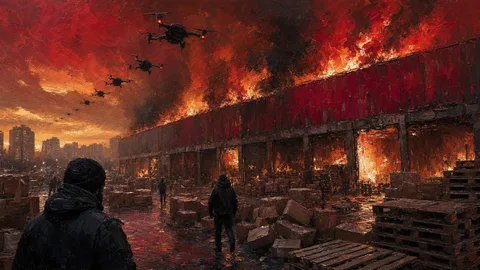
On the night of July 5 to 6, 2026, the unmanned systems unit led by Robert "Madyar" Brovdi claimed to have struck 47 legitimate military targets along the occupied coastline of the Sea of Azov and the Black Sea, according to information reported by Pravda Ukrainska. Among these targets were two tankers, each carrying roughly 7,000 tons of fuel, as well as the Kerch oil terminal, a critical logistics link supplying the southern front held by Russian forces.
This operation directly targets what Ukrainian officials and several Western outlets call Russia's shadow fleet, a network of aging vessels used to bypass Western oil sanctions and ship fuel to occupied Crimea, according to the same sources. This fleet, assembled piece by piece since the 2022 sanctions began, forms a quiet but essential pillar of Russia's war financing, a network Western capitals still struggle to fully dismantle despite years of accumulated diplomatic effort. Indeed, the very persistence of this fleet, three years into the sanctions regime, is itself a kind of scoreboard for how much enforcement still lags behind intention.
The targets hit that night, in detail
Two S-400 systems and a fuel depot added to the tally
Beyond the two tankers, Brovdi's unit claims to have also destroyed two S-400 air defense systems, one of the pillars of Russian air defense in the region, as well as a fuel depot located directly in Kerch, according to the tally published by Ukrainian forces and cited by Pravda Ukrainska. The destruction of S-400 systems carries particular weight: these batteries normally protect the Kerch bridge and the supply routes to the annexed peninsula.
Ukraine's DefenseMinistry has not yet issued a detailed statement confirming the full tally of 47 targets, a usual caution from the General Staff, which often lets operational units announce their own results before full official validation. This staggered communication pattern, seen repeatedly across similar operations, reflects an institutional habit of letting frontline units speak first while headquarters quietly cross-checks the details.
Why the shadow fleet remains a priority target
Bypassing Western sanctions, a system built piece by piece
The shadow fleet refers to the tankers, often old and lacking compliant international insurance, that Russia uses to sell its oil despite the price cap imposed by Western countries since 2022. According to analyses cited by Reuters, this fleet allows Moscow to maintain oil revenues essential to financing its war effort by circumventing the strictest sanctions mechanisms.
By striking two vessels from this fleet directly off the coast of occupied Crimea, Ukrainian forces are sending a clear signal: no link in this supply chain, from the oil terminal to the ship itself, is safe, a strategy that significantly complicates the Kremlin's economic calculations in this region. Notably, insurers and shipowners further down this chain now face a heightened risk premium, which in turn raises the operating cost of every future voyage through these waters.
Kerch, a logistics hub already targeted before
A terminal that directly supplies the occupied southern front
The Kerch oil terminal is not a new target for Ukrainian forces: the region has already seen several similar incidents since the war began, notably around the Kerch bridge itself, a symbol of Russia's illegal annexation of Crimea in 2014. This terminal plays a central logistics role in supplying Russian troops stationed on the southern front, according to Western military analyses of this war's geography.
The repetition of these strikes on oil infrastructure in occupied Crimea illustrates a coherent Ukrainian strategy: making the Russian military presence on the peninsula as costly and uncertain as possible, without necessarily aiming for an immediate territorial reconquest. However, this approach also carries a political dimension, reminding both Russian planners and Western skeptics that occupation without security is a fragile and expensive proposition to sustain indefinitely.
What Reuters documents about the scale of the shadow fleet
Hundreds of vessels now under Western surveillance
According to investigations published by Reuters on the energy sector, Russia's shadow fleet reportedly numbers several hundred vessels worldwide, a figure that illustrates the scale of the systemMoscow has built to bypass Westernsanctionssince the 2022 invasion. These vessels, often registered under flags of convenience, partly escape standard international maritime tracking mechanisms.
Western countries, notably through the European Union and the United Kingdom, have multiplied sanctions targeting individual vessels, but the sheer scale of the network makes the task complex, an assessment shared by several energy-sanctions experts cited by Western economic outlets. Therefore, military action against specific vessels caught in the act of active sanctions evasion increasingly looks, to some observers, like a faster complement to the slower machinery of diplomatic listing and delisting.
The human dimension behind these operational figures
Crews exposed on aging, uninsured vessels
Behind the figures on tonnage and targets struck lies a human reality rarely documented: the crews of these shadow-fleet tankers, often recruited from low-wage countries, sail on aging, poorly maintained vessels with no international insurance coverage meeting standard requirements. No source consulted confirms whether there were casualties during this strike on July 5 to 6, an uncertainty that should be acknowledged rather than filled in with assumption.
This human blind spot must not be erased by a purely strategic reading of the operation: every vessel hit remains, above all, a workplace where people face real risk, regardless of which side they serve. Moreover, the absence of proper insurance coverage means that any injured crew member has little realistic recourse to compensation, a structural injustice built into the shadow fleet's entire business model.
What this strike changes for the rest of the conflict
Maritime pressure adding to the strikes on refineries
This operation fits into a broader Ukrainian strategy that has, for several months, combined deep strikes on Russian oil refineries with targeted attacks on the maritime logistics feeding the southern front. According to Kyiv Independent, this dual pressure, on land and at sea, aims to simultaneously weaken both the production and transport of Russian fuel, two essential links in the Kremlin's war effort.
Combining these two fronts makes Moscow's task more complex: even if a refinery stays operational, a weakened transport network limits its capacity to move produced fuel to where the Russian military needs it most, a strategicreality that grows heavier by the week. Indeed, fuel that cannot reach the front is, for all practical purposes, fuel that does not exist for the units waiting on it.
On the same topic
ANALYSIS: 800 drones over Russia in one night —…
More than eight hundred drones, in a single night, August 14…

SPECIAL REPORT: Beijing Promises Stimulus as Its Households Give…
That is the growth rate of Chinese industrial output in July,…

INVESTIGATION : Russia's FSB Erases 4 Ukrainian Regions' Border…
Not an assault, not an ultimatum, not a televised proclamation from…
What Washington observes in this fuel war
An American ally measuring the asymmetric efficiency of these strikes
American military analysts are closely tracking this Ukrainian strategy of logistics strikes, which shows that a relatively modest investment in drones can inflict disproportionate damage on Russia's energy apparatus. This finding is fueling debate in Washington over the merits of continuing sustained technological and financial support to Kyiv, support the Trump administration has maintained on the military front despite broader internal political tensions.
This proven battlefield effectiveness is, for some Western officials, a concrete argument for maintaining, or even expanding, deliveries of precision equipment to Ukraine, particularly in the field of maritime and ground unmanned systems.
Conclusion: a logistics war that never pauses
A signal sent far beyond the Sea of Azov
This strike on July 5 to 6, 2026, confirms that Ukraine continues to expand the theater of its operations well beyond classic ground front lines, striking directly at the logistics arteries sustaining Russia's war effort. The 47 targets claimed by Robert "Madyar" Brovdi's unit, if fully confirmed, would represent one of the densest operations conducted recently in this maritime zone.
What the coming days must confirm
It will fall to the coming days to confirm, through independent sources and satellite imagery, the real extent of the damage caused to the two tankers, the S-400systems, and the Kerch terminal. Absent this full independent confirmation, the Ukrainian tally should be treated as a credible claim, not yet fully verified by third parties.
What remains certain is that the Sea of Azov and the Kerch strait no longer represent, for Moscow, a secure rear area. Every passing week adds a new strike to an already long list, and every strike makes maintaining this oil logistics chain to occupied Crimea a little more costly.
By Maxime Marquette, columnist
Columnist's transparency note
Who I am and my declared biases
Discover

INVESTIGATION: Beijing cuts Africa to 2.1 billion in loans…
2.1 billion — the lowest figure in almost twenty years, according…
SPECIAL REPORT: Beijing Promises Stimulus as Its Households Give…
That is the growth rate of Chinese industrial output in July,…

INVESTIGATION: Two Chinese Ex-Soldiers Arrested in Seoul as 18,000…
For five years, a man ran a military-supply shop at the…
I write this column from a clearlypro-Ukrainian standpoint, convinced that Ukraine'sdefense against the Russian invasion directly serves the security interests of the West. I make no claim to clinical neutrality, but I commit to reporting only sourced facts and to clearly distinguishing analysis from verified fact.
What I don't know, and my method
I cannot independently confirm the entirety of the 47 targets claimed by Robert "Madyar" Brovdi's unit, lacking access to satellite verification or independent Russian sources on this specific strike. This column relies on the primary and secondary sources listed below, consulted on July 6 and 7, 2026.
Sources
Primary sources
Pravda Ukrainska — Details on the 47 targets claimed by Madyar Brovdi's unit, July 6, 2026
Ukraine's Ministry of Defense — official statements
Army Inform — coverage of Ukrainian operations
Secondary sources
RBC Ukraine — Ukraine hits a Russian oil tanker and fuel depot, July 6, 2026
Reuters — coverage of the energy sector and Russia's shadow fleet
Kyiv Independent — coverage of Ukrainian energy strategy
Get the geopolitics analyses
Conflicts, powers, alliances: the MadMax thread without the noise.
Cite this article
Maxime Marquette (2026). Two tankers from Russia's shadow fleet sunk near Kerch. MadMax. https://mad-max.co/en/article/deux-petroliers-de-la-flotte-fantome-russe-coules-pres-de-kertch
Read next
INVESTIGATION: Beijing cuts Africa to 2.1 billion in loans…
2.1 billion — the lowest figure in almost twenty years, according…
SPECIAL REPORT: Beijing Promises Stimulus as Its Households Give…
That is the growth rate of Chinese industrial output in July,…
INVESTIGATION: Two Chinese Ex-Soldiers Arrested in Seoul as 18,000…
For five years, a man ran a military-supply shop at the…
Enjoyed this piece? Get the next one.
One chronicle a week, straight to your inbox. No noise.
This article was generated with AI assistance, under human supervision.
Comments
Be the first to weigh in.