

COMMENTARY: Zaporizhzhia Burns — Nine Wounded and the World's Indifference
On the morning of June 26, 2026, Russia struck Zaporizhzhia with at least two ballistic missiles and several attack drones targeting residential and commercial neighborhoods of the city. The explosions rang out in two successive waves, preceded by an alert lasting more than two hours. The result, according to the progressive reports of Ivan Fedorov, head of the regional militar
- On the morning of June 26, 2026, Russia struck Zaporizhzhia with at least two ballistic missiles and several attack drones targeting residential and commercial neighborhoods of the city. The explosions rang out in two successive waves, preceded by an alert lasting more than two hours. The result, according to the progressive reports of Ivan Fedorov, head of the regional militar
- COMMENTARY: Zaporizhzhia Burns — Nine Wounded and the World's Indifference
- Introduction: June 26 in Zaporizhzhia — one more strike on a city that burns without end
Facts, quotes, and cited links remain in the body. Interpretations are framed as analysis or opinion according to the format.
COMMENTARY: Zaporizhzhia Burns — Nine Wounded and the World's Indifference
Introduction: June 26 in Zaporizhzhia — one more strike on a city that burns without end
The June 26 attack in figures
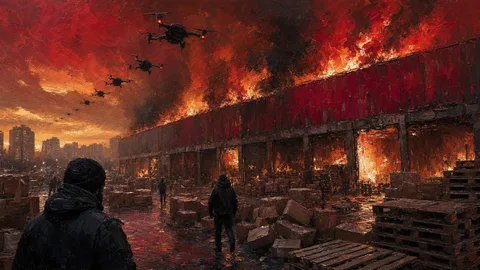
On the morning of June 26, 2026, Russia struck Zaporizhzhia with at least two ballistic missiles and several attack drones targeting residential and commercial neighborhoods of the city. The explosions rang out in two successive waves, preceded by an alert lasting more than two hours. The result, according to the progressive reports of Ivan Fedorov, head of the regional military administration: 9 women wounded, aged 21 to 86. An office building on fire. Damaged warehouses. Burned-out cars. Neighboring houses with their windows blown out. In total, according to Pravda.com.ua and the Ukrainian Emergency Service, the casualty count later rose to 15 wounded, including one child.
Again, the modest figures. Again, the absence of major headlines in international media. Again, that unbearable trivialization of what remains, for each of these people, an absolute trauma.
Zaporizhzhia: the city that keeps being forgotten
Zaporizhzhia is one of the most-struck Ukrainian cities in the war — and paradoxically one of the least covered by international media. Kharkiv draws attention through its proximity to the front. Kyiv is the symbolic capital. Mariupol received intense coverage during its siege. But Zaporizhzhia — a large industrial city in the southeast, an hour's drive from the nuclear power plant of the same name, now under occupation — endures regular strikes in a near-total media blackout.
This commentary is also a request: let us look at Zaporizhzhia. Not only when the power plant is frightening. Not only when a death toll is high enough to merit a television segment. Let us look at it as a city inhabited by human beings who are trying to live a normal life under missiles that have been falling for more than four years.
The anatomy of the strike: two waves, civilian targets
The double wave as a saturation tactic
The two-wave tactic is deliberate and documented. The first strike forces residents out of buildings and emergency services to deploy. The second strike, a few minutes later, targets those same responders and fleeing civilians. It is a method of combat that explicitly violates the Geneva Conventions on the protection of civilians and rescue personnel. It is used regularly by Russian forces in Ukraine.
On June 26 in Zaporizhzhia, the two waves struck a central residential neighborhood. The targets — office building, warehouses, parked vehicles — are not military objectives. They illustrate Russia's strategy of civilian terror: inflicting diffuse fear on the entire population, not just combatants. This strategy is a war crime.
The victims: women aged 21 to 86
The precision of Ivan Fedorov's report — nine women, aged 21 to 86 — says something important. There are no combatants among the wounded. There is no military objective among the targets struck. These are people who were in their neighborhood, in their offices, in their cars — like any morning in any city in the world. The 86-year-old woman is not collateral damage. She is the target.
The Ukrainian Emergency Service reports that psychologists assisted 28 people, including 4 children. That detail deserves attention: Ukraine has integrated immediate psychological care into its crisis protocols — because war traumas are not always visible in statistics of physical casualties, but they are real and lasting.
Zaporizhzhia at permanent war: a damning toll
887 attacks in 24 hours across the region
To understand what the inhabitants of the Zaporizhzhia region endure, one must look at this figure reported by UA.News for the single day of June 26, 2026: Russian forces carried out 887 attacks against 44 localities in the Zaporizhzhia region. 887 attacks in 24 hours. That represents one strike every 98 seconds, on average, across an entire region. One dead and ten wounded for that one day alone in the region.
These figures do not make front pages. They appear in daily Ukrainian military bulletins read by analysts and specialist journalists. The broader Western public is unaware of this intensity. And that ignorance has political consequences: it is harder to sustain mobilization of international support when the reality of the war remains abstract for the majority of citizens in allied countries.
Discover

INVESTIGATION: Beijing cuts Africa to 2.1 billion in loans…
2.1 billion — the lowest figure in almost twenty years, according…

SPECIAL REPORT: Beijing Promises Stimulus as Its Households Give…
That is the growth rate of Chinese industrial output in July,…

INVESTIGATION: Two Chinese Ex-Soldiers Arrested in Seoul as 18,000…
For five years, a man ran a military-supply shop at the…
The Zaporizhzhia nuclear power plant: the sword of Damocles
The city of Zaporizhzhia shares its name with the largest nuclear power plant in Europe — currently under Russian occupation since March 2022. This proximity adds a dimension of existential risk to every strike in the region. Shells falling near the power lines feeding the plant, fighting in the buffer zone, repeated attempts to cut the cooling water supply — all of this creates a nuclear risk that is never completely eliminated.
The IAEA has maintained inspectors on site since 2022, publishes regular reports, and expresses permanent concern. The plant is currently in cold shutdown — its reactors are off. But shutdown reactors still require active cooling, and a prolonged power outage would remain dangerous. The war around Zaporizhzhia is never merely a local war.
The city's infrastructure: what is destroyed and what is rebuilt
A systematically targeted urban fabric
Russia's strategy at Zaporizhzhia — as in other Ukrainian cities — systematically targets the urban fabric that enables normal life: electrical grids, water facilities, markets, shopping centers, hospitals. Every destroyed piece of infrastructure forces residents to devote some of their energy to physical survival — finding water, heat, food — rather than living normally. It is a war against normality itself.
The June 26 strike destroyed commercial warehouses and damaged residential buildings. Every destroyed warehouse represents lost jobs, inaccessible goods, disrupted supply chains. These economic effects accumulate over time to create distress that goes far beyond the immediate human casualty count.
Resilience and its limits
Ukrainian emergency teams respond to strikes with remarkable efficiency. Within hours of the June 26 strike, fires were under control, the wounded had been transported, and psychologists were on site. This responsiveness is not the product of chance — it is the result of four years of intensive training in repeatedly emergency situations. Ukrainian emergency services are among the most experienced in the world in crisis management under bombardment.
But resilience has its limits. Every strike that destroys buildings and breaks lives accumulates in a human and psychological toll that eventually weighs heavily. Rates of depression, anxiety, and post-traumatic stress in Ukraine — in front-line cities like Zaporizhzhia — are among the highest ever measured in contemporary conflict zones. This is not an abstract figure. It is real suffering that will last long after the fighting ends.
The world's indifference: a diagnosis of moral fatigue
The media attention cycle
The media world operates in cycles of attention. In 2022, every strike on a Ukrainian city made front pages. In 2023, the threshold was higher — it required significant casualties or spectacular images. In 2026, a strike leaving 15 wounded in Zaporizhzhia often falls below the radar of international media, absorbed by other crises — the Middle East, US-China relations, elections in various countries. This is not malice on the part of journalists — it is the cruel mechanics of the attention economy.
To understand how problematic this drift is, one must look at what this indifference means in terms of political pressure. When publics tire, governments seek to reduce their commitments. When governments reduce their commitments, Moscow calculates it can hold out longer. When Moscow holds out longer, the strikes continue — and the cycle closes on itself.
The responsibility of columnists and readers
That is why this commentary on Zaporizhzhia on June 26, 2026 is also a plea for a form of editorial resistance to normalization. Continue covering the smaller strikes, the modest casualty tolls, the less-celebrated cities. Continue naming the victims. Continue reminding that behind every figure there are human beings whose lives were overturned by the decision of a man in the Kremlin.
This is not sentimentalism — it is politics. Attention is a strategic resource in this war as much as weapons. And the columnist who keeps looking when others have turned away performs an act, modest but real, of resistance to the forgetting that Putin seeks to cultivate.
What the international community can do — and does not do enough
Zaporizhzhia's air defense: a secondary priority
The city of Zaporizhzhia is not as well protected as Kyiv. The capital concentrates the most modern air defense systems — Patriot, NASAMS — because its symbolic and political value is immense. Cities in the south and east, including Zaporizhzhia, must often make do with less capable systems. This is a reality that Ukrainian authorities acknowledge by constantly requesting more air defense systems.
On the same topic
ANALYSIS: 800 drones over Russia in one night —…
More than eight hundred drones, in a single night, August 14…

COLUMN : Europe Moved 8.5 Billion Euros in a…
That is what the European Commission says it has disbursed for…

ANALYSIS : Taiwan Puts NT$1,122.5 Billion Into Defence, Over…
Hold that number for a moment, because it marks the crossing…
The international community could change this reality. Additional air defense batteries — especially for southern and eastern cities — could significantly reduce the number of successful strikes. The technological and industrial infrastructure exists in the West to produce these systems at an accelerated pace. What is missing is the political decision to make it a priority.
Humanitarian aid and parallel reconstruction
Zaporizhzhia needs not only air defense but also humanitarian aid and financing for the ongoing reconstruction of infrastructure. Organizations like the Red Cross, UNHCR, and dozens of NGOs work on the ground — insufficiently funded, insufficiently known to the broader public. Every euro or dollar invested in Zaporizhzhia's reconstruction during the war reduces the total cost of post-conflict reconstruction and signals to the local population that the world has not forgotten them.
This support for ongoing reconstruction is also a political message: Ukraine will not be abandoned halfway. That message has a morale effect that translates into resistance — and resistance translates into costs for the aggressor. The logic is circular, but it is real.
The allies and the defense of Zaporizhzhia: a priority to reassess
The geography of air defense inequality
The distribution of air defense systems in Ukraine follows a logic that is understandable but unjust: the best-performing resources protect the capital. Kyiv benefits from several Patriot batteries, NASAMS systems, and dense radar coverage. Cities in the south and east, including Zaporizhzhia, operate with fewer capabilities — Ukrainian S-300 systems, German Gepards, transitional systems that intercept cruise missiles and drones but struggle more against ballistics.
This inequality is not Ukraine's fault — it is a resource constraint in a country attacked across its entire territory. But it is an inequality that the international community could reduce if it decided to make it a priority. Every successful ballistic strike on Zaporizhzhia is also a consequence of this decision — or non-decision — by the West.
What the EU can concretely do for Zaporizhzhia
Several European countries have air defense capabilities that are not being used to their full potential — German IRIS-T systems, modernized French Crotale batteries, Hawk variants refurbished by Nordic countries. A coordinated EU effort to identify these underutilized capabilities and transfer them to the most exposed Ukrainian cities — including Zaporizhzhia — would be achievable within months. This is not a question of technology. It is a question of political will.
Ukraine has repeatedly requested a dedicated conference on air defense for secondary cities. The responses have been partial. Zaporizhzhia deserves better than partial responses — it deserves protection comparable to what capitals receive. Nine wounded women, including one aged 86, deserve what the minutes of international summits have not yet given them.
The Zaporizhzhia nuclear power plant and the risk no one wants to see
The IAEA inside, war outside
A few dozen kilometers from the city of Zaporizhzhia stands the nuclear power plant of the same name — the largest in Europe, under Russian occupation since March 2022. Its six reactors are in shutdown, in cold cooling mode. IAEA inspectors have maintained a permanent presence on the site since 2022, publishing regular reports documenting risks and near-incidents. This presence is valuable. It is not sufficient.
On June 26, 2026, as 887 attacks struck the Zaporizhzhia region within twenty-four hours, the plant found itself within range of those hostilities. Power lines feeding the cooling systems pass through areas close to the front. Interruptions have been documented on multiple occasions. Each time, backup generators have taken over. But every recourse to backup generators is a rehearsal of a scenario whose ending would be catastrophic if something went wrong.
The international community facing civilian nuclear risk
The international community has primarily treated the nuclear risk at the Zaporizhzhia plant as a diplomatic problem — UN resolutions, calls for de-escalation, demands for demilitarization of the zone. None of these initiatives has produced a concrete result. The plant remains under Russian occupation. The war continues around it.
The only real protection for the plant would be a cessation of hostilities in its vicinity — a Russian withdrawal or a freeze on combat in the buffer zone. In the absence of this political solution, the IAEA works with what it has: courageous inspectors in a war zone, reports that nobody is obligated to act on. The Zaporizhzhia nuclear plant is this war's greatest sword of Damocles, and it remains suspended over the heads of all of Europe.
Conclusion: do not look away
Zaporizhzhia should not be a distant symbol
This commentary ends with a simple request: do not look away. Every strike on Zaporizhzhia — whether it leaves 9 or 15 wounded, whether it burns a warehouse or an office building — deserves to be seen, named, transmitted. Not because every incident is in itself a global crisis. But because the accumulation of these incidents constitutes a reality that the world must keep in view in order to maintain the political pressure necessary to end this war.
Putin counts on forgetting. He counts on fatigue. He counts on the fact that the nth strike on a city whose name is difficult to pronounce will eventually provoke no reaction. That is his long-game strategy. And the only way to counter it is to keep watching, naming, reporting. Even the modest casualty counts. Especially the modest casualty counts.
For the 15 wounded of June 26
For the 86-year-old woman, for the four children who received psychological support that morning, for all the inhabitants of Zaporizhzhia who live under permanent threat — this commentary is also an act of solidarity. Modest. Textual. Insufficient. But real.
By Maxime Marquette, columnist
Columnist's transparency note
Positioning and bias
I am pro-Ukraine. I regard Russian strikes on Ukrainian cities as war crimes. This bias shapes every angle of this commentary. I am particularly sensitive to civilian victims that international media undercover — an editorial choice that reflects my conviction that politics is also shaped by the attention we pay to victims.
Sources and method
The data in this article come exclusively from sources dated June 26, 2026: Euronews, UNN, Pravda.com.ua, UA.News, RBC-Ukraine. All figures (wounded, number of attacks, ages of victims) are drawn directly from these sources. I do not invent or modify data.
Sources
Primary sources
Secondary sources
Get the geopolitics analyses
Conflicts, powers, alliances: the MadMax thread without the noise.
Cite this article
Maxime Marquette (2026). COMMENTARY: Zaporizhzhia Burns — Nine Wounded and the World's Indifference. MadMax. https://mad-max.co/en/article/commentaire-zaporijjia-brule-neuf-blesses-et-l-indifference-du-monde
Read next
INVESTIGATION: Beijing cuts Africa to 2.1 billion in loans…
2.1 billion — the lowest figure in almost twenty years, according…
SPECIAL REPORT: Beijing Promises Stimulus as Its Households Give…
That is the growth rate of Chinese industrial output in July,…
INVESTIGATION: Two Chinese Ex-Soldiers Arrested in Seoul as 18,000…
For five years, a man ran a military-supply shop at the…
Enjoyed this piece? Get the next one.
One chronicle a week, straight to your inbox. No noise.
This article was generated with AI assistance, under human supervision.
Comments
Be the first to weigh in.