

ACCOUNT: At Taganrog, the port burns and Putin finds his weak point
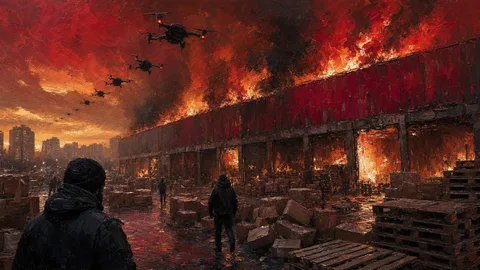
On the night of July 9 to 10, 2026, Ukrainian drones struck the seaport of Taganrog, in Rostov oblast, setting off fires at two fuel depots.
- On the night of July 9 to 10, 2026, Ukrainian drones struck the seaport of Taganrog, in Rostov oblast, setting off fires at two fuel depots.
- Introduction: A night of fires on the Sea of Azov
- Two depots in flames, a mayor who orders evacuations
Facts, quotes, and cited links remain in the body. Interpretations are framed as analysis or opinion according to the format.
Introduction: A night of fires on the Sea of Azov
Two depots in flames, a mayor who orders evacuations
On the night of July 9 to 10, 2026, Ukrainian drones struck the seaport of Taganrog, in Rostov oblast, setting off fires at two fuel depots. The city's mayor, Svetlana Kambulova, confirmed the damage and announced the evacuation of residents living near the port. The governor of Rostov oblast, Yury Slyusar, had already reported on Telegram that fires had broken out at the Taganrog port oil terminal, adding that emergency crews were on site.
This was not an isolated accident. The same night, another fire broke out at the Ilsky refinery, in neighboring Krasnodar Krai, after drone debris fell there. Fuel storage facilities were also hit in the city of Azov, where an optical-mechanical plant tied to the Russian military-industrial complex was struck as well. One single night, three separate fires of an energy war lit at once — the signature of a campaign, not a single lucky strike.
The terminal that feeds tankers on the Sea of Azov
The terminal hit at Taganrog belongs to Kurgannefteprodukt, a subsidiary of Yugtranzitservice. Its job: loading and unloading petroleum products onto merchant vessels moving through the Sea of Azov, with an annual handling capacity of roughly 1.2 million tons. This is not a random target or some ordinary neighborhood warehouse: it is a logistics node that lets Russia keep exporting and supplying its war economy from the country's south.
According to information relayed by Ukrainian analysts and specialized monitoring channels, FP-1 drones — mass-produced by Ukraine's own defense industry — may have carried out the strike, given Taganrog's relative proximity to the front line. A detail that says everything about how this war has evolved: it is no longer just Patriot interceptors or F-16 fighters reshaping the balance of power. It is cheap, assembly-line machines methodically wearing down the aggressor's rear.
There is something relentless in this image repeating night after night: depots on fire, Russian mayors announcing evacuations without ever saying why they are necessary, a population learning from Telegram what its own government refuses to name. The war Putin launched against Ukraine is coming home to him, and it no longer gives warning.
Taganrog, a recurring target in a war that no longer spares the rear
A city hit for months
Taganrog is not a new name in the tally of Ukrainian strikes. The city, home to roughly 240,000 people, has already weathered several waves of attacks in 2025 and 2026. In late May 2026, drones had already damaged a tanker and a fuel depot at the same Kurgannefteprodukt terminal, in a strike overseen by the Deep Strike USF Centre, Ukraine's dedicated structure for deep strikes. An aerial bridge of sabotage, month after month, that never lets Taganrog catch its breath for long.
In early July, two tankers had also been targeted in Taganrog Bay, forcing a crew to evacuate. This repetition is no statistical accident: it is a doctrine. Striking the same infrastructure repeatedly, before it can be fully repaired, prevents any rebuilding of capacity. The port of Taganrog has become a full-scale laboratory of this methodical war of attrition.
City hall facing a reality it can no longer hide
Svetlana Kambulova is not a political figure accustomed to wartime statements. She runs a mid-sized city in southern Russia, confronted with a reality neither she nor the Kremlin anticipated a few years ago: becoming, week after week, a hot spot in a conflict they claim to be waging far from their own borders. Announcing an evacuation is, implicitly, admitting that the threat is real, immediate, and not going away.
What local authorities never say in their statements is the link between these repeated strikes and Kyiv's broader strategy: turning every oil facility, every terminal, every depot into a variable of uncertainty for the Russian economy. Residents of Taganrog don't need a military briefing to understand what it means when the sky over the port lights up two or three times a month.
Sometimes I wish Western correspondents spent more time on these repetitions instead of the spectacular strikes on Moscow. It is in these repeated attacks on a mid-sized, almost anonymous city that the real mechanics of this war of attrition play out — slow, methodical, and devastatingly effective.
The wider offensive: a Russian sky that no longer knows a truce
Ilsky, Azov, Taganrog: three targets, one single night
The coordination of the night of July 9 to 10 illustrates the reach of the Ukrainian campaign. At Ilsky, a refinery caught fire after drone debris fell. At Azov, fuel depots and an optical-mechanical plant tied to the military sector were hit simultaneously. The spokesman for Ukraine's Centre for Countering Disinformation, Andrii Kovalenko, summed up the logic in one line posted online: Ukraine's defense forces continue systematically dismantling Russia's oil sector, logistics, and economy.
That night fits into a much larger sequence. A day earlier, according to information picked up by several specialized outlets, Ukrainian drones had reportedly already neutralized up to 40% of Russia's refining capacity, leaving tens of millions of Russians facing fuel shortages. Whether the exact figure is debated among analysts changes nothing about the essential point: Russia, historically an oil exporter, is watching its own domestic supply crack under blows from its neighbors.
An asymmetric war redefining the balance of power
The contrast has become almost mundane through sheer repetition: unmanned aircraft, mass-produced at a fraction of the cost of a tank or a cruise missile, manage to shut down infrastructure worth hundreds of millions of dollars. This cost-to-destruction ratio has become Ukraine's true strategic weapon, sometimes more effective than Western arms deliveries that have been awaited for months.
Russian air defense, despite costly systems like the S-400 or Pantsir, keeps letting through enough drones for the damage to pile up night after night. Every Russian statement announcing dozens of downed drones is, in effect, an admission: the scale of the Ukrainian threat has exceeded what Moscow anticipated when it launched its invasion in February 2022.
There is a harsh justice in this story. Russia wanted to punish Ukraine by bombing its power plants, its apartment blocks, its schools. Today it reaps burning ports and lines at the gas pump. This is not revenge — it is the elementary law of any war that refuses to end at the negotiating table.
What Taganrog reveals about the real state of Russia's war economy
Oil, the nerve center of Putin's machine
Understanding why Taganrog matters means understanding just how literally oil powers Vladimir Putin's rule. Oil and gas revenues fund the Russian military apparatus, buy the passivity of part of the population, and preserve Moscow's leverage over international partners reluctant to fully wean themselves off it. Every terminal knocked offline, every depot set ablaze, is a link in this chain breaking.
The port of Taganrog is not Russia's largest refinery, nor its most strategic terminal. But its importance lies precisely in this repetition: hit in May, hit in early July, hit again on July 10. This recurrence prevents any lasting reconstruction and imposes a permanent cost of repair and security that Russia's economy, already under Western sanctions, must absorb without respite.
A population paying the price of a war it never chose
The residents of Taganrog evacuated on the night of July 10 did not choose this war. They endure it, as millions of Ukrainians have endured it since 2022 under Russian bombardment deliberately aimed at civilian infrastructure. The difference, and it is a fundamental one, lies in the nature of the targets: Ukraine strikes military-industrial and logistics infrastructure, not apartment buildings or schools. This moral distinction, however uncomfortable it may be for some Western observers, underpins the entire legitimacy of Ukraine's response.
Zelensky himself has repeatedly called these strikes "long-range sanctions" — a phrase that reframes the entire campaign not as gratuitous escalation, but as direct, methodical economic pressure on Russia's war machine. Taganrog, in this frame, is just one more point on a map that now stretches from the Sea of Azov to western Siberia.
People sometimes ask me if I think it's fair that Russian civilians, even far from the front, bear the indirect consequences of this war. My answer is simple: the responsibility for every evacuation in Taganrog traces straight back to the Kremlin's own office, not to the Ukrainian drone operators defending their invaded country.
The Kremlin's response: minimize, again and again
A communication strategy running out of steam
Faced with this accumulation of strikes, official Russian communication follows a now-familiar pattern: announce an impressive number of intercepted drones, downplay the actual damage, and carefully avoid any mention of the link between these attacks and the war in Ukraine itself. Governor Yury Slyusar confirmed the fires without detailing their exact scale or their impact on regional fuel supply.
This calculated silence contrasts with the reality documented by independent analysts and outlets tracking the conflict: a fuel crisis now affecting dozens of Russian regions, sales restrictions imposed in several territories, and mounting pressure on a military logistics chain already strained by more than three years of war. State propaganda can delay the acknowledgment of facts; it cannot put out the fires themselves.
A precedent piling up with no structural answer
Since the start of 2026, the pace of strikes on Russian oil infrastructure has clearly accelerated compared with the previous year. Taganrog fits into this continuity, with Moscow having so far offered no structural response capable of reversing the trend. Air defense systems, however sophisticated on paper, cannot cover the entire territory against swarms of low-cost drones.
This chronic inability to protect its own energy infrastructure may be one of the most telling failures of Russian power since the invasion began. A country claiming to challenge the West militarily cannot stop fuel depots, located hundreds of kilometers from the front, from regularly burning in front of its own citizens.
The silence of Russian authorities in the face of these repeated fires says more than any triumphant statement ever could. When you have to evacuate civilians without ever explaining why, you have already lost the battle for the truth — even if you keep winning the battle of the lie, for now.
Implications for Ukraine: a strategic model that keeps sharpening
Strike far, strike often, strike right
The strike on Taganrog is just one of dozens of examples of what Ukraine has turned into a full-fledged military doctrine: a campaign of systematic, coordinated strikes aimed at saturating Russian defenses across the whole territory rather than concentrating effort on a single front. This distributed approach forces Moscow to defend targets simultaneously from the Sea of Azov to the Urals, a task its air defense systems simply cannot handle with equal effectiveness everywhere.
Ukraine's defense industry, by producing low-cost drones like the FP-1 in growing quantities, has enabled this multiplication of strikes without relying exclusively on Western deliveries, which are often slow and subject to political roadblocks. It is a major strategic lesson of this war: local innovation, forged under bombardment, can sometimes make up for the wait for outside support.
On the same topic
ANALYSIS: 800 drones over Russia in one night —…
More than eight hundred drones, in a single night, August 14…

SPECIAL REPORT: Beijing Promises Stimulus as Its Households Give…
That is the growth rate of Chinese industrial output in July,…

INVESTIGATION : Russia's FSB Erases 4 Ukrainian Regions' Border…
Not an assault, not an ultimatum, not a televised proclamation from…
A political signal as much as a military one
Every strike on a terminal like the one in Taganrog also sends a political message: no infrastructure tied to Russia's war effort is permanently out of reach. That message is aimed as much at the Kremlin as at Ukraine's Western partners, who are sometimes hesitant to authorize deep strikes with weapons they themselves supplied. By demonstrating its ability to act with its own means, Kyiv strengthens its position in upcoming discussions on military support, notably at international summits such as the NATO summit in Ankara in early July.
This strategic autonomy, patiently built since 2022, may prove to be the most lasting legacy of this phase of the conflict: a Ukraine capable of waging a war of economic attrition against a far larger adversary, without waiting for every Western green light before acting.
What Taganrog shows, once again, is that Ukraine has stopped being merely a country that resists. It has become an actor imposing its own strategic timetable on an aggressor who thought it would dictate the pace of this war from day one.
The role of Ukrainian command: Madyar and the Deep Strike USF Centre
A strike architecture built to last
Behind every strike on Taganrog lies a well-oiled command structure: the Deep Strike USF Centre, a unit created by Ukraine's Unmanned Systems Forces (USF), specifically dedicated to coordinating deep strikes on Russian territory. This structure has already claimed, in previous waves, dozens of targets hit in a single night — tankers, depots, military facilities — across the entire coastline of the Sea of Azov and the Black Sea.
Commander Robert Brovdi, known by his call sign "Madyar," has personally overseen several of these campaigns against Russian oil and military infrastructure in the region. His communication style — sober, factual, almost accountant-like — stands in sharp contrast to Russia's triumphalist rhetoric. He announces targets hit, not definitive victories. That may be exactly what makes his reports more credible than those of Russia's Defense Ministry.
Taganrog on the wider map of strikes from May to July
Between May and July 2026, Taganrog was targeted repeatedly: in late May, a tanker and a fuel depot hit in a coordinated operation that also struck a maritime oil terminal at Feodosia, in occupied Crimea; in early July, two tankers damaged in the bay; then, on the night of July 9 to 10, the two depots at the port itself. This accumulation draws a war map on which no oil infrastructure in southern Russia seems safe from being struck again.
This recurrence is not a sign that previous strikes failed — quite the opposite: it proves Ukraine considers these targets strategic enough to justify returning regularly, even if that means hitting the same facility two or three times before it is fully repaired. It is the very definition of a methodical war of attrition, waged with a discipline that contrasts with the chaotic image sometimes associated with Ukrainian forces in the early months of the invasion.
What stands out is the cold discipline of this campaign. No isolated flashes meant to impress Western cameras, but methodical sapping work, target after target, month after month. This is a war fought by accountants as much as by soldiers, and Ukraine seems to have grasped that equation better than anyone.
The silence of the great powers over an escalation taking root
Washington and Brussels, spectators of a war that is changing
As Ukrainian strikes on Russian oil infrastructure multiply, Western capitals remain largely quiet on this specific dimension of the conflict. Public discussion focuses more on deliveries of air defense systems like Patriot, or on diplomatic negotiations around a possible ceasefire. Ukraine's campaign against Russian oil, meanwhile, unfolds in near-total silence in the Western media, despite its scale and its considerable economic consequences for Moscow.
This discretion is not necessarily disapproval. It reflects, rather, a diplomatic reality: Western governments avoid speaking too directly about strikes carried out largely with Ukrainian-made weapons, so as not to feed Russia's narrative of a proxy war fully directed from Washington or Brussels. The silence, here, paradoxically serves Kyiv's strategic autonomy.
Economic pressure that could speed up negotiations
Some analysts believe this ongoing erosion of Russian oil capacity could, over time, weigh on Moscow's position in any future peace negotiations. A country facing chronic fuel shortages, falling export revenue, and constant logistical pressure on its army has less room to indefinitely prolong a war of attrition. This is no guarantee of a quick end to the conflict, but it is a factor even the most cautious negotiators can no longer ignore.
Still, this economic pressure, however real, does not replace Ukraine's immediate need for air defense against daily Russian bombardment of its own cities. Both fronts — striking Russia's war economy and defending against Russian strikes — advance in parallel, and neither alone is enough to tip the conflict.
Western silence over this Ukrainian oil campaign is not necessarily a problem. But it reveals a kind of intellectual comfort: we prefer commenting on arms deliveries we control rather than the autonomous strategy Kyiv developed without waiting for our green light. It is time to take it seriously.
Conclusion: The port that burns, symbol of a war that has changed nature
A city, a port, a lesson repeated
Taganrog will remain, in the long tally of this war, one name among others — Ilsky, Azov, Kapotnya, Tyumen — on a list that keeps growing since 2025. But every name on that list tells the same story: that of an aggressor country discovering, strike after strike, that distance and apparent strength no longer guarantee any safety. The residents evacuated on the night of July 10 will probably never read an official apology explaining why their neighborhood had to be emptied. Yet they will keep living with this reality, month after month.
Discover

INVESTIGATION: Beijing cuts Africa to 2.1 billion in loans…
2.1 billion — the lowest figure in almost twenty years, according…
SPECIAL REPORT: Beijing Promises Stimulus as Its Households Give…
That is the growth rate of Chinese industrial output in July,…

INVESTIGATION: Two Chinese Ex-Soldiers Arrested in Seoul as 18,000…
For five years, a man ran a military-supply shop at the…
What this strike confirms, once again, is the solidity of a Ukrainian strategy built patiently over time: target oil, target logistics, target the infrastructure that keeps Russia's war machine running. This is not a strategy of revenge. It is a strategy of survival, applied with a rigor that still surprises some Western analysts.
What remains to be watched
The question that remains, one no victory statement can settle at this stage, is how long Russia can keep absorbing this methodical erosion of its energy capacity. The coming weeks will tell whether Taganrog joins the long list of targets hit once and then forgotten, or whether it becomes, like others before it, a regular waypoint in a campaign showing no sign of slowing down.
I don't know how much longer Russia can absorb these repeated blows without it affecting its ability to wage the war itself. But I know that every depot that burns in Taganrog makes a little more visible what Moscow would rather keep invisible: this war is costing it, at home too, far more than it will ever admit.
By Maxime Marquette, columnist
Columnist's transparency note
Editorial position
This account takes a clear editorial stance: support for Ukraine in its defensive war against the Russian invasion, opposition to Vladimir Putin and the military apparatus he commands. Volodymyr Zelensky is presented as the legitimate president of an invaded country, defending his territory through means this text judges proportionate to the targets struck — military-industrial and logistics infrastructure, not civilian populations. This stance reflects the columnist's own judgment, without claiming a neutrality the subject would not honestly allow.
Methodology and sources
The facts reported in this text come from information available at the time of writing, notably published by The Moscow Times, RBC-Ukraine, and Ukrainska Pravda, supplemented by general, verifiable geopolitical context surrounding Ukraine's campaign against Russian oil infrastructure since 2025. No specific detail — name, exact time, quote — has been invented beyond what these sources document. Some elements, such as the exact drone model used in this particular strike, remain unconfirmed at this stage and are presented as such.
Nature of this text
This text is a journalistic account with an editorial angle, combining factual reconstruction with openly personal commentary. The italicized passages marked "mini editorial" are explicitly personal opinions of the columnist, distinct from the factual reporting that surrounds them.
Sources
Primary sources
Secondary sources
Get the geopolitics analyses
Conflicts, powers, alliances: the MadMax thread without the noise.
Cite this article
Maxime Marquette (2026). ACCOUNT: At Taganrog, the port burns and Putin finds his weak point. MadMax. https://mad-max.co/en/article/account-at-taganrog-the-port-burns-and-putin-finds-his-weak-point
Read next
INVESTIGATION: Beijing cuts Africa to 2.1 billion in loans…
2.1 billion — the lowest figure in almost twenty years, according…
SPECIAL REPORT: Beijing Promises Stimulus as Its Households Give…
That is the growth rate of Chinese industrial output in July,…
INVESTIGATION: Two Chinese Ex-Soldiers Arrested in Seoul as 18,000…
For five years, a man ran a military-supply shop at the…
Enjoyed this piece? Get the next one.
One chronicle a week, straight to your inbox. No noise.
This article was generated with AI assistance, under human supervision.
Comments
Be the first to weigh in.