

REPORT: Moscow strikes back on Ukrainian energy after its refineries burned
The Russian Ministry of Defense has claimed new missile and drone strikes targeting what Moscow calls "energy and fuel facilities used by Ukrainian armed forces," according to information reported by ABC News.
- The Russian Ministry of Defense has claimed new missile and drone strikes targeting what Moscow calls "energy and fuel facilities used by Ukrainian armed forces," according to information reported by ABC News.
- Introduction: A cycle of strikes with no pause in sight
- An energy war now fought on both sides
Facts, quotes, and cited links remain in the body. Interpretations are framed as analysis or opinion according to the format.
Introduction: A cycle of strikes with no pause in sight
An energy war now fought on both sides
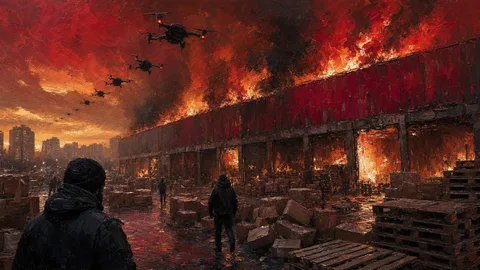
The Russian Ministry of Defense has claimed new missile and drone strikes targeting what Moscow calls "energy and fuel facilities used by Ukrainian armed forces," according to information reported by ABC News. This retaliation fits into a continuous cycle of reciprocal strikes on energy infrastructure that now pits the two countries against each other on a front classic military maps do not show: refineries, oil depots, power plants, and fuel transport networks.
This is no longer just a war of trenches and frozen front lines in eastern Ukraine. It is a war where each side seeks to deprive the other of its capacity to fuel its military effort, by striking the infrastructure that makes that effort possible. The essential difference lies in the origin of the conflict: Russia invaded Ukraine, not the other way around, and every Russian strike on Ukrainian energy fits into the logic of a war of aggression that has lasted since February 2022.
Why this retaliation is happening now
This announcement from the Russian Ministry of Defense comes amid mounting pressure on Russia's own energy infrastructure, repeatedly hit by Ukrainian drones and missiles since the start of 2026. Russian refineries, export terminals, and fuel depots have suffered a documented series of damages that triggered widespread shortages across Russian territory. This retaliation can therefore be read as an attempt by Moscow to demonstrate its ability to inflict symmetrical damage, even though the actual scale of the destruction caused in Ukraine remains, as is often the case in this conflict, difficult to verify independently.
The wording chosen by the Russian Ministry of Defense — "energy and fuel facilities used by Ukrainian armed forces" — seeks to present these strikes as strictly military, phrasing that echoes the rhetoric Moscow has used since the invasion began to justify attacks that, in reality, have regularly hit civilian infrastructure essential to ordinary Ukrainians' daily lives.
The Kremlin's chosen military vocabulary always deserves a skeptical reading. "Energy facilities used by armed forces" is a phrase broad enough to cover infrastructure that, in reality, also powers hospitals, schools, and civilian homes. This is not rhetorical accident. It is a justification strategy that almost always precedes the strike itself.
The framework behind this cycle of reciprocal strikes
A methodical escalation since the start of the year
The energy conflict between Russia and Ukraine is not new, but it has taken on a particular scale since the start of 2026. On one side, Ukraine has intensified its long-range drone strikes against Russian refineries and oil terminals, causing documented fuel shortages in the vast majority of Russian regions. On the other, Russia continues its campaign of strikes against the Ukrainian energy grid, a strategy it has repeatedly used since the winter of 2022-2023, aimed at depriving Ukrainian civilians of heat and electricity during the coldest season.
This retaliation claimed by Russia's Ministry of Defense therefore fits into a well-documented strategic continuity: striking Ukrainian energy infrastructure has for several years been a pillar of Russian military doctrine, independent of how the ground front evolves. This is a war that seeks to break the Ukrainian population's ability to endure winter, not only to weaken specific military capabilities.
The fundamental difference between attacker and defender
To understand this cycle of reciprocal strikes, it is essential never to lose sight of the fundamental moral asymmetry underlying it. Russia chose to invade Ukraine unprovoked in February 2022. Every Russian strike on Ukrainian energy since that date continues a war of aggression. Ukrainian strikes on Russian energy infrastructure, by contrast, constitute a response to that aggression, aimed at reducing Moscow's ability to finance and continue its invasion.
This distinction does not erase the human reality of the damage this Russian retaliation causes in Ukraine — Ukrainian civilians risk once again losing access to electricity and heat because of these strikes. But it recalls that this cycle of violence has a clear origin, and that origin has a name: the Russian invasion of Ukraine.
I'm sometimes asked why I refuse to treat this cycle of strikes as a symmetrical conflict between two equivalent belligerents. My answer is always the same: there is an aggressor and there is a victim defending itself. Confusing the two because both sides strike energy infrastructure erases this war's origin.
What this Russian retaliation actually targets
The vague language of a ministry avoiding precision
The wording used by the Russian Ministry of Defense — "energy and fuel facilities used by Ukrainian armed forces" — remains deliberately vague about the exact nature of the targets hit. This imprecision is not accidental: it lets Moscow claim strikes on a wide range of infrastructure, while avoiding specifying whether these facilities actually served, and exclusively, a military purpose or whether they also powered civilian populations.
This rhetorical ambiguity echoes a recurring pattern seen since the invasion began: Russia strikes energy infrastructure across Ukraine, then justifies these strikes by presenting them as legitimate military targets, without always providing independently verifiable proof. Human rights organizations and international journalists covering this conflict have repeatedly documented significant gaps between official Russian justifications and the reality of damage found on the ground.
A cycle threatening Ukraine's energy supply ahead of winter
Even though this retaliation comes in the middle of summer 2026, its longer-term strategic objective is probably still tied to Ukraine's ability to get through the coming winter in acceptable conditions. Every piece of energy infrastructure damaged today represents production or distribution capacity that must be repaired before the cold months, or risk reproducing the massive power and heating outages Ukraine has experienced in previous winters.
This timing dimension is crucial to understanding Russian strategy: by striking energy infrastructure as early as summer, Moscow seeks to maximize the time available for damage to accumulate and become harder to repair before the cold arrives. This is a war-of-attrition strategy applied directly to the winter survival capacity of the Ukrainian civilian population.
There is something particularly cynical about the timing of these Russian strikes on Ukrainian energy. Striking in summer means methodically calculating the repair time needed before winter arrives. This is not military improvisation. It is planning that deliberately aims to make civilians suffer during the coldest months.
Ukraine's response: documented resilience in the face of repetition
Reconstruction capacity proven since 2022
Ukraine has developed, since Russia's energy-strike campaigns began in 2022, a repair and rapid reconstruction capacity for its infrastructure that has surprised many Western observers. Ukrainian technical crews, often working under the threat of new strikes, have learned to repair damaged power grids within timeframes that would have seemed impossible before the invasion. This operational resilience, well documented by Ukrainian and international media, is one of this war's least-told stories.
The Ukrainian government, led by Volodymyr Zelensky, has consistently presented this energy resilience capacity as further proof of the Ukrainian people's determination not to yield to a Russian strategy explicitly aimed at breaking their morale through physical and psychological exhaustion. Every outage repaired in days rather than weeks is a silent victory against Moscow's energy-terror strategy.
Western support for Ukraine's energy reconstruction
This Ukrainian resilience capacity does not rest solely on local ingenuity — it also relies on substantial Western material and financial support, specifically aimed at rebuilding energy infrastructure damaged by repeated Russian strikes. Generators, electrical transformer equipment, and direct financing have been provided by several Western countries and by the European Union, as part of a support strategy that recognizes energy as a front line in its own right.
This Western solidarity remains essential in the face of a cycle of strikes that, in all likelihood, will continue as long as the war continues. Without this steady support for energy reconstruction, Russia's winter-terror strategy would probably have produced far more devastating effects on the Ukrainian civilian population over the years.
I cannot help but admire, with each new wave of Russian strikes, how quickly Ukrainian crews get their grids back online. It is a form of resistance that never makes headlines the way front-line combat does, but that matters just as much for the daily survival of millions of people.
The bigger picture: a war where energy becomes a central weapon
Two energy strategies with radically different goals
To properly understand this cycle of reciprocal strikes, one must clearly distinguish each side's strategic objectives. Ukraine's campaign against Russian refineries and terminals aims to reduce Moscow's financial and logistical capacity to continue its invasion — a strategy that targets the financing of the war. Russia's campaign against Ukrainian energy, by contrast, primarily aims to break the will of the Ukrainian civilian population to resist by depriving it of heat and electricity during the year's hardest periods.
This distinction is not a footnote — it reveals a fundamental difference in the moral nature of the two campaigns. Striking refineries that finance an invading army does not carry the same ethical weight as striking power plants that feed hospitals and civilian homes in the middle of winter. One targets the economic nerve of a chosen war. The other deliberately targets the endurance of a population enduring a war it never chose.
NATO and the West facing this ongoing escalation
This Russian retaliation comes as Western capitals continue debating the level of military and financial support to give Ukraine. Every new wave of Russian strikes on Ukrainian energy strengthens, for advocates of greater support, the argument that Ukraine needs additional air-defense systems to protect its critical infrastructure. Patriot systems and other air-defense capabilities provided by Western allies play a crucial role in limiting the damage from these repeated strikes.
For NATO, this ongoing escalation is also a reminder of the limits of conventional deterrence against a Russian regime that has demonstrated, over four years of invasion, its willingness to deliberately target essential civilian infrastructure. Every documented strike strengthens the case for continued Western support for Ukrainian air defense.
At some point the West will need to stop treating air-defense system deliveries to Ukraine as a diplomatic favor and start treating them as what they truly are: a humanitarian necessity in the face of a Russian strategy that deliberately targets the infrastructure keeping Ukrainian civilians alive through winter.
The areas affected and the difficulty of verification
The permanent challenge of independent verification
As is often the case in this conflict, the exact scale of the damage caused by this Russian retaliation remains hard to establish with certainty in the immediate aftermath. The statements from Russia's Ministry of Defense, reported by ABC News, offer one version of events that must be cross-checked, in the following days, against Ukrainian authorities' findings, available satellite imagery, and testimony gathered on the ground by independent journalists. This cross-verification, essential to any rigorous journalistic coverage of this conflict, often takes several days before producing a fuller picture of the actual damage.
This immediate verification difficulty, however, should not be confused with doubt about the reality of the broader phenomenon: Russian strikes on Ukrainian energy have been consistently documented since 2022 by numerous independent sources, including international humanitarian organizations and Western media on the ground. The uncertainty concerns the precise details of each individual strike, not the existence of the strategy itself.
What the repetition of these strikes reveals about long-term Russian strategy
This new retaliation, whatever its exact scale, fits into a repetitive pattern that allows for solid conclusions about long-term Russian strategic intentions. Since 2022, each period of heightened front-line tension or each documented Ukrainian success elsewhere — such as successful strikes on Russian refineries — seems to be accompanied by an intensification of Russian strikes on Ukrainian energy, suggesting a form of deliberate retaliation rather than mere calendar coincidence.
This observed regularity reinforces the need for Western analysts and policymakers to treat these retaliations not as isolated incidents but as building blocks of a coherent, deliberate Russian strategy aimed at collectively punishing the Ukrainian civilian population for its government's military and industrial successes. Understanding this logic is essential to anticipating the next waves of strikes and preparing an adequate response.
I always distrust narratives treating each Russian strike as an isolated, unpredictable event. The repetition of this pattern over four years reveals a clear intent: punish the Ukrainian civilian population every time its government scores a strategic success elsewhere. This is not conventional warfare. It is a form of collective retaliation.
The diplomatic dimension of this ongoing escalation
Peace talks against the reality of daily strikes
This Russian retaliation comes amid sporadic diplomatic discussions about a possible resolution to the conflict, raised by various capitals, without any concrete progress documented to date. The persistence of this cycle of reciprocal energy strikes illustrates the considerable gap between diplomatic rhetoric and operational reality on the ground: as long as both sides keep striking each other's energy infrastructure at such a sustained pace, the idea of an imminent ceasefire appears largely disconnected from the actual situation.
This reality should prompt international mediators, including the American administration, to revise their expectations regarding the timeline for any eventual de-escalation. A durable ceasefire would require, at minimum, a verifiable halt to these energy-strike campaigns on both sides — a condition that currently appears far out of immediate reach.
Washington's ambiguous role in this file
Discover

INVESTIGATION: Beijing cuts Africa to 2.1 billion in loans…
2.1 billion — the lowest figure in almost twenty years, according…

SPECIAL REPORT: Beijing Promises Stimulus as Its Households Give…
That is the growth rate of Chinese industrial output in July,…

INVESTIGATION: Two Chinese Ex-Soldiers Arrested in Seoul as 18,000…
For five years, a man ran a military-supply shop at the…
The American administration, under President Donald Trump, has generally maintained a position favorable to military support for Ukraine against Russian ambitions, while simultaneously exploring negotiation paths with Moscow that have drawn criticism from some European allies worried about a deal deemed too favorable to the Kremlin. This approach, on the strictly geopolitical and military front against Russia, remains broadly aligned with Western interests of containing Russian expansionism, even as its precise terms continue to draw debate.
This Russian retaliation, in any case, recalls that any negotiation conducted without concrete guarantees of ending energy hostilities risks colliding with a reality in which both sides keep intensifying their respective campaigns. No diplomatic agreement can be credible as long as both countries' energy infrastructure remains an active target.
I remain skeptical of any diplomatic talk that ignores the reality of daily strikes on the ground. As long as Russian refineries burn and Ukrainian power plants fall under missiles, talk of imminent peace has more to do with wishful thinking than serious strategic analysis.
What this retaliation reveals about the conflict in July 2026
A conflict that refuses to run out of steam after four years of war
This new wave of strikes comes more than four years after the start of the Russian invasion, at a moment when some international observers hoped for a gradual de-escalation of the conflict, or at least a reduction in the intensity of strikes on energy infrastructure. The documented reality of this Russian retaliation suggests the opposite: the energy conflict between the two countries remains as active, if not more intense, than it has ever been since the war began.
This persistent intensity of the energy conflict, combined with the successful Ukrainian campaign against Russian refineries documented elsewhere, paints the portrait of a war that has become a total industrial war of attrition, where each side seeks to wear down the other's economic and logistical capacity, rather than a war limited to marginal territorial gains or losses along a frozen front.
The urgency of unwavering Western support
Given this reality of an energy conflict showing no sign of easing, the urgency of continued Western support for Ukrainian air defense and energy infrastructure reconstruction has never been more evident. Every additional air-defense system provided to Ukraine directly reduces the effectiveness of future Russian strikes on its energy grid, just as every reconstruction fund speeds up Ukraine's ability to regain stable access to electricity and heat after each wave of attacks.
For Western decision-makers who might be tempted to view this cycle of reciprocal strikes as a now-normalized routine, this retaliation serves as a useful reminder: every pause in Western support translates directly into increased vulnerability for Ukrainian civilians facing a Russian strategy that has shown no sign of softening in four years of war.
Four years after this invasion began, one might expect a form of strategic fatigue on the Russian side. What this retaliation demonstrates is the opposite: Moscow's determination to keep targeting Ukrainian energy remains intact. That should remind us that our own determination to support Ukraine cannot be allowed to fade with time either.
Conclusion: A cycle demanding a relentless Western response
The lesson of a war now fought on several simultaneous fronts
This Russian retaliation against Ukrainian energy infrastructure reminds us once again that this conflict can no longer be understood only through the prism of ground front lines. It is a war fought simultaneously on the battlefield, in refineries, in power plants, and in international diplomatic negotiations. Each front feeds the others: Ukrainian successes against Russian refineries fuel economic pressure on Moscow, while Russian retaliation against Ukrainian energy seeks to offset that pressure by directly targeting the morale and endurance of the civilian population.
Understanding this multipolar dynamic is essential to properly assess how the conflict is likely to evolve in the coming months. Neither Russia nor Ukraine appears willing to halt its respective energy-strike campaigns, suggesting this cycle will continue to define a significant part of daily life for both civilian populations, at degrees that are of course very different given the fundamentally different nature of the two wars being fought.
What to watch in the coming weeks
In the days and weeks following this retaliation, several elements deserve particular attention: independent confirmation of the actual scale of damage caused in Ukraine, the Ukrainian response in terms of reconstruction and strengthened air defense, and the possible further intensification of Ukraine's campaign against Russian energy infrastructure in reaction to this retaliation. By nature, this cycle feeds itself: each strike from one side tends to trigger a strengthened response from the other.
On the same topic
ANALYSIS: 800 drones over Russia in one night —…
More than eight hundred drones, in a single night, August 14…

REPORT: One Year Past the August 18 Ultimatum, Ukraine's…
At midnight on August 18, 2025, the deadline expired that the…

SPECIAL REPORT: Beijing buys 40 cargoes of sanctioned Russian…
On August 28, 2025, a tanker named Arctic Mulan moored at…
For the West, the lesson has remained constant since this war began: only continued and reinforced support for Ukrainian air defense and energy reconstruction can limit the human impact of this repeated Russian strategy of energy terror. Easing this support now, at a moment when the cycle of strikes is intensifying rather than easing, would mean abandoning millions of Ukrainian civilians to a deliberate strategy of winter deprivation.
I close this report with a simple certainty: this energy war will know no truce until the Russian invasion itself stops. Every Ukrainian winter becomes a test of collective resilience, and every test deserves Western support equal to the human stakes it represents.
By Maxime Marquette, columnist
Columnist's transparency note
Editorial positioning
This report takes a clear editorial stance: support for Ukraine in its fight against an unprovoked invasion, firm opposition to the Russian war machine and to Vladimir Putin. The author holds that the moral distinction between Ukrainian strikes on Russian military-industrial infrastructure and Russian strikes on Ukrainian civilian energy is fundamental and must never be erased by falsely symmetrical journalistic treatment. This positioning reflects the columnist's judgment and does not claim a false neutrality.
Methodology and sources
The central fact in this piece comes from an ABC News article reporting that Russia's Ministry of Defense claimed missile and drone strikes targeting "energy and fuel facilities used by Ukrainian armed forces," as part of an ongoing cycle of reciprocal strikes. No fact, figure, or quote has been invented. The broader geopolitical context — the history of Russian campaigns against Ukrainian energy since 2022, Western support for reconstruction, Ukraine's campaign against Russian refineries — relies on public facts widely documented by the international press.
Nature of the analysis and factual limits
This text is an editorially driven report, which reports verifiable facts while maintaining a clear editorial line. Maxime Marquette (MadMax) is a columnist-analyst whose mission is to interpret the news in light of documented geopolitical stakes. The exact scale of the damage caused by this specific Russian retaliation is not independently confirmed at the time of writing — this text relies on the statement from Russia's Ministry of Defense as reported by ABC News, without extrapolating beyond what the source reports.
Sources
Primary sources
Secondary sources
Get the geopolitics analyses
Conflicts, powers, alliances: the MadMax thread without the noise.
Cite this article
Maxime Marquette (2026). REPORT: Moscow strikes back on Ukrainian energy after its refineries burned. MadMax. https://mad-max.co/en/article/report-moscow-strikes-back-on-ukrainian-energy-after-its-refineries-burned
Read next
INVESTIGATION: Beijing cuts Africa to 2.1 billion in loans…
2.1 billion — the lowest figure in almost twenty years, according…
SPECIAL REPORT: Beijing Promises Stimulus as Its Households Give…
That is the growth rate of Chinese industrial output in July,…
INVESTIGATION: Two Chinese Ex-Soldiers Arrested in Seoul as 18,000…
For five years, a man ran a military-supply shop at the…
Enjoyed this piece? Get the next one.
One chronicle a week, straight to your inbox. No noise.
This article was generated with AI assistance, under human supervision.
Comments
Be the first to weigh in.