

FIELD REPORT: In Sumy, the Kremlin’s bombs shatter a refuge for child victims of violence
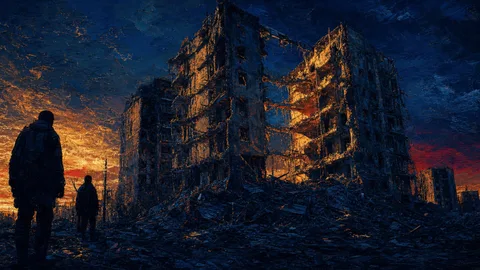
When the Barnahus in Sumy opened in December 2023, the regional council had set out toys, candy and tea; on Sunday, September 27, Russian guided bombs blew out its windows and doors, according to Ukraine’s human rights commissioner, Dmytro Lubinets.
- When the Barnahus in Sumy opened in December 2023, the regional council had set out toys, candy and tea; on Sunday, September 27, Russian guided bombs blew out its windows and doors, according to Ukraine’s human rights commissioner, Dmytro Lubinets.
- When the Barnahus in Sumy opened in December 2023 , the regional council had set out toys, candy and tea; on Sunday, September 27 , Russian guided bombs blew out its windows and doors, according to Ukraine’s human rights commissioner, Dmytro Lubinets.
- That is the inventory of a waiting room for children.
Facts, quotes, and cited links remain in the body. Interpretations are framed as analysis or opinion according to the format.
Toys, candy, tea
December 2023
When the Barnahus in Sumy opened in December 2023, the regional council had set out toys, candy and tea; on Sunday, September 27, Russian guided bombs blew out its windows and doors, according to Ukraine’s human rights commissioner, Dmytro Lubinets.
Toys. Candy. Tea.
That is the inventory of a waiting room for children. Nothing rare. Nothing expensive. Just what it takes for a child to agree to sit down.
That is what this text is about: a toy on a shelf, in a room where a child comes to describe the violence done to them.
Sunday, September 27
On Sunday, according to Lubinets, the windows burst. So did the doors. The equipment and the inventory were damaged.
The inventory. The bureaucratic word for what sat on the shelves.
No one knows what is left of the toys. No official message says.
A toy in an interview room gives a child something to hold while talking. A stuffed animal to squeeze. A little car to roll across the table. The sound of tiny wheels while the adult waits for the next sentence.
That gesture is what sat on the shelves.
Where tea was served, the glass came down.
A room for talking
The 10th in Ukraine
In December 2023, Sumy became the 10th region of Ukraine to open such a center, according to the regional council.
The model is called Barnahus. It comes from Iceland, where it was designed some 20 years ago, according to Ukraine’s National Social Service.
The idea fits on one line. Bring social, medical and judicial services together in one place. So that a child who is already hurt is not hurt again by the paperwork.
One place. One door to push open.
The center takes in children who are victims of violence, and those who have witnessed it, according to the regional council.
A child who took the blows. A child who saw them. A child who heard them through a wall. A child who saw the war up close. A child who no longer says anything.
All of them come through the same door.
Rooms to breathe
The Sumy center had rooms for psychological decompression, a room for one-on-one work with a child, a rest room, a kitchen.
A rest room. In a city where guided bombs fall in the middle of the afternoon.
At the opening, the head of the regional council, Viktor Fedorchenko, said children must be protected in all circumstances, especially in wartime. After almost two years of full-scale invasion, he added, violent crimes that children witness or suffer were multiplying.
The region then counted more than 156,000 children. About 800 a year suffer violence there, according to the council.
Everything under one roof, so a child hurts a little less.
Around 3 p.m., three bombs
Downtown Sumy
On Sunday, around 3 p.m., Russian guided aerial bombs hit Sumy, according to acting mayor Artem Kobzar, quoted by Interfax-Ukraine.
Governor Oleh Hryhorov counts three. One lands near the building of the center supporting families and children. The building is damaged.
The social policy minister, Denys Uliutin, spells out what was hit. The regional center for social support to children and families. And the Barnahus. Right in the center of Sumy.
No one inside
At the moment of impact, no visitors were in the building, the governor says. No children, the minister says.
It was a Sunday. The rooms were empty.
And yet, outside, the city was not.
Two people die near the center. An elderly woman. A girl of 16. Five others are injured, including a 12-year-old child, according to the acting mayor. All are receiving care, the governor says.
Three bombs. A single address named by the authorities: the children’s.
Three bombs, and the children’s room is gone.
The Russian ministry and Sumy
Sites linked to the military
Russia’s Defense Ministry claims it targets only military-linked sites. The Associated Press recalls this the next day, reporting on another night of strikes.
That Sunday, the ministry claims data centers in Kyiv, according to the agency. It says they were supplying internet to the Ukrainian armed forces.
About Sumy, in what the agency reports, not a word.
No Barnahus. No social center. Not one line for a 16-year-old girl.
A Sunday, downtown
So here is where I stand. With the children this Barnahus took in, and with the people who received them there. Against the Russian command’s decision to drop guided bombs on downtown Sumy on a Sunday afternoon. Because on September 27, three of those bombs took the life of a 16-year-old girl and an elderly woman, and destroyed a place built for children who are victims of violence.
Against a decision. Never against a people.
Moscow talks about targets. Sumy talks about doors.
The day before, kindergartens
September 26
Sumy did not discover guided bombs this Sunday.
The day before, Saturday, September 26, Russian strikes on the city leave two dead and 23 injured, including four children, according to the governor, quoted by the Kyiv Independent.
The strikes hit several places in the Sumy community, the governor says. Apartment buildings, administrative buildings and more than 20 vehicles are damaged. And kindergartens.
14 years, 8 years, 11 months
Three children are hospitalized, the Kyiv Independent writes. A girl of 14. A girl of eight. A baby of 11 months.
Eleven months. The age when a child can barely stand, gripping the edge of a table.
Saturday, the kindergartens. Sunday, the children’s center.
Two days in a row, the same word comes back in the Sumy tallies. Children.
That Saturday, according to the Kyiv Independent, the Russian army also launches 173 drones of the Shahed type at Ukraine, 50 of them jet-powered. Air defenses stop 134.
Two days, two places for children, one city.
The same Sunday, elsewhere
Kyiv, two schools and two kindergartens
Sumy is not alone that Sunday.
In Kyiv, President Zelensky writes that same evening, Russian jet-powered drones hit two kindergartens and two schools. He counts 277 drones launched at Ukraine since the day before.
Discover
NARRATIVE: At 11:18 a.m. on a Monday, the Kremlin…
In Dnipro, once the search was over on September 28, the…

SPECIAL REPORT: Brussels sanctions a camp called Peace and…
Romashka, Sputnik, Raduga, Mir, Leto, Vita: the Official Journal of the…

COLUMN: At 54 Volodymyrska Street, Moscow burns the address…
A Russian jet-powered drone struck the presidium building of the National…
Lubinets sums it up in one line: Russia is attacking Sumy, Kyiv and the Kyiv region.
Eight dead nationwide
That Sunday, eight people die under Russian strikes across Ukraine, according to Al Jazeera’s count. Three in the Zaporizhzhia region. A man in Kyiv. One person in the Odesa region. The others in Sumy.
Schools in Kyiv. Kindergartens in Sumy the day before. A Barnahus on Sunday.
The map of one wartime weekend ends up reading like a directory of places for children.
Schools, daycares, a refuge: childhood makes the list.
Two dead, or three
The governor and the minister
Here I have to write down what does not help our story.
The numbers don’t match.
Two dead for the governor of Sumy. Two dead for the Associated Press, which quotes him. Three for the interior minister, Ivan Vyhivskyi, according to Al Jazeera, citing AFP.
The names don’t match either. A center supporting families and children, for the governor. A regional center and a Barnahus, for the social policy minister. The building of the regional children’s home, for President Zelensky, in his Sunday evening message.
Three institutions. Three ways of naming the same facade.
An empty building
And the building was empty. No child was hurt inside.
The 16-year-old did not die under the center’s roof. She died outside, on her way.
These are the numbers and words of a country under bombardment, published in a hurry by its own institutions. I report them with their gaps.
That is true. And it does not change this: three bombs fell on the center of a city, on a Sunday, at shopping time.
The numbers waver. The windows don’t.
Sixteen, running for the shelter
A trip to the store
According to the local outlet Kordon.Media, quoted by Ukrainska Pravda, the girl had gone out to run an errand at the store.
She hears the alert. Guided bombs are heading for the city.
She starts running toward the nearest shelter.
She doesn’t make it in time.
A tree falls on her.
On the same topic
COLUMN: At 54 Volodymyrska Street, Moscow burns the address…
A Russian jet-powered drone struck the presidium building of the National…
SPECIAL REPORT: Brussels sanctions a camp called Peace and…
Romashka, Sputnik, Raduga, Mir, Leto, Vita: the Official Journal of the…

EDITORIAL: Peskov names the “price” Ukraine will pay. Arm…
On September 28, speaking in Moscow, Dmitry Peskov warned that Ukraine…
A tree
Minister Uliutin writes that she was simply passing by.
Passing by. Sixteen years old.
In a city under bombardment, a shelter is measured in steps. The sound of approaching bombs is measured in seconds. In between, a teenager running.
There is the store. There is the alert. There is the nearest shelter. There is the tree.
Four places on a single street. The last one was on no map of dangers.
How many steps was she short?
The Barnahus was built for children who have suffered violence. On Sunday, violence did not wait for a child to walk through its door.
Sixteen.
She was running for the shelter. The tree fell first.
An elderly woman, no name
Sunday’s second death
There is another death that Sunday in Sumy.
The governor describes her in two words: an elderly woman. The Associated Press writes: a woman.
No name. No exact age. No street.
Who, in the evening tally, knew what she was called?
An elderly woman out on a Sunday afternoon, downtown, is often someone who walks at her own pace. Someone for whom the nearest shelter is always a little farther away than for everyone else.
Five injured, one of them 12
Five people are injured. Among them, a 12-year-old child, according to the acting mayor.
For any child hurt on a Sunday afternoon, that can mean a cut to clean, a bandage, a night of asking for the hallway light to stay on.
The next day, the tallies are already about something else. Kharkiv. Kyiv. Odesa.
The governor has an age for the first woman who died. For the second, he has only an adjective.
Elderly, says the tally. That is all it says.
Imprecise, but dropped
The ministry’s argument
Moscow’s defense exists. It has to be laid out in its strongest form.
A glide bomb is not a weapon of perfect precision. Sumy is a city close to the Russian border, where soldiers and equipment pass through, the ministry would argue. It says it targets only military-linked sites. The center was empty. No one was hurt inside.
That is what a spokesman would sign. It takes facts to answer it.
3 p.m. in the city center
Here are the facts that turn it around. A weapon known to be imprecise, dropped on a city center at 3 p.m. on a Sunday, does not land among civilians by mistake. It lands where someone decided to release it.
The day before, strikes had hit several places in the city, according to the governor. Kindergartens among them.
And the Russian ministry claims nothing in Sumy, in what the agency reports of its statements. A military target that is hit gets claimed.
An empty center does not make the bomb innocent. It only makes the day lighter than it could have been. The same bomb, on a Tuesday morning, could have found children in those rooms.
Everything points the same way. Precision is not the issue. The choice is.
An imprecise bomb is still a chosen bomb.
The protection system
The commissioner’s word
Dmytro Lubinets, the Ukrainian Parliament’s human rights commissioner, chose one word: system.
Russia, he writes, is striking the very system that protects the rights of people and of children.
He adds that this is not random destruction. That even the places created to protect children come under fire.
Russia is striking the foundations, he also writes. The word is right. A Barnahus does not hold a front line. It holds a chain: the child, the social worker, the doctor, the investigator, the judge.
Documenting, then losing the room
In 2023, Ukraine’s National Social Service explained why the model had become relevant in the country: the full-scale war, and the need to document Russian war crimes.
A Barnahus takes in the child. It also records the child’s account, with judicial services under the same roof.
Striking such a place means striking the spot where a child’s words become evidence in a case file.
I have no proof of intent. I have the list of what was hit.
Even a place of protection falls under the bombs.
An ordinary Sunday
The corner store
I reread the line from Kordon.Media: she had gone out to run an errand.
I think of my own Sundays. I think of the milk we forget. I think of the bread we dash out for. I think of the kid we send to the corner store because they are old enough now.
That is what tightens my throat. Not the bomb. The errand.
Running for a shelter
I don’t know what it is like to run for a shelter. I won’t pretend to.
I only know that in Sumy, on a Sunday at 3 p.m., a trip to the store now includes the distance to the shelter.
And yet the city keeps living, buying bread, sending its teenagers to the store. A city that stops living has already lost more than its windows.
On a Sunday at 3 p.m., people run errands.
The Barnahus windows
Doors, windows, equipment
The list of damage is short, according to Lubinets. Windows. Doors. Equipment. Inventory.
All of it can be replaced. Glaziers, carpenters, a budget.
The real measure is time. At the pace of 800 child victims of violence a year that the regional council counted in 2023, each week means, on average, about 15 more children in the region.
About 15 children a week. And a rest room with no glass, while autumn…
What no one knows about the toys
No one knows what is left of the toys. No one knows whether the candy is still there. No one knows who will serve the tea next week, or where.
In 2023, according to the National Social Service, 183 child victims of violence had received full support through this model in Ukraine. Each of them walked through a door like that one.
And yet those were the things that told a child, on the way in, that the room was made for them.
Glass gets swept up. The trust of a child who is afraid of a door gets rebuilt more slowly.
Eight hundred children a year look for an open door.
A refuge can be rebuilt, not a 16-year-old
What Sumy lost on Sunday
On Sunday, in Sumy, three Russian guided bombs fell on the center of the city.
They left two dead, including a 16-year-old girl running for a shelter. Five injured, including a child. A social center damaged. A Barnahus destroyed.
The day before, kindergartens.
The Russian ministry says it targets the military. None of these addresses was claimed as such.
The Sumy Barnahus was opened so that a child would have only one door to push. On Sunday, that door was blown in.
The room to reopen
Who, here at home, will pay for the windows of the Sumy Barnahus, and for the weeks when children will have nowhere to tell their story?
Toys can be bought again. Doors can be hung. Tea can be served again.
In one family in Sumy, there will remain a place that nothing fills.
The refuge will be rebuilt. A 16-year-old, never.
Sources:
Primary Sources:
- Oleh Hryhorov, Sumy Regional Military Administration — three guided bombs, two dead including a 16-year-old, September 27, 2026
- Dmytro Lubinets, Parliament Commissioner for Human Rights — Barnahus space destroyed in Sumy, September 27, 2026
- Sumy Regional Council — opening of the Barnahus center, December 26, 2023
Secondary Sources:
Get the geopolitics analyses
Conflicts, powers, alliances: the MadMax thread without the noise.
Cite this article
Maxime Marquette (2026). FIELD REPORT: In Sumy, the Kremlin’s bombs shatter a refuge for child victims of violence. MadMax. https://mad-max.co/en/article/in-sumy-the-kremlins-bombs-shatter-a-refuge-for-child-victims-of-violence
Read next
NARRATIVE: At 11:18 a.m. on a Monday, the Kremlin…
In Dnipro, once the search was over on September 28, the…
SPECIAL REPORT: Brussels sanctions a camp called Peace and…
Romashka, Sputnik, Raduga, Mir, Leto, Vita: the Official Journal of the…
COLUMN: At 54 Volodymyrska Street, Moscow burns the address…
A Russian jet-powered drone struck the presidium building of the National…
Enjoyed this piece? Get the next one.
One chronicle a week, straight to your inbox. No noise.
This article was generated with AI assistance, under human supervision.
Comments
Be the first to weigh in.