

REPORT: Eight Hundred Kilometers From the Front, Ukraine Torches Russian Refineries
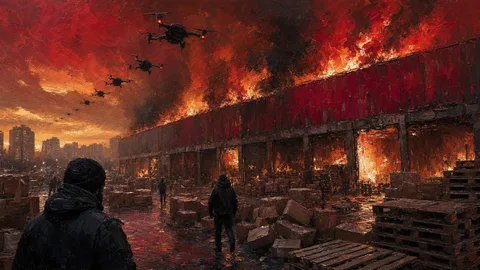
On the night of July 11 into 12, 2026, Ukrainian long-range drones struck the Syzran refinery in Russia's Samara oblast, more than eight hundred kilometers from the front line, according to Euromaidan Press.
- On the night of July 11 into 12, 2026, Ukrainian long-range drones struck the Syzran refinery in Russia's Samara oblast, more than eight hundred kilometers from the front line, according to Euromaidan Press.
- Introduction: a war also being fought far from the trenches
- Syzran, a target hit for the third time in 2026
Facts, quotes, and cited links remain in the body. Interpretations are framed as analysis or opinion according to the format.
Introduction: a war also being fought far from the trenches
Syzran, a target hit for the third time in 2026
On the night of July 11 into 12, 2026, Ukrainian long-range drones struck the Syzran refinery in Russia's Samara oblast, more than eight hundred kilometers from the front line, according to Euromaidan Press. It was the third strike of the year on this same facility, following two earlier attacks in April and May, according to Kyiv Post. Open-source analysts identified the units hit with unusual precision: the ELOU-AVT-5 unit, responsible for about 30% of the site's processing capacity, and the AVT-6 unit, which accounts for nearly 70%.
This strike is not an isolated event — it is part of a methodical campaign waged for months by Ukrainian forces against Russian oil infrastructure, a campaign that directly targets Moscow's ability to finance its war and fuel its military machine. This report traces, from available sources and official statements, the mechanics of this parallel war being waged far from the media spotlight usually fixed on the Donbas.
Eight hundred kilometers used to be the distance separating this trench war from a genuine economic war. That distance has just closed, and it may be one of the most underrated shifts of this conflict.
A strike claimed with precision
The operation was jointly claimed by the 1st Separate Center, the 414th "Magyar's Birds" brigade, Ukrainian military intelligence HUR, and the border guard service, according to Censor.net. This multiple claim, unusual in its precision, illustrates the growing coordination among the various Ukrainian units specializing in long-range strikes.
According to an analysis by the Cyberboroshno monitoring group, relayed by Euromaidan Press, this strike reportedly damaged 100% of the site's primary processing capacity, estimated at 8.9 million tons a year, potentially making it the most significant single-strike result in months, exceeding even the impact of the strike on the AVT-11 unit at the Omsk refinery.
There is something both fascinating and terrible in this surgical precision documented by open-source analysts: Ukraine is no longer striking at random — it is methodically dismantling its aggressor's oil capacity, unit by unit.
The context: a campaign accelerating since the start of the year
Sixty-eight strikes in five months
According to an analysis by the re-russia.net center, Ukraine carried out sixty-eight strikes against Russian oil infrastructure during the first five months of 2026, fifty-five of them in the last three months alone, a marked acceleration reflecting the buildup of Kyiv's long-range drone capabilities. According to Reuters estimates cited by that same center, about seven hundred thousand barrels a day of Russian refining capacity have been offline since the start of the year, double the same period in 2025.
This acceleration is no accident: it reflects a deliberate strategic decision by the Ukrainian General Staff to turn the energy war into a front in its own right, capable of weighing on the Russian war economy independently of developments on the ground front in the Donbas.
Tuapse and the "oil rain" phenomenon
The Tuapse refinery on the Black Sea has been repeatedly struck during this campaign, producing what some local witnesses have nicknamed "oil rain," an environmental contamination phenomenon documented by several analyses picked up by re-russia.net. This detail, however troubling, illustrates the physical scale of the damage inflicted on infrastructure that is nonetheless supposed to be heavily protected by Russian air defense.
This report notes, with the caution this kind of indirect testimony demands, that these details come from open-source analyses rather than a direct presence on Russian soil, an essential methodological point to never confuse verified information with uncorroborated speculation.
Oil rain over a Russian city is not an image I am inventing for effect — it is a phenomenon documented by specialized analysts. The sheer scale of this economic war already exceeds what fiction would dare propose.
The scale of the damage according to Western estimates
Twenty to forty percent of Russian capacity offline
According to a Financial Times estimate picked up by RBC-Ukraine, Russia may have lost between 20% and 40% of its national oil-refining capacity because of this Ukrainian strike campaign, a wide range that reflects the difficulty of precisely assessing damage on territory closed to independent Western observers. That same estimate points to a direct impact on roughly fifty million Russian citizens, facing fuel shortages and rising prices at the pump.
President Volodymyr Zelensky himself remarked, after the strike on the Omsk refinery in early July, that there was practically no major Russian refinery left untouched by a Ukrainian strike since this campaign began, a statement that, while part of wartime communication, rests on a material record now difficult to dispute.
A shortage that reaches the front as well
According to the Institute for the Study of War's assessment published July 1, fuel shortages caused by this strike campaign are reportedly starting to be felt on the battlefield itself, with reports of fuel rationing affecting Russian units in the Kharkiv and Sumy sectors. If this assessment holds over time, it would represent a rare, documented example of an economic war producing a direct operational effect on the front.
This report treats this information with the methodological caution it requires: an assessment from a research institute, however respected, remains an assessment, not an absolute certainty, and it deserves to be followed in the coming weeks for confirmation.
If Russian soldiers really are starting to run short of fuel on the front because of strikes launched eight hundred kilometers away, then this economic war is no longer merely symbolic — it becomes a genuine second front. That is a serious hypothesis, not yet a certainty.
The weapons of this invisible war: FP-1 drones
Ukrainian technology matured under pressure
Open-source analysts cited by Euromaidan Press attribute the strike on Syzran to FP-1 type drones, developed by Ukraine's defense industry to hit very long-range targets without depending on Western systems restricted for use on Russian territory. This technological autonomy, built under the pressure of war and necessity, represents one of the most significant industrial transformations of the Ukrainian defense effort since 2022.
The development of this domestic long-range strike capability illustrates a form of industrial resilience that deserves to be documented with the same rigor as the defensive shortages widely covered elsewhere: Ukraine is not merely a victim waiting for Western aid — it has also become an offensive actor capable of rapid innovation under constraint.
A precision that raises questions about targeting methods
The precision documented by analysts, able to identify the exact unit hit within an industrial complex as vast as a refinery, suggests sophisticated prior intelligence work, likely combining satellite imagery, human sources, and signals-intelligence analysis. This report, however, cannot confirm the exact targeting methods used, as that information falls under the operational secrecy of Ukrainian services.
This methodological limit must be stated plainly: this report documents the observed and claimed effects of the strikes, not the classified details of their preparation, an essential distinction to never cross the line between verified journalism and unfounded speculation.
I refuse to speculate on the exact Ukrainian intelligence methods behind these strikes, tempting as it is. What I can document are the effects, not the operational secrets I have no independent way of verifying.
The other targets that same night: tankers and ferries
Ten tankers and four ferries hit in the Sea of Azov
That same night of July 11 into 12, according to RBC-Ukraine, Ukrainian forces also struck ten tankers and four ferries in the Azov Sea and Don canal region, extending the reach of this night offensive beyond land infrastructure alone. This maritime dimension of the campaign illustrates a Ukrainian intent to strike the entire Russian oil logistics chain, from refining to transport.
According to India Today, an empty tanker was also hit in the Rostov region, which, according to the analysts cited, would significantly reduce the risk of an oil spill associated with this particular strike, an important nuance this report must faithfully convey rather than give in to excessive dramatization.
A limited but real human toll
According to India Today, this wave of strikes reportedly killed one person and wounded three others in the Samara region, a human toll that, while limited compared to the regular Russian bombardments of Ukrainian cities, must be reported with the same factual rigor, without minimizing or exaggerating.
This report refuses to cynically weigh the civilian victims of either side of this conflict against each other: every life lost, whether Ukrainian under Russian missiles or Russian in the course of this energy-strike campaign, deserves to be named with the same factual accuracy, without a simplistic moral hierarchy on the value of human lives.
I document this human toll without seeking to minimize it because the target is Russian, nor to exaggerate it because the cause is just. A life lost remains a life lost, and factual rigor does not take sides.
Ukraine's doctrine of deep strikes
A strategy born of necessity, not choice
This deep-strike campaign fits within a Ukrainian doctrine that has become explicit over recent months: since Western air-defense deliveries remain insufficient to fully protect Ukrainian territory, as documented by the Patriot shortages covered elsewhere in this outlet, Kyiv has chosen to develop an autonomous offensive capability able to make Moscow directly pay the economic price of its aggression.
This doctrine, which depends on neither Western authorization nor Western financing for its execution, represents a major strategic evolution compared to the early years of the conflict, when Ukraine remained almost exclusively dependent on its allies' equipment and approval for any significant offensive action on Russian soil.
A doctrine that does not replace defensive needs
This report stresses an essential nuance, already documented in the analysis of the NATO summit in Ankara: this autonomous offensive capability, however impressive, does nothing to offset the glaring defensive needs of the Ukrainian population, which continues to endure Russian ballistic missile strikes without sufficient interception, as documented in early July in Kyiv.
The two dimensions of this war, offensive and defensive, must be analyzed together rather than in isolation, to avoid any simplistic reading that would celebrate Ukrainian offensive successes while minimizing the defensive vulnerabilities that keep costing civilian lives every week.
This Ukrainian offensive capability is impressive, but I refuse to turn it into an argument for minimizing the defensive urgency documented in Kyiv. Both realities coexist, and celebrating them separately would distort the complete picture of this war.
The Russian reaction: official silence and partial denial
A Russian communication style that systematically downplays
Following a pattern now well documented throughout this war, Russian authorities did not publicly confirm the scale of the damage caused by the strike on Syzran, generally limiting themselves to statements referring to a successful drone interception by air defense, a systematic minimization posture that several Western outlets have documented through previous strikes in this same campaign.
Discover

INVESTIGATION: Beijing cuts Africa to 2.1 billion in loans…
2.1 billion — the lowest figure in almost twenty years, according…

SPECIAL REPORT: Beijing Promises Stimulus as Its Households Give…
That is the growth rate of Chinese industrial output in July,…

INVESTIGATION: Two Chinese Ex-Soldiers Arrested in Seoul as 18,000…
For five years, a man ran a military-supply shop at the…
This official silence, or partial minimization, contrasts sharply with the images and open-source analyses that circulate after each strike, creating a revealing information gap between Kremlin communication and the reality documented by independent observers.
What this silence reveals about Russian vulnerability
This methodical silence, rather than reassuring about the real scale of the damage, tends instead to indirectly confirm its severity: a regime that tightly controls its own media narrative generally has no reason to downplay an event without real strategic importance.
This report limits itself to noting this recurring pattern without claiming absolute certainty about the exact scale of the damage, a necessary methodological caution given a regime whose informational transparency remains structurally limited.
The Kremlin's silence after each strike is not proof in itself, but it is hard not to read it as an indirect admission. A power that fears nothing usually has no need to downplay this much.
The 2026 precedents: Omsk and Yaroslavl
Omsk, western Siberia's largest refinery hit
In early July, according to the Moscow Times, Ukrainian drones struck the Omsk refinery, described as the last of Russia's eleven largest gasoline-producing facilities to be hit by this campaign, an important symbolic milestone in the mechanics of this parallel economic war. This strike on Omsk's AVT-11 unit had already been identified by analysts as one of the most significant of the year even before the strike on Syzran.
The Yaroslavl refinery, operated by Slavneft-Yanos, was also hit during this same period, confirming that this campaign is not limited to one or two emblematic targets but methodically covers the entire Russian territory reachable by Ukrainian long-range drones.
A method that progressively wears down Russia's eleven oil giants
The fact that all eleven of Russia's largest gasoline-producing refineries have been hit at one point or another during this campaign constitutes, according to analyses picked up by the Moscow Times, a strong signal of the real reach and operational maturity achieved by Ukraine's long-range drone program.
This report documents this methodical progression without giving in to exaggeration: hitting a facility does not mean destroying it entirely, and most of these refineries retain partial production capacity despite the damage inflicted, an essential nuance for honestly assessing the real scope of this campaign.
Eleven of Russia's largest refineries hit within a few months is no longer a series of isolated incidents — it is a systematic campaign. But I refuse to speak of total destruction when the facts document partial, if severe, damage.
What this campaign reveals about the evolution of the war
From trench warfare to a war of strategic depth
This strike campaign illustrates a major shift in the very nature of this conflict: after several years dominated by images of trenches and attritional fighting in the Donbas, the war has expanded into a dimension of strategic depth that now touches the entirety of Russian territory reachable by Ukrainian drones, redefining what it means to fight in this twenty-first-century conflict.
This evolution does nothing to erase the brutal reality of the ground front, documented by the two hundred sixty-eight clashes reported on July 9 in the Pokrovsk sector, but it adds a further dimension to the overall understanding of this conflict, a dimension Western media coverage has sometimes tended to underweight compared to the more immediately dramatic images of the ground front.
A lesson for future strategic analysis
This campaign should prompt Western analysts to revise their models for assessing this conflict, fully integrating the economic and energy dimension alongside the more traditional indicators of territorial gains and losses on the ground front. A conflict analyzed solely through front lines on a map would miss a significant share of the strategic reality documented by this strike campaign.
It is this broader analytical dimension that this report seeks to highlight, without ever claiming it replaces the human urgency documented on the ground front itself, where Ukrainian soldiers keep paying the heaviest price of this war every day.
We can no longer analyze this war with just a map of the front. We now need to add a map of refineries, tankers, and power cables, because that is also where the outcome of this conflict is being decided, slowly but surely.
The limits of this campaign: what strikes cannot accomplish alone
An economic war that takes time to produce decisive effects
Despite the documented scale of this campaign, this report must note an essential limit: Russia still has strategic fuel reserves and enough production capacity, for now, to avoid an immediate economic collapse despite these repeated strikes. The effects of this economic war are measured in months and years, not days, a reality some overly optimistic commentary tends to minimize.
This long timeframe imposes a strategic patience that contrasts with the human urgency documented on the Ukrainian ground front, where every day of delay in Western air-defense deliveries directly translates into further civilian losses, a temporal asymmetry worth naming clearly.
An open question about Russia's capacity to adapt
This report must also acknowledge a real uncertainty: Russia's capacity to quickly repair these facilities, import workaround equipment, or reorganize its energy supply chain remains difficult to assess precisely from outside, for lack of independent access to Russian territory to verify this information.
This methodological uncertainty must be acknowledged rather than concealed: this report documents what is known and verifiable as of today, without claiming to predict with certainty the future evolution of this campaign nor its decisive impact, or lack thereof, on the overall outcome of the conflict.
I cannot predict whether this economic war alone will be enough to bring Moscow to its knees. What I can state, based on available sources, is that it inflicts real, documented damage, which is already no small thing after more than four years of conflict.
The role of Ukrainian inter-agency coordination
An orchestration among several branches of Ukrainian forces
The joint claim for the strike on Syzran by four distinct entities, the 1st Separate Center, the 414th brigade, HUR, and the border guard service, reveals a level of inter-agency coordination that has considerably matured since the early years of the conflict, when long-range strike capabilities remained largely experimental and scattered across different units operating more independently.
This growing coordination between military intelligence, specialized drone units, and border security forces illustrates a notable professionalization of the Ukrainian offensive apparatus, an evolution that deserves to be documented as an indicator of institutional maturity rather than a mere organizational detail.
What this coordination means for the campaign's future
This inter-agency coordination capacity suggests that Ukraine's deep-strike campaign now rests on a durable institutional structure, capable of planning and executing complex operations repeatedly, rather than depending on one-off, isolated successes difficult to reproduce over time.
It is this institutional dimension, rarely highlighted in coverage centered solely on the spectacular results of each individual strike, that could determine Ukraine's ability to sustain this pressure on the Russian economy over time, beyond the isolated successes already documented.
A single successful strike can be luck. Four agencies methodically coordinating multiple strikes a month for months is no longer luck — it is a war institution that has reached operational maturity.
The international dimension: what this campaign signals to Beijing and Tehran
A demonstration of capability beyond the Russo-Ukrainian theater alone
This deep-strike campaign also sends a strategic signal that extends beyond the Russo-Ukrainian conflict alone: it demonstrates that a country with a sufficiently developed drone industry can inflict significant economic damage on an adversary with far greater conventional military superiority, a lesson that powers such as China and Iran, allies or partners of Russia in this conflict, are almost certainly watching closely.
This international dimension reinforces the strategic importance of this campaign beyond its immediate impact on the Russian economy alone: it constitutes a demonstration of capability that could influence the strategic calculations of several regional actors watching this conflict as a laboratory for future wars.
A lesson the West should also learn
This campaign should also prompt Western strategists to invest more quickly in their own long-range drone capabilities, rather than continuing to rely almost exclusively on costly missile systems produced in limited quantities, an industrial lesson this report considers necessary to name explicitly.
It is this dimension of strategic innovation, concretely documented by the Ukrainian campaign against Russian refineries, that could constitute one of the most durable legacies of this conflict for Western military doctrines in the decades ahead.
Ukraine, under the absolute pressure of survival, may have invented part of the military doctrine the West will spend years copying. There is a lesson in industrial humility here that few Western capitals seem to have fully absorbed yet.
What the residents of Syzran experienced that night
What the available sources allow us to establish
This report must be honest about its limits regarding the direct experience of Syzran's residents during this strike: no independent primary source could be consulted directly on site, and the available information comes from Ukrainian statements, open-source analyses, and coverage by outlets such as India Today and Censor.net, without direct access to testimony from Russian residents of this industrial city in the Samara oblast.
This documented absence of direct testimony must be named rather than filled in with invention: this report does not claim to know what Syzran's residents felt that night — it documents only the material facts and the human toll reported by available and verifiable sources.
What this documentary silence reveals about the limits of war journalism
This methodological limit is not unique to this report alone: it runs through the entirety of Western coverage of this war, structurally deprived of independent access to Russian territory, which demands constant caution against any temptation to artificially reconstruct scenes or emotions not documented by verifiable sources.
It is this methodological caution, more restrictive but more honest, that this report chooses to maintain rather than give in to the temptation of a livelier but potentially invented narrative, in keeping with the absolute zero-invention standard that structures this entire body of coverage.
I could invent a poignant scene to make this report more vivid. I refuse to do so. The absence of verified testimony is itself information, and I would rather name that void than fill it with a comfortable fiction.
What this campaign costs the Kremlin financially
Fiscal losses accumulating quietly
Beyond the barrels physically lost, this strike campaign costs the Kremlin considerable tax revenue drawn from the sale of refined products, an essential funding source for the Russian war effort against Ukraine. Every refinery partially shut down mechanically reduces the revenue Moscow can devote to producing missiles, drones, and paying the troops engaged in the Donbas.
This budgetary dimension, less spectacular than images of refineries in flames, is nonetheless one of the central strategic objectives of this campaign, according to analyses picked up by re-russia.net: durably weakening Russia's financial capacity to sustain a prolonged war of attrition against its neighbor.
A pressure that adds to Western sanctions
This direct economic pressure adds to the Western sanctions already imposed by the United States, the European Union, and their partners since 2022, creating a cumulative effect that several Western economists consider underestimated in public analyses of the war's real cost to the Russian economy.
On the same topic
ANALYSIS: 800 drones over Russia in one night —…
More than eight hundred drones, in a single night, August 14…

DOSSIER: 60,000 Russian passports in Transnistria — the annexation…
More than sixty thousand applications for Russian citizenship in three months,…

SPECIAL REPORT: Beijing buys 40 cargoes of sanctioned Russian…
On August 28, 2025, a tanker named Arctic Mulan moored at…
This report notes, however, that Russia has shown, since the conflict began, an economic adaptability greater than many Western analysts anticipated in 2022, a reality that should temper any premature triumphalism about the decisive impact of this campaign alone.
Wearing down the Kremlin's war budget strike by strike is a slow, thankless strategy, without spectacular images of victory. But with the necessary patience, it may be one of the most durable ways to grind down the Russian war machine from within.
Conclusion: a two-speed war, economic and human
What the night of July 11 into 12 establishes with certainty
This report establishes, from multiple corroborated sources, that a methodical campaign of Ukrainian strikes has considerably damaged Russian oil-refining capacity during the early months of 2026, with the strike on Syzran of July 11 into 12 as the latest documented episode in a series of sixty-eight similar strikes since the start of the year. This campaign, conducted with growing inter-agency coordination, illustrates the industrial and operational maturity reached by Ukraine's long-range drone offensive capabilities.
That same night also saw strikes against tankers and ferries in the Sea of Azov, confirming this campaign's ambition to hit the entire Russian oil logistics chain, from refining to maritime transport, in a coherent strategy of economic attrition against the Kremlin's war machine.
What this campaign does not solve
But this report insists, in conclusion, on what this campaign does not solve: it does not, on its own, protect Ukrainian civilians who continue to endure Russian ballistic missile strikes without sufficient interception, and it does not replace the urgent need for massive Western deliveries of air-defense systems for Kyiv. The economic war and the defensive war move at different speeds, and confusing the successes of one with the resolution of the other would be a dangerous analytical error.
It is this dual reality, a methodical offensive on one side and persistent defensive vulnerability on the other, that must continue to structure any serious coverage of this conflict in the months ahead, without ever giving in to a one-sided reading that would neglect either of these two essential dimensions of this war.
Signed Maxime Marquette, columnist
Columnist's transparency note
What I know and what I do not know
I know that Ukrainian drones struck the Syzran refinery on the night of July 11 into 12, 2026, according to Euromaidan Press and Censor.net, and that this strike hit the ELOU-AVT-5 and AVT-6 units. I know that this same night saw strikes against tankers and ferries in the Sea of Azov, according to RBC-Ukraine, and that a toll of one dead and three wounded was reported by India Today. I know that the Financial Times estimates a 20% to 40% loss of Russian refining capacity this year, according to RBC-Ukraine, and that the ISW documented reports of fuel rationing in certain front sectors.
I do not know with certainty the exact, verified scale of the damage to the ELOU-AVT-5 unit beyond Cyberboroshno's estimates, nor the direct experience of Syzran's residents, for lack of independent access to Russian territory. I would rather say this clearly than fill that void with an unverifiable reconstruction.
Method
This report draws on Euromaidan Press's detailed OSINT analysis, on coverage by Kyiv Post and Censor.net regarding the official Ukrainian claim, on RBC-Ukraine for the tanker toll and the Financial Times estimate, on India Today for the human toll, on re-russia.net's analysis for the overall count of the campaign, and on the Institute for the Study of War's July 1 assessment regarding the impact on the front. No scene has been invented and no direct testimony is claimed by this columnist.
My editorial angle is openly stated: I consider this strike campaign a legitimate Ukrainian response to unprovoked Russian aggression, while refusing to present it as sufficient to offset the urgent defensive needs documented elsewhere.
Sources
Primary sources
Secondary sources
Get the geopolitics analyses
Conflicts, powers, alliances: the MadMax thread without the noise.
Cite this article
Maxime Marquette (2026). REPORT: Eight Hundred Kilometers From the Front, Ukraine Torches Russian Refineries. MadMax. https://mad-max.co/en/article/report-eight-hundred-kilometers-from-the-front-ukraine-torches-russian-refinerie
Read next
INVESTIGATION: Beijing cuts Africa to 2.1 billion in loans…
2.1 billion — the lowest figure in almost twenty years, according…
SPECIAL REPORT: Beijing Promises Stimulus as Its Households Give…
That is the growth rate of Chinese industrial output in July,…
INVESTIGATION: Two Chinese Ex-Soldiers Arrested in Seoul as 18,000…
For five years, a man ran a military-supply shop at the…
Enjoyed this piece? Get the next one.
One chronicle a week, straight to your inbox. No noise.
This article was generated with AI assistance, under human supervision.
Comments
Be the first to weigh in.