

INVESTIGATION: Pokrovsk under pressure, inside one of the front's most contested hotspots
Pokrovsk, a city with a pre-war population of roughly 60,000 people in Donetsk region, has become one of the most fought-over pieces of ground in the entire war since Russian forces began pressing toward it in earnest…
- Pokrovsk, a city with a pre-war population of roughly 60,000 people in Donetsk region, has become one of the most fought-over pieces of ground in the entire war since Russian forces began pressing toward it in earnest…
- Introduction: a town that became a symbol
- Why Pokrovsk matters beyond its own size
Facts, quotes, and cited links remain in the body. Interpretations are framed as analysis or opinion according to the format.
Introduction: a town that became a symbol
Why Pokrovsk matters beyond its own size
Pokrovsk, a city with a pre-war population of roughly 60,000 people in Donetsk region, has become one of the most fought-over pieces of ground in the entire war since Russian forces began pressing toward it in earnest in the autumn of 2024. Its value lies not in its size but in its position: a rail and road logistics hub whose loss would open further routes toward the larger cities of Kramatorsk and Sloviansk.
This investigation draws on assessments from the Institute for the Study of War published across July 2026, alongside independent reporting from Ukrainska Pravda and The New York Times, to reconstruct why this specific stretch of front line has resisted both a quick Russian breakthrough and a stable Ukrainian resolution for close to two years.
A battle that has outlasted its own predicted timeline
When Russian forces first pushed toward Pokrovsk in autumn 2024, several military analysts anticipated the city's fall within months, given the scale of forces committed to the offensive. Nearly two years later, according to ISW's continuous mapping of the area, the city remains contested rather than fully captured, a persistence that itself deserves investigation.
This gap between early predictions and the grinding reality that followed is not a minor footnote. It is, in many ways, the central story of this entire sector of the war: a Russian military that has repeatedly struggled to convert numerical and material advantage into decisive territorial gain against a defender fighting for a position it considers existential.
I remember when analysts predicted Pokrovsk would fall within weeks. Watching that prediction fail, repeatedly, for nearly two years has taught me more humility about this war than any single battlefield report ever could.
The shift from frontal assault to encirclement
Why Moscow changed its approach
According to ISW's Russian offensive campaign assessments published throughout early July 2026, Russian forces have progressively shifted their tactical approach around Pokrovsk from direct frontal assaults toward a strategy of encirclement, attempting to sever the city's remaining supply and logistics routes rather than storming its defended core directly.
This shift reflects a documented pattern seen elsewhere on the front: after suffering heavy, poorly compensated losses in direct assaults, Russian commanders have increasingly favored the slower, less costly approach of isolating a defended position and forcing its abandonment through logistical strangulation rather than street-by-street combat.
The 7th Rapid Reaction Corps and its role in this shift
Ukrainian defense sources have identified the 7th Rapid Reaction Corps as one of the key formations tasked with countering this encirclement strategy, according to reporting compiled alongside ISW's tactical assessments. The corps's mandate, responding rapidly to breakthroughs or infiltration attempts along the contested perimeter, reflects how mobile and reactive the defense of Pokrovsk has had to become as the static, purely defensive posture of earlier in the war gave way to a more fluid contest for control of supply routes.
This institutional adaptation on the Ukrainian side, standing up a corps specifically oriented toward rapid response rather than static defense, is itself a sign of how much this specific battle has forced tactical innovation on defenders who could not simply hold a fixed line indefinitely against a determined encirclement effort.
Watching Russia shift from frontal assault to encirclement isn't a sign of Moscow getting smarter, it's a sign of Moscow running out of soldiers willing to die in frontal assaults. That distinction matters, and I won't let it pass unremarked.
Drone saturation as the defining feature of this battle
Seventy to eighty percent of strikes now come from drones
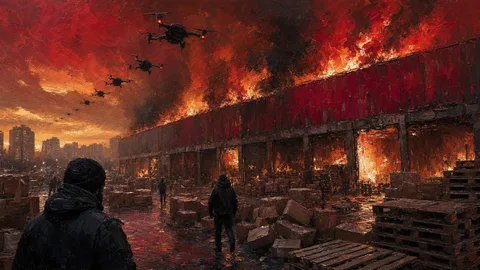
According to figures compiled from Ukrainian military reporting and cited across multiple ISW assessments, drones now account for an estimated 70% to 80% of Russian strikes in the Pokrovsk sector, a dramatic shift from the artillery-dominated combat that characterized the war's earlier years. This saturation has transformed the tactical texture of the battle into something closer to a constant aerial contest than a traditional ground engagement.
This drone-dominated environment affects everything from resupply logistics to medical evacuation, with both sides forced to develop increasingly elaborate countermeasures, electronic warfare systems, camouflage netting, and dispersed movement patterns, just to maintain basic operational capability under near-constant aerial surveillance and strike threat.
What this means for the men actually holding the line
For Ukrainian soldiers defending positions in and around Pokrovsk, this drone saturation means that even routine movements, resupply runs, casualty evacuation, unit rotations, carry a level of risk that did not exist in comparable positional battles earlier in the war. Independent reporting from The New York Times in July 2026 described this reality in granular detail, documenting soldiers who described the psychological toll of near-constant aerial threat.
This human dimension of the drone war deserves emphasis alongside the tactical analysis, because the statistics about strike percentages, however useful analytically, can obscure the lived reality of soldiers who now plan every movement around a threat that is airborne, persistent, and difficult to fully counter with available resources.
Seventy to eighty percent of strikes from drones is a statistic. A soldier timing his water resupply run around when he thinks the drones might be recharging is the actual war. I try never to lose sight of the second thing while reporting the first.
Infiltration tactics and the erosion of a clean front line
Small groups, not massed columns
Russian tactics around Pokrovsk have increasingly relied on small infiltration groups, sometimes just a handful of soldiers, attempting to slip through gaps in Ukrainian defensive coverage rather than massed armored assaults, according to ISW's documented tactical analysis. This approach reflects both the difficulty of massing armor safely under drone-saturated skies and a deliberate attempt to create ambiguity about the actual line of control.
This infiltration-based approach has made the battle for Pokrovsk unusually difficult to map cleanly, with Ukrainian and Russian forces sometimes holding positions within the same urban blocks simultaneously, a fragmented reality that ISW's own control-of-terrain maps have had to represent through complex, frequently updated contested zones rather than a simple front line.
Why this fragmentation favors neither side decisively
This fragmented, infiltration-heavy battlefield creates challenges for both attacker and defender. For Russian forces, small infiltration groups that succeed in entering contested urban areas often lack the numbers and logistics to hold and expand their gains without reinforcement, which in turn requires exposing additional forces to Ukrainian drone strikes and artillery.
For Ukrainian defenders, this same fragmentation makes it extremely difficult to fully clear infiltrators from contested urban blocks without committing significant additional resources to what amounts to house-by-house verification, a slow and manpower-intensive process that further strains already stretched units.
A front line that isn't really a line anymore, but a patchwork of contested blocks, is exactly the kind of detail that gets lost in simplified maps and headline summaries. This is the messy, granular truth of Pokrovsk today.
The civilian reality behind the military statistics
From sixty thousand residents to a near-empty city
Pokrovsk's pre-war population of approximately 60,000 people has been almost entirely evacuated as the fighting intensified since autumn 2024, according to figures compiled by Ukrainian regional authorities and cited in international reporting throughout the past year. What remains is a small, dwindling population of residents who have refused or been unable to evacuate, living amid a city increasingly defined by military infrastructure rather than civilian life.
This near-total civilian evacuation, while reducing the immediate risk of mass civilian casualties compared to earlier battles fought in more densely populated urban centers, also represents its own form of loss: an entire city's civilian identity and economic life effectively suspended, with no clear timeline for when, or whether, anything resembling normal civilian life might resume.
The economic devastation that will outlast the battle itself
Pokrovsk's pre-war economy, anchored by coal mining and rail logistics tied to the broader Donetsk industrial region, has been effectively destroyed by nearly two years of continuous fighting, according to economic assessments cited by Ukrainian regional officials. Even in a scenario where Ukrainian forces successfully hold the city long-term, the infrastructure required to restore any semblance of its pre-war economic function would require reconstruction on a scale that will take years, if not decades, to complete.
More investigation

INVESTIGATION: Beijing cuts Africa to 2.1 billion in loans…
2.1 billion — the lowest figure in almost twenty years, according…

SPECIAL REPORT: Beijing Promises Stimulus as Its Households Give…
That is the growth rate of Chinese industrial output in July,…

INVESTIGATION: Two Chinese Ex-Soldiers Arrested in Seoul as 18,000…
For five years, a man ran a military-supply shop at the…
This economic dimension of the battle is easy to overlook amid tactical reporting on troop movements and drone strikes, but it represents a genuine, lasting cost of this specific fight, one that will continue to burden whichever side ultimately controls the city long after the current combat concludes.
Even a Ukrainian victory at Pokrovsk, if it comes, will be a victory over rubble. I think readers deserve to understand that distinction before any future headline calls it a win.
Western logistics support behind the Ukrainian defense
What sustains the defenders, beyond raw courage
Ukrainian defense of Pokrovsk has depended significantly on continued Western logistics and material support, including ammunition supplies, drone components, and electronic warfare systems, according to assessments referenced across ISW's ongoing campaign analysis. This external support has been a necessary, if insufficient on its own, condition for sustaining a defense against a numerically superior attacking force over nearly two years.
The commitments made at the NATO summit in Ankara on July 8, 2026, including at least 70 billion euros in pledged aid for 2026 and a license for Ukrainian co-production of Patriot interceptors, according to The Kyiv Independent, represent exactly the kind of sustained material commitment that battles like Pokrovsk require to remain viable for Ukrainian defenders over the medium term.
Why sustained support matters more than any single pledge
What matters for a grinding, multi-year battle like this one is not any single announcement of support, but the reliability and continuity of that support over time. A defense that depends on continuous ammunition and equipment resupply cannot function on sporadic or uncertain commitments, a reality that makes the consistency of Western support, more than its total headline value, the decisive variable for positions like Pokrovsk.
This is precisely why I continue to track diplomatic and funding announcements alongside battlefield reporting: because the fate of a specific contested city like Pokrovsk is inseparable from decisions made far away, in rooms like the one that hosted the Ankara summit.
Every soldier holding a position in Pokrovsk is, whether he thinks about it or not, also depending on a funding decision made months earlier in a NATO capital. That link deserves to be stated plainly, not left implicit.
The information war over Pokrovsk's actual status
Competing claims that rarely match reality
Both Russian and Ukrainian official statements about the status of Pokrovsk have, at various points throughout this nearly two-year battle, diverged significantly from the more granular, geolocation-based assessments produced by independent analysts like ISW. This pattern of competing, often exaggerated claims from both belligerents is not unique to Pokrovsk, but the length and intensity of this specific battle has made the gap between official claims and documented reality unusually visible over time.
ISW's methodology, relying on geolocated visual evidence, satellite imagery, and cross-referenced reporting rather than either side's self-interested statements, has become an essential corrective tool for anyone trying to track the actual, granular status of this contested urban area over its many months of fighting.
Why granular mapping matters more here than almost anywhere else
Given the fragmented, infiltration-heavy nature of the fighting described earlier, simplified claims of "capture" or "full control" are particularly poorly suited to describing the actual situation in and around Pokrovsk at any given moment. This is a battle that resists simple binary framing, held or lost, in a way that demands the kind of granular, block-by-block mapping that ISW and similar organizations provide.
Readers relying solely on official statements from either Kyiv or Moscow risk receiving a badly distorted picture of this specific battle, one reason I have leaned heavily throughout this investigation on independent, methodologically transparent sources rather than either government's own characterization of the fighting.
I've stopped trusting simple words like "captured" or "held" when it comes to Pokrovsk. This battle only makes sense in fragments, and any account that flattens it into a clean binary is, in my view, already lying by omission.
Comparing Pokrovsk to Kostiantynivka's parallel battle
Two fronts, one Russian strategic objective
The battle for Pokrovsk unfolds in close strategic relationship with the parallel fight for Kostiantynivka, roughly forty kilometers away, both representing key obstacles on potential Russian routes toward Kramatorsk and Sloviansk. Russian forces appear to be pursuing a broadly similar encirclement-oriented strategy at both locations, according to ISW's comparative assessments across its July 2026 reporting.
This dual-front pressure forces Ukrainian commanders to make difficult resource allocation decisions, balancing reinforcement and support between two simultaneously contested positions that, if either fell decisively, would significantly worsen the strategic picture for the defense of the broader Kramatorsk-Sloviansk urban agglomeration.
Different tactical textures, same underlying attrition logic
Despite their strategic linkage, the tactical texture of fighting at Pokrovsk and Kostiantynivka differs somewhat, with Kostiantynivka's battle characterized by the specific dispute over Russia's premature July 3, 2026 capture claim, while Pokrovsk's battle has been defined more by the drone saturation and infiltration dynamics described earlier in this investigation.
Both battles, despite their tactical differences, ultimately serve the same underlying attritional logic on both sides: a Russian effort to wear down Ukrainian defensive capacity through sustained pressure at multiple points simultaneously, and a Ukrainian effort to make that pressure as costly as possible for an attacking force that has already sustained enormous documented losses throughout this war.
Pokrovsk and Kostiantynivka are not two separate stories, they're two chapters of the same Russian strategy, and treating them separately risks missing the larger pattern Moscow is actually pursuing.
What Ukrainian commanders say about the battle's trajectory
Cautious statements, avoiding both despair and false optimism
Ukrainian military officials speaking about the situation in Pokrovsk have generally avoided both alarmist declarations of imminent collapse and triumphant claims of decisive victory, according to statements compiled across Ukrainian media coverage throughout 2026. This calibrated public messaging reflects, in my assessment, a genuine institutional awareness of just how unpredictable and fluid this specific battle has proven to be over nearly two years.
This relative caution in official Ukrainian communication about Pokrovsk contrasts somewhat with the more triumphant tone sometimes present in statements about other, more clearly resolved engagements elsewhere on the front, suggesting that Ukrainian commanders themselves recognize the particular difficulty and uncertainty that continues to define this specific battle.
Why this caution should inform outside expectations too
I think outside observers, myself included, should take a cue from this institutional caution rather than defaulting to either despair or premature celebration whenever new reporting emerges about Pokrovsk. A battle that has defied confident predictions for nearly two years deserves an analytical posture that matches its demonstrated unpredictability.
This is precisely the posture I have tried to maintain throughout this investigation: documenting what is known, flagging what remains genuinely uncertain, and resisting the pull toward a tidier narrative than the facts on the ground currently support.
I'd rather match the caution of the commanders actually fighting this battle than manufacture false confidence in either direction from the comfort of a keyboard far from Pokrovsk.
The role of artillery and traditional fires alongside drones
Drones dominate the numbers, but artillery still shapes the battle
While drones account for the majority of strikes in the Pokrovsk sector, traditional artillery fire remains a significant component of the battle, particularly in preparing and supporting the infiltration attempts and localized assaults described earlier, according to ISW's tactical assessments. The interaction between drone reconnaissance, drone strikes, and more traditional artillery fire has created a layered, technically complex battlefield that neither weapon system alone fully explains.
This layered reality matters for understanding why the battle has proven so resistant to quick resolution: no single technological advantage, not drones alone, not artillery alone, has proven sufficient for either side to achieve a decisive breakthrough, forcing both attacker and defender into a combined-arms contest that plays out slowly and at significant cost.
Ammunition consumption as a strategic constraint
Sustained artillery and drone operations at this intensity require enormous, continuous ammunition and component resupply, a logistics burden that has, according to various Western assessments of the broader war, shaped both sides' strategic calculations throughout 2025 and 2026. Ukraine's dependence on Western-supplied ammunition and components makes battles like Pokrovsk directly sensitive to the reliability of exactly the kind of aid commitments discussed earlier in this investigation.
This resource dimension of the battle reinforces a point made throughout this piece: the fate of a specific contested city cannot be separated from the broader logistics and funding realities that determine how long and how effectively its defenders can actually sustain their position.
Every artillery shell fired in defense of Pokrovsk had to travel through a supply chain that starts in a Western factory and ends in a trench nobody sees on television. That chain is as much a part of this battle as the fighting itself.
What a Russian capture of Pokrovsk would actually mean
The strategic domino effect, if it happened
Should Russian forces eventually achieve full control of Pokrovsk, the most significant consequence, according to ISW's strategic assessments, would be the opening of more direct logistics and assault routes toward Kramatorsk and Sloviansk, the two largest remaining Ukrainian-held urban centers in Donetsk region. This is the scenario Ukrainian commanders have been working for nearly two years to prevent.
This potential domino effect explains the disproportionate resources, both Ukrainian and Western, committed to holding this specific city relative to its modest pre-war population and economic significance. Pokrovsk's value is almost entirely strategic and geographic, a fact that has made it one of the most consequential battles of the war's more recent phases despite its relatively low public profile compared to earlier, more widely covered engagements.
Why this scenario remains far from certain
Discover
INVESTIGATION: Beijing cuts Africa to 2.1 billion in loans…
2.1 billion — the lowest figure in almost twenty years, according…
SPECIAL REPORT: Beijing Promises Stimulus as Its Households Give…
That is the growth rate of Chinese industrial output in July,…
INVESTIGATION: Two Chinese Ex-Soldiers Arrested in Seoul as 18,000…
For five years, a man ran a military-supply shop at the…
Despite nearly two years of sustained Russian pressure, the persistence of Ukrainian defense documented throughout this investigation, the shift to encirclement tactics, the fragmented and contested control patterns, the sustained infiltration struggles, all suggest that a clean, decisive Russian capture remains far from guaranteed, even as the fighting continues to grind on with no clear resolution in sight.
This uncertainty is not a comfortable conclusion to offer readers hoping for clarity, but it is, based on the evidence compiled throughout this investigation, the most honest assessment available of where this specific battle actually stands as of July 2026.
I won't pretend to know how this ends. What I can say, based on nearly two years of evidence, is that every confident prediction about Pokrovsk's imminent fall has so far been wrong, and that pattern deserves real weight.
The soldiers' own accounts, where they exist
What independent reporting has captured directly
Independent reporting from outlets including The New York Times has, at various points throughout 2026, captured direct accounts from Ukrainian soldiers describing the specific conditions of fighting in and around Pokrovsk: the psychological toll of drone saturation, the physical exhaustion of extended deployments without adequate rotation, and the improvisation required to sustain defensive positions with limited resources.
These direct accounts, while necessarily limited in scope and unable to capture the full breadth of experience across an entire contested sector, offer a dimension of understanding that statistical and tactical analysis alone cannot provide: the specific, human texture of what sustained defense of a position like Pokrovsk actually demands of the individuals doing the fighting.
Why I treat these accounts carefully, not uncritically
I want to be careful about how much weight any single soldier's account can bear in a broader investigative piece like this one. Individual experiences, however genuine and moving, do not necessarily represent the full range of conditions across an entire contested sector, and I have tried throughout this investigation to treat such accounts as illustrative rather than definitive.
This caution does not diminish the value of these accounts, it simply reflects the same methodological rigor I have tried to apply to official statements from both sides: real information, treated honestly, without overstating what any single source, however compelling, can actually prove about the battle as a whole.
A single soldier's account moved me more than any statistic in this entire investigation, and I still made myself treat it as one data point among many, not as the whole truth. That discipline is harder than it sounds, and I think it matters.
What this battle reveals about the broader war's trajectory
A microcosm of the war's current attritional phase
The battle for Pokrovsk, in its nearly two-year duration, its shift from frontal assault to encirclement, its drone-saturated tactical texture, and its fragmented, contested control patterns, functions as a microcosm of the broader attritional phase this war has settled into since at least mid-2023, according to the pattern documented across ISW's ongoing regional assessments.
Understanding Pokrovsk in this depth, rather than through the occasional dramatic headline, offers a more accurate window into how this entire war is actually being fought in its current phase than almost any other single battle currently underway, precisely because it displays so many of the war's defining current features in one concentrated location.
Why this matters for how the war should be covered and understood
I think this investigation illustrates a broader argument I have made elsewhere: that this war, in its current phase, is best understood through sustained, granular attention to specific contested positions like Pokrovsk, rather than through episodic coverage that jumps from one dramatic headline to the next without building the kind of cumulative understanding this piece has tried to construct.
This is, ultimately, the case for investigative depth over headline chasing in coverage of this war: a single city's nearly two-year battle, examined closely, teaches more about the war's actual state than a dozen scattered headlines about isolated dramatic events ever could.
If you want to understand this war, don't just read the headlines about missile strikes on capitals. Read about Pokrovsk, in depth, over months. That's where the real shape of this conflict actually lives.
What Western intelligence assessments add to the picture
Satellite and signals analysis beyond battlefield claims
Western intelligence agencies, while rarely commenting publicly and specifically on Pokrovsk, are understood through background reporting cited by several outlets to be providing satellite imagery analysis and signals intelligence that feed into Ukrainian tactical decision-making around the contested sector. This assistance, though its exact scale is not publicly detailed by the governments involved, forms part of the broader Western material and intelligence support structure discussed earlier in this investigation.
This intelligence dimension matters because it partly explains how Ukrainian forces have managed to track and respond to Russian infiltration attempts with the tactical precision described throughout this piece, despite the fog created by drone saturation and the fragmented, block-by-block nature of the fighting in and around the city.
The limits of what can be verified from open sources
As an investigation built primarily on open-source reporting, I cannot independently confirm the exact scale or nature of any specific intelligence-sharing arrangement related to Pokrovsk. What I can confirm, based on the pattern of Ukrainian tactical responsiveness documented across ISW's assessments, is that Ukrainian forces have consistently demonstrated a level of situational awareness that would be difficult to sustain without some form of external intelligence support, whatever its precise scope.
This caution about attributing specific capabilities to specific undisclosed intelligence arrangements is a deliberate methodological choice, one I have tried to apply consistently throughout this investigation rather than speculating beyond what available sources can actually support.
I won't pretend to know the exact scope of intelligence support behind Ukraine's defense of Pokrovsk. I will say that pretending it doesn't exist at all would be its own kind of dishonesty, given the tactical precision documented throughout this investigation.
Conclusion: a battle without a clean ending in sight
What nearly two years of fighting has actually established
This investigation into the battle for Pokrovsk establishes, above all, a single clear conclusion: nearly two years after Russian forces first pushed toward the city in autumn 2024, no decisive resolution has been achieved by either side, despite enormous cost in resources, manpower, and civilian displacement documented throughout this piece. The battle continues in its current fragmented, drone-saturated, infiltration-heavy form, with no clear end point currently visible.
This is not a satisfying conclusion for readers hoping for clarity about how or when this specific battle will resolve, but it is the most honest assessment available based on the evidence compiled from ISW's ongoing mapping, Ukrainian military statements, and independent ground-level reporting examined throughout this investigation.
On the same topic

ANALYSIS : Taiwan Puts NT$1,122.5 Billion Into Defence, Over…
Hold that number for a moment, because it marks the crossing…

COLUMN : Europe Moved 8.5 Billion Euros in a…
That is what the European Commission says it has disbursed for…
ANALYSIS: 800 drones over Russia in one night —…
More than eight hundred drones, in a single night, August 14…
What this battle demands from observers going forward
Pokrovsk will likely continue to demand the same sustained, careful attention this investigation has tried to provide, rather than episodic coverage triggered only by dramatic developments. A battle this long, this fragmented, and this strategically consequential deserves ongoing scrutiny that matches its actual complexity, not the simplified binary narratives that both belligerents' official statements too often offer.
That sustained scrutiny, more than any single dramatic prediction about the battle's outcome, is what this investigation ultimately argues for.
I don't know how the battle for Pokrovsk ends. I know that nearly two years of watching it has taught me to distrust anyone, on either side, who claims they do.
Signed Maxime Marquette, columnist
Columnist's transparency note
What I know and what I don't
I know that the battle for Pokrovsk began in earnest in autumn 2024 and continues, contested and fragmented, as of July 2026, according to ISW's continuous mapping and assessments published throughout that period. I know that Russian tactics have shifted toward encirclement, that drones account for an estimated 70% to 80% of strikes in the sector, and that the city's pre-war population of roughly 60,000 has been almost entirely evacuated, according to figures compiled from Ukrainian regional authorities and international reporting.
I do not know the precise current line of control within Pokrovsk's urban area, given how quickly small-unit and infiltration-based positions shift in this kind of fighting, nor do I know with certainty how or when this specific battle will ultimately resolve. I have tried throughout this piece to state these uncertainties plainly rather than imply a confidence the available evidence does not support.
Method
This investigation relies on the Institute for the Study of War's Russian offensive campaign assessments of July 3, July 5, and July 7, 2026, Ukrainska Pravda's July 10, 2026 report, The New York Times's July 5, 2026 report on the Donetsk front, and The Kyiv Independent's coverage of the NATO Ankara summit. No scene, dialogue, or soldier testimony beyond what is directly attributed to named sources was invented.
My editorial position, stated openly throughout, is one of support for Ukraine's defense of Pokrovsk as a legitimate act of self-defense against an unprovoked invasion, while trying to maintain analytical honesty about the genuine uncertainty and cost that continues to define this specific, grinding battle.
Sources
Primary sources
Secondary sources
Get the geopolitics analyses
Conflicts, powers, alliances: the MadMax thread without the noise.
Cite this article
Maxime Marquette (2026). INVESTIGATION: Pokrovsk under pressure, inside one of the front's most contested hotspots. MadMax. https://mad-max.co/en/article/investigation-pokrovsk-under-pressure-inside-one-of-the-front-s-most-contested-h
Read next
INVESTIGATION: Beijing cuts Africa to 2.1 billion in loans…
2.1 billion — the lowest figure in almost twenty years, according…
SPECIAL REPORT: Beijing Promises Stimulus as Its Households Give…
That is the growth rate of Chinese industrial output in July,…
INVESTIGATION: Two Chinese Ex-Soldiers Arrested in Seoul as 18,000…
For five years, a man ran a military-supply shop at the…
Enjoyed this piece? Get the next one.
One chronicle a week, straight to your inbox. No noise.
This article was generated with AI assistance, under human supervision.
Comments
Be the first to weigh in.