

EDITORIAL: Trump approves H200 chips for Beijing and takes a 25% cut — but his own hawks call the levy illegal
On December 8, 2025, two announcements landed in Washington, the same day, a few hours apart.
- On December 8, 2025, two announcements landed in Washington, the same day, a few hours apart.
- The day the party learned the price
- The first came from the top.
Facts, quotes, and cited links remain in the body. Interpretations are framed as analysis or opinion according to the format.
The day the party learned the price
On December 8, 2025, two announcements landed in Washington, the same day, a few hours apart.
The first came from the top. The Trump administration authorized the sale of Nvidia's H200s to China — artificial-intelligence accelerators among the most powerful in the American catalog. In exchange, the federal government would collect a quarter of the revenue from those sales.
25%.
A quarter. Not a symbolic fee, not a processing charge: a full quarter of the revenue from a technology the law had ranked, the day before, among the most sensitive in the country.
The second announcement came from the basement. The Justice Department revealed, that same December 8, the dismantling of a smuggling network that had illegally shipped $160 million worth of cutting-edge chips to China.
Read those two sentences side by side.
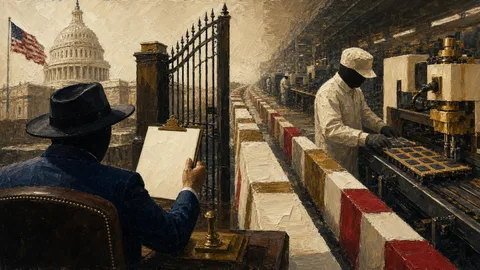
In the morning, the state arrests people for selling chips to Beijing. In the afternoon, it announces it will sell its own — for a commission.
Federal prosecutors describe shell companies, transshipments, doctored labels. The executive branch describes a commercial partnership with a royalty attached.
That day, something broke among Republican hawks. Not their loyalty to the president — that holds, and it is precisely what makes what follows so fascinating. What broke was their silence.
Dissent now wears the same red tie as power.
You don't tax what you prohibit
Let us state the principle, because this entire editorial rests on it.
An export control is not a tariff. It is a national-security prohibition. You block a technology because you judge it will strengthen a military adversary — not because you want to negotiate its price.
The day a prohibition starts generating revenue, it changes nature.
It becomes a tollbooth.
And a tollbooth, by definition, lets everyone through — it simply collects.
American export controls were designed as levees, not ticket windows. The 2018 law that governs them speaks of national security on every page, never of fiscal revenue.
That is the heart of the Republican fracture over semiconductors. It does not pit moderates against radicals, or globalists against protectionists. It pits lawmakers who think of China as a strategic adversary against an administration that, on this specific file, treats it as a customer.
Both camps vote Trump. Both camps claim his banner.
Only one of them collects.
The slide happened in three stages, and each stage has its date, its document, its wire report.
July 2025, the first reversal
The first tremor dates to the summer of 2025.
In April, the administration had blocked the H20s — chips Nvidia had designed specifically to stay under the thresholds set for the Chinese market. Three months later, in July, it reopened the sales. The April block had cost the manufacturer a multibillion-dollar charge, widely reported at the time.
John Moolenaar, chairman of the House select committee on China, then wrote to Commerce Secretary Howard Lutnick a sentence that says everything about what followed. The Commerce Department had made the correct decision in banning the H20, he protested, as Reuters reported on July 18, 2025.
Note the construction.
He does not say: you are wrong. He says: you were right, and you have just disavowed yourselves.
That is the peculiar grammar of this internal war. You don't attack the man; you defend his doctrine against him.
Moolenaar is no firebrand. He is a low-key Michigan lawmaker, known for his files rather than his theatrics. When that man writes to his own government about the same subject for more than a year, it is not a mood: it is an alarm.
That crease would never smooth out. For eighteen months, letter after letter, hearing after hearing, Republican hawks would repeat the same thing to their own administration: return to your first decision.
They are not fighting Trump; they are fighting for the Trump of April 2025.
Fifteen percent, the tollbooth's first draft
August 2025 brought the invention that changed everything.
To accompany the resumption of H20 sales, the administration negotiated an unprecedented arrangement: Nvidia and AMD would pay the American government 15% of the revenue from their artificial-intelligence chip sales in China. Unheard of in the history of export controls, every wire service noted at the time.
Trump owned it, publicly, with his usual aplomb. The H20 is obsolete, he told reporters, as Politico reported on August 11, 2025. The implication: we only sell Beijing old silicon, and we get paid for it.
The president hides nothing, and he deserves credit for that. The deal is public, the percentage is public, the defense is public. You can dispute the policy; you cannot accuse him of concealment.
Let me be honest, because this editorial owes loyalty to the facts as much as to its side.
Discover

INVESTIGATION: Beijing cuts Africa to 2.1 billion in loans…
2.1 billion — the lowest figure in almost twenty years, according…

SPECIAL REPORT: Beijing Promises Stimulus as Its Households Give…
That is the growth rate of Chinese industrial output in July,…

INVESTIGATION: Two Chinese Ex-Soldiers Arrested in Seoul as 18,000…
For five years, a man ran a military-supply shop at the…
The argument is not absurd.
A throttled chip sold with a commission means Chinese money financing the American Treasury, and one more lever in a much larger trade negotiation. A necessary evil serving a greater good, perhaps. On the H20, designed precisely to stay under the thresholds, the logic could be defended.
But August's draft announced December's final version.
Fifteen percent on throttled silicon, then twenty-five on cutting-edge silicon.
The tollbooth was born; all that remained was to widen the road and raise the rate with the seasons.
December, the month of knives
December 2025 is the month dissent organized itself into legislation.
On December 4, before the H200 announcement even landed, Republican senators Tom Cotton and Pete Ricketts introduced a bill to freeze, for thirty months, any easing of controls on artificial-intelligence chips sold to China, Reuters reported.
Republicans legislating to tie the hands of a Republican president.
Four days later, on the 8th, came the H200s and their quarter of revenue for the state.
On December 18, on the Senate floor, Democrat Tim Kaine rose to support the so-called SAFE CHIPS Act, championed by Ricketts and Democrat Chris Coons with ten cosponsors, half Republican, half Democrat. The official record of the debates preserves every word of his speech.
A Virginia Democrat rising to defend a bill carried by a Nebraska Republican: the fracture no longer follows party lines; it follows the line of risk.
Kaine reminded the chamber of a detail few people had noticed.
Operation Gatekeeper, launched by the administration's own agencies, had already seized more than $50 million in illicit China-linked shipments.
The Cotton-Ricketts bill may never come to a vote, and it hardly matters. A bill introduced is a marker, a border drawn inside the party, and everyone now knows which side of it they camp on.
Fifty million seized on one side of the building.
On the same topic

SPECIAL REPORT: Beijing buys 40 cargoes of sanctioned Russian…
On August 28, 2025, a tanker named Arctic Mulan moored at…

ANALYSIS: Marcos Talks Drilling With Beijing While His Fishermen…
That is what moves through the South China Sea every year.…
INVESTIGATION: 2.9 million TSMC chips diverted to Huawei —…
It all starts in a Canadian laboratory, far from the clean…
A quarter of the revenue collected on the other.
The same state, the same technology, the same adversary — and two policies driving straight at each other, headlights off, on the same night road.
A tollbooth had just replaced the doctrine.
The letter that says "illegal"
On January 12, 2026, eight House members — Republicans and Democrats mixed — signed a letter that Representative Adriano Espaillat's office published online. It targeted the H200 approval directly.
Eight signatures, two parties, one document: in the Washington of 2026, that arithmetic has become rare.
The document lays out three charges, and each deserves to be weighed.
One. The H200 is not a chip throttled for export. According to the letter, its performance exceeds the compute thresholds set by American controls roughly sixfold. This is no longer the obsolescence argument; it is its exact opposite.
Two. The 25% levy would be likely illegal, the signatories wrote, under the 2018 export-control law, which prohibits selling licenses for money.
Three. The existing smuggling proves Beijing wants these chips at any price — the letter cites the $160 million network dismantled the very day of the announcement.
Pause on the second charge, because it is vertiginous.
Lawmakers from the ruling party are suggesting that the president's signature economic move — the chip tollbooth — violates the law their own majority passed in 2018.
Likely illegal.
Two lawyer's words, planted like a mine under the Resolute desk — and signed by lawmakers whose loyalty to the party no one can dispute.
When loyalty writes "illegal," it has exhausted every other word.
You don't tax what you prohibit; you choose.
The old guard takes the field
In mid-January 2026, the contestation left the corridors of Congress and reached the veterans of the first Trump administration.
Matt Pottinger, the president's own former deputy national security adviser, chose his words carefully for Reuters on January 14. Selling H200s to China will significantly enhance Beijing's military modernization, he warned.
The man who wrote Trump's China strategy now disputes Trump's chip policy.
Michael McCaul, the Republican foreign-affairs veteran in the House, drove the point home in the same dispatch: they steal so much intellectual property, he said of the Chinese — so why sell them our best tools on top of it?
Theft, then purchase.
Beijing long had to steal what Washington refused to sell. These same hawks are discovering a world where paying is enough — and where a quarter of the payment funds the Treasury of the one who used to prohibit.
None of these men has jumped ship. Pottinger remains a reference for the conservative camp on China; McCaul votes the party line on almost everything.
That is exactly what should worry the White House.
Pottinger is no last-minute convert; his wariness of Beijing already structured the first administration. Axios catalogued, as early as January 9, the legislative counterattacks Republican lawmakers were preparing; The Hill compiles their worries the way one keeps a trench diary.
When the loyal stay silent, power sleeps soundly. When the loyal publish dated, signed warnings, power should reread its own decisions of April 2025.
The summer of denials
Fast-forward to the summer of 2026, and look at what the fracture has become: a dialogue of the deaf, documented dispatch after dispatch.
On July 14, Under Secretary of Commerce Jeffrey Kessler tried to reassure: there have been only minimal exports of H200s, he insisted, as Reuters reported.
Minimal exports.
Minimal according to whom, measured how, capped by what? No one specifies, and that is precisely the problem: Congress doesn't know either.
The phrase was meant to soothe; it produced the opposite effect. Because if the volumes are minimal, why build an entire 25% collection mechanism? And if they swell tomorrow, what will today's promise be worth?
In the same dispatch, Republican Bill Huizenga went after a May 31 guidance from the export-control bureau that leaves smuggled Blackwell chips beyond regulatory reach. Democrat Gregory Meeks, for his part, accused the administration of treating national security as a bargaining chip.
A Republican and a Democrat, same anger, same hearing.
The scene has repeated for months in House hearing rooms: lawmakers brandish smuggling figures, officials answer with collection percentages, and no one speaks the other's language.
Then comes August 10, 2026. Reuters reveals a new letter from Moolenaar to Kessler, dated August 6, demanding that no more advanced chips reach sanctioned Chinese entities. The dispatch notes that Huizenga had publicly criticized Kessler a few weeks earlier.
Eighteen months of internal war, and the front has not moved an inch.
They write. The administration collects.
In both senses of the word.
The divided house and the island watching
Step back, and look at the shape of this battle rather than its episodes.
None of the dissidents has broken with Trump. Moolenaar still chairs his committee. Cotton, Ricketts, Banks vote the presidential line on immigration, on judges, on the budget. Their rebellion holds on a single front: silicon.
This is a dissent of specialists, not of rebels.
Rebels can be replaced overnight; specialists can be counted on one hand, and the party has no others in reserve on this file.
And that is precisely why it carries weight. A professional opponent shouts about everything; no one hears him anymore. A loyalist who contests only one file forces the question: what does he know that we refuse to see?
What they know fits in three dates.
April 2025: the administration judges the H20 too dangerous for Beijing. December 2025: it sells something more powerful, with a commission. January 2026: its own lawmakers call the commission likely illegal.
A party can survive its mistakes. It survives its inconsistencies far less well, because the adversary turns them into confessions. Democratic strategists have not missed the window: every Republican letter against the tollbooth becomes, in their playbook, a free exhibit for the prosecution.
25%.
The figure will remain the symbol of a moment when the world's leading power hesitated between two definitions of itself: arsenal or trading counter. The history of export controls may remember that hesitation as the true turning point, more than any blacklist.
One last actor watches this family quarrel, and says almost nothing: Taiwan.
The island manufactures most of the planet's most advanced chips. Its security rests, in part, on the idea that this technology is worth defending — that Taiwanese silicon is a red line, not a line of credit.
Every time Washington turns a prohibition into a tollbooth, the value of that red line gets negotiated a little.
It is hard to imagine Taipei protesting out loud; allies who depend on a protector learn to read its hesitations in silence.
That is why I file this Republican fracture among the debates that matter, not among the corridor squabbles. It will not decide an election; it will decide what America's strategic word is worth.
The hawks are right on the merits, and I write that while supporting this president on the essentials of his foreign policy. Firmness toward Beijing has produced real results; power-balance diplomacy too. But a balance of power is built on lines that do not move.
Yet the chip line has moved three times in eight months.
Banned in April. Rented at 15% in August. Sold at 25% in December.
Beijing, which reads the wires like everyone else, drew the only rational conclusion: everything is a matter of patience and price.
The dissidents, for their part, ask the question their loyalty makes heavier, not lighter.
If a quarter of the revenue is enough to reopen the door for the H200s, what percentage will reopen it for the Blackwells?
Sources :
Sources Primaires :
GovInfo — Official transcript of the June 12, 2025 House committee hearing on export controls
Sources Secondaires :
Politico — Trump defends the 15% arrangement on H20 sales: "The H20 is obsolete," August 11, 2025
The Hill — Republican concerns over the administration's policy on Nvidia chips sold to China
Get the geopolitics analyses
Conflicts, powers, alliances: the MadMax thread without the noise.
Cite this article
Maxime Marquette (2026). EDITORIAL: Trump approves H200 chips for Beijing and takes a 25% cut — but his own hawks call the levy illegal. MadMax. https://mad-max.co/en/article/trump-approves-h200-chips-for-beijing-and-takes-a-25-pourcent-cut-but-his-own-hawks-call-t
Read next
INVESTIGATION: Beijing cuts Africa to 2.1 billion in loans…
2.1 billion — the lowest figure in almost twenty years, according…
SPECIAL REPORT: Beijing Promises Stimulus as Its Households Give…
That is the growth rate of Chinese industrial output in July,…
INVESTIGATION: Two Chinese Ex-Soldiers Arrested in Seoul as 18,000…
For five years, a man ran a military-supply shop at the…
Enjoyed this piece? Get the next one.
One chronicle a week, straight to your inbox. No noise.
This article was generated with AI assistance, under human supervision.
Comments
Be the first to weigh in.