

COMMENTARY: A Supermarket in Chernihiv — the Normalization of War Crimes in Ukraine
On the night of July 27 to 28, 2026 , the Ukrainian Air Force reported that Russia had launched 147 strike drones — Shahed, Gerbera, Italmas — along with Parodiya decoy drones across Ukrainian territory.
- On the night of July 27 to 28, 2026 , the Ukrainian Air Force reported that Russia had launched 147 strike drones — Shahed, Gerbera, Italmas — along with Parodiya decoy drones across Ukrainian territory.
- A Night of 147 Drones and a Supermarket That Won't Reopen
- The Number Ukraine's Air Force Published
Facts, quotes, and cited links remain in the body. Interpretations are framed as analysis or opinion according to the format.
A Night of 147 Drones and a Supermarket That Won't Reopen
The Number Ukraine's Air Force Published
On the night of July 27 to 28, 2026, the Ukrainian Air Force reported that Russia had launched 147 strike drones — Shahed, Gerbera, Italmas — along with Parodiya decoy drones across Ukrainian territory. The night before, the same command had already reported 7 ballistic missiles and 136 drones. These are not minor variations in a routine tally. This is a rhythm, and that rhythm carries a human cost counted city by city.
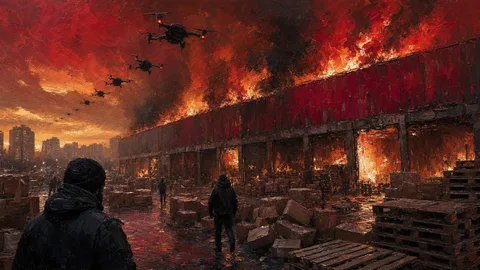
In Chernihiv, a Russian drone struck a supermarket. According to Al Jazeera, the strike killed two people, including a 9-year-old girl, and wounded 25 others. Le Soir, citing local authorities, confirms two deaths and numerous injuries, citing a 10-year-old child. This discrepancy over the child's age changes nothing about what matters: a child died in a place built to sell bread and milk.
A supermarket has never been a military target. It's an admission of what this war has become.
A Supermarket Was Never a Military Target
The Place That Should Have Stayed Ordinary
A neighborhood supermarket houses no radar, no ammunition depot, no command post. It houses shopping baskets, checkout lines, children tagging along with a parent after school. That very ordinariness is what makes the Chernihiv strike hard to describe as anything other than what it is: a weapon aimed at an ordinary civilian site, documented by two separate outlets, one English-language, one French-language.
International humanitarian law strictly separates military targets from civilian property. The precise legal qualification belongs to competent bodies — courts, tribunals, independent investigative missions — not to an editorial commentary. What the reported facts establish is this: a supermarket was struck, civilians died there, and no source consulted documents any military presence at this specific site.
A Toll That Reaches Beyond One Supermarket
On July 27, according to the Straits Times, Ukrainian officials reported that Russian strikes in eastern Ukraine had killed 7 people and wounded more than 20 others. In the Donetsk region, prosecutors recorded 3 deaths in two areas near Kostiantynivka. In the neighboring Dnipropetrovsk region, Governor Oleksandr Hanzha reported 3 deaths and 6 injuries from more than 50 drone and artillery attacks spread across five districts.
Seven dead here, three there, two elsewhere: this war no longer makes headlines for every name.
Normalization Shows Up in the Rhythm, Not Just the Toll
A Night Among So Many Others
What stands out in this file is not just how many died in a single night. It's that this night looks like the one before it, and probably the one after. RBC Ukraine documents 147 drones launched on the night of July 27–28; Al Jazeera cites 136 drones and 7 ballistic missiles the night before; a post cited by DailyKos even mentions around 320 drones according to Russian sources. The numbers vary — but the repetition never does.
It's this repetition that normalizes. A strike on a supermarket should be an event. In the Russia-Ukraine war of summer 2026, it becomes one more line in a daily bulletin, sandwiched between a toll in Donetsk and another in Dnipropetrovsk.
What 600 Attacks in Three Months Reveal Elsewhere
Another front in this broader conflict shows the same logic of repetition: the U.S. CENTCOM recorded more than 600 attempted attacks against American citizens and installations by Iran-aligned militias in Iraq between February and April 2026. The mechanism differs, the actor differs, but the symptom is the same: once violence becomes a recurring statistic, it stops alarming to the same degree as an isolated event.
Violence repeated often enough starts reading like weather, not like a crime.
Kostiantynivka's Status, or the Information War Riding Alongside the Real One
A City Taken, a City Not Surrendered
The Straits Times reports that the Russian army claims to have captured Kostiantynivka in July, while Ukrainian officials deny the city has changed hands. This contradiction is not a technical footnote. It shows that even control of territory — the most factual data point a war can offer — becomes an object of competing communications.
Who actually controls Kostiantynivka as of publication remains, in the sources consulted, one claim against another, with no independent corroboration on either side. What is verifiable, however, are the deaths documented in the Donetsk region the same day — three people, according to local prosecutors.
Estimates Even the Source Calls Approximate
DailyKos describes some of its own estimates as "highly approximate," while noting that around 123 of 147 drones may have been intercepted or neutralized according to a cited post. This methodological caution, flagged by the source itself, deserves to be reproduced here rather than smoothed over to create a false impression of certainty.
When even control of a city gets negotiated through press releases, truth becomes a scarce resource.
The Chernihiv Child, Somewhere Between 9 and 10 Years Old
A Discrepancy That Doesn't Erase What Matters
Al Jazeera puts the killed child's age at 9; Le Soir cites 10. Both figures are reported here rather than arbitrarily resolved, with the gap flagged: it's the only honest way to handle a discrepancy between two outlets covering the same event from different angles.
What doesn't vary between the two sources is the location — a supermarket —, the cause — a Russian drone strike —, and the outcome: a dead child, twenty-five people wounded. The precise age is secondary next to that core of converging facts.
Twenty-Five Wounded, a Number That Never Makes the Headline
The wounded from a strike almost never generate a headline of their own. They become a comma in a sentence devoted to the dead. Twenty-five people wounded in Chernihiv means twenty-five interrupted life trajectories, hospitalized, sometimes maimed — and whose names or prognoses this piece cannot report, for lack of a source documenting them.
The wounded of a war have no name in the bulletins. They have a number, and the number stops there.
Humanitarian Law Sets Three Conditions for Any Strike
Distinction, Proportionality, Precaution
International humanitarian law rests on three central principles applicable to any strike: distinction between military and civilian targets, proportionality of expected effects, and precaution in the choice of means and methods of attack. A supermarket, absent proof of military use, falls by default into the category of protected civilian property.
No international tribunal has, as of this writing and in the sources consulted, classified this specific strike as a violation. The legal framework recalled here serves only as a reference point, so readers can measure the gap between that legal framework and what journalistic sources report on the ground.
The Necessary Caution Around Classification
The editorial manifest accompanying this file itself flags a high legal risk around any war-crime classification, with an explicit recommendation to leave that classification to competent bodies and to cite sources on tolls that remain provisional. This piece honors that caution: it documents, it does not convict in the name of a tribunal it is not.
Documenting is not judging. But refusing to document is already choosing not to see.
The Context of a War That No Longer Pauses
Fifty Drone and Artillery Attacks Across Five Districts
In Dnipropetrovsk, more than 50 attacks by drone and artillery struck five districts over the same period, according to Governor Oleksandr Hanzha. That number alone says something death tolls don't always capture: civilian exposure isn't limited to strikes that kill. It includes every strike that terrorizes without producing a fatal casualty, night after night.
A region absorbing 50 attacks in a short window isn't living through episodic war. It is living through continuous war, where the air raid siren becomes background noise rather than an exceptional signal.
A Front That Is Expanding, Not Stabilizing
Between Chernihiv in the north, Donetsk and Kostiantynivka in the east, and Dnipropetrovsk in the center-east, strikes documented within a single 48-hour window cover a wide swath of Ukrainian territory. This is not the map of a war winding down. It is the map of a war that keeps demanding, simultaneously, the attention of several distinct regions.
A war spreading across several fronts at once leaves no region feeling spared for long.
Why Media Attention Runs Out of Breath Faster Than the War Does
Information Fatigue in the Face of Repeated Facts
A novel event captures attention. An event that repeats, however tragic, gradually loses it — not because the public stops caring, but because the human mind handles repetition without apparent variation poorly. That is a cognitive mechanism documented well beyond this specific file, and it partly explains why a strike on a supermarket in July 2026 does not land with the same shock as an equivalent strike in February 2022.
It is not the gravity of the fact that diminishes. It is the collective capacity to keep feeling it as grave. And that shift, broadly understood, is exactly what normalization means.
The Role of Numbers That Start Looking Alike
When every daily bulletin announces a three-digit drone count and a toll of a few dead, the numbers themselves start blurring together from one day to the next. That statistical resemblance feeds normalization as much as any other factor: the human brain does a poor job distinguishing 136 drones from 147, or seven deaths from ten.
When the numbers look too much alike from one day to the next, no one is really counting anymore.
Seventy-Two Hours of Strikes Elsewhere Reveal the Same Pattern
A Different Theater, the Same Logic of Saturation
CENTCOM indicated that American and Saudi fighter jets struck several logistics and weapons sites in Iraq in response to more than 30 drone attacks directed by the IRGC over the preceding 72 hours. This theater, distinct from the Ukrainian conflict, shares a striking feature with Chernihiv: saturation through repetition as method.
In both cases, the frequency of strikes — whether aimed at a supermarket in Ukraine or at Saudi energy infrastructure — produces a habituation effect that reaches well beyond the boundaries of a single theater of operations.
A Broader War Sharing the Same Numerical Vocabulary
Ballistic missiles, Shahed drones, precision strikes: the military vocabulary of 2026 crosses regional borders. This is not a semantic coincidence. It is a sign that several distinct conflicts now rely on comparable technologies and tactics, with civilian consequences that, too, resemble each other from one theater to the next.
The vocabulary of war has changed continents without changing its grammar.
An Accommodation Also Settling In Among Ukraine's Allies
Statements of Support Are Repeating Too
Western statements of support for Ukraine, repeated since 2022, now follow a recognizable rhetorical pattern: condemnation, reaffirmation of support, calls for de-escalation. No source consulted for this file documents that pattern as insincere — but its very repetition produces, in the public, the same habituation effect as bulletins about Russian drones.
A condemnation repeated identically for more than three years starts, itself, to read like a ritual rather than a response proportionate to the specific event that just occurred in Chernihiv.
The Risk of a War Becoming Permanent Scenery
When condemnation becomes ritual and the strike becomes statistic, the risk is that the war itself becomes permanent scenery in international news rather than an ongoing emergency demanding a proportionate response every time a serious new fact occurs, such as a child's death in a supermarket.
A condemnation repeated identically ends up sounding like a ritual, not a response.
The Weight Carried by a City Like Chernihiv
A City That Has Already Paid More Than Its Share
Chernihiv is not a stranger to this war. It has already endured documented sieges and bombardments since 2022. That this same city keeps absorbing strikes on civilian sites in 2026 says something about the duration of exposure that no single tally fully captures.
A struck supermarket in Chernihiv in 2026 is not an isolated event in this city's history. It fits into a continuity of vulnerability that reaches well beyond the five-day window this piece can document with precision.
What Repetition Does to a Civilian Population
Living under the repeated threat of drone strikes is not merely a statistical risk. It is a cumulative psychological burden that adds up, day after day, for civilians who never chose this rhythm. No documented direct testimony is available for this specific file, and none is invented here — but the scale of the numbers alone is enough to establish the scale of the exposure.
A city absorbing strikes since 2022 has had no pause to rebuild an ordinary routine.
The Limits of This File, and Why They Matter
Discover

INVESTIGATION: Beijing cuts Africa to 2.1 billion in loans…
2.1 billion — the lowest figure in almost twenty years, according…

SPECIAL REPORT: Beijing Promises Stimulus as Its Households Give…
That is the growth rate of Chinese industrial output in July,…

INVESTIGATION: Two Chinese Ex-Soldiers Arrested in Seoul as 18,000…
For five years, a man ran a military-supply shop at the…
No Intent Assigned Without Direct Proof
The precise intent of the pilot or operator behind the drone that struck the Chernihiv supermarket is established by no source consulted. Nor can it be established with certainty whether the site was mistaken for a legitimate target or deliberately targeted as a civilian location. These questions belong to investigations no source consulted documents at this stage.
What is observable, however, fits in one sentence: a supermarket was destroyed or damaged, civilians died and were wounded there, and that outcome fits a repeated pattern of strikes on sites not identified as military by the available sources.
Caution Is Not Leniency
Reserving legal classification for competent bodies does not amount to minimizing the gravity of the facts. It means recognizing the difference between what is documented and what remains to be established — a distinction this piece refuses to erase, even when the emotional weight of the facts might push toward a faster conclusion than the evidence allows.
The rigor that withholds a verdict isn't coldness. It's a form of respect for the nameless dead.
Drones Are Easier to Count Than Interrupted Lives
Drones Counted, Lives Less Often Named
The available coverage offers more precision on the number of drones launched — 136, 147, or even 320 depending on the source — than on the identity of the victims. This imbalance is not unique to this file; it runs through coverage of many contemporary conflicts, where weaponry is easier to quantify than pain.
On the same topic

ANALYSIS: 313 Votes, a 20th Extension — Ukraine Keeps…
313 votes to approve the presidential decree extending martial law by…
ANALYSIS: 800 drones over Russia in one night —…
More than eight hundred drones, in a single night, August 14…

INVESTIGATION : Russia's FSB Erases 4 Ukrainian Regions' Border…
Not an assault, not an ultimatum, not a televised proclamation from…
A drone can be counted. An interrupted life cannot be counted the same way — it gets told, or it disappears into an aggregate number. This asymmetry, more than any other factor, feeds the normalization this piece is calling out.
What the Absence of Named Testimony Signals
None of the sources consulted for this file names the 25 wounded in Chernihiv, the 3 dead in Dnipropetrovsk, or the 3 dead near Kostiantynivka. This absence is not an arbitrary editorial choice: it likely reflects the urgency of initial bulletins, the protection of families, or simply a news cycle moving faster than investigations can follow.
A number without a name always ends up reading like a statistic instead of a loss.
Regional Alliances and the Asymmetry of Media Attention
Western Support Doesn't Move at the Same Pace as the Strikes
The pace of Western arms deliveries and air-defense systems to Ukraine does not receive, in the sources consulted for this specific file, a figure comparable to the 147 drones launched in a single night. That documentary imbalance doesn't allow a conclusion that Western support is insufficient — it only signals that media attention during this period concentrated on strike tolls rather than on defensive shipments.
That relative gap in available coverage isn't neutral: it means a reader following the news of July 27 and 28, 2026, had access to precise figures on what Russia sent, and far less precision on what Ukraine's allies delivered in response during the same window.
An Asymmetry of Attention, Not Necessarily of Resources
It would be inaccurate to claim, based solely on the sources consulted here, that Ukraine lacks air-defense capacity. What the sources show is an asymmetry of journalistic attention: strikes that kill produce precise tallies, while successful interceptions — of which DailyKos still cites 123 out of 147 on one specific night — get mentioned more briefly.
Whatever destroys always makes more media noise than whatever protects successfully.
The Verdict This File Supports, Without Overreaching What It Proves
An Accumulation, Not an Isolated Accident
A struck supermarket in Chernihiv. Seven dead in the east. Three dead near Kostiantynivka. Three dead and six wounded in Dnipropetrovsk. More than 130 drones in a single night, repeated the following night. This is not the description of an isolated accident. It is the snapshot of a functioning system of violence, night after night, with a regularity that should alarm more than it currently does.
Normalization doesn't begin when a strike stops shocking. It begins when it stops surprising. And reading through the bulletins accumulated over a single 48-hour window, surprise has already largely given way to waiting for the next number.
What the Reader Keeps After This Piece
This file makes no claim to resolve any legal question. It offers something more modest and more urgent: refusing to let repeated strikes on civilian sites become, through sheer collective fatigue, an accepted fact rather than a documented scandal. A child died in a supermarket. That fact alone should be enough to interrupt, even for a moment, the routine of reading one more war bulletin among so many others.
A child dead in a supermarket should never become just another line in a bulletin.
This piece stops here, not because the file is closed, but because the verifiable facts available today stop here. The war itself does not stop: the next drone bulletin is already being prepared, somewhere, before this piece is even published.
Signed Maxime Marquette, Columnist
Columnist transparency box
Positionnement éditorial
I am not a journalist, but a columnist and analyst. This piece is a signed opinion commentary that qualifies and contextualizes war facts already documented by several outlets, without claiming an independent field investigation.
This piece makes no legal accusation of war crimes in the strict sense of the term. Any final classification belongs to competent bodies — courts, tribunals, independent investigative missions — not to an editorial commentary.
Méthodologie et sources
This piece distinguishes verified facts and interpretive analysis: the human tolls, drone counts, and official statements are reported as published by the cited sources; the judgments about normalization and repetition belong to the columnist.
Primary sources: communications from the Ukrainian Air Force and the Ukrainian General Staff, cited via the outlets reporting them, absent direct access to their raw publications for this piece.
Secondary sources: Al Jazeera, Le Soir, The Straits Times, RBC Ukraine, and DailyKos, which report and cross-check the human and material tolls for the period of July 27–28, 2026.
Numerical discrepancies between sources — drone counts, the age of the child killed in Chernihiv, Kostiantynivka's status — are explicitly flagged in the text rather than arbitrarily resolved in favor of a single source.
Nature de l'analyse
The human and material tolls cited are reported as published by the identified sources, with their acknowledged uncertainties. The analysis of war-crime normalization, information fatigue, and comparison with other conflict theaters belongs to the columnist's interpretation.
A later official confirmation about Kostiantynivka's status or the victims' identities could change some elements of this piece.
Sources
Sources primaires et officielles
Sources secondaires
Get the geopolitics analyses
Conflicts, powers, alliances: the MadMax thread without the noise.
Cite this article
Maxime Marquette (2026). COMMENTARY: A Supermarket in Chernihiv — the Normalization of War Crimes in Ukraine. MadMax. https://mad-max.co/en/article/commentary-a-supermarket-in-chernihiv-the-normalization-of-war-crimes-in-ukraine
Read next
INVESTIGATION: Beijing cuts Africa to 2.1 billion in loans…
2.1 billion — the lowest figure in almost twenty years, according…
SPECIAL REPORT: Beijing Promises Stimulus as Its Households Give…
That is the growth rate of Chinese industrial output in July,…
INVESTIGATION: Two Chinese Ex-Soldiers Arrested in Seoul as 18,000…
For five years, a man ran a military-supply shop at the…
Enjoyed this piece? Get the next one.
One chronicle a week, straight to your inbox. No noise.
This article was generated with AI assistance, under human supervision.
Comments
Be the first to weigh in.