

COLUMN: At 54 Volodymyrska Street, Moscow burns the address Ukrainian science has held since 1919
A Russian jet-powered drone struck the presidium building of the National Academy of Sciences of Ukraine on September 28, in broad daylight, at 54 Volodymyrska Street in central Kyiv.
- A Russian jet-powered drone struck the presidium building of the National Academy of Sciences of Ukraine on September 28, in broad daylight, at 54 Volodymyrska Street in central Kyiv.
- At 54 Volodymyrska Street
- A Russian jet-powered drone struck the presidium building of the National Academy of Sciences of Ukraine on September 28 , in broad daylight, at 54 Volodymyrska Street in central Kyiv.
Facts, quotes, and cited links remain in the body. Interpretations are framed as analysis or opinion according to the format.
People at the windows
At 54 Volodymyrska Street
A Russian jet-powered drone struck the presidium building of the National Academy of Sciences of Ukraine on September 28, in broad daylight, at 54 Volodymyrska Street in central Kyiv.
Fire took the upper floors. People found themselves cut off by the flames, the Academy wrote the next day. They had to escape through the windows.
Videos showed people clinging to the outside of windows while smoke poured from the building, the Kyiv Independent reports.
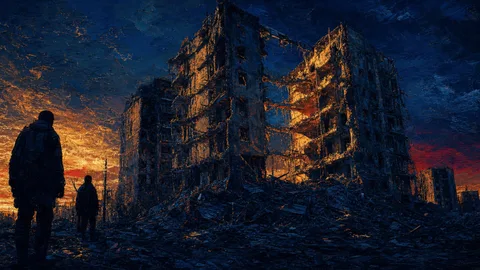
Flames through the openings. Rubble in the courtyard. A car half buried, Reuters writes.
That is what this column is about. An address. Number 54, Volodymyrska Street. A building Ukrainian science has lived in since 1919.
Two ladders, two people
When rescuers arrived, people were holding on at the windows, Pavlo Petrov, spokesman for the emergency service, told Suspilne. Using two ladders, rescuers brought two people out.
Two survivors came out through the upper-floor windows, onto ladders raised by the emergency services, Reuters writes.
Everyone knows the feel of a windowsill under two palms. Nobody ever thought of hanging on to one.
Who looks at an office window as an exit?
People clinging outside, at the address of knowledge.
A home since 1919
The Academy of 1918
The Academy of Sciences of Ukraine was founded in 1918, under Hetman Pavlo Skoropadsky, the Academy itself recalls.
Ukraine was fighting then for its right to a state. It was building its own institutions.
A hetman. A war. An academy.
A year later, in 1919, the building at number 54 became academic. It has stayed that way.
More than a century at the same number.
According to Forbes Ukraine, the Academy had some 24,000 employees at the start of 2026, including more than 13,000 researchers. Anatoliy Zahorodniy has led it since 2020.
Near the Golden Gate
The building stands near the Teatralna and Zoloti Vorota metro stations, Forbes Ukraine specifies. The historic heart of the city.
Taras Shevchenko National University is close by, Ukrinform notes.
An academy is also a sound. Filing drawers sliding shut. Stairs climbed with folders under the arm. Doors swinging between two meetings.
An address handed down from one president to the next, like a file that never gets closed.
More than a century at the same number, then a drone.
Born in 1918
What the address tells
Moscow did not strike a barracks. It struck the address of an institution Ukraine created at the same time as its state.
The Academy says so in its statement of September 29. More than a century after its founding, Moscow is striking one of these institutions with weapons.
Born with the state in 1918, struck in 2026.
That is what the address tells. That is what the drone hit.
Not a barracks. Not a depot. A presidium.
Two dead at number 54
I stand with the people of this Academy, and with those who died there this Monday. I stand against the Russian command’s decision to send a jet-powered drone onto the Academy’s presidium in the middle of a working day.
The reason is a toll. Two dead, the Academy writes. Two people, at number 54.
And I stand with the Academy when it asks the scholarly world not to renew ties with the Russian state’s scientific institutions. I will come back to that.
My opponent is not Russian science. It is the order to strike, and those who sign it.
Founded with a state, targeted like one.
Nataliia Bukalo
Horbulin’s assistant
The first known victim was named Nataliia Bukalo. She was the assistant to Volodymyr Horbulin, vice-president of the Academy and a former secretary of the National Security and Defense Council.
Horbulin confirmed her death to Suspilne. It was the lunch break, he said.
He tried to get to the reception area, where his assistant should have been. During the break, she had stepped out into the small courtyard next to the building.
She is survived by a husband and a daughter, according to Ukrainska Pravda.
A husband. A daughter. A break that never ended.
Logs kept in order
Her colleague Oleksandra Liashenko described her to Ukrainska Pravda. Nataliia loved order.
She kept the documents. She kept the call logs. She kept the schedules.
And that order had style, her colleague says. Nataliia knew how to work fast and organize things. She also knew how to “manage life.”
Oleksandra Liashenko learned of her death by calling her. A man answered the phone. Her husband.
A woman who kept other people’s days in order.
Everything was in order, except the sky.
One floor up
Between two windows
Volodymyr Horbulin was at his post, he told Suspilne. He was sitting against the wall, between two windows.
The blast wave tore out the windows, along with the glass and the equipment on his desk.
The glass. The equipment. The whole office.
He describes himself as an orderly man. What happened in his office, he says, is hard to imagine.
According to two sources for BBC News Ukraine, cited by Ukrainska Pravda, the strike hit the room one floor above his office. He went home with minor injuries from shattered glass.
A colleague who did not answer
The Academy’s press office, for its part, told Ukrinform it had lost contact with another colleague whose office had been hit. The fire was still burning.
It did not confirm the rumored deaths of two academicians.
Everyone knows the crack of a pane giving way. We do not always know where it comes from.
A man between two windows. A colleague who does not answer. And in the courtyard…
On the same topic

EDITORIAL: Peskov names the “price” Ukraine will pay. Arm…
On September 28, speaking in Moscow, Dmitry Peskov warned that Ukraine…

SPECIAL REPORT: Brussels sanctions a camp called Peace and…
Romashka, Sputnik, Raduga, Mir, Leto, Vita: the Official Journal of the…

ANALYSIS: With decree 686, Putin hides who buys Russian…
Decree 686, signed by Vladimir Putin on September 28, does not…
He sat between two windows and lived. She was in the courtyard.
The count says two
One, then two
The numbers from this Monday do not agree. I give them all, each with its source.
The count first says one woman dead and three wounded, according to Mayor Vitali Klitschko, cited by the Kyiv Independent.
The count then says one dead and five wounded, according to the Kyiv military administration, cited by Ukrinform.
In the evening, the count says 24 wounded across the city, six of them in hospital, according to Klitschko, cited by Reuters. Three children among them, the mayor adds, according to Ukrinform.
The count also says two dead at number 54, for Reuters. One of them was recovered from the rubble in the evening, according to emergency services cited by the agency.
The count says two, finally, in the Academy’s statement of September 29.
Hours of digging
One. Then two.
Between one and two lie hours of digging through rubble.
A difference of one is not a rounding error. It is a person.
Two.
Two, say the Academy and Reuters. One, the city said.
A missile designer
Horbulin, from Pivdenne to the Council
The opposing argument has to be set out in its hardest form.
Volodymyr Horbulin worked from 1962 to 1977 at the Pivdenne design bureau in Dnipro, on strategic missile systems, Suspilne recalls. He was secretary of the National Security and Defense Council from 1996 to 1999.
Since 2023, he has chaired the supervisory board of the National Academy of the Security Service of Ukraine, according to the same outlet.
That same Monday, Kyiv announced it had struck two Russian defense plants and oil facilities in the Krasnodar region, according to Reuters.
A defense man. A war waged in both directions. That is what Moscow could plead.
The argument is serious. It deserves proof, not an adjective.
What the Russian list leaves out
Here is what turns it around. The Russian Defense Ministry published its list for the previous night: logistics, communications, port infrastructure, ships, according to RFE/RL. The Academy is not on it.
And yet a military strike that owns itself gets claimed. This one was not.
Moscow and Kyiv both deny deliberately targeting civilians, Reuters notes. At number 54, that denial repairs nothing.
The drone did not find a weapons lab. It found a presidium, floors of offices, and an assistant who had stepped into the courtyard on her break.
If a man was the target, the drone missed him by a floor. It found a lunch break.
Moscow pleads defense. The drone finds a lunch break.
Science in the service of defense
What the Academy writes about itself
The Academy writes that its scientists will continue their research.
The Academy writes that Ukrainian science will work for the country’s defense, its reconstruction and its European future.
This fact gets in the way of my case. It stays in the text. It carries weight.
The line between knowledge and war is not as clean as outrage would like. A former missile designer sits in the vice-presidency. The Academy openly says it serves the country’s defense.
A presidium of files
True. And it changes nothing about this: number 54 is a presidium, a place of files, appointments and schedules, home to science since 1919.
Serving the defense of a country under attack has never turned an assistant on her break in the courtyard into a combatant.
What was military about a lunch break at 54 Volodymyrska Street?
A presidium of files is not a weapons workshop.
One hundred twenty-four drones
From 6:30 in the morning to 6:30 at night
That Monday, from 6:30 a.m. to 6:30 p.m., Moscow launched 124 drones against Ukraine, 86 of them jet-powered, according to the Air Force, cited by Ukrinform. The main target: the Kyiv region.
86 shot down or neutralized, including 49 jet-powered. Strikes recorded at 27 locations.
In the evening, Zelensky gives other figures, according to Reuters. 90 of the 120 drones were jet-powered. The interception rate for those: 57%.
Faster, higher
In recent weeks, Moscow has been hitting Kyiv with faster jet-powered drones that fly higher, Reuters writes.
For all drones combined, the rate rises to 70%, he says, according to Ukrinform. For the jet-powered ones, it stays low.
New interceptors are being tested, Zelensky says. Some units are already using them. Some details still need work.
The evening before, two people had died at the Stolichny market, just outside the capital, according to Klitschko, cited by the Kyiv Independent.
Over Kyiv, the air raid alert lasted nine hours, according to the Kyiv Independent.
Fifty-seven percent.
And yet a rate says nothing about the courtyard of a building at break time.
Fifty-seven out of a hundred, and the rest get through.
Ten minutes late
A Monday in September 2022
Oleksandra Liashenko told Ukrainska Pravda another story.
In September 2022, a missile struck a nearby intersection and damaged the Teacher’s House. It was also September, she says. It was also a Monday.
She had called Nataliia to check on her. Nataliia told her she had arrived at work, perhaps for the first time in her life, exactly 10 minutes late.
“I was so ashamed,” she had told her.
Those 10 minutes, her colleague explains, had kept her route away from the point of impact.
A break in the courtyard
Ten minutes late, in 2022. A break in the courtyard, in 2026.
That Monday, the patrol police closed Volodymyrska Street from the Bohdana Khmelnytskoho intersection to Taras Shevchenko Boulevard, according to Ukrinform. Bus 109 took another route.
A closed street. A rerouted bus. A courtyard, at noon.
The first time, being late saved her. The second time, the most ordinary hour of the day did not protect her.
I read that sentence of shame again. A woman apologizing for being late on the day that lateness spared her.
Ten minutes.
There will be no third Monday.
In 2022, 10 minutes. In 2026, none.
Dobrobut, Darnytsia, the museum
Discover
SPECIAL REPORT: Brussels sanctions a camp called Peace and…
Romashka, Sputnik, Raduga, Mir, Leto, Vita: the Official Journal of the…

OPEN LETTER: Leo XIV, you quote Benedict XV, so…
Holy Father, on September 28 in Metz, you asked Europe to…
NARRATIVE: At 11:18 a.m. on a Monday, the Kremlin…
In Dnipro, once the search was over on September 28, the…
A clinic hit twice
Number 54 was not alone that Monday. The Dobrobut clinic on Antonovych Street was hit for the second time, according to its own message, cited by Ukrinform. Seven wounded, six of them employees.
The upper floors, home to the Dobrobut Academy, were hit and burned. On the courtyard side, the windows of the first three floors blew out. The clinic is suspending operations for a few days.
The Darnytsia pharmaceutical plant was hit for the third time in six days, on September 23, 26 and 28, according to Kateryna Zahorii, chair of its board, cited by Ukrainska Pravda. No one hurt. The company declines to describe the damage.
A museum, a university
On the 29th, the Culture Ministry reports that the Taras Shevchenko National Museum was damaged in the attack, according to Ukrinform. The same museum had already been damaged on October 10, 2022.
The same day, Taras Shevchenko University moves to remote teaching until October 16. It asks for important documents and data to be safeguarded.
In other words, Kyiv’s worsening security sends a university home for nearly three weeks.
Around noon, Klitschko was already reporting drones hitting non-residential buildings in the Obolonskyi, Darnytskyi and Shevchenkivskyi districts, according to the Kyiv Independent.
A clinic. A drug plant. A museum. A university.
To heal. To make. To keep. To teach.
Clinic, plant, museum, university: the list keeps growing.
London and Paris condemn
The Royal Society, Macron
On September 28, the Royal Society condemns the attack. Its president, Paul Nurse, is himself a member of the Ukrainian Academy. He had visited the building recently, he writes.
Science pursues knowledge for the benefit of humanity, the Royal Society says. Striking the Academy is therefore striking civilization itself.
Emmanuel Macron denounces the Russian regime’s hostile contempt for science and truth, according to Ukrinform.
His ministers Jean-Noël Barrot and Philippe Baptiste call it an attack on Ukraine’s very future.
Sybiha, the same day
Ukraine’s foreign minister, Andrii Sybiha, accuses Moscow of cynicism for targeting a scientific institution in the middle of a working day, according to Reuters.
Every attack left without a strong response, he says, “only encourages the next one.” He calls for more air defense.
London. Paris. Kyiv.
Condolences. Condemnations. The right words.
And yet none of those words stops a jet-powered drone.
Words arrive fast. Interceptors arrive slowly.
Sixty academies
What the Academy asks for
The Academy is not asking only for condolences. It is asking for decisions.
It calls on academies, universities, research centers, foundations and publishers not to renew institutional cooperation with the scientific and educational bodies of the Russian state for as long as the war of aggression lasts.
It recalls that it broke with Russian scientific organizations in 2022. That same year, ALLEA, the European federation of academies, suspended the Russian Academy of Sciences. The suspension has never been lifted.
ALLEA brings together some 60 academies from about 40 countries, according to the Ukrainian Academy.
Sixty academies. Forty countries. A suspension that holds.
Science outside politics
There can be no science outside politics when science is attacked with weapons, the Academy writes. There can be no normalization without accountability, it adds.
I admit I long believed an academy was the last place a war would come looking for anyone. Number 54 corrected me.
I stand behind this request. Not against Russian researchers as people. Against state institutions that, according to the Ukrainian Academy, support the aggression.
No ordinary conference with those who strike an academy.
The door stays shut
What carries on
The Academy promises to carry on. Its scientists will continue their research, it writes. Its institutes will produce knowledge.
The drone destroyed part of the building. It took lives. It left wounds that no repair of walls can erase, the Academy also writes.
At number 54, the walls will be repaired. Nataliia Bukalo will not come back to the reception desk.
An address. Two dead. A door.
An invitation still to come
When the next invitation arrives from a Russian state scientific institution, will our universities and academies have 54 Volodymyrska Street in mind?
The Ukrainian Academy has already answered.
It has had an address since 1919. It now counts two more dead.
At 54 Volodymyrska Street, the science of 1918 goes on, two fewer.
Sources:
Primary Sources:
- National Academy of Sciences of Ukraine — statement on the strike at 54 Volodymyrska Street, two dead and a call to the scholarly world, September 29, 2026
- Reuters, via the Lexington Herald-Leader — two dead at the Academy, 24 wounded in Kyiv, 57% interception rate, September 28, 2026
- Suspilne Kyiv — interview with Volodymyr Horbulin and emergency service data, September 28, 2026
Secondary Sources:
Get the geopolitics analyses
Conflicts, powers, alliances: the MadMax thread without the noise.
Cite this article
Maxime Marquette (2026). COLUMN: At 54 Volodymyrska Street, Moscow burns the address Ukrainian science has held since 1919. MadMax. https://mad-max.co/en/article/at-54-volodymyrska-street-moscow-burns-the-address-ukrainian-science-has-held
Read next
SPECIAL REPORT: Brussels sanctions a camp called Peace and…
Romashka, Sputnik, Raduga, Mir, Leto, Vita: the Official Journal of the…
OPEN LETTER: Leo XIV, you quote Benedict XV, so…
Holy Father, on September 28 in Metz, you asked Europe to…
NARRATIVE: At 11:18 a.m. on a Monday, the Kremlin…
In Dnipro, once the search was over on September 28, the…
Enjoyed this piece? Get the next one.
One chronicle a week, straight to your inbox. No noise.
This article was generated with AI assistance, under human supervision.
Comments
Be the first to weigh in.